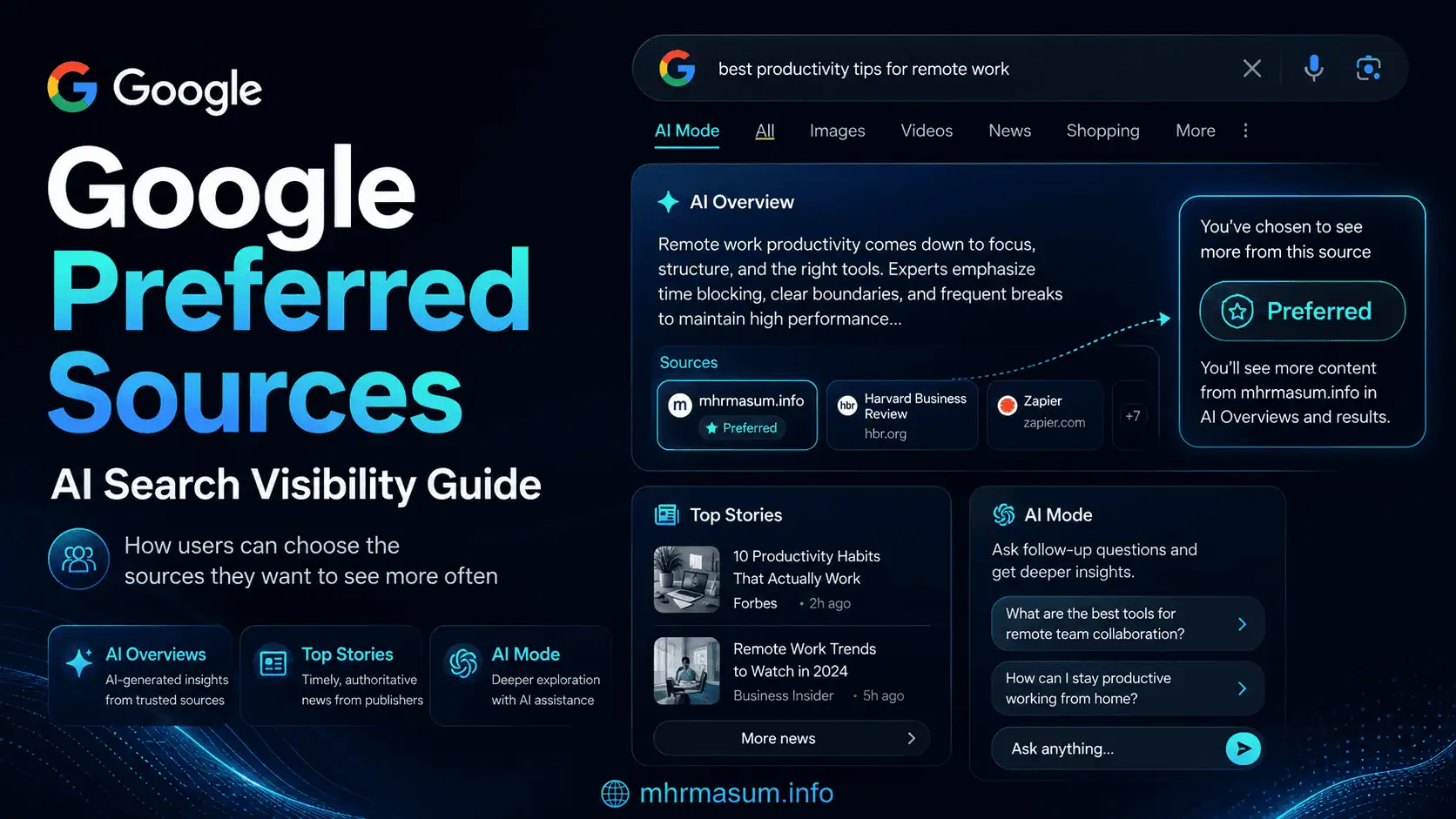
Google Search is becoming increasingly personalised, AI-driven and source-focused.
Users are no longer limited to receiving the same general list of publishers for every search. Through Google Preferred Sources, people can select the websites, publishers, creators and specialist sources they value most.
Once a website is selected as a preferred source, Google may show its fresh and relevant content more prominently to that specific user.
The feature originally focused on Top Stories. Google has since expanded Preferred Sources globally and integrated it into AI Overviews and AI Mode.
This development creates a new opportunity for:
- Independent publishers
- Industry blogs
- News websites
- Professional consultants
- Specialist content creators
- Local publications
- Business websites
- Research organisations
- eCommerce content teams
- Personal brands
Preferred Sources does not replace traditional SEO, nor does it guarantee a universal ranking boost. It introduces an additional audience-driven visibility layer in which loyal readers can influence which sources stand out in their personalised Google Search experience.
This guide explains:
- What Google Preferred Sources is
- How it works in Top Stories
- How it works in AI Overviews and AI Mode
- Which websites are eligible
- Whether it is an SEO ranking factor
- How publishers can become preferred sources
- How WordPress websites can add a Preferred Source button
- How to build an audience that actively selects your website
- How to measure its potential impact
- Which mistakes and unsupported claims to avoid
- How Preferred Sources fits into AI SEO, Entity SEO and brand authority
The Quick Answer
Google Preferred Sources allows users to select websites they want to see more frequently in personalised Google Search experiences.
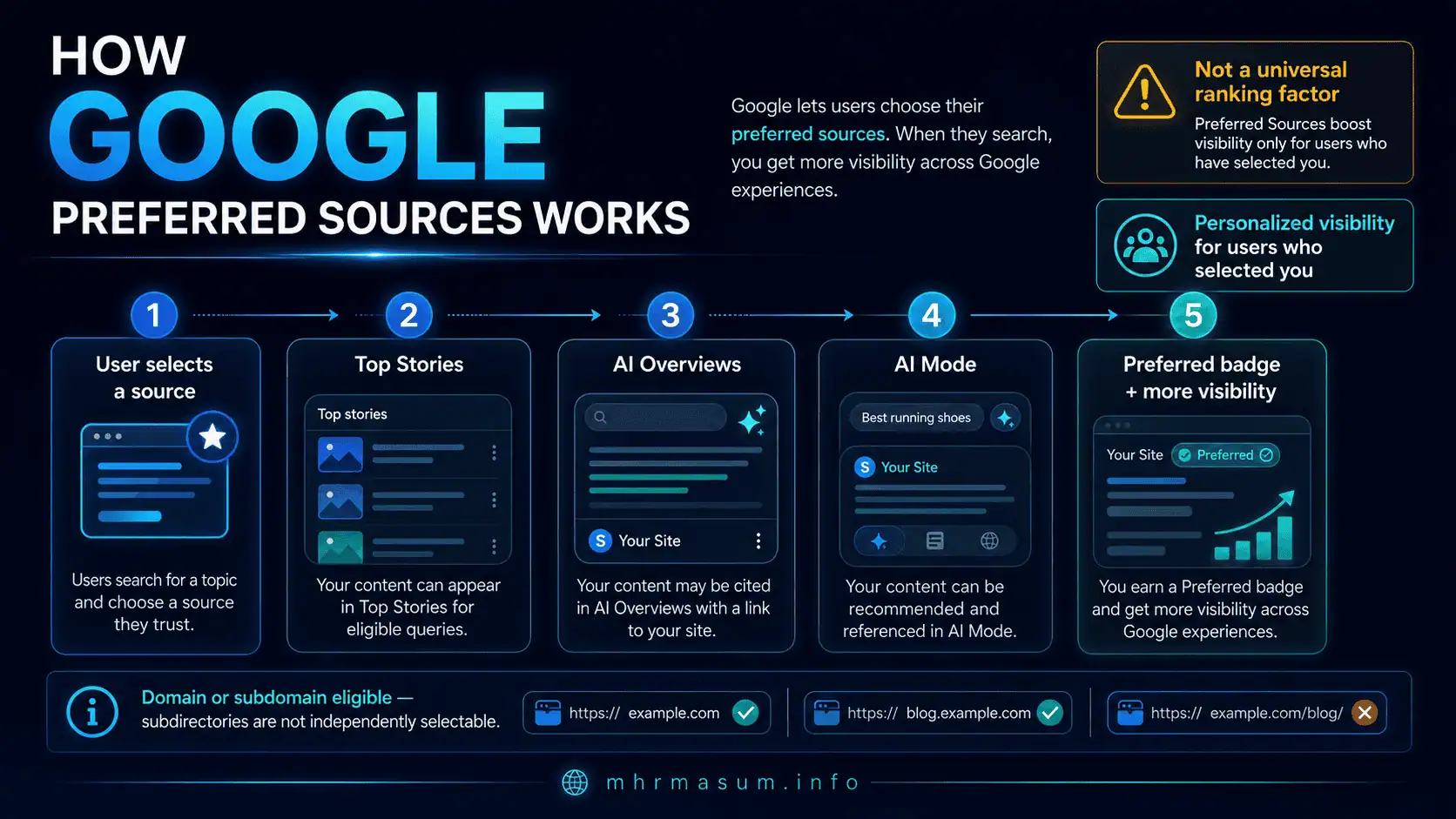
When a user selects a domain as a preferred source, Google may:
- Show more of its fresh and relevant articles in Top Stories
- Include it in a dedicated “From your sources” section
- Display a “Preferred” badge beside its content
- Highlight its links in AI Overviews
- Highlight its links in AI Mode
- Make the source easier for that user to recognise and revisit
Google states that Preferred Sources is available globally for Top Stories in the languages supported by Google Search. Preferred websites can also appear in AI Overviews and AI Mode wherever those features are available.
However, Preferred Sources is personalised.
It does not mean that selecting a website increases its rankings for every Google user. It means the selected website may receive increased prominence for people who have personally added it to their preferred-source list.
What Is Google Preferred Sources?
Google Preferred Sources is a Search personalisation feature that enables users to choose websites they want to see more often.
A preferred source may be:
- A news organisation
- An industry publication
- A local blog
- A specialist website
- A business publishing useful articles
- A professional expert
- A creator website
- A research organisation
- A niche community publication
When the selected source publishes relevant and fresh content, Google can give that content greater prominence within supported personalised search experiences.
Google explains in its official Preferred Sources documentation that content from a selected website is more likely to appear in Top Stories for that user and may receive a visible “Preferred” badge.
The feature now extends beyond conventional news results. Preferred links can also be highlighted inside Google’s generative AI experiences.
Why Google Introduced Preferred Sources
Search users often develop strong preferences for particular publications, experts and websites.
For example, one user may prefer:
- A specific technology publication
- An independent political analysis website
- A local community news source
- A favourite sports blog
- An experienced SEO consultant
- A specialist product review website
Another user may prefer completely different sources.
Traditional ranking systems attempt to identify broadly useful and relevant results. Preferred Sources adds a personal preference signal on top of that process.
The feature allows users to tell Google:
I trust, follow or value this website, so show me more of its relevant content when available.
This supports several broader Google Search objectives:
- Giving users more control
- Strengthening relationships between websites and audiences
- Highlighting original sources
- Supporting independent and niche publishers
- Improving source recognition
- Helping users find content from websites they already value
- Making AI-generated search experiences more transparent and useful
Preferred Sources therefore represents both a search personalisation feature and an audience-development opportunity.
The Google Preferred Sources Timeline
Google introduced and expanded Preferred Sources in several stages.
Understanding the timeline helps explain why the feature is becoming increasingly relevant to AI search visibility.
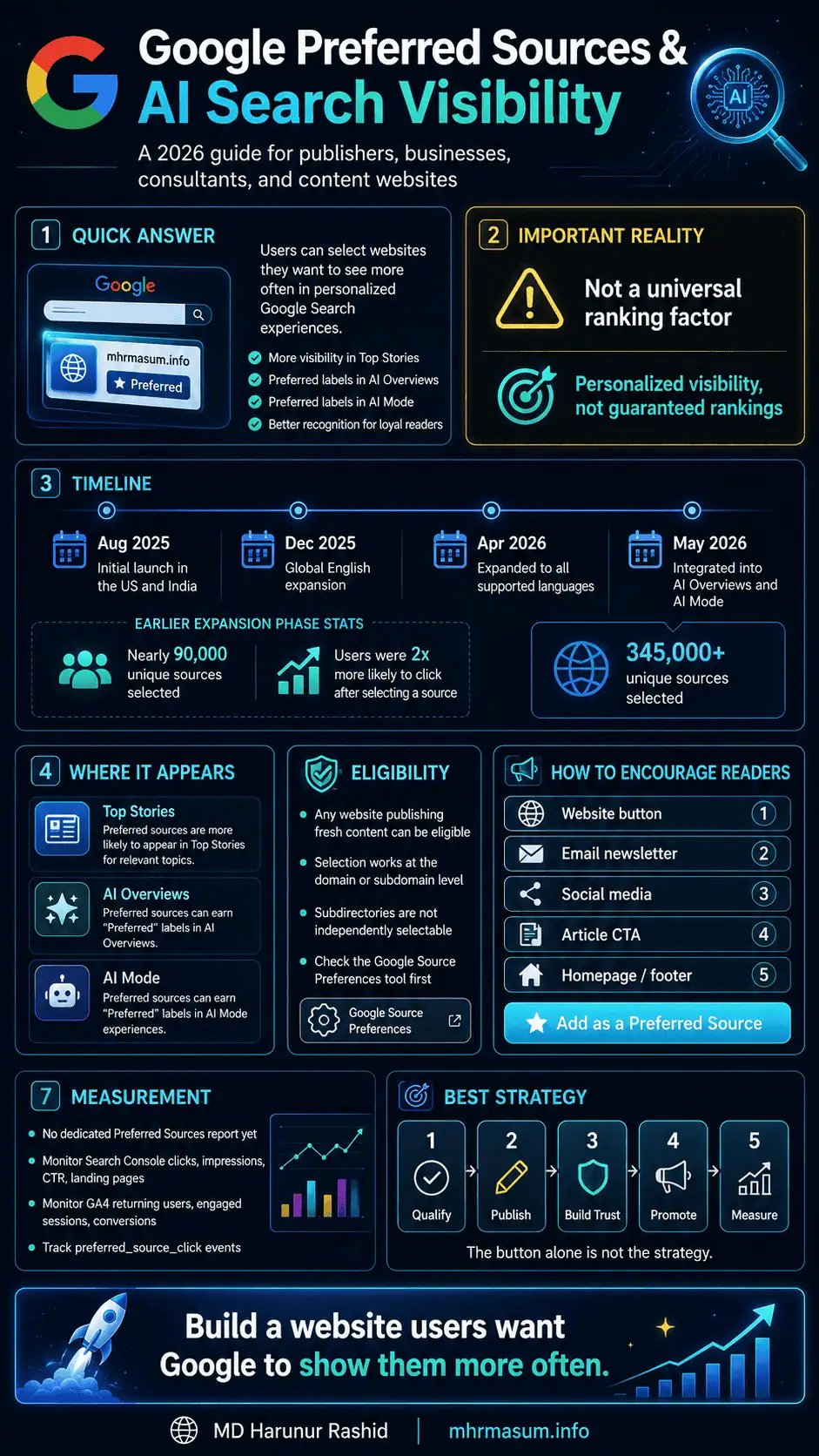
August 2025: Initial Preferred Sources Launch
Google launched Preferred Sources for Top Stories in the United States and India in August 2025.
Users could select favourite websites by clicking the source-selection icon beside Top Stories and searching for the publications they wanted to follow.
Google explained that selected sources could then appear:
- More frequently in Top Stories
- More prominently in results
- Inside a dedicated “From your sources” section
The original announcement is available through the official Google article, How to Select Preferred Sources in Google Search.
December 2025: Global English Expansion
Google expanded Preferred Sources to English-language users worldwide in December 2025.
At that stage, Google reported that users had already selected nearly 90,000 unique sources, ranging from local blogs to large global publications.
Google also reported that users were twice as likely to click through to a website after selecting it as a preferred source.
April 2026: Expansion to All Supported Languages
Google began rolling out Preferred Sources globally across all supported Google Search languages in April 2026.
This significantly increased the feature’s relevance for:
- International publishers
- Multilingual websites
- Regional publications
- Local news sources
- Non-English content creators
- Businesses targeting several countries
Google’s language expansion announcement can be reviewed in Preferred Sources Is Now Available in All Languages.
May 2026: AI Overviews and AI Mode Integration
On May 27, 2026, Google expanded Preferred Sources into AI Overviews and AI Mode.
Selected sources could now receive visible “Preferred” labels within generative AI responses.
Google also stated that:
- Any website publishing fresh content can be eligible
- Users were twice as likely to click a Preferred Source
- More than 345,000 unique sources had already been selected
- Preferred Sources could be highlighted in emerging article and perspective carousels
The official announcement is available in New Ways to Find Your Favourite Sources and Original Content in AI Search.
How Preferred Sources Works in Top Stories
Top Stories is a Google Search feature that highlights timely and news-related content.
When a user selects a website as a preferred source, Google may show more of that website’s relevant articles in Top Stories.
The content still needs to be:
- Relevant to the query
- Fresh enough for the topic
- Accessible to Google
- Indexed
- Eligible to appear in Search
- Consistent with Google Search policies
Selecting a preferred source does not mean every article from that domain will automatically appear.
The feature gives preference to suitable content when the website has published something relevant to the search.
The Preferred Badge
Content from a selected website may display a “Preferred” badge.
The badge helps users recognise that the link comes from a source they previously selected.
This can improve:
- Source recognition
- Trust
- Attention
- Click-through behaviour
- Repeat visits
- Publisher loyalty
Google’s reported two-times click-through tendency suggests that the visible relationship between a user and a preferred source can materially affect engagement.
The “From Your Sources” Section
Google may also show content from selected websites inside a dedicated “From your sources” section.
This section can appear in addition to standard Top Stories results.
Other websites are not automatically excluded. Preferred Sources personalises part of the experience rather than replacing Google’s wider results.
This means Google can still display:
- Other authoritative publishers
- Alternative perspectives
- Relevant websites the user has not selected
- Original reporting
- General organic results
How Preferred Sources Works in AI Overviews
AI Overviews provide AI-generated summaries for queries where Google determines that generative assistance adds value.
These summaries can include clickable links to supporting websites.
When a selected website is used as a supporting source, Google may display a “Preferred” badge beside its link for the user who selected it.
This has several potential benefits.
Greater Source Recognition
AI-generated answers can reference several websites.
A Preferred badge helps a selected source stand out from other supporting links.
The user may be more likely to recognise and click a website they already trust.
Stronger Audience Continuity
A person may first discover a website through:
- Organic search
- Social media
- A newsletter
- A referral
- A previous AI Overview
- A professional recommendation
After selecting the website as a preferred source, that relationship can continue inside future AI Overviews.
This creates a connection between audience development and AI search visibility.
More Opportunities Across Complex Queries
Google states that AI Overviews may use query fan-out to run several related searches and identify supporting pages.
A user asking a complex question may therefore encounter sources covering:
- Definitions
- Comparisons
- Examples
- Supporting evidence
- Specialist subtopics
- Practical recommendations
A preferred website with a strong content cluster may have multiple relevant pages available across that expanded query journey.
This is one reason a complete AI SEO strategy should focus on comprehensive topic coverage rather than isolated articles.
How Preferred Sources Works in AI Mode
AI Mode is designed for longer, more exploratory and multi-step search journeys.
Users can ask detailed questions, compare alternatives, explore follow-up questions and review supporting sources.
Preferred Sources can be highlighted inside these AI-generated responses.
For example, someone may ask:
How should a small business recover after a Google core update while also improving AI search visibility?
Google AI Mode may explore several related areas:
- Ranking-loss diagnosis
- Search Console data
- Content quality
- Technical SEO
- Brand authority
- Entity signals
- AI search measurement
- Local SEO
- Website performance
If the user has selected a specialist SEO website as a preferred source, relevant pages from that domain may stand out with a Preferred badge when included in the response.
This does not guarantee selection as a supporting source. It enhances the visibility of the source when Google’s systems identify it as relevant and use it in the response.
Preferred Sources Is a User-Controlled Signal
Preferred Sources is fundamentally controlled by the user.
Google does not allow a website owner to mark their own domain as universally preferred for everyone.
A publisher can encourage readers to select the site, but the final decision belongs to each Google user.
This distinction is critical.
Website owners can:
- Share the source-selection link
- Add a Preferred Source button
- Explain the benefit
- Promote the feature through newsletters
- Mention it on social media
- Place a CTA within articles
- Encourage loyal readers to use it
Website owners cannot:
- Automatically add themselves to a user’s preferences
- Force Google to show their content
- Buy universal preferred status
- Use schema to become preferred automatically
- Use a meta tag to activate it for everyone
- Replace content quality with a button
The feature is based on an explicit audience choice.
Is Google Preferred Sources a Ranking Factor?
Google has not described Preferred Sources as a universal organic ranking factor.
It is more accurately understood as a personalised source-preference feature.
When a user selects a website:
- The website may appear more prominently for that user
- Relevant content may appear more frequently in supported features
- Preferred labels may increase recognition
- Click-through behaviour may improve
The selection does not necessarily increase the website’s standard ranking for users who have not selected it.
This means Preferred Sources should not be sold as:
- A universal ranking boost
- A backlink replacement
- A shortcut to page-one rankings
- A guaranteed AI Overview placement
- A new Google authority score
- A way to bypass core ranking systems
Google’s AI search features remain rooted in core Search ranking and quality systems.
The website must still be:
- Crawlable
- Indexable
- Relevant
- Helpful
- Technically accessible
- Compliant with Search policies
- Eligible to display a snippet
Google explains these requirements in its official guide to AI Features and Your Website.
Preferred Sources vs Traditional Google Rankings
Traditional rankings aim to identify broadly relevant results for a query.
Preferred Sources adds a personalised layer based on a user’s explicit selection.
| Factor | Traditional Rankings | Preferred Sources |
|---|---|---|
| Applies to all users | Potentially | No |
| Based on user selection | Not primarily | Yes |
| Requires relevant content | Yes | Yes |
| Requires indexability | Yes | Yes |
| Guarantees visibility | No | No |
| Can influence personalised prominence | Through personalisation systems | Yes |
| Can display a visible badge | Not normally | Yes |
| Applies to AI Overviews and AI Mode | Supporting links can appear | Selected sources can be highlighted |
| Replaces SEO | No | No |
Preferred Sources should therefore be integrated into an SEO strategy rather than treated as an alternative to SEO.
Preferred Sources vs Google News
Preferred Sources and Google News are related to content discovery, but they are not the same system.
Google News focuses on discovering and presenting news content across Google News surfaces.
Preferred Sources allows users to identify websites they want to see more often in personalised Search experiences.
A website does not necessarily need to be a traditional national news organisation to become a preferred source.
Google states that websites publishing fresh content can be eligible.
This can include:
- Specialist blogs
- Independent publications
- Professional experts
- Local publishers
- Industry websites
- Research organisations
- Creator websites
However, consistent publication of useful and timely content is likely to make the feature more relevant.
Preferred Sources vs Google Discover
Google Discover recommends content based on user interests without requiring a traditional search query.
Preferred Sources focuses on websites users explicitly select within Google Search personalisation.
There is no official indication that selecting a preferred source guarantees increased Google Discover visibility.
A website may benefit from both systems, but each has separate selection and personalisation mechanisms.
Publishers should continue following Discover and general Search best practices, including:
- Compelling original content
- Clear titles
- High-quality images
- Strong page experience
- Transparent authorship
- Accurate dates
- Mobile usability
- Helpful information
Preferred Sources vs Subscriptions and Following
A user may already follow a website through:
- Email subscriptions
- RSS feeds
- Social media
- Push notifications
- Browser bookmarks
- Google News
- YouTube subscriptions
- Community memberships
Preferred Sources adds another relationship channel inside Google Search.
It does not replace owned audience channels.
In fact, the strongest strategy is to connect them.
For example:
- A reader discovers an article through Google.
- The reader subscribes to the newsletter.
- The newsletter invites the reader to select the website as a Preferred Source.
- Future Google searches may highlight the website.
- The reader returns directly or through AI Search.
- The relationship becomes less dependent on a single discovery channel.
This creates a more resilient audience ecosystem.
Which Websites Are Eligible for Preferred Sources?
Google states that any website publishing fresh content can be eligible.
However, Google’s technical documentation also explains that the source-preference system works at the domain or subdomain level.
Eligible examples include:
https://example.com/
https://news.example.com/
https://blog.example.com/
A subdirectory cannot be selected independently.
For example:
https://example.com/blog/
The user would select:
example.com
Rather than only the /blog/ folder.
This matters for websites containing several unrelated sections on the same domain.
Domain-Level and Subdomain-Level Eligibility
Google allows domain-level and subdomain-level source selection.
This means a user may be able to select:
example.com
Or a distinct subdomain such as:
news.example.com
The following would not be independently eligible:
example.com/news/
For WordPress publishers, this has architectural implications.
A website using:
company.com/blog/
Would normally promote the main domain:
company.com
A website using:
blog.company.com
May have a separately selectable subdomain, provided it appears in Google’s source-preference tool.
Do not move a blog to a subdomain solely for Preferred Sources. The broader SEO, branding, authority and maintenance implications are more important.
How to Check Whether Your Website Appears
Google recommends checking the Source Preferences tool before promoting your website as a preferred source.
Open the Google source-selection interface and search for your domain.
The official tool can be accessed through:
Search using:
mhrmasum.info
Or the applicable domain without unnecessary paths or tracking parameters.
If the site appears, users can select it.
If it does not appear immediately, confirm that the website:
- Publishes accessible content
- Is indexed in Google
- Uses the correct canonical domain
- Is not blocked by robots.txt
- Does not have a site-wide noindex directive
- Has a consistent website name
- Has valid article URLs
- Publishes fresh content
- Is not using a staging domain
Google does not guarantee inclusion in every Search feature even when technical requirements are met.
The Preferred Source Deep Link
Google provides a deep-link format that takes users directly to a domain inside the Source Preferences interface.
The format is:
https://google.com/preferences/source?q=example.com
For mhrmasum.info, the preferred-source link would be:
https://google.com/preferences/source?q=mhrmasum.info
A clickable version is:
Add mhrmasum.info as a Google Preferred Source
Before promoting the link widely, test it while signed in to a Google account and confirm that the correct domain appears.
How Users Can Select a Preferred Source
Users can select sources in more than one way.
The interface may vary by device, country, language and Google product updates.
Through Top Stories
A user can search for a current topic and locate the source-selection icon beside Top Stories.
The general process is:
- Search for a timely topic.
- Locate the icon beside Top Stories.
- Open source preferences.
- Search for the preferred website.
- Select the website.
- Refresh the results.
Through Search Personalisation Settings
Users can also access the source-preference interface through Google Search personalisation settings.
They can:
- Search for domains
- Add websites
- Remove websites
- Manage existing selections
- Select several sources
Google does not limit users to one source. People can select a variety of websites covering different viewpoints and subject areas.
Through a Publisher Deep Link
A website owner can provide a direct link that opens the domain in the source-selection interface.
This is usually the easiest method for publisher campaigns.
How Publishers Can Encourage Readers to Select Them
Google explicitly allows website owners to guide readers toward the source-selection interface.
Publishers can promote the deep link through:
- Website buttons
- Email newsletters
- Social media posts
- Author bios
- Article CTAs
- Homepage banners
- Subscription confirmation pages
- Community groups
- Resource pages
- Mobile menus
- Website footers
The CTA should be clear and transparent.
A suitable message is:
Follow MD Harunur Rashid in Google Search. Add mhrmasum.info as a Preferred Source to see more SEO, AI SEO and digital growth insights in Top Stories and supported AI Search experiences.
Avoid promising that the user will see every article or that selecting the website guarantees rankings.
Recommended Preferred Source CTA for mhrmasum.info
A concise CTA can be placed after the introduction or near the conclusion of important articles.
Suggested CTA heading:
Make mhrmasum.info One of Your Google Preferred Sources
Suggested CTA text:
Get more practical SEO, AI SEO, Local SEO, Technical SEO and WordPress growth insights from MD Harunur Rashid. Add mhrmasum.info as a Preferred Source in Google Search so relevant articles can stand out in Top Stories, AI Overviews and AI Mode.
Suggested button text:
Add as a Google Preferred Source
Suggested destination:
https://google.com/preferences/source?q=mhrmasum.info
This messaging explains the benefit without overstating what the feature can do.
WordPress Preferred Source Button
The following HTML creates a simple Preferred Source CTA.
It can be added through:
- A WordPress Custom HTML block
- GenerateBlocks
- Elementor
- A theme hook
- A reusable block
- A custom template
- A code-snippet plugin
<div class="mhr-preferred-source-box">
    <div class="mhr-preferred-source-icon" aria-hidden="true">★</div>

    <div class="mhr-preferred-source-content">
        <h3>Make mhrmasum.info a Google Preferred Source</h3>

        <p>
            Get more practical SEO, AI SEO, Local SEO, Technical SEO and
            WordPress growth insights from MD Harunur Rashid in supported
            Google Search experiences.
        </p>

        <a
            class="mhr-preferred-source-button"
            href="https://google.com/preferences/source?q=mhrmasum.info"
            target="_blank"
            rel="noopener noreferrer"
            aria-label="Add mhrmasum.info as a Google Preferred Source"
        >
            <span aria-hidden="true">★</span>
            Add as a Preferred Source
        </a>
    </div>
</div>
The button opens Google’s Source Preferences interface in a new tab.
Branded CSS for the Preferred Source Button
The following CSS matches the dark navy, cyan, blue and teal style used across mhrmasum.info.
/* =========================================================
   MHR Google Preferred Source CTA
   Brand: Dark navy, cyan, blue and teal
========================================================= */

.mhr-preferred-source-box {
    position: relative;
    display: flex;
    align-items: flex-start;
    gap: 18px;
    width: 100%;
    margin: 32px 0;
    padding: 26px;
    overflow: hidden;
    box-sizing: border-box;
    background:
        radial-gradient(
            circle at top right,
            rgba(0, 224, 184, 0.15),
            transparent 42%
        ),
        linear-gradient(
            135deg,
            #071321 0%,
            #081a2b 52%,
            #06111d 100%
        );
    border: 1px solid rgba(35, 215, 255, 0.28);
    border-radius: 18px;
    box-shadow:
        0 18px 50px rgba(0, 0, 0, 0.28),
        inset 0 1px 0 rgba(255, 255, 255, 0.04);
}

.mhr-preferred-source-box::before {
    content: "";
    position: absolute;
    top: 0;
    left: 0;
    width: 100%;
    height: 3px;
    background: linear-gradient(
        90deg,
        #20d9ff,
        #2788ff,
        #00dfb5
    );
}

.mhr-preferred-source-icon {
    position: relative;
    z-index: 1;
    display: flex;
    align-items: center;
    justify-content: center;
    flex: 0 0 54px;
    width: 54px;
    height: 54px;
    color: #03121e;
    font-size: 25px;
    line-height: 1;
    background: linear-gradient(
        135deg,
        #29ddff,
        #00dfb5
    );
    border-radius: 15px;
    box-shadow: 0 10px 28px rgba(0, 215, 220, 0.22);
}

.mhr-preferred-source-content {
    position: relative;
    z-index: 1;
    min-width: 0;
}

.mhr-preferred-source-content h3 {
    margin: 0 0 10px !important;
    color: #ffffff !important;
    font-size: clamp(21px, 2.4vw, 28px);
    line-height: 1.25;
    font-weight: 750;
}

.mhr-preferred-source-content p {
    margin: 0 0 18px !important;
    color: #c8d9e8 !important;
    font-size: 16px;
    line-height: 1.7;
}

.mhr-preferred-source-button {
    display: inline-flex;
    align-items: center;
    justify-content: center;
    gap: 9px;
    min-height: 48px;
    padding: 12px 20px;
    color: #03131f !important;
    font-size: 15px;
    line-height: 1.2;
    font-weight: 750;
    text-decoration: none !important;
    background: linear-gradient(
        135deg,
        #23dbff,
        #00dfb5
    );
    border: 1px solid rgba(255, 255, 255, 0.25);
    border-radius: 11px;
    box-shadow: 0 10px 28px rgba(0, 212, 220, 0.2);
    transition:
        transform 0.25s ease,
        box-shadow 0.25s ease,
        filter 0.25s ease;
}

.mhr-preferred-source-button:hover,
.mhr-preferred-source-button:focus {
    color: #03131f !important;
    text-decoration: none !important;
    transform: translateY(-2px);
    filter: brightness(1.05);
    box-shadow: 0 15px 34px rgba(0, 212, 220, 0.3);
}

.mhr-preferred-source-button:focus-visible {
    outline: 3px solid rgba(42, 220, 255, 0.45);
    outline-offset: 4px;
}

@media (max-width: 640px) {
    .mhr-preferred-source-box {
        flex-direction: column;
        gap: 15px;
        padding: 22px 18px;
        border-radius: 15px;
    }

    .mhr-preferred-source-icon {
        width: 48px;
        height: 48px;
        flex-basis: 48px;
        font-size: 22px;
    }

    .mhr-preferred-source-content h3 {
        font-size: 22px;
    }

    .mhr-preferred-source-button {
        width: 100%;
        box-sizing: border-box;
    }
}
Test the design on desktop, tablet and mobile before adding it globally.
WordPress Shortcode for the Preferred Source CTA
A shortcode can make the CTA reusable across multiple posts.
Add the following PHP through a trusted code-snippet plugin or custom functionality plugin.
/**
 * MHR Google Preferred Source CTA Shortcode
 *
 * Usage:
 * [mhr_preferred_source]
 */

add_shortcode( 'mhr_preferred_source', 'mhr_preferred_source_shortcode' );

function mhr_preferred_source_shortcode() {

    $preferred_source_url = 'https://google.com/preferences/source?q=mhrmasum.info';

    ob_start();
    ?>
    <div class="mhr-preferred-source-box">
        <div class="mhr-preferred-source-icon" aria-hidden="true">
            ★
        </div>

        <div class="mhr-preferred-source-content">
            <h3>
                Make mhrmasum.info a Google Preferred Source
            </h3>

            <p>
                Get more practical SEO, AI SEO, Local SEO,
                Technical SEO and WordPress growth insights
                from MD Harunur Rashid in supported Google
                Search experiences.
            </p>

            <a
                class="mhr-preferred-source-button"
                href="<?php echo esc_url( $preferred_source_url ); ?>"
                target="_blank"
                rel="noopener noreferrer"
                aria-label="<?php echo esc_attr(
                    'Add mhrmasum.info as a Google Preferred Source'
                ); ?>"
            >
                <span aria-hidden="true">★</span>
                Add as a Preferred Source
            </a>
        </div>
    </div>
    <?php

    return ob_get_clean();
}
After activating the snippet, insert the following shortcode into any post or page:
[mhr_preferred_source]
Use the shortcode selectively rather than displaying the CTA after every few paragraphs.
Best Locations for the Preferred Source CTA
CTA placement can influence whether readers notice and understand the feature.
Recommended locations include:
After the Article Introduction
A CTA after the introduction can reach engaged readers early.
This position works well for:
- Major guides
- Industry updates
- News analysis
- Regular columns
- Search trend reports
Avoid placing the CTA before users have seen enough value to understand why they should select the website.
Near the Article Conclusion
A CTA near the conclusion targets readers who consumed most of the article.
These users are more likely to:
- Understand the site’s expertise
- Trust the author
- Want similar content
- Select the website intentionally
This is usually the safest default placement.
Newsletter Confirmation Page
Readers who have just subscribed have already demonstrated interest.
A confirmation page can invite them to:
- Confirm the email subscription.
- Add the website as a Preferred Source.
- Follow relevant social profiles.
- Browse cornerstone content.
This creates a multi-channel audience relationship.
Homepage or Blog Sidebar
A compact CTA can appear on the homepage, blog archive or article sidebar.
The design should not compete with:
- Contact CTAs
- Newsletter signups
- Service enquiries
- Article navigation
Use a clear hierarchy.
Social Media Posts
Publishers can periodically share the deep link through Facebook, LinkedIn, X and other platforms.
The post should explain:
- What Preferred Sources is
- Why the reader may benefit
- Which content the website publishes
- That the final selection is controlled by the user
How to Become a Website People Want to Select
Adding a button does not give readers a reason to use it.
A website must first become a source worth following.
This requires a combination of:
- Useful content
- Recognisable expertise
- Consistent publishing
- Clear positioning
- Strong editorial quality
- Original insights
- Accurate information
- Trustworthy authorship
- Reliable updates
- A distinctive point of view
Preferred Sources rewards audience relationships, not merely technical implementation.
Publish Fresh and Relevant Content
Google repeatedly connects Preferred Sources with fresh and relevant content.
A website does not need to become a breaking-news publication, but it should publish or update content that reflects current developments.
For an SEO and digital growth website, fresh content may include:
- Google core-update analysis
- Search Console feature updates
- AI search changes
- WordPress developments
- Local SEO trends
- Schema changes
- Google Business Profile updates
- eCommerce search changes
- Case-study findings
- Search measurement techniques
Evergreen guides remain valuable, but timely analysis gives users more reasons to select and revisit the source.
Create Non-Commodity Content
Content that repeats publicly available information without adding value is less likely to create a loyal audience.
Strong source-worthy content can include:
- Original analysis
- First-hand implementation experience
- Screenshots
- Real examples
- Case studies
- Tests
- Frameworks
- Checklists
- Comparisons
- Practical warnings
- Expert opinions
- Updated recommendations
Google’s generative AI guidance emphasises creating valuable, non-commodity content rather than relying on AI search hacks.
My article explaining why generic AI content does not rank anymore provides a practical framework for improving originality and usefulness.
Build a Recognisable Editorial Identity
Readers need to recognise the website before they will choose it as preferred.
Strengthen recognition through:
- A consistent website name
- A recognisable favicon
- A clear logo
- Consistent author names
- Repeated subject expertise
- Stable visual branding
- Professional article design
- Consistent social profiles
- Clear editorial standards
For a personal brand, the author and website identity should be closely connected.
On mhrmasum.info, articles should consistently identify:
- MD Harunur Rashid
- SEO, AI SEO and Digital Growth Consultant
- 17+ years of experience
- Core expertise
- Relevant portfolio evidence
- Contact and consultation options
The About MD Harunur Rashid page should reinforce that entity consistently.
Strengthen Entity SEO
Entity SEO helps Google understand the people, organisations, services, subjects and relationships associated with a website.
A strong entity framework can clarify:
- Who publishes the content
- What the publisher specialises in
- Which topics the site covers
- Which services are offered
- Which external profiles belong to the same person
- Which case studies demonstrate expertise
Entity clarity does not automatically create Preferred Source selections, but it supports recognition and trust.
My complete Entity SEO guide explains how to improve those relationships.
Build Brand Authority for AI Search
Preferred Sources connects AI visibility with audience trust.
A website becomes easier to select when people already recognise it through:
- Useful search results
- Social posts
- Industry mentions
- Reviews
- Referrals
- Newsletters
- Case studies
- External publications
- Communities
- Professional networks
This makes Preferred Sources closely connected to brand authority for AI search.
Brand authority is built through repeated proof rather than self-declaration.
Maintain Strong Technical SEO
A user preference cannot rescue a technically inaccessible website.
Important articles should remain:
- Crawlable
- Indexable
- Canonical
- Mobile-friendly
- Fast
- Secure
- Internally linked
- Eligible to display snippets
- Free from accidental noindex directives
- Accessible through stable URLs
Google states that pages must be indexed and eligible to appear in Search with a snippet before they can appear as supporting links in AI Overviews or AI Mode.
Use my Technical SEO checklist for WordPress to review the foundation.
Keep Publication Dates Accurate
Freshness is relevant to many Preferred Source use cases.
Article pages should clearly show:
- Original publication date
- Last updated date when appropriate
- Author name
- Meaningful update history
Do not change dates merely to create the appearance of freshness.
Update the article substantially before revising the visible modified date.
Useful updates may include:
- New platform information
- Revised screenshots
- Current statistics
- Updated processes
- Corrected claims
- New examples
- Better internal links
- Improved FAQs
- New official references
Use Article Structured Data Correctly
Article structured data can help Google understand information such as:
- Headline
- Author
- Publication date
- Modification date
- Images
- Publisher
Google states that Article, NewsArticle and BlogPosting structured data can help it understand article pages and present improved title, image and date information.
Official guidance is available in Google’s Article Structured Data documentation.
Structured data does not force Preferred Source visibility.
It supports general content understanding and search presentation.
Use a Clear Author Profile
Professional and specialist websites should provide a clear author identity.
An author page should include:
- Full name
- Professional title
- Areas of expertise
- Experience
- Relevant credentials
- Portfolio evidence
- Social profiles
- Other published articles
- Contact pathways
For mhrmasum.info, content should naturally connect with the About page and relevant portfolio projects.
This reinforces the relationship between the content and its expert publisher.
Improve Internal Linking
Preferred content still needs to be discoverable and contextually connected.
Internal links can help Google and users understand relationships between:
- AI SEO
- Entity SEO
- Technical SEO
- Local SEO
- Content quality
- Brand authority
- Search measurement
- WordPress performance
- Case studies
A reader who enters through one article should be able to find the next useful resource.
For example, an article about Preferred Sources can link naturally to:
- AI SEO
- GEO vs AEO vs SEO
- Entity SEO
- Brand authority for AI search
- Google Search Console Generative AI Performance Reports
- Technical SEO for WordPress
This supports both topical authority and user engagement.
Build an Email Audience
Email subscribers are strong candidates for Preferred Source campaigns because they have already chosen to receive content.
A practical newsletter strategy is:
- Publish a high-value article.
- Send it to subscribers.
- Explain the Preferred Sources feature briefly.
- Include the direct source-selection link.
- Repeat the CTA occasionally rather than in every email.
- Track link clicks through campaign parameters where appropriate.
The campaign should focus on reader benefit.
For example:
Add mhrmasum.info as a Preferred Source in Google to make it easier to find future SEO and AI search guides when they are relevant to your searches.
Use Social Media to Build Source Preference
Social audiences can become preferred-source audiences.
A LinkedIn campaign may explain:
- What the feature is
- Why it matters
- How to select the site
- Which topics the site publishes
A Facebook post may focus on practical value for business owners.
An X post should use a shorter CTA with the direct link.
Do not publish the same repetitive promotional message every day. Combine Preferred Source campaigns with genuinely valuable content.
Encourage Returning Visits
Google reports that users are more likely to click websites they have marked as preferred.
Returning-user growth can be supported through:
- Related-article recommendations
- Newsletter subscriptions
- Content series
- Updated guides
- Topic hubs
- Resource libraries
- Case studies
- Clear navigation
- Fast mobile performance
- Strong article design
A Preferred Source button works best when it is part of a complete retention strategy.
Can Local Businesses Benefit?
Local businesses can benefit, although the feature may be more directly relevant to businesses that publish regular content.
Suitable local content may include:
- Local market updates
- Service guides
- Regulation changes
- Seasonal advice
- Community news
- Case studies
- Local comparisons
- Event coverage
- Frequently asked questions
A local business should not prioritise Preferred Sources over:
- Google Business Profile
- Reviews
- Local landing pages
- Local citations
- Accurate contact information
- Service-area relevance
- Conversion tracking
My Local SEO guide for small businesses explains those higher-priority foundations.
Reviews can also support recognition and trust, as discussed in How Reviews Help Local SEO and AI Search Visibility.
Can eCommerce Websites Benefit?
An eCommerce website may benefit when it publishes fresh, useful content beyond basic product listings.
Suitable content includes:
- Product comparisons
- Buying guides
- New product analysis
- Industry updates
- Product-testing results
- Seasonal guides
- Original research
- Expert reviews
- Compatibility guides
- Maintenance advice
Preferred Sources is not a replacement for:
- Product structured data
- Merchant Center feeds
- Accurate pricing
- Availability
- Shipping information
- Reviews
- High-quality product images
- Category-page SEO
It can support editorial discovery when an eCommerce brand has a strong content operation.
Can Consultants and Personal Brands Benefit?
Consultants and personal brands can benefit when they publish current specialist content.
For example, an SEO consultant can publish:
- Google update analysis
- Technical SEO guides
- AI search research
- Local SEO strategies
- WordPress fixes
- Case studies
- Search Console tutorials
- Industry commentary
A reader who values that expertise may select the website as a preferred source.
This can strengthen the relationship between:
- Search visibility
- Professional authority
- Returning readership
- Service enquiries
- AI search discovery
The website should connect informational content to relevant services, portfolio evidence and the contact page.
Can Small Publishers Compete With Large News Websites?
Preferred Sources can create opportunities for niche and independent publishers because selection is based on user preference.
Google has reported that selected sources range from local blogs to global news organisations.
A small publisher may offer advantages such as:
- Deep subject expertise
- Local knowledge
- First-hand experience
- Strong community relationships
- Specialised reporting
- Distinctive analysis
- Faster coverage of niche developments
The objective is not necessarily to compete with every global publisher.
It is to become indispensable to a clearly defined audience.
How Preferred Sources Supports AI Search Visibility
Preferred Sources connects audience trust with Google’s generative search experiences.
It may support AI search visibility in several ways.
Preferred Labels Increase Attention
When Google includes a selected website in an AI response, the Preferred badge may help the source stand out.
This can increase the likelihood that the user notices the link.
Audience Trust Can Improve Click Behaviour
Google reports that users are twice as likely to click through after marking a website as preferred.
This does not mean every preferred result receives exactly twice the CTR. It is an average behavioural observation reported by Google.
Actual performance will depend on:
- Query intent
- Result placement
- Headline
- Source recognition
- Device
- Competing links
- Content relevance
Topic Coverage Creates More Retrieval Opportunities
AI Mode and AI Overviews may use query fan-out.
A website with a complete topic cluster can potentially provide supporting pages for several related subtopics.
For example, a modern AI SEO cluster may include:
- General AI SEO
- Entity SEO
- AI crawler control
- GA4 AI referral tracking
- Preferred Sources
- Brand authority
- Content quality
- Search Console AI reports
- Agentic SEO
- GEO and AEO
This gives Google more contextually relevant pages to retrieve.
Source Preference Supports Repeat Discovery
A preferred source may become more recognisable across repeated search journeys.
The user may move between:
- Top Stories
- AI Overviews
- AI Mode
- Organic results
- Direct visits
- Newsletters
- Social media
This repeated exposure can strengthen brand recall.
Preferred Sources and GEO
Generative Engine Optimization focuses on improving visibility in AI-generated answers and recommendation systems.
Preferred Sources can support GEO because selected websites may be highlighted inside Google’s generative experiences.
However, Preferred Sources does not replace the main GEO requirements:
- Source-worthy content
- Clear answers
- Entity authority
- External validation
- Original evidence
- Technical accessibility
- Strong brand signals
Read GEO vs AEO vs SEO for a detailed comparison of these optimisation disciplines.
Preferred Sources and AEO
Answer Engine Optimization focuses on making content suitable for direct-answer experiences.
A preferred source still needs to provide useful answers.
Content should include:
- Clear definitions
- Direct explanations
- Well-structured headings
- Comparison tables
- Practical steps
- Supporting evidence
- Relevant FAQs
The Preferred Source relationship can make the selected source more visible when Google uses it, but answer quality remains essential.
Preferred Sources and Entity SEO
Google must understand which website, person or organisation the user selected.
Strong entity consistency helps reinforce:
- Website identity
- Publisher identity
- Author identity
- Subject expertise
- External profile relationships
- Brand recognition
This is especially important for personal brands where the individual and website name may differ.
For example:
Person:
MD Harunur Rashid
Website:
mhrmasum.info
Professional role:
Digital Growth & Web Solutions Expert
The website, structured data, author pages and external profiles should consistently connect these elements.
Preferred Sources and Brand Searches
Preferred Source campaigns may indirectly support branded search behaviour.
After repeated exposure, users may search for:
- MD Harunur Rashid
- mhrmasum
- mhrmasum AI SEO
- mhrmasum Technical SEO
- MD Harunur Rashid Local SEO
Branded searches can indicate growing awareness, but Preferred Source selection should not be assumed to cause every branded-search increase.
Other contributors may include:
- Social media
- Referrals
- Client recommendations
- Email campaigns
- Public speaking
- Backlinks
- External mentions
How to Measure Preferred Sources Performance
Google does not currently provide a dedicated Search Console report showing:
- How many users selected your website
- Which specific users selected it
- Which clicks came from preferred status
- Which impressions displayed a Preferred badge
- Which queries triggered preferred placement
This measurement limitation means publishers need to use indirect indicators.
Search Console Metrics to Monitor
Search Console can help identify changes in search performance.
Monitor:
- Total clicks
- Total impressions
- Click-through rate
- Search queries
- Landing pages
- Countries
- Devices
- News search performance where available
- Discover performance where available
- Generative AI performance
Google introduced dedicated Generative AI performance reports in June 2026 for a subset of websites.
These reports can show:
- AI feature impressions
- Appearing pages
- Countries
- Devices
- Performance dates
My guide to Google Search Console Generative AI Performance Reports explains how to use that data.
The report does not currently provide a Preferred Source filter.
GA4 Metrics to Monitor
Google Analytics 4 can help measure what users do after reaching the website.
Monitor:
- Organic sessions
- Engaged sessions
- Engagement rate
- Average engagement time
- Returning users
- Newsletter signups
- Contact submissions
- Service-page visits
- Assisted conversions
- Revenue
- Revenue per session
A Preferred Source campaign may contribute to stronger returning-user behaviour, but GA4 will not normally identify “Preferred Source” as a separate traffic source.
Track Preferred Source CTA Clicks
You can track clicks on your website’s Preferred Source button through Google Tag Manager or GA4 event tracking.
A suitable event name is:
preferred_source_click
Useful event parameters include:
button_location
page_path
cta_text
outbound_domain
Tracking the click shows how many users opened the Google source-selection interface.
It does not confirm that they completed the selection.
Google Tag Manager Click Tracking
A practical Google Tag Manager setup is:
- Add a consistent CSS class to the button.
- Create a link-click trigger.
- Set the trigger to fire when Click Classes contains
mhr-preferred-source-button. - Create a GA4 event tag.
- Use the event name
preferred_source_click. - Add page and placement parameters.
- Test in Preview mode.
- Publish the container.
- Confirm the event in GA4 Realtime.
This measures CTA engagement without making unsupported assumptions about completed selections.
Create a Preferred Source Campaign Report
A monthly report can include:
| Metric | Current Month | Previous Month | Change |
|---|---|---|---|
| Preferred Source CTA clicks | |||
| Organic sessions | |||
| Returning users | |||
| Newsletter signups | |||
| AI feature impressions | |||
| Organic CTR | |||
| Branded queries | |||
| Lead conversions |
Add notes for:
- Major articles published
- Newsletter promotions
- Social campaigns
- Google Search updates
- Seasonal demand
- Core updates
- Website changes
Do not attribute every increase to Preferred Sources.
What Preferred Sources Cannot Do
Preferred Sources has clear limitations.
It cannot:
- Guarantee a first-page ranking
- Force inclusion in AI Overviews
- Force inclusion in AI Mode
- Guarantee Top Stories visibility
- Improve rankings for every user
- Replace backlinks
- Replace content quality
- Replace Technical SEO
- Replace schema markup
- Make unindexed pages visible
- Override Google Search policies
- Make outdated content relevant
- Automatically create brand authority
It enhances an existing relationship between a website and its audience.
It does not manufacture relevance or authority.
Common Preferred Sources Myths
Several unsupported claims may emerge as the feature gains attention.
The following myths should be avoided.
Myth 1: Preferred Sources Is a New Universal Ranking Factor
Preferred Sources is a personalised feature.
A user’s selection may affect how the website appears for that user, not necessarily the global ranking for everyone.
Myth 2: Adding the Button Improves Rankings
The button itself does not improve rankings.
It gives readers a convenient route to the source-selection interface.
Myth 3: Every Website Automatically Appears in the Tool
Google says websites publishing fresh content can be eligible, but website owners should verify that the domain appears in the tool.
Myth 4: A Preferred Website Always Appears First
The content must still be relevant, fresh and eligible.
Selection does not guarantee the first position.
Myth 5: Preferred Sources Replaces SEO
Google’s AI and Search features still depend on core Search ranking and quality systems.
SEO remains essential.
Myth 6: Preferred Sources Is Only for Global News Organisations
Google has reported selections ranging from niche local blogs to global publishers.
Specialist websites may also be eligible.
Myth 7: Schema Can Automatically Make a Website Preferred
There is no special Preferred Source schema.
The user must choose the website.
Myth 8: Preferred Sources Guarantees AI Citations
A Preferred badge can highlight a source Google already selected for an AI response.
It does not guarantee that the source will be retrieved or cited.
Myth 9: Publishers Can See Who Selected Them
Google does not provide publishers with personal user-selection information.
Myth 10: More Popup Requests Create More Preferred Selections
Aggressive popups can harm user experience.
The CTA should appear after the website has demonstrated value.
Preferred Sources and Website User Experience
A poorly implemented campaign can create friction.
Avoid:
- Immediate full-screen popups
- Repeated modal windows
- Misleading button text
- Forced redirects
- Auto-opening new tabs without user action
- Promising guaranteed rankings
- Covering article content
- Mobile overflow
- Excessive animations
- Multiple competing CTAs
Use:
- Clear explanations
- Accessible buttons
- Mobile-responsive design
- Honest messaging
- Logical placement
- Visible focus states
- Fast-loading code
The CTA should support the content rather than interrupt it.
A 30-Day Preferred Sources Implementation Plan
A structured plan can help publishers launch the feature without distracting from higher-priority SEO work.
Days 1–7: Verify Eligibility and Technical Readiness
The first week should confirm that the website can participate effectively.
Complete these tasks:
- Search for the domain in the Source Preferences tool
- Confirm the canonical domain
- Check robots.txt
- Check indexing
- Review article sitemaps
- Test mobile usability
- Review publication dates
- Check author information
- Confirm Article schema
- Review the website favicon
Days 8–14: Create the Preferred Source CTA
The second week should focus on building a clear and accessible campaign asset.
Complete these tasks:
- Create the deep link
- Test the link
- Add the HTML button
- Add branded CSS
- Test mobile responsiveness
- Add accessible labels
- Choose article placements
- Add event tracking
- Confirm the CTA does not affect page speed
Days 15–21: Promote to Existing Audiences
The third week should focus on readers who already know and trust the website.
Promote through:
- Email newsletter
- X
- Homepage
- Blog conclusion
- Author page
- Subscription confirmation page
Explain the reader benefit and avoid overpromotion.
Days 22–30: Measure Initial Engagement
The final week should establish a baseline.
Review:
- CTA clicks
- Outbound click rate
- Returning users
- Branded searches
- AI feature impressions
- Organic CTR
- Newsletter growth
- Lead conversions
Document the launch date and avoid drawing conclusions from a very small data sample.
A 90-Day Preferred Sources Growth Strategy
Preferred Sources should be supported by consistent content and audience development.
Month 1: Build the Foundation
During the first month:
- Verify eligibility
- Add the CTA
- Improve author information
- Fix Technical SEO issues
- Update cornerstone articles
- Implement event tracking
Month 2: Publish Source-Worthy Content
During the second month:
- Publish timely industry analysis
- Add original examples
- Create supporting topic clusters
- Update older guides
- Improve internal linking
- Share through owned channels
Month 3: Analyse and Refine
During the third month:
- Review CTA performance
- Compare returning-user trends
- Review branded queries
- Analyse AI feature visibility
- Identify high-performing topics
- Improve weak CTAs
- Expand successful content clusters
Preferred Sources should be treated as a long-term audience strategy rather than a one-day technical task.
Preferred Sources Audit Checklist
Use this checklist before and after launching the campaign.
- The domain appears in Google Source Preferences
- The correct domain or subdomain is promoted
- The preferred-source deep link works
- The website publishes fresh content
- Important articles are indexed
- Googlebot can crawl the website
- The site is eligible to display snippets
- Canonical URLs are correct
- Article dates are visible and accurate
- Author information is complete
- Article structured data is accurate
- The favicon is configured
- Internal links connect related content
- The CTA explains the benefit clearly
- The CTA does not promise guaranteed rankings
- The design is mobile responsive
- The button is keyboard accessible
- CTA clicks are tracked
- Newsletter and social campaigns are planned
- Results are measured without overstating causation
Frequently Asked Questions About Google Preferred Sources
The following questions address the most common concerns from publishers, businesses and SEO professionals.
What Is Google Preferred Sources?
Google Preferred Sources is a personalisation feature that lets users select websites they want to see more often in supported Search experiences.
Selected websites may appear more prominently in Top Stories and may receive Preferred labels in AI Overviews and AI Mode.
Is Preferred Sources Available Worldwide?
Google states that Preferred Sources is globally available for Top Stories in all languages where Google Search is available.
Preferred Sources can also appear in AI Overviews and AI Mode wherever those features are available.
Can Preferred Sources Appear in AI Overviews?
Yes.
Google expanded Preferred Sources into AI Overviews in May 2026.
A selected website may display a Preferred badge when Google uses it as a supporting source.
Can Preferred Sources Appear in AI Mode?
Yes.
Selected sources can be highlighted inside AI Mode responses when their content is used.
Does Preferred Sources Improve Google Rankings?
It may increase personalised prominence for users who selected the website.
Google has not described it as a universal ranking improvement for every search user.
Does a User Selection Guarantee Visibility?
No.
The website must still publish relevant, fresh and eligible content.
Google does not guarantee that every article will appear.
Can Any Website Become a Preferred Source?
Google states that websites publishing fresh content can be eligible.
Website owners should verify whether their domain appears in the Source Preferences tool.
Can a Local Business Become a Preferred Source?
Potentially, especially when it publishes regular and useful local or industry content.
A local business should still prioritise Google Business Profile, reviews, local pages and Local SEO fundamentals.
Can an SEO Consultant Become a Preferred Source?
Yes, provided the consultant’s website appears in the tool and publishes fresh, relevant content.
Specialist guides, update analysis, case studies and original insights can help build an audience that wants to select the source.
Can I Select a Subdirectory?
No.
Google’s documentation states that domain-level and subdomain-level sites are eligible, but subdirectories are not independently selectable.
Can I Select a Subdomain?
Yes, eligible subdomains can appear separately in the Source Preferences tool.
How Many Preferred Sources Can a User Select?
Google allows users to select multiple sources.
The user can also manage or remove selections later.
Does Preferred Sources Remove Other Websites?
No.
Google can still show other relevant sources and perspectives.
The feature personalises prominence rather than excluding all unselected websites.
Can I Add My Website Automatically for Users?
No.
The user must choose the website.
Publishers can provide a direct link or button but cannot force the selection.
Is There Preferred Source Schema Markup?
Google has not announced special Preferred Source schema markup.
Use accurate Article, Organization, Person and other relevant structured data as part of normal SEO, not as a method of forcing preferred status.
Can I See How Many Users Selected My Website?
Google does not currently provide publishers with a dedicated selection-count report.
You can track clicks on your source-selection CTA, but a click does not confirm that the user completed the selection.
Is There a Search Console Preferred Sources Report?
Google does not currently provide a dedicated Preferred Sources report or filter in Search Console.
Publishers can monitor general Search, News, Discover and generative AI performance where those reports are available.
How Do I Track Preferred Source Button Clicks?
Use Google Tag Manager or another analytics implementation to create an outbound-link event.
A suitable event name is:
preferred_source_click
Should I Add the CTA to Every Page?
Not necessarily.
Use it on important articles, the blog, homepage or newsletter confirmation page.
Avoid creating CTA fatigue.
Does Preferred Sources Replace a Newsletter?
No.
A newsletter is an owned communication channel. Preferred Sources is a Google personalisation feature.
They work best together.
Does Preferred Sources Help ChatGPT or Perplexity Visibility?
No direct connection has been announced.
Google Preferred Sources applies to supported Google Search experiences.
ChatGPT, Perplexity and Claude use their own retrieval, search and personalisation systems.
How Often Should I Promote the Preferred Source Link?
Promote it periodically and contextually.
Suitable occasions include:
- Newsletter onboarding
- Major article launches
- Google feature announcements
- Homepage updates
- Social campaigns
Avoid repetitive daily promotion.
What Is the Best Preferred Source Strategy?
The strongest strategy is to combine:
- Fresh content
- Original expertise
- Strong Technical SEO
- Clear entity signals
- Brand authority
- Email audiences
- Social audiences
- Useful CTAs
- Accurate measurement
The button alone is not the strategy.
Final Google Preferred Sources Framework
A practical framework can be summarised in five stages.
1. Qualify
First, confirm that the domain appears in Google’s Source Preferences tool and that important content is crawlable, indexed and eligible.
2. Publish
Create fresh, original and relevant content that gives users a reason to value the website.
3. Build Trust
Strengthen authorship, entity clarity, brand authority, case studies, reviews and external recognition.
4. Promote
Use a direct Preferred Source link through the website, newsletter and social channels.
5. Measure
Track CTA clicks, returning users, branded searches, AI visibility, organic CTR and conversions without claiming unsupported causation.
Final Thoughts
Google Preferred Sources represents an important change in how websites can build visibility through audience loyalty.
Traditional SEO asks:
How can my website become relevant and authoritative enough to rank?
Preferred Sources adds another question:
How can my website become valuable enough that users actively ask Google to show them more of it?
That shift makes audience trust increasingly important.
A website cannot rely only on keywords, links or technical optimisation. It also needs:
- A recognisable identity
- Reliable expertise
- Consistent publishing
- Useful original content
- Strong reader relationships
- Clear authorship
- Practical value
Preferred Sources does not replace SEO.
It creates an additional personalised opportunity for websites that already publish relevant, accessible and trusted content.
For mhrmasum.info, the recommended strategy is to:
- Continue publishing detailed SEO and AI search resources
- Add a branded Preferred Source CTA
- Promote the link to existing readers
- Strengthen author and entity signals
- Build email and social audiences
- Monitor Search Console and GA4
- Treat Preferred Sources as an audience-growth channel rather than a guaranteed ranking factor
For help with AI SEO, Google Search visibility, Technical SEO, Entity SEO, WordPress optimisation and digital growth strategy, explore my SEO and digital growth services or contact MD Harunur Rashid for a detailed consultation.