Boost Your SEO, AEO, and GEO Visibility
Search is changing fast. For many years, businesses focused mainly on SEO to rank higher on Google and bring visitors to their websites. Today, the search journey is no longer limited to traditional search results. People now ask questions to Google AI Overviews, ChatGPT, Gemini, Perplexity, Copilot, voice assistants, and other AI-powered answer engines.
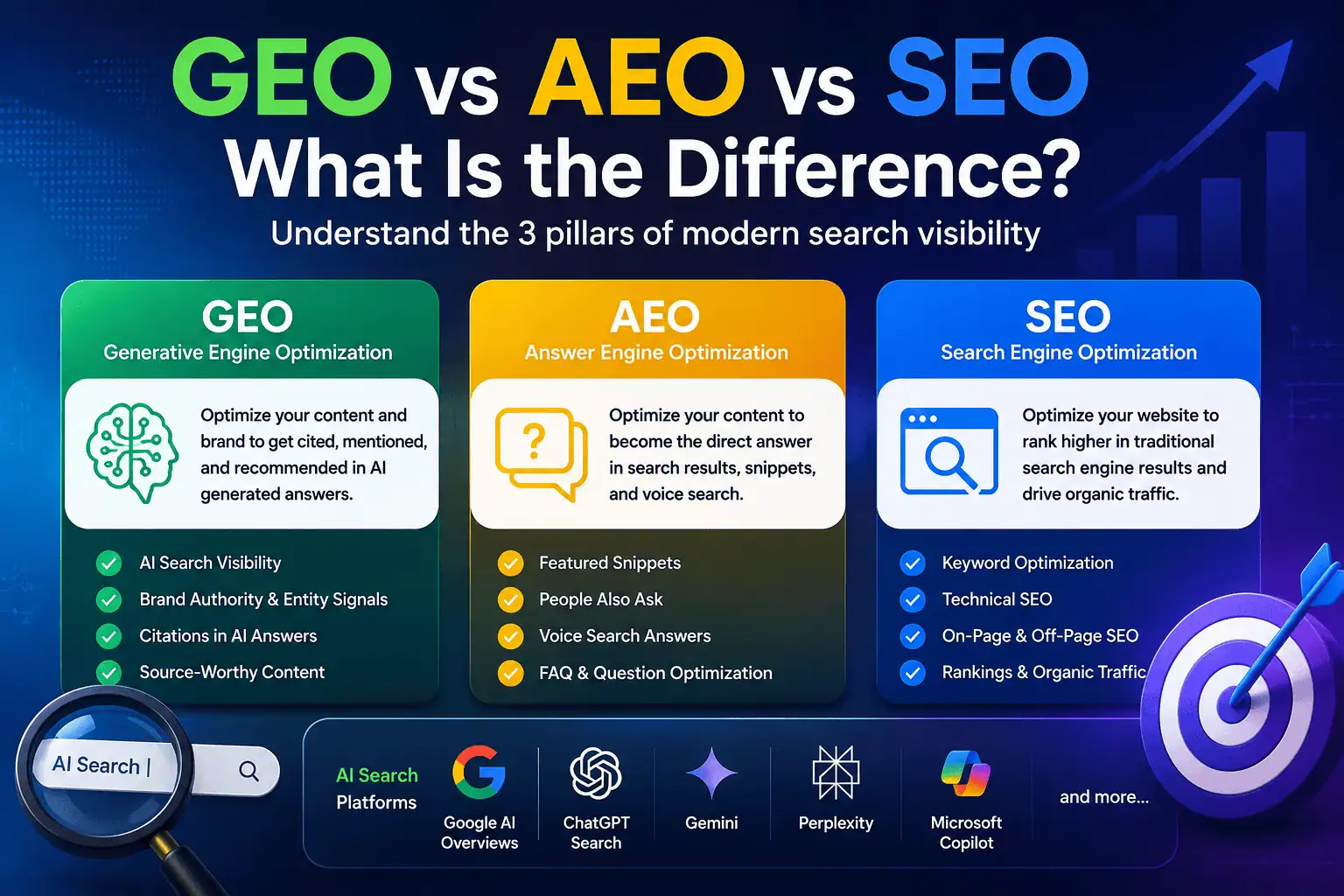
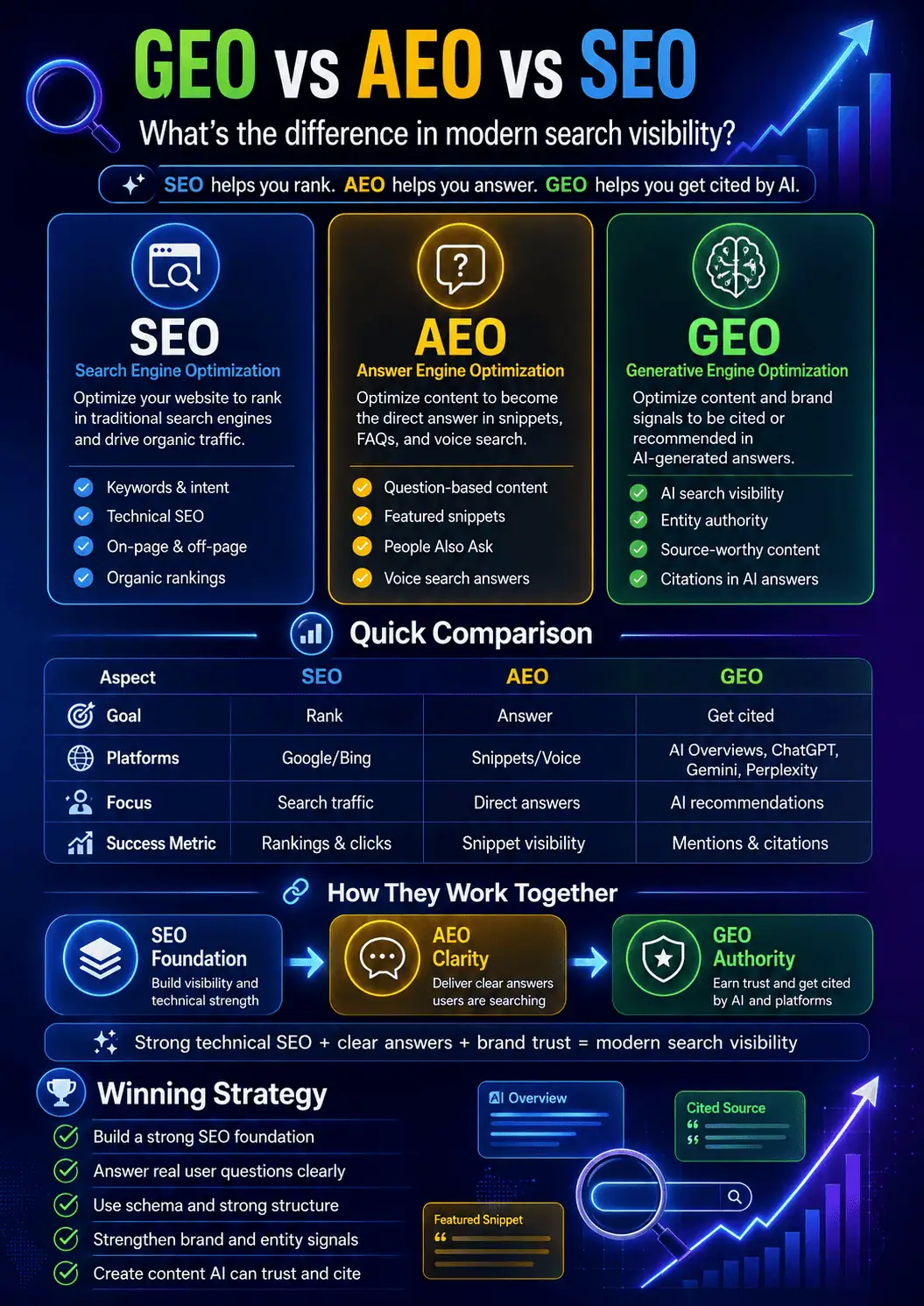
This shift has introduced new optimization methods such as AEO and GEO. SEO, AEO, and GEO are connected, but they are not exactly the same. SEO helps your website rank in search engines. AEO helps your content become the direct answer to user questions. GEO helps your brand and content appear inside AI-generated answers.
In simple words, SEO is about ranking, AEO is about answering, and GEO is about being cited or recommended by generative AI engines.
What Is SEO?
SEO stands for Search Engine Optimization. It is the process of improving your website so search engines like Google, Bing, and Yahoo can crawl, index, understand, and rank your pages for relevant search queries.
The main goal of SEO is to increase organic visibility, drive qualified traffic, and help users find your website when they search for products, services, information, or solutions.
How SEO Works
SEO works by helping search engines understand three important things:
- What your website or page is about
- How useful your content is for the searcher
- How trustworthy and authoritative your website is compared to competitors
When a user searches for something, search engines compare many pages and rank the most relevant and useful results. SEO helps your page become one of those results.
Main Areas of SEO
Technical SEO
Technical SEO focuses on the backend health of your website. It includes crawlability, indexing, site speed, mobile responsiveness, XML sitemap, robots.txt, canonical tags, schema markup, website structure, and Core Web Vitals.
On-Page SEO
On-page SEO focuses on optimizing individual pages. It includes title tags, meta descriptions, headings, keyword placement, internal linking, image optimization, content quality, and URL structure.
Off-Page SEO
Off-page SEO focuses on building trust and authority outside your website. It includes backlinks, brand mentions, guest posts, citations, digital PR, social signals, and online reputation.
Local SEO
Local SEO helps businesses appear in local search results and Google Maps. It includes Google Business Profile optimization, local citations, reviews, local landing pages, service-area pages, and local backlinks.
Example of SEO
If someone searches “best SEO consultant in Bangladesh” or “local SEO expert for Australian businesses,” SEO helps your website appear in Google search results for those keywords.
What Is AEO?
AEO stands for Answer Engine Optimization. It is the process of optimizing your content so it can appear as a direct answer in search results, voice search, featured snippets, People Also Ask boxes, knowledge panels, AI answers, and other answer-based search experiences.
AEO is not only about ranking a page. It is about making your content easy for search engines and answer engines to extract, summarize, and present as a clear answer.
How AEO Works
AEO works by matching your content with question-based search intent. Users often search using full questions such as:
- What is AI SEO?
- How does Local SEO work?
- Why is schema markup important?
- How much does SEO cost?
- What is the difference between GEO and AEO?
If your content gives a direct, structured, and trustworthy answer, it has a better chance of being used in answer-based results.
Main Areas of AEO
Question-Based Content
AEO works best when your content directly answers real user questions. This includes FAQ sections, how-to guides, comparison posts, glossary pages, and problem-solution articles.
Featured Snippet Optimization
Featured snippets are short answers shown at the top of Google search results. AEO helps structure your content so Google can extract a definition, list, step-by-step process, or table from your page.
Voice Search Optimization
Voice assistants often provide one direct answer instead of showing a full list of results. AEO helps your content become suitable for spoken answers by using natural language, short explanations, and conversational formatting.
FAQ Optimization
FAQs are important for AEO because they directly match question-based search behavior. A strong FAQ section helps users and search engines quickly understand the topic.
Example of AEO
If someone searches “What is Local SEO?” and your content provides a clear definition in the first few lines, your answer may be used in a featured snippet, People Also Ask result, or AI-generated summary.
What Is GEO?
GEO stands for Generative Engine Optimization. It is the process of optimizing your content, brand, and digital presence so generative AI engines can find, understand, cite, mention, or recommend your business in AI-generated answers.
GEO focuses on visibility inside generative AI platforms such as Google AI Overviews, Google AI Mode, ChatGPT Search, Gemini, Perplexity, Copilot, and other AI-powered search tools.
How GEO Works
Generative AI engines do not always show traditional search results. Instead, they generate a direct answer by collecting and summarizing information from different sources. Some platforms also include source links, citations, references, or brand mentions.
GEO helps your content become one of the trusted sources used in those AI-generated answers.
Main Areas of GEO
AI Search Visibility
GEO focuses on making your content visible in AI-powered answers, not only in traditional search results. This includes being cited, summarized, mentioned, or recommended by AI systems.
Entity Authority
Generative AI engines need to understand your brand as an entity. This means your business name, services, location, expertise, social profiles, author profiles, reviews, and external mentions should be consistent across the web.
Source-Worthy Content
AI tools prefer content that is clear, helpful, accurate, well-structured, and easy to cite. GEO content should include definitions, examples, expert insights, statistics, original frameworks, case studies, and practical explanations.
Brand Mentions and Digital PR
GEO is not limited to your own website. Your brand should also appear on trusted third-party websites, directories, review platforms, news sites, industry blogs, social platforms, and local citations.
Citation-Friendly Structure
Generative AI engines often use concise and well-structured information. Pages with clear headings, direct answers, bullet points, tables, FAQs, summaries, and schema markup are easier for AI systems to understand.
Example of GEO
If someone asks ChatGPT, Gemini, or Perplexity, “Who are reliable SEO consultants for Local SEO and AI SEO?” GEO helps your name, brand, or website appear as a recommended or cited source.
GEO vs AEO vs SEO: Quick Comparison
| Factor | SEO | AEO | GEO |
|---|---|---|---|
| Full Form | Search Engine Optimization | Answer Engine Optimization | Generative Engine Optimization |
| Main Goal | Rank higher in search results | Become the direct answer | Appear in AI-generated answers |
| Main Platform | Google, Bing, Yahoo | Google snippets, voice search, answer boxes | Google AI Overviews, ChatGPT, Gemini, Perplexity |
| Content Focus | Keywords, search intent, topical depth | Questions, direct answers, FAQs | Source-worthy content, citations, entity trust |
| Success Metric | Ranking, clicks, organic traffic | Featured snippets, answer visibility, voice results | AI mentions, citations, references, brand visibility |
| Best For | Organic traffic growth | Question-based visibility | AI search and generative answer visibility |
The Simple Difference Between SEO, AEO, and GEO
SEO Helps You Rank
SEO is mainly focused on ranking your website in traditional search results. The goal is to appear on the first page of Google and attract users to click your website.
AEO Helps You Answer
AEO is focused on answering specific questions clearly. The goal is to become the best direct answer for users, especially in featured snippets, People Also Ask, voice search, and answer boxes.
GEO Helps You Get Mentioned by AI
GEO is focused on AI-generated answers. The goal is to make your website, brand, and content trustworthy enough to be used, cited, or recommended by generative AI engines.
Simple Formula
SEO = Rank in search results.
AEO = Answer user questions directly.
GEO = Get cited, mentioned, or recommended by AI engines.
Why SEO Is Still Important
Even with the rise of AI search, SEO is still the foundation of digital visibility. AI platforms need reliable information sources. A technically strong and well-optimized website gives search engines and AI systems better access to your content.
If your website is not crawlable, indexable, mobile-friendly, fast, and well-structured, it will struggle in both traditional SEO and AI search.
SEO Builds the Foundation
SEO provides the base for AEO and GEO. Without proper SEO, your content may not be discovered by search engines or AI systems.
SEO Supports AEO
AEO works better when your pages are already optimized for keywords, search intent, internal linking, and content structure.
SEO Supports GEO
GEO works better when your website is technically accessible, trusted by search engines, supported by backlinks, and recognized as an authority in your niche.
Why AEO Is Becoming More Important
Search behavior is becoming more conversational. Users now ask full questions instead of typing only short keywords. This is why AEO is becoming more important for modern SEO strategies.
Users Want Fast Answers
People often want quick, direct, and simple answers. They may not want to read a full article just to understand a basic concept. AEO helps your content answer those questions quickly while still encouraging users to explore more details.
Voice Search Depends on Answers
Voice search usually gives one answer, not ten website links. This means your content needs to be direct, conversational, and easy to understand.
Featured Snippets Increase Authority
When your content appears in a featured snippet or answer box, it builds authority. Users see your website as a trusted source because search engines are highlighting your answer.
Why GEO Is the Future of AI Search Visibility
Generative AI tools are changing how people discover information, compare services, choose products, and make decisions. Instead of only searching Google, users may ask AI tools for direct recommendations.
This creates a new visibility challenge. Your website may rank on Google, but if AI tools do not understand or trust your brand, you may not appear in AI-generated answers.
GEO Focuses on AI Trust
Generative AI systems need confidence before they mention or cite a source. GEO helps improve that confidence by strengthening your content quality, brand entity, authority signals, and online mentions.
GEO Focuses on Source Inclusion
Traditional SEO often focuses on ranking position. GEO focuses more on whether your content is included, cited, summarized, or recommended inside AI-generated answers.
GEO Focuses on Brand Authority
In AI search, a strong brand matters. AI systems may look at your website, reviews, profiles, citations, social presence, media mentions, and third-party references to understand whether your brand is trustworthy.
SEO vs AEO vs GEO in Real-Life Search Examples
Example 1: Traditional SEO Query
Search query: “Local SEO services in Brisbane”
SEO goal: Rank your service page in Google organic results and Google Maps.
Example 2: AEO Query
Search query: “What is Local SEO?”
AEO goal: Provide a short, clear definition that can appear in a featured snippet, People Also Ask, or voice answer.
Example 3: GEO Query
AI prompt: “Recommend a reliable Local SEO consultant for small businesses.”
GEO goal: Get your brand, website, or name mentioned by AI tools as a trusted recommendation or cited source.
How to Optimize for SEO
Start with Keyword Research
Find keywords your target audience actually searches for. Focus on commercial keywords, informational keywords, local keywords, and long-tail keywords.
Examples
- SEO consultant in Bangladesh
- Local SEO expert Australia
- WordPress SEO services
- Google Business Profile optimization
- AI SEO services
Create High-Quality Content
Your content should match user intent and provide more value than competing pages. It should be detailed, clear, helpful, and easy to read.
Improve Technical SEO
Make sure your website loads fast, works on mobile, has a clean structure, uses proper canonical tags, and does not block important pages from indexing.
Build Internal Links
Internal links help search engines understand your website structure. Link related blog posts, service pages, case studies, and important landing pages together.
Earn Backlinks and Mentions
Backlinks from relevant websites help build authority. Brand mentions, guest posts, directories, reviews, and PR can also support your SEO performance.
How to Optimize for AEO
Answer Questions Clearly
Use question-based headings and answer the question directly in the first few lines. Then provide deeper explanation below.
Example Format
Question: What is AEO?
Answer: AEO stands for Answer Engine Optimization. It is the process of optimizing content so search engines and answer engines can use it as a direct answer to user questions.
Add FAQ Sections
FAQ sections are very useful for AEO because they match how users search. Add relevant questions and concise answers at the end of your article or service page.
Use Short Definitions
Every important concept should have a short definition. This helps search engines extract the answer easily.
Use Lists and Tables
Answer engines often use lists and tables because they are easy to understand. Use them when comparing features, steps, benefits, pricing, or processes.
Write in Natural Language
AEO content should sound natural and conversational. Write the way people ask questions and expect answers.
How to Optimize for GEO
Create Source-Worthy Content
GEO content should be useful enough for AI tools to cite or summarize. This means your content should include original insights, practical examples, clear explanations, expert opinions, and structured information.
Build Strong Entity Signals
Your brand should be easy for AI systems to understand. Make sure your About page, Contact page, author bio, social profiles, business listings, and schema markup all send consistent signals.
Important Entity Signals
- Business name
- Founder or expert name
- Service categories
- Location
- Experience
- Client reviews
- Social profiles
- External mentions
- Author pages
- Organization schema
Use Structured Data
Schema markup helps search engines and AI systems understand your website. Use relevant structured data such as Organization, Person, Article, FAQPage, LocalBusiness, Service, Review, BreadcrumbList, and WebPage schema.
Get Mentioned on Trusted Websites
GEO is strongly connected with brand authority. Try to earn mentions from trusted websites, industry blogs, business directories, news platforms, partner websites, and local citation sources.
Make Content Easy to Cite
AI engines prefer content that is clear and well-organized. Use short sections, meaningful headings, bullet points, summaries, and direct statements.
Update Content Regularly
AI search platforms often need fresh information, especially for fast-changing topics such as SEO, AI, digital marketing, technology, finance, and legal updates. Keep important pages updated.
Best Content Types for SEO, AEO, and GEO
Best Content Types for SEO
- Service pages
- Location pages
- Blog posts
- Product pages
- Landing pages
- Case studies
- Comparison articles
Best Content Types for AEO
- FAQ pages
- Glossary pages
- How-to guides
- Definition articles
- Step-by-step tutorials
- Question-based blog posts
- Featured snippet-style answers
Best Content Types for GEO
- Expert guides
- Original research
- Industry reports
- Authoritative comparison pages
- Case studies
- Data-backed articles
- Brand profile pages
- Thought leadership content
- Source-worthy FAQs
SEO, AEO, and GEO Work Better Together
The best digital marketing strategy does not choose only one between SEO, AEO, and GEO. A strong website needs all three.
SEO Brings Search Visibility
SEO helps your website appear in traditional search results and builds the technical and content foundation for all other optimization methods.
AEO Captures Question-Based Searches
AEO helps your content become the direct answer when users search with questions or use voice assistants.
GEO Builds AI Search Visibility
GEO helps your brand and content appear in AI-generated answers, AI recommendations, and citation-based responses.
Combined Strategy
The strongest strategy is to create content that ranks well in Google, answers user questions directly, and is trustworthy enough for AI tools to cite.
SEO, AEO, and GEO Strategy for Local Businesses
Local businesses should pay special attention to all three optimization methods. Customers now use traditional search, map search, voice search, and AI tools to find local service providers.
Local SEO Strategy
Optimize your Google Business Profile, service pages, location pages, reviews, citations, local backlinks, and local schema markup.
Local AEO Strategy
Answer local questions clearly. For example:
- How much does carpet cleaning cost in Brisbane?
- What is the best time for pest control in Sydney?
- How do I choose a roof restoration company?
- What does a local SEO consultant do?
Local GEO Strategy
Build brand mentions and authority across trusted local sources. This includes Google Business Profile, local directories, reviews, social profiles, news mentions, community pages, and industry-specific websites.
Common Mistakes to Avoid
Mistake 1: Thinking SEO Is Dead
SEO is not dead. It is evolving. AI search still depends on content quality, crawlability, authority, trust, and structured information.
Mistake 2: Publishing Generic AI Content
Generic content with no original value will struggle. Your content should include experience, examples, insights, proof, and practical advice.
Mistake 3: Ignoring Brand Authority
In AI search, your brand reputation matters. Reviews, mentions, case studies, author profiles, and third-party references help build trust.
Mistake 4: Not Answering Questions Clearly
If your content does not answer the main question quickly, it may perform poorly for AEO and GEO.
Mistake 5: Overusing Keywords
Keyword stuffing does not help modern SEO. Focus on intent, clarity, topical depth, and user value.
Mistake 6: Ignoring Technical SEO
If search engines cannot crawl and index your website properly, your SEO, AEO, and GEO efforts will be limited.
SEO, AEO, and GEO Checklist
SEO Checklist
- Perform keyword research
- Optimize title tags and meta descriptions
- Use proper heading structure
- Improve page speed
- Make the website mobile-friendly
- Fix indexing issues
- Add internal links
- Build quality backlinks
- Optimize images
- Use schema markup
AEO Checklist
- Add question-based headings
- Answer questions directly
- Create FAQ sections
- Use short definitions
- Add step-by-step explanations
- Use bullet points and tables
- Write in natural language
- Optimize for featured snippets
- Cover People Also Ask style queries
- Use clear and concise answers
GEO Checklist
- Create source-worthy content
- Build strong brand authority
- Add detailed author bios
- Improve About and Contact pages
- Use Organization and Person schema
- Earn brand mentions
- Build citations and directory profiles
- Publish original insights and case studies
- Keep content updated
- Track AI search visibility manually
Which One Should You Focus on First?
If your website is new or technically weak, start with SEO. Make sure your website is crawlable, indexable, fast, mobile-friendly, and properly structured.
Once your SEO foundation is strong, focus on AEO by answering common questions and building FAQ-style content. This helps you capture featured snippets, People Also Ask results, and voice search opportunities.
After that, focus on GEO by building brand authority, source-worthy content, expert profiles, schema markup, reviews, external mentions, and AI-friendly content structure.
Recommended Order
- Start with SEO foundation
- Add AEO structure
- Build GEO authority
- Track visibility across Google and AI platforms
- Update content regularly
Future of SEO: From Ranking to Recommendation
The future of search is not only about ranking on Google. It is also about being recommended by AI systems, cited in generated answers, and trusted as a reliable source.
Users are changing how they search. They want direct answers, personalized explanations, expert recommendations, and fast comparisons. That is why businesses need to optimize for traditional search engines, answer engines, and generative AI engines together.
The New Search Visibility Model
Traditional Visibility
Your website appears in organic search results.
Answer Visibility
Your content appears as a direct answer in snippets, FAQs, answer boxes, and voice search.
AI Visibility
Your brand or content appears in AI-generated answers, recommendations, summaries, or citations.
FAQs About GEO, AEO, and SEO
What is the main difference between SEO, AEO, and GEO?
SEO focuses on ranking in search engines. AEO focuses on becoming the direct answer to user questions. GEO focuses on appearing in AI-generated answers from tools like Google AI Overviews, ChatGPT, Gemini, and Perplexity.
Is GEO replacing SEO?
No. GEO is not replacing SEO. GEO builds on SEO. A strong SEO foundation helps your content become more discoverable and trustworthy for AI search engines.
Is AEO part of SEO?
Yes, AEO can be considered a specialized part of SEO. It focuses specifically on answer-based search visibility, featured snippets, voice search, and question-based content.
Do I need GEO for my business website?
Yes, if your customers use AI tools to research services, compare providers, or ask for recommendations, GEO can help your business appear in AI-generated answers.
Does schema markup help GEO and AEO?
Schema markup helps search engines understand your content, entities, services, authors, and business information. It does not guarantee ranking or AI visibility, but it supports SEO, AEO, and GEO.
Can small businesses benefit from GEO?
Yes. Small businesses can benefit from GEO by building strong service pages, reviews, local citations, Google Business Profile visibility, author profiles, case studies, and helpful content.
What type of content works best for GEO?
Expert guides, comparison articles, case studies, original research, FAQs, industry reports, and well-structured service pages work well for GEO because they are easier for AI systems to understand and cite.
What type of content works best for AEO?
FAQ pages, definition articles, how-to guides, step-by-step tutorials, and question-based blog posts work best for AEO.
Should I use AI tools to write SEO content?
You can use AI tools for research, outlines, ideas, and drafting. However, the final content should include human editing, expert insight, original examples, real experience, and accurate information.
What is the best strategy for 2026 and beyond?
The best strategy is to combine SEO, AEO, and GEO. Build a technically strong website, create helpful content, answer questions clearly, strengthen brand authority, and make your content trustworthy enough for AI engines to cite.
Conclusion
SEO, AEO, and GEO are different, but they work together. SEO helps your website rank in traditional search results. AEO helps your content become the direct answer to user questions. GEO helps your brand and content appear in AI-generated answers.
For modern digital marketing, you should not depend on only one method. Search is becoming more intelligent, conversational, and AI-driven. Businesses that want long-term visibility need to optimize for search engines, answer engines, and generative AI engines at the same time.
The winning formula is simple: build a strong SEO foundation, answer user questions better than your competitors, and create trustworthy content that AI systems can confidently cite, mention, and recommend.