Online shopping is beginning to move beyond search boxes, category pages and traditional checkout journeys.
Instead of visiting several websites manually, a customer may ask an AI assistant:
Find me a waterproof hiking jacket under $150 that is available in medium, can arrive before Friday and has free returns.
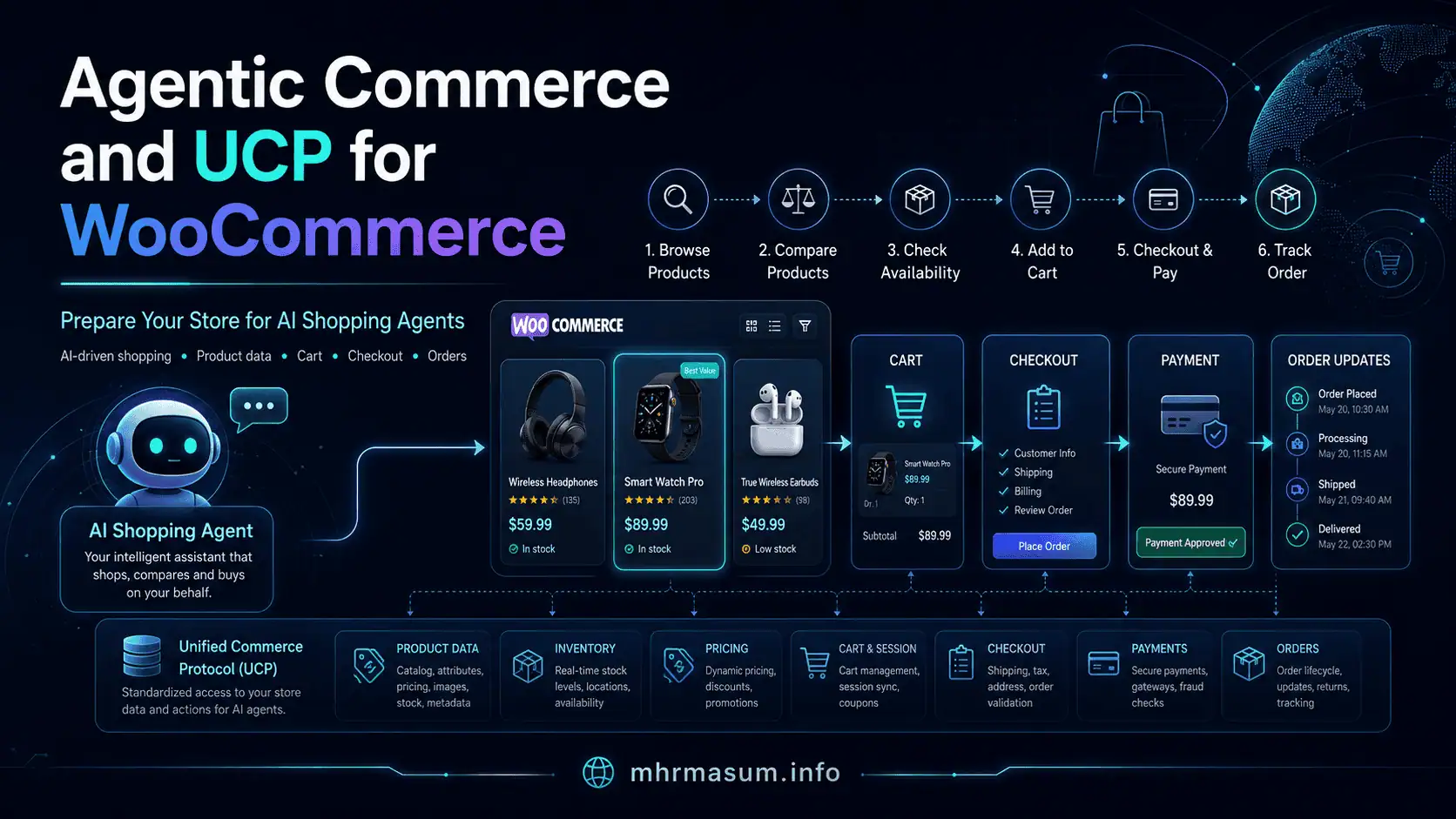
An AI shopping agent may then attempt to:
- Understand the shopper’s requirements
- Search several product catalogues
- Compare prices and specifications
- Check real-time availability
- Review shipping times
- Apply the shopper’s preferences
- Add the selected item to a cart
- Present the total cost
- Request payment approval
- Complete the order
- Track delivery
- Help with returns or customer support
This emerging model is known as Agentic Commerce.
Traditional eCommerce websites were designed mainly for humans interacting through pages, menus, forms and buttons. AI agents require more predictable access to product data, inventory, carts, checkout states, identity, payment systems and order updates.
The Universal Commerce Protocol, commonly known as UCP, is one attempt to create that shared commerce language.
Google launched UCP as an open standard in January 2026. It is designed to help platforms, AI agents, merchants, payment providers and credential providers interact across the shopping journey without requiring a completely different custom integration for every agent. Google currently positions UCP as a way for approved merchants to enable direct commerce actions through AI Mode in Google Search and Gemini.
For WooCommerce merchants, this creates both an opportunity and a technical challenge.
WooCommerce gives store owners extensive control over:
- Product data
- Pricing
- Inventory
- Checkout
- Payments
- Customer relationships
- Extensions
- Custom functionality
However, that flexibility also means two WooCommerce stores may structure products, variations, taxes, shipping and checkout logic very differently.
This guide explains:
- What Agentic Commerce means
- What UCP is designed to do
- How UCP works on Google
- How UCP differs from MCP, ACP and AP2
- The current state of UCP support for WooCommerce
- What WooCommerce merchants should prepare now
- Which Merchant Center settings are required
- How a custom WooCommerce UCP integration may be structured
- How to handle products, variations, carts, checkout and orders
- Which security and privacy controls are essential
- How to measure agentic commerce performance
- Which merchants should prioritise UCP
- Which claims and implementation mistakes to avoid
The Quick Answer
Agentic Commerce allows an AI system to do more than recommend a product. The agent may be able to search a catalogue, build a cart, manage checkout and support post-purchase tasks on behalf of a user.
UCP is an open commerce standard designed to support those interactions through a common set of capabilities.
Its documented commerce capabilities include:
- Catalogue search and product lookup
- Cart building
- Identity linking
- Checkout
- Payment handling
- Order creation
- Order-status updates
- Post-purchase support
Google currently uses UCP to support approved direct-buying integrations on AI Mode in Google Search and Gemini. Merchants remain the Merchant of Record and keep responsibility for the order, customer relationship, fulfilment and applicable legal obligations.
WooCommerce merchants should not assume that installing WooCommerce automatically makes a store fully UCP-compatible.
WooCommerce has introduced AI and agent infrastructure, including MCP-based store interaction, and Woo states that it is developing around ACP and UCP. However, merchants should verify current official WooCommerce releases before assuming that native UCP checkout is available in WooCommerce core.
The highest-priority preparation work is currently:
- Clean and complete product data
- Accurate stock and pricing
- Clear product variations
- Google Merchant Center integration
- Approved free-listing products
- Accurate shipping and return policies
- Product structured data
- Stable cart and checkout behaviour
- Secure APIs and authentication
- Reliable order and inventory synchronisation
UCP should be treated as a commerce integration project, not as a simple SEO plugin or ranking trick.
What Is Agentic Commerce?
Agentic Commerce is a model in which an AI agent can perform part or all of a shopping task on behalf of a user.
Traditional eCommerce assistance usually stops at recommendations.
For example, a chatbot may suggest three products and provide links to the relevant store pages.
An agentic commerce system can potentially continue beyond the recommendation by:
- Checking current product availability
- Selecting a specific variation
- Adding the product to a cart
- Calculating tax and shipping
- Applying available discounts
- Requesting user approval
- Submitting payment credentials
- Creating the order
- Tracking fulfilment
- Initiating a return
The defining characteristic is action.
The AI is not only generating an answer. It is interacting with commerce systems and changing their state.
How Agentic Commerce Differs From Conversational Commerce
Conversational commerce uses chat, messaging or voice to assist the shopping journey.
A conversational assistant might answer:
This jacket is waterproof, weighs 450 grams and is currently available in medium.
An agentic assistant may go further:
The medium size is in stock, qualifies for free delivery and can arrive by Thursday. I have added it to your cart. The total is $137. Would you like to approve the purchase?
Conversational commerce focuses on communication.
Agentic Commerce combines communication with authorised action.
The two can work together, but they are not identical.
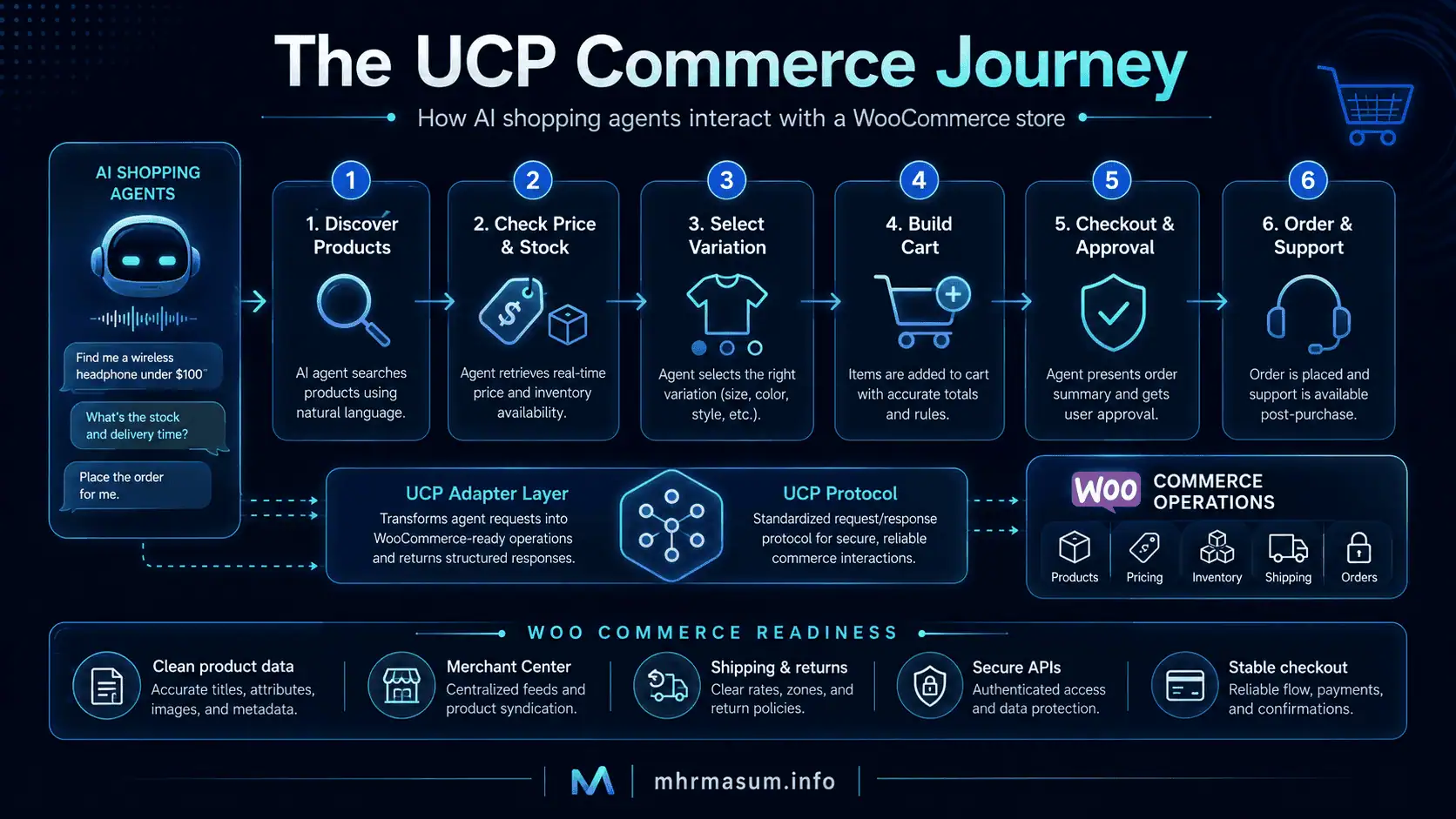
How Agentic Commerce Differs From Traditional Automation
Traditional eCommerce automation generally follows fixed rules.
Examples include:
- Send an abandoned-cart email after six hours
- Reduce stock when an order is paid
- Apply free shipping above $100
- Notify a customer when an order ships
- Add a customer to a mailing list after purchase
An AI agent can work with more open-ended instructions.
For example:
Build a complete camping cooking kit for two people under $200, excluding aluminium cookware, and make sure everything can arrive before 25 July.
The agent may need to:
- Interpret the requirement
- Compare several categories
- Evaluate compatibility
- Keep the total below a budget
- Confirm delivery dates
- Explain trade-offs
- Request approval
This requires structured data, reliable tools and clearly defined permission boundaries.
Why Agentic Commerce Matters for WooCommerce
WooCommerce powers stores ranging from small specialist retailers to complex international catalogues.
Its open-source architecture means merchants can control:
- Product information
- Checkout logic
- Payment providers
- Customer data
- Extensions
- Hosting
- Integrations
- Custom APIs
This creates an opportunity to participate in AI-driven shopping without moving the entire business into a closed marketplace.
WooCommerce describes AI-driven commerce as a shift in which agents may discover products, compare options and complete transactions while merchants retain control of their own stores. Woo has been building MCP infrastructure, platform integrations and protocol support to help merchants participate in emerging AI shopping environments.
However, WooCommerce flexibility creates additional implementation complexity.
A store may use:
- Standard products
- Variable products
- Product add-ons
- Subscriptions
- Bookings
- Bundles
- Composite products
- Dynamic pricing
- Custom shipping rules
- Multi-currency systems
- Custom checkout fields
- Third-party payment gateways
An AI agent needs deterministic, machine-readable answers across all of these systems.
What Is the Universal Commerce Protocol?
The Universal Commerce Protocol is an open standard that defines a common language and functional building blocks for commerce systems.
It is designed to allow:
- AI agents
- Consumer applications
- Merchants
- Payment service providers
- Credential providers
- Commerce platforms
to interact without every participant building a completely different integration for every other participant.
The official UCP specification describes the protocol as a way to standardise interactions between commerce entities while supporting secure checkout, personalised experiences and autonomous capability discovery.
The official standard is available through the Universal Commerce Protocol website and its open-source GitHub repository.
Why Google Introduced UCP
The modern commerce ecosystem is fragmented.
A merchant may need separate connections for:
- Google Shopping
- Social shopping
- Marketplaces
- AI assistants
- Payment providers
- Loyalty systems
- Shopping applications
- Customer-service platforms
Each integration may define products, carts, checkout, identity and order states differently.
UCP aims to reduce this fragmentation by providing a common protocol.
Google describes UCP as a standard that works across the shopping journey, from discovery and purchase to post-purchase support. The protocol was developed with participation from major commerce, retail and payment organisations.
The intended benefit is not that every platform becomes identical.
The benefit is that platforms and merchants can negotiate supported capabilities through a predictable technical framework.
Is UCP Controlled Only by Google?
Google introduced UCP and uses it for its own AI commerce surfaces, but UCP is published as an open-source protocol.
The specification, SDKs, discussions and conformance tools are publicly available.
The protocol is intended to support interoperability across:
- Platforms
- Agents
- Businesses
- Payment services
- Credential providers
- Commerce verticals
Google’s implementation is one application of the wider UCP standard.
Google also notes that the UCP specification is evolving and that not every capability defined by the protocol is currently available on Google’s own surfaces.
This means merchants should distinguish between:
- What the general UCP specification supports
- What Google currently supports
- What WooCommerce currently supports
- What a specific integration provider supports
Is UCP an SEO Standard?
UCP is not an ordinary organic ranking standard.
It does not replace:
- Technical SEO
- Product structured data
- Merchant Center feeds
- XML sitemaps
- Internal linking
- Product-page content
- Image SEO
- Website performance
- Brand authority
UCP is mainly a commerce interoperability and transaction protocol.
It can help an eligible merchant participate in agentic shopping experiences, but publishing a UCP profile does not automatically improve conventional Google rankings.
For broader preparation beyond transaction protocols, read Agentic SEO: How to Prepare Websites for AI Agents.
The Core UCP Commerce Journey
UCP is designed to support several stages of the shopping lifecycle.
The exact capabilities available depend on the platform, merchant and protocol version.
Product Discovery and Catalogue Lookup
The discovery stage helps an agent understand what the merchant sells.
The system may need access to:
- Product name
- Description
- Product identifier
- Brand
- Category
- Price
- Currency
- Availability
- Variations
- Images
- Delivery options
- Return conditions
The UCP standard includes catalogue search and lookup among its intended commerce capabilities. Google’s current direct-buying implementation also relies on existing Merchant Center feeds for product discovery.
For a WooCommerce store, this means the product catalogue must be consistent across:
- The visible product page
- WooCommerce product data
- Structured data
- Merchant Center feed
- Inventory system
- Cart
- Checkout API
Cart Building
The cart stage allows an agent or user to collect, update and remove items before a purchase decision is final.
Google’s UCP Cart API is designed for basket building before the user has expressed explicit checkout intent. It can support cart activity across Google surfaces such as AI Mode and Gemini.
A cart may need to support:
- Adding an item
- Removing an item
- Changing quantity
- Changing a variation
- Persisting a cart
- Recalculating totals
- Confirming availability
- Transitioning into checkout
The cart state must remain synchronised with the store.
An agent should not be shown an outdated price or unavailable variation after the WooCommerce store has changed.
Checkout
Checkout begins when the shopper has expressed purchase intent.
UCP checkout can include:
- Line items
- Quantity
- Price
- Discounts
- Tax
- Shipping
- Delivery address
- Payment handler
- Customer information
- Regulatory notices
- Final order total
Google’s native UCP integration requires merchants to provide a REST API through which Google can create, update and complete checkout sessions.
This is more complex than displaying product data.
The API must accurately reflect the store’s current business logic.
Identity Linking
Identity linking connects an AI or commerce platform with an existing customer account.
This can support:
- Loyalty benefits
- Saved addresses
- Personalised offers
- Order history
- Account-specific pricing
- Wishlists
- Faster checkout
Google’s implementation uses OAuth 2.0 for identity linking. Google also recommends PKCE using S256 and stronger asymmetric client authentication for relevant OAuth exchanges.
Identity linking is optional.
A merchant that does not implement it must support an appropriate guest experience for Google’s current UCP implementation.
Payment
UCP supports payment-handler integration rather than requiring merchants to surrender payment control completely.
Google’s implementation currently includes a Google Pay payment handler through which a shopper can provide payment credentials from Google Wallet.
The merchant remains responsible for:
- Payment processing
- Fraud decisions
- Order acceptance
- Refund handling
- Customer support
- Legal compliance
Google can provide contextual risk information during checkout, but the merchant retains control over whether to approve the transaction.
Order Creation and Post-Purchase Updates
The commerce journey continues after payment.
The agent or platform may need information about:
- Order confirmation
- Processing status
- Shipment
- Delivery
- Cancellation
- Refund
- Return
- Fulfilment adjustments
Google requires merchants using its current UCP integration to push order-status updates to Google through an order webhook.
The WooCommerce order system must therefore remain synchronised with the external platform.
Cart vs Checkout in UCP
Cart and checkout are separate concepts.
A cart represents exploration.
A checkout represents purchase intent.
| Cart | Checkout |
|---|---|
| Used while comparing products | Used after purchase intent |
| Items may change frequently | Totals and fulfilment must be confirmed |
| Payment is not required | Payment configuration is required |
| Can exist before customer identity | May require address and customer data |
| Supports adding and removing items | Supports completion and order creation |
| Lower risk | High-impact transaction stage |
The UCP specification describes the typical progression as:
Cart session
→ Checkout session
→ Order
Separating these stages helps agents explore without prematurely initiating payment or collecting sensitive information.
UCP vs MCP vs ACP vs AP2
Several protocols are discussed in connection with AI commerce.
They solve different problems and should not be treated as interchangeable names for the same technology.
| Protocol | Primary Role | Typical Use |
|---|---|---|
| MCP | Connect AI systems with tools and live data | Read or manage products, inventory and orders |
| ACP | Support commerce within the OpenAI and Stripe ecosystem | Product discovery, merchant connection and commerce workflows |
| UCP | Standardise commerce across agents, businesses and payment systems | Cart, checkout, identity and order lifecycle |
| AP2 | Provide secure agent payment authorisation | Verifiable payment mandates and credentials |
Model Context Protocol
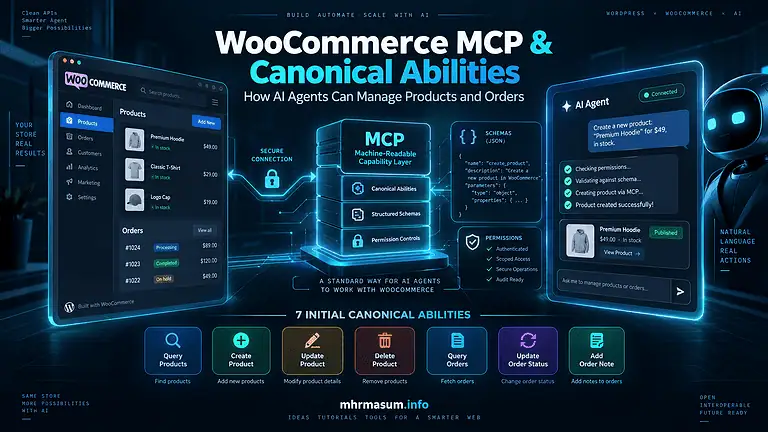
MCP provides a standard way for an AI system to interact with external tools and data.
For WooCommerce, MCP can allow an authorised AI assistant to:
- Search products
- Read inventory
- Review orders
- Update products
- Manage store operations
WooCommerce introduced its first MCP-based capabilities through its Abilities API work and later reported that MCP was live for supported store operations.
MCP does not automatically mean that a consumer can complete a UCP checkout through Google.
It is an interaction layer, not a complete universal commerce transaction system.
Agentic Commerce Protocol
ACP is associated with OpenAI and Stripe’s agentic commerce ecosystem.
WooCommerce has stated that it has worked on Stripe’s Agentic Commerce Protocol integration and the wider Stripe Agentic Commerce Suite.
ACP and UCP may support similar commercial goals, but they serve different ecosystems and use different implementations.
A store may eventually support both.
Universal Commerce Protocol
UCP is intended as a general commerce language that can operate across platforms and agents.
Its architecture includes modular capabilities such as:
- Cart
- Checkout
- Identity linking
- Order management
Google currently uses it for its developing agentic shopping experiences in AI Mode and Gemini.
Agent Payments Protocol
AP2 focuses on secure agent-initiated payments.
It provides concepts for confirming:
- User intent
- Agent authority
- Payment mandates
- Credential handling
- Accountability
UCP is designed to be compatible with related standards such as AP2, MCP and Agent-to-Agent communication.
How UCP Works on Google
Google’s UCP implementation combines existing Merchant Center product discovery with a new direct-commerce integration.
Approved merchants must complete several connected implementation stages.
Merchant Center Preparation
The merchant must first have a Google Merchant Center account in good standing.
Products must be approved for free listings before they can be prepared for UCP-powered checkout.
Google requires participating merchants to configure:
- Product data
- Returns
- Customer support
- Agentic checkout eligibility
- Product identifiers
- Required legal notices
These settings are used to determine eligibility, calculate costs and present legally required information during checkout.
Google Approval
UCP integration on Google is not currently a universal self-service switch for every store.
Google’s documentation states that merchants must join the waitlist and receive approval before going live on AI Mode in Google Search and Gemini.
The Merchant Center onboarding interface has been rolling out through a US early-access programme.
Availability, country support and merchant eligibility may change.
Google Pay Setup
Google’s current implementation includes Google Pay as a payment-handler option.
The merchant must configure the relevant payment integration so payment credentials can be provided securely during checkout.
The merchant still processes the transaction through its payment provider and remains responsible for acceptance and fraud controls.
UCP Profile Publication
The merchant must publish a UCP business profile at:
https://example.com/.well-known/ucp
The profile is a public JSON document.
It tells compatible platforms:
- Which UCP version is supported
- Which capabilities are available
- Which endpoints should be used
- Which payment handlers are supported
- Which public keys are available
- Which extensions are implemented
Google requires the profile to be publicly accessible without authentication.
Checkout API Implementation
For Google’s native checkout path, the merchant must provide REST endpoints for:
- Creating a checkout session
- Updating a checkout session
- Completing a checkout session
These endpoints must communicate with the actual commerce backend.
For WooCommerce, that means they must map reliably to:
- Products
- Variations
- Cart calculations
- Coupons
- Taxes
- Shipping
- Payment
- Order creation
- Stock reduction
Guest or Linked Account Experience
The merchant can support:
- Guest checkout
- Account-linked checkout
Guest checkout requires less identity integration.
Account-linked checkout can support loyalty, saved information and personalisation but requires OAuth-based identity linking.
Order Synchronisation
After the order is created, the merchant must send updated order information back to Google.
This can include:
- Processing
- Shipment
- Delivery
- Cancellation
- Return
- Refund
The external order state should remain consistent with WooCommerce.
Native Checkout vs Embedded Checkout
Google currently documents two integration paths.
Native checkout is the main path.
Embedded checkout is an optional path for approved merchants with more complex requirements.
Native Checkout
Native checkout uses a merchant API while Google renders the buyer-facing checkout interface.
The current documented flow includes:
- The cart or checkout session is created.
- The agent and user can adjust items.
- Control moves to a Google checkout interface.
- The user enters sensitive fulfilment and payment information.
- The agent is not involved in the sensitive manual payment stage.
- The order is completed and confirmed.
Google explains that separating the agent from the sensitive completion stage helps make the transaction deterministic and controlled.
Embedded Checkout
Embedded checkout allows an existing merchant checkout interface to be displayed within a Google surface through an iframe or webview.
Google describes this path as suitable for merchants with complex or highly customised checkout logic that cannot be represented through the native API.
Possible use cases include:
- Detailed product customisation
- Complex bundles
- Special regulatory steps
- Unique fulfilment logic
- Highly branded checkout requirements
Embedded checkout still requires secure communication and UCP capability declaration.
What Is the Current WooCommerce UCP Status?
WooCommerce is actively developing AI and agentic commerce capabilities.
Official WooCommerce publications describe work involving:
- MCP
- WordPress Abilities API
- Store API
- REST API
- Stripe ACP
- UCP development
- AI product discovery
- Agentic checkout
WooCommerce reported in May 2026 that MCP was live in WooCommerce 10.7 and that its architecture was designed to support additional protocols as they emerged. Woo also stated that ACP integration had been built and that it was developing around UCP.
However, merchants should not interpret those statements as proof that every normal WooCommerce installation has full native Google UCP checkout support.
Before implementing a project, verify:
- Current WooCommerce core release notes
- Official WooCommerce extensions
- Google Merchant Center availability
- Google approval status
- Payment-gateway compatibility
- Current UCP specification version
- Country eligibility
A third-party plugin claiming UCP support should be audited carefully.
Why WooCommerce Does Not Become UCP-Ready Automatically
WooCommerce core provides many necessary commerce components, but UCP requires a standard external interface.
A standard WooCommerce store does not automatically publish:
/.well-known/ucp
It may also lack UCP-compatible endpoints for:
- Checkout creation
- Checkout updates
- Checkout completion
- Cart persistence
- Identity linking
- Order webhooks
- Risk signals
- UCP-specific payment handlers
A complete integration needs an adapter between WooCommerce and the UCP specification.
The WooCommerce UCP Adapter Layer
A WooCommerce UCP adapter would translate UCP requests into WooCommerce operations and translate WooCommerce responses back into UCP responses.
A simplified architecture could look like this:
Google AI Mode or Gemini
          ↓
      UCP request
          ↓
Public UCP profile at /.well-known/ucp
          ↓
WooCommerce UCP integration layer
          ↓
WooCommerce Store API / REST API / custom services
          ↓
Products, cart, taxes, shipping, payment and orders
The adapter may be implemented as:
- A custom WordPress plugin
- An official WooCommerce extension
- A specialised middleware service
- A headless commerce layer
- An enterprise integration platform
The implementation should preserve WooCommerce as the source of truth.
What a WooCommerce UCP Integration Must Map
The integration must connect UCP concepts with WooCommerce concepts accurately.
| UCP Concept | WooCommerce Equivalent |
|---|---|
| Item | Product or variation |
| Item ID | Product ID, variation ID or mapped feed ID |
| Cart session | WooCommerce cart state |
| Checkout session | Checkout state or draft order logic |
| Buyer | Customer or guest |
| Fulfilment | WooCommerce shipping package and method |
| Discount | Coupon or pricing rule |
| Tax | WooCommerce tax calculation |
| Payment handler | WooCommerce payment gateway |
| Order | WooCommerce order |
| Order update | Order status and fulfilment events |
Any mismatch can create incorrect orders.
Product ID Consistency
Product identification is one of the most important integration requirements.
Google states that the product ID in Merchant Center should match the ID expected by the checkout API.
When the identifiers differ, Google allows merchants to provide a merchant_item_id mapping attribute.
WooCommerce merchants may have several identifiers:
- WordPress post ID
- WooCommerce product ID
- Variation ID
- SKU
- GTIN
- MPN
- Merchant Center item ID
- ERP product ID
The integration must define one reliable mapping strategy.
Do not assume that the parent product ID is enough for a selected variation.
WooCommerce Variable Products
Variable products are one of the most complex areas of agentic commerce.
A product may have variations based on:
- Colour
- Size
- Storage
- Length
- Material
- Voltage
- Pack quantity
- Configuration
Each valid variation can have a different:
- Price
- SKU
- Stock quantity
- Image
- Weight
- Shipping class
- Availability
- Delivery date
An agent must be able to select a valid combination.
Poor variation labels such as:
- Option 1
- Standard
- Other
- Type A
can create ambiguity.
Use descriptive attribute names and values such as:
Colour: Navy Blue
Size: Medium
Storage: 512 GB
Cable length: 10 metres
Voltage: 230 V EU
Product Data WooCommerce Stores Should Prepare
AI shopping systems depend on structured and consistent product information.
Every important product should include:
- Clear product name
- Accurate description
- Brand
- SKU
- GTIN or MPN where applicable
- Product category
- Current price
- Currency
- Availability
- Variation attributes
- Product condition
- High-quality images
- Shipping information
- Return information
- Warranty information
- Regulatory notices
- Accurate dimensions and weight
This information should remain consistent across the page, feed, schema, cart and checkout.
Product Titles for Agentic Discovery
A product title should identify the item clearly without becoming a keyword list.
A weak title is:
Amazing Power Product Best Portable Battery New Model
A stronger title is:
EcoFlow DELTA 2 Max Portable Power Station – 2048Wh
The stronger title identifies:
- Brand
- Model
- Product type
- Key specification
An AI agent can compare precise product data more reliably than vague marketing language.
Product Descriptions for AI Shopping Agents
Product descriptions should answer practical decision questions.
Useful information includes:
- What the product does
- Who it is for
- Important specifications
- Compatible products
- Required accessories
- Limitations
- Materials
- Dimensions
- Warranty
- Safety information
- Delivery considerations
Do not hide important limitations in an image or downloadable PDF.
Machine-readable text should explain them clearly.
Product Structured Data
Product structured data helps Google understand product information on the visible page.
Relevant data may include:
- Name
- Image
- Brand
- SKU
- GTIN
- MPN
- Price
- Currency
- Availability
- Shipping
- Returns
- Reviews
- Variants
Structured data does not replace Merchant Center or UCP.
These systems should reinforce one another.
Use my Technical SEO Checklist for WordPress to review crawlability, structured data and indexing requirements.
Merchant Center Requirements for UCP
Google’s current UCP onboarding requires several Merchant Center settings.
These requirements should be completed before expensive custom API development begins.
Merchant Center Account Standing
The account must be in good standing.
Products must be approved for free listings.
Resolve:
- Policy violations
- Feed errors
- Domain verification problems
- Price mismatches
- Availability mismatches
- Image issues
- Shipping conflicts
before beginning a UCP rollout.
Return Policy
Google requires return policies to be configured because the merchant remains the Merchant of Record.
The policy must include:
- Return period
- Return cost
- Link to the complete policy
Google supports account-level and product-level return information.
The policy on the store should match Merchant Center.
Customer Support Information
The Merchant Center account must contain at least one supported customer contact method.
This may include:
- Customer-service webpage
- Customer-service email address
- Customer-service telephone number
Google uses this information to provide a Contact Merchant option after the order.
Agentic Checkout Eligibility
Google documents a native_commerce product attribute.
Products are not eligible for the documented checkout experience when the attribute is false or missing.
This attribute should not be enabled blindly.
Only opt in products that the integration can fulfil accurately.
Consumer Notices
Products with legal or safety warning requirements must provide the relevant consumer notices.
Google currently documents notice types including:
- Legal disclaimer
- Safety warning
- California Proposition 65
The merchant remains responsible for compliance with applicable laws.
Product Identifier Mapping
The feed identifier and API identifier must correspond.
If the Google product ID does not match the WooCommerce or integration ID, establish an explicit mapping.
Shipping and Delivery Information
Agents need reliable delivery information before recommending or purchasing a product.
WooCommerce stores should provide:
- Delivery countries
- Excluded areas
- Shipping methods
- Shipping cost
- Free-shipping thresholds
- Handling time
- Transit time
- Estimated delivery date
- Weight restrictions
- Oversized-item surcharges
A product should not be recommended as arriving before Friday when the actual store cannot make that commitment.
Shipping calculation should be performed by the same business logic used by the real WooCommerce checkout.
Taxes
Tax rules can vary by:
- Country
- State
- Province
- Product type
- Customer type
- Tax exemption
- Shipping destination
- Digital or physical status
The UCP checkout response must use the same tax calculations as the actual WooCommerce store.
Do not use a simplified fixed tax estimate when the final WooCommerce order uses a different calculation.
Coupons and Dynamic Pricing
WooCommerce stores may use:
- Coupon codes
- Automatic discounts
- Role-based pricing
- Quantity discounts
- Membership pricing
- Time-limited promotions
- Bundles
- Buy-one-get-one offers
The integration must define:
- Which discounts agents can discover
- Which discounts require a code
- Whether a code is valid
- Whether discounts can be combined
- How totals change
- Whether customer identity is required
An agent should not promise a discount that the checkout cannot apply.
Subscriptions and Recurring Payments
Subscription products introduce additional requirements.
An agent must understand:
- Initial payment
- Recurring amount
- Billing interval
- Trial period
- Renewal date
- Cancellation process
- Minimum commitment
- Shipping frequency
- Payment mandate
Do not opt subscription products into agentic checkout until recurring consent and payment handling are fully supported.
Product Add-Ons and Customised Products
Some WooCommerce products require:
- Engraving text
- File uploads
- Personalisation
- Measurements
- Custom dates
- Design approval
- Conditional options
These products may not fit a basic native checkout API.
An embedded checkout or human handoff may be more appropriate.
The store should not simplify a customised product so aggressively that the final order becomes incomplete or invalid.
Bookings and Reservations
Bookings require availability rather than ordinary inventory alone.
The system may need:
- Date
- Time
- Location
- Number of guests
- Capacity
- Duration
- Cancellation policy
- Real-time slot availability
- Confirmation rules
Google has expanded UCP into additional verticals such as lodging and food, but those integrations may follow separate onboarding and specifications.
A standard retail UCP implementation should not be assumed to support complex bookings automatically.
UCP Profile Requirements
The UCP profile is the discovery document for the merchant’s protocol capabilities.
It must be:
- Publicly accessible
- Valid JSON
- Served from
/.well-known/ucp - Consistent with the implemented endpoints
- Updated when versions or capabilities change
- Protected from unauthorised publishing changes
The profile tells platforms what the store actually supports.
Do not declare a capability that is only partially implemented.
Simplified UCP Profile Example
The following example is illustrative only.
The official schema and current version must be used during a real implementation.
{
  "ucp": {
    "version": "CURRENT_SUPPORTED_VERSION"
  },
  "services": {
    "dev.ucp.shopping": {
      "version": "CURRENT_SUPPORTED_VERSION",
      "spec": "https://ucp.dev/",
      "rest": {
        "endpoint": "https://example.com/wp-json/mhr-ucp/v1"
      }
    }
  }
}
The final profile may also declare:
- Capabilities
- Extensions
- Payment handlers
- Signing keys
- Embedded checkout
- Identity linking
- API schemas
Use the official Google UCP profile documentation rather than copying an old online example.
WooCommerce REST API and Store API
WooCommerce provides existing APIs that can support parts of an integration.
Possible sources include:
- WooCommerce REST API
- WooCommerce Store API
- WordPress REST API
- WooCommerce CRUD objects
- Custom plugin endpoints
The UCP layer may use those systems internally.
However, exposing the normal WooCommerce REST API directly as a public UCP API is not sufficient.
The adapter must:
- Validate UCP requests
- Map UCP schemas
- Apply checkout logic
- Authenticate callers
- Handle idempotency
- Return UCP error states
- Protect private store data
- Log transactions
Checkout Session Creation
A checkout-session endpoint may need to:
- Validate requested products
- Validate variations
- Confirm quantities
- Read current prices
- Check inventory
- Create or reconstruct a cart
- Calculate discounts
- Calculate shipping
- Calculate tax
- Return the current checkout state
No order should be created merely because an agent explored a product unless that behaviour is intentionally required.
Checkout Session Updates
A checkout can change when the shopper provides:
- Delivery address
- Shipping method
- Quantity
- Variation
- Coupon
- Contact information
The update endpoint should recalculate:
- Availability
- Price
- Tax
- Shipping
- Discounts
- Final total
Every response should be based on current store state.
Checkout Completion
Checkout completion is a high-impact action.
The integration should:
- Confirm the session remains valid
- Confirm the total
- Validate the payment credential
- Apply fraud controls
- Prevent duplicate charges
- Create the WooCommerce order
- Reduce stock
- Store attribution
- Return confirmation
- Trigger notifications
The system should not trust a total supplied by the external agent.
The merchant backend must calculate and verify the final amount.
Idempotency and Duplicate Orders
Agentic systems can retry requests after timeouts or network failures.
Without idempotency, one purchase request could create:
- Two orders
- Two charges
- Duplicate stock reduction
- Duplicate customer emails
Every completion request should include or derive a stable idempotency key.
The integration should store the relationship between:
- External checkout ID
- Idempotency key
- WooCommerce order ID
- Payment transaction ID
Repeated completion requests should return the existing result rather than create a new order.
Error Handling
Errors should be specific enough for the platform or agent to respond correctly.
Possible error conditions include:
- Product unavailable
- Variation invalid
- Quantity unavailable
- Shipping unavailable
- Address invalid
- Coupon expired
- Payment rejected
- Identity required
- Insufficient permission
- Checkout expired
- Price changed
- Merchant review required
Avoid returning only:
Something went wrong.
A structured error should identify:
- Error code
- Human-readable message
- Affected field or item
- Whether the request can be retried
- Whether the user must act
- Whether human support is required
Authentication
Google currently documents several authentication approaches for checkout endpoints, including API keys and OAuth 2.0, with OAuth recommended for the relevant server authentication use cases.
A production WooCommerce integration should not rely on:
- A public unauthenticated write endpoint
- A secret included in frontend JavaScript
- A permanent key shared across every environment
- User-agent strings alone
- IP addresses alone without rotation handling
Use:
- Dedicated credentials
- Key rotation
- Environment separation
- Rate limiting
- Request signing
- Logging
- Least-privilege permissions
Identity and Customer Accounts
Account linking can provide a better experience, but it creates privacy and security responsibilities.
The integration may gain access to:
- Addresses
- Order history
- Loyalty data
- Saved preferences
- Customer-specific pricing
The user should understand:
- Which account is being linked
- Which permissions are requested
- What information will be shared
- How access can be revoked
- How long tokens remain valid
Do not expose the full WooCommerce customer record when the agent needs only a limited checkout scope.
Payment Security
Payment credentials should not pass unnecessarily through WordPress or plugin code.
Use tokenised payment handling through a supported payment provider.
The merchant should retain control over:
- Fraud screening
- Three-D Secure
- Address verification
- CVV response
- Order acceptance
- Refunds
- Chargebacks
Google’s UCP risk signals can provide additional context, but they do not replace the merchant’s own fraud and payment controls.
Prompt Injection and Agent Security
Agentic commerce introduces security risks beyond normal checkout attacks.
Malicious instructions may appear in:
- Product descriptions
- Reviews
- Uploaded files
- Support messages
- Third-party pages
- Hidden webpage content
An AI agent should not treat untrusted website text as authority to:
- Reveal private data
- Change the delivery address
- Buy a different product
- Ignore the user’s budget
- Bypass confirmation
- Send credentials
- Call an unauthorised endpoint
The commerce integration should enforce policy at the server level.
Do not depend on the AI model alone to obey transaction rules.
Human Confirmation
Consequential actions should normally require clear user confirmation.
Before completing a purchase, show:
- Merchant name
- Product
- Variation
- Quantity
- Delivery address
- Shipping method
- Delivery estimate
- Tax
- Discounts
- Total amount
- Return policy
- Payment method
The user should know exactly what will happen before payment.
Merchant of Record Responsibilities
Google states that the merchant remains the Merchant of Record in its UCP implementation.
This means the merchant retains responsibility for areas such as:
- Product accuracy
- Price
- Tax
- Payment
- Fulfilment
- Customer support
- Returns
- Refunds
- Legal compliance
- Customer relationship
UCP does not transfer these responsibilities to Google or the AI agent.
SEO Preparation for Agentic Commerce
UCP does not make traditional product SEO unnecessary.
An agent often needs to discover and evaluate the product before checkout becomes relevant.
WooCommerce stores should maintain:
- Crawlable product pages
- Accurate canonical URLs
- Clear categories
- Product structured data
- Merchant Center feeds
- High-quality images
- Useful descriptions
- Reviews
- Shipping information
- Return information
- Internal links
- Fast mobile performance
Read Multimodal SEO for AI Search for guidance on product images, demonstration videos and visual search preparation.
Product Images for AI Shopping
Product imagery can influence:
- Search visibility
- Google Images
- Google Lens
- Product understanding
- Comparison
- Conversion
Use:
- Front view
- Side view
- Detail view
- Scale reference
- Product in use
- Packaging
- Accessories
- Variation images
Images should match the selected variation.
Do not display a black product when the agent selected the red variation.
Brand and Product Entity Signals
AI systems need to understand the relationship between:
- Merchant
- Brand
- Manufacturer
- Product
- Model
- Category
- Variation
Use consistent:
- Brand names
- Product names
- SKUs
- GTINs
- MPNs
- Logos
- Manufacturer information
- Structured data
My Entity SEO guide explains how clear entities support search and AI understanding.
Content for Comparison Shopping
WooCommerce identifies comparison-oriented purchases as a strong potential use case for AI shopping agents.
These are purchases where the customer knows the need but has not selected the exact product.
Useful content includes:
- Product comparisons
- Buying guides
- Compatibility guides
- Size guides
- Specification tables
- Use-case guides
- Pros and cons
- Original reviews
- Frequently asked questions
Clean structured product data gives an AI agent facts.
Useful editorial content helps it understand trade-offs.
Agentic Commerce and Brand Authority
An agent may be able to find many technically compatible products.
The shopper still needs a reason to trust the merchant.
Brand authority can be supported through:
- Reviews
- Accurate policies
- Clear contact information
- Original content
- Transparent authorship
- Secure checkout
- Reliable fulfilment
- Strong support
- External mentions
- Case studies
Read How to Build Brand Authority for AI Search for the wider trust framework.
Should WooCommerce Stores Create llms.txt for UCP?
llms.txt is not a UCP implementation requirement.
A UCP integration uses the UCP profile at:
/.well-known/ucp
This is different from:
/llms.txt
The files serve different purposes.
llms.txt is a proposed content index for compatible AI tools.
The UCP profile declares commerce capabilities, protocol versions, endpoints and configuration.
Do not confuse them.
Does robots.txt Control UCP Transactions?
Robots.txt can communicate crawler preferences, but it does not authenticate or authorise commerce actions.
A checkout API should rely on:
- Authentication
- Authorisation
- Request validation
- Request signing
- Rate limiting
- Idempotency
- Access logs
Do not protect a transaction endpoint by adding it to robots.txt.
For crawler-specific guidance, read AI Crawler Control for WordPress.
WooCommerce Performance and Availability
An agentic checkout depends on reliable API responses.
The store should be able to handle:
- Product lookup
- Inventory checks
- Cart calculations
- Checkout updates
- Payment callbacks
- Order webhooks
Review:
- Server response time
- Database performance
- Object caching
- WooCommerce scheduled actions
- Payment webhook reliability
- REST API availability
- CDN rules
- Firewall rules
- Rate limits
- Plugin conflicts
A visually attractive store with unreliable checkout APIs is not agent-ready.
Staging and Sandbox Testing
Google’s Merchant Center integration process includes sandbox testing before production validation.
Google recommends separate credentials for staging and production environments.
A WooCommerce testing environment should include:
- Representative products
- Variations
- Shipping zones
- Taxes
- Coupons
- Payment sandbox
- Order webhooks
- Stock updates
- Customer accounts
- Error scenarios
Do not test only the successful purchase path.
UCP Conformance Testing
The UCP open-source ecosystem provides SDKs and conformance tools.
Google’s native checkout documentation points developers to:
- UCP GitHub repository
- Python SDK
- JavaScript SDK
- Conformance test suite
These resources can help validate protocol behaviour before production onboarding.
Passing protocol tests does not replace WooCommerce business-logic testing.
WooCommerce Test Scenarios
A serious integration should test at least the following scenarios.
Product and Inventory Tests
These tests confirm that agents cannot purchase invalid inventory.
Test:
- In-stock simple product
- Out-of-stock product
- Back-order product
- Low-stock quantity
- Deleted product
- Disabled product
- Price changed after cart creation
- Variation became unavailable
Shipping Tests
These tests confirm that delivery information remains accurate.
Test:
- Valid domestic address
- Unsupported country
- Unsupported postal code
- Free-shipping threshold
- Oversized product
- Multiple shipping packages
- Delivery-date change
Discount Tests
These tests confirm that promotional logic works correctly.
Test:
- Valid coupon
- Expired coupon
- Usage-limit reached
- Product-excluded coupon
- Minimum-order requirement
- Multiple discount conflict
Payment Tests
These tests confirm safe transaction handling.
Test:
- Successful payment
- Declined payment
- Authentication required
- Timeout
- Duplicate completion request
- Payment succeeded but order response failed
- Refund
Order Tests
These tests confirm post-purchase synchronisation.
Test:
- Processing
- Completed
- Cancelled
- Partially refunded
- Fully refunded
- Shipped
- Delivered
- Returned
Measuring Agentic Commerce
Agentic commerce measurement should connect technical activity with business outcomes.
A complete measurement system may include:
- Merchant Center reporting
- UCP integration monitoring
- WooCommerce order data
- Payment-provider data
- GA4
- Server logs
- BigQuery
- CRM data
UCP Event Monitoring
Google provides optional guidance for storing UCP event information in BigQuery.
This can help merchants analyse:
- Endpoint latency
- Errors
- Request and response activity
- Checkout conversion
- Revenue attribution
Google provides a reference implementation for streaming UCP event data into BigQuery.
Sensitive payment and personal information should be excluded or handled according to legal and security requirements.
Recommended UCP Metrics
Useful technical metrics include:
- Product-lookup success rate
- Cart-creation success rate
- Checkout-creation success rate
- Checkout-update success rate
- Completion success rate
- API latency
- Error rate
- Payment failure rate
- Duplicate-request rate
- Order-webhook success rate
Useful business metrics include:
- Agentic sessions
- Carts created
- Checkout starts
- Orders
- Revenue
- Average order value
- Refund rate
- Return rate
- Customer-support volume
- New vs returning customers
- Product-category performance
GA4 and UCP Attribution
Some agentic purchases may happen primarily on an external surface rather than through a traditional website session.
Normal page-based GA4 tracking may therefore be incomplete.
Use server-side or order-level attribution where available.
Store appropriate source information in WooCommerce order metadata, such as:
- Source platform
- Agentic commerce channel
- Campaign
- UCP checkout ID
- External session ID
- Merchant Center source
Do not store payment secrets or unnecessary personal data in analytics fields.
Example WooCommerce Order Metadata
A custom integration might store non-sensitive operational information such as:
Commerce source: Google UCP
External checkout ID: chk_123456
Agentic order: Yes
Integration version: 2026-04-08
This can support:
- Reporting
- Troubleshooting
- Reconciliation
- Customer support
The exact fields should follow the platform’s attribution and privacy requirements.
Which WooCommerce Stores Should Prioritise UCP?
UCP is most relevant to stores with strong product data and a realistic opportunity in AI-assisted comparison or direct buying.
Good early candidates may include:
- Specialist retailers
- Stores with clear product specifications
- Stores with standard physical products
- Stores with reliable stock
- Stores with predictable fulfilment
- Stores already using Merchant Center
- Stores with substantial Google product visibility
- Enterprise WooCommerce operations
Which Stores Should Delay UCP?
A store should delay protocol-level integration when core commerce data is unreliable.
Delay UCP when:
- Prices frequently mismatch
- Stock data is inaccurate
- Merchant Center has many disapprovals
- Shipping calculations are unstable
- Checkout is broken
- Product variations are unclear
- Return policies are missing
- Payment webhooks fail
- APIs are insecure
- Product identifiers are inconsistent
Fixing these foundations will benefit human customers, traditional search and future AI agents.
High-Risk Product Categories
Some products require additional care because they involve:
- Age restrictions
- Medical claims
- Legal restrictions
- Safety warnings
- Hazardous materials
- Complex licences
- Prescription requirements
- High fraud risk
- High-value purchases
Do not enable automated checkout without reviewing:
- Platform eligibility
- Applicable law
- Consumer disclosures
- Verification requirements
- Payment-provider rules
- Shipping restrictions
Google requires merchants to provide applicable consumer notices and remain responsible for legal compliance.
UCP Is Not Suitable for Every Purchase
AI agents may be especially useful for considered purchases with clear constraints.
Examples include:
- Outdoor equipment
- Electronics accessories
- Home-office products
- Replacement parts
- Specialist apparel
- Standardised supplies
Agentic checkout may be less suitable for:
- Very high-value purchases
- Emotionally significant items
- Highly customised products
- Products requiring professional consultation
- Complex legal agreements
- Products requiring physical inspection
The best agentic commerce use case removes real customer friction without removing necessary human judgement.
Common UCP and Agentic Commerce Myths
Agentic Commerce is developing quickly, which has created several exaggerated claims.
Myth 1: Every WooCommerce Store Is Already UCP-Compatible
WooCommerce contains useful commerce APIs and AI infrastructure, but a complete Google UCP checkout requires specific capability, profile, API and onboarding work.
Myth 2: UCP Automatically Improves Google Rankings
UCP is a commerce protocol, not a conventional ranking factor.
Myth 3: Product Schema Is Enough
Product schema helps explain a page.
It does not implement carts, checkout, payment, identity or order webhooks.
Myth 4: Merchant Center Is Enough
Merchant Center supports product discovery and eligibility.
Direct UCP checkout also requires integration, testing and approval.
Myth 5: An AI Agent Should Be Allowed to Purchase Without Confirmation
High-impact transactions should use clear authorisation and confirmation.
Myth 6: WooCommerce Product IDs and Feed IDs Always Match
Many stores use different identifiers across WooCommerce, feeds, variations and inventory systems.
Mapping must be verified.
Myth 7: UCP Replaces the WooCommerce Checkout
UCP can use native or embedded flows, but the merchant’s backend must still enforce the real checkout and order rules.
Myth 8: A Third-Party UCP Plugin Is Automatically Safe
The plugin may process products, customers, payments and orders.
It should receive a full security and code review.
Myth 9: llms.txt Makes a Store UCP-Ready
UCP uses its own capability profile and transaction APIs.
Myth 10: Agents Remove the Need for Product Content
Agents still need accurate information to compare and recommend products.
Common WooCommerce UCP Implementation Mistakes
Technical mistakes can create failed purchases, incorrect totals or security problems.
Using Stale Product Data
The feed may show one price while WooCommerce uses another.
Synchronise:
- Price
- Sale price
- Stock
- Variation
- Availability
- Delivery data
Treating Parent and Variation IDs as the Same
A variable product and its selected variation may require different identifiers.
Trusting Agent-Supplied Totals
The merchant backend must calculate and validate totals.
Creating Orders Before Payment Confirmation
Do not create unnecessary duplicate or unpaid orders unless the checkout architecture explicitly requires a draft-order stage.
Missing Idempotency
Retries must not create duplicate charges or orders.
Exposing WooCommerce Admin APIs
The integration should expose only the minimum public commerce capabilities required.
Storing Secrets in WordPress Options Without Protection
API keys and signing secrets should be protected, access-controlled and rotated.
Ignoring Order Webhooks
The external platform needs accurate post-purchase status.
Enabling Every Product Immediately
Start with a controlled product subset.
Ignoring Human Checkout Quality
AI readiness should not be used to excuse a poor website checkout.
A Practical WooCommerce Readiness Score
A simple readiness score can help prioritise work.
Score each area from 0 to 5.
| Area | Readiness Question |
|---|---|
| Product data | Are names, IDs, specifications and images complete? |
| Inventory | Is stock accurate in real time? |
| Merchant Center | Are products approved and policies configured? |
| Variations | Are all valid options deterministic? |
| Shipping | Can costs and delivery times be calculated reliably? |
| Returns | Are return rules clear and machine-readable? |
| Checkout | Is the checkout stable and testable? |
| Payments | Are tokenisation and fraud controls reliable? |
| APIs | Are endpoints secure, documented and performant? |
| Orders | Can order states be synchronised externally? |
A store with major failures in product data, inventory or checkout should not begin with a complex UCP build.
A 30-Day WooCommerce Agentic Commerce Plan
The first month should focus on foundations rather than rushing into a production protocol deployment.
Days 1–7: Audit Product and Merchant Data
During the first week, review whether the product catalogue is accurate enough for machine-driven recommendations.
Complete these tasks:
- Audit product titles
- Audit descriptions
- Check SKUs
- Check GTINs and MPNs
- Review variations
- Review images
- Check stock
- Compare product pages with feeds
- Review structured data
- Export feed errors
Days 8–14: Fix Merchant Center and Policies
During the second week, prepare the Google commerce foundation.
Complete these tasks:
- Resolve Merchant Center disapprovals
- Confirm free-listing eligibility
- Configure shipping
- Configure returns
- Add customer support information
- Confirm domain verification
- Review price and availability mismatches
- Review product identifiers
- Identify eligible pilot products
Days 15–21: Audit Checkout and APIs
During the third week, examine whether the store can support predictable external actions.
Review:
- Store API
- REST API
- Product lookup
- Cart calculation
- Shipping calculation
- Tax
- Coupons
- Payment gateway
- Webhooks
- Order creation
- Duplicate-request handling
- Security controls
Days 22–30: Define the Integration Strategy
During the final week, decide whether the store should:
- Wait for official WooCommerce support
- Use an approved partner
- Build a custom plugin
- Use middleware
- Join Google’s waitlist
- Run a limited pilot
Document:
- Product scope
- Country scope
- Payment scope
- Risk controls
- Technical owner
- Support process
- Success metrics
A 90-Day UCP Readiness Roadmap
A longer roadmap can prepare a serious WooCommerce store for pilot integration.
Month 1: Data and Policy Readiness
Focus on:
- Product accuracy
- Merchant Center
- Identifiers
- Returns
- Support
- Shipping
- Structured data
Month 2: Technical Architecture
Focus on:
- UCP profile
- API adapter
- Cart mapping
- Checkout mapping
- Authentication
- Idempotency
- Order metadata
- Logging
- Sandbox environment
Month 3: Testing and Validation
Focus on:
- Conformance tests
- Google sandbox
- Product eligibility
- Payment testing
- Shipping scenarios
- Failure cases
- Order webhooks
- Monitoring
- Production validation
WooCommerce UCP Readiness Checklist
Use this checklist before applying for or building a UCP integration.
Product Catalogue
This section confirms that the agent can understand and identify products correctly.
- Product names are specific
- Descriptions are complete
- SKUs are unique
- GTINs and MPNs are supplied where relevant
- Parent and variation IDs are mapped
- Brand information is consistent
- Product categories are accurate
- Product images match the item
- Variation images are correct
- Stock is synchronised
- Prices are current
- Regulatory notices are available
Merchant Center
This section confirms that Google can discover and approve the eligible products.
- Merchant Center is verified
- Account is in good standing
- Products are approved for free listings
- Shipping is configured
- Returns are configured
- Customer support information is present
- Feed identifiers match integration identifiers
- Eligible products can receive
native_commerce - Required consumer notices are included
- Feed errors are monitored
WooCommerce Checkout
This section confirms that WooCommerce can produce deterministic transaction results.
- Cart totals are accurate
- Shipping calculations are stable
- Taxes are accurate
- Coupons are validated
- Variations are validated
- Out-of-stock items are rejected
- Payment is tokenised
- Duplicate completion is prevented
- Orders are created once
- Stock is reduced correctly
- Confirmation data is returned
UCP Integration
This section confirms that the protocol layer is implemented properly.
-
/.well-known/ucpis available - Supported version is declared
- Capabilities match real implementation
- Endpoints use current schemas
- Authentication is configured
- Request signing is reviewed
- Idempotency is implemented
- Errors are structured
- Guest checkout is supported where required
- Identity linking is secure when enabled
- Order updates are synchronised
Security and Privacy
This section confirms that agentic actions do not weaken store security.
- API credentials are protected
- Staging and production keys are separate
- Rate limiting is active
- Logs exclude sensitive payment data
- Customer scopes are limited
- High-impact actions require confirmation
- Fraud controls are active
- Privacy notices are updated
- Revocation is supported
- Plugin code has been reviewed
Measurement
This section confirms that the merchant can evaluate performance and troubleshoot failures.
- UCP requests are logged
- API latency is measured
- Error rates are measured
- Checkout completion is measured
- Source attribution is stored
- WooCommerce orders are identifiable
- Revenue is reported
- Refunds and returns are monitored
- Webhook failures are alerted
- Pilot results are documented
Frequently Asked Questions About Agentic Commerce and UCP
The following questions address common concerns from WooCommerce merchants, developers and SEO professionals.
What Is Agentic Commerce?
Agentic Commerce is a commerce model in which an AI agent can perform tasks such as discovering products, comparing options, building a cart, assisting with checkout and managing post-purchase actions.
The agent acts within permissions provided by the user and merchant systems.
What Does UCP Stand For?
UCP stands for Universal Commerce Protocol.
It is an open standard for communication between commerce platforms, agents, merchants, payment providers and related systems.
Who Created UCP?
Google introduced UCP in collaboration with commerce and payment industry participants.
The protocol is published as an open-source standard with public specifications and repositories.
When Was UCP Launched?
Google announced UCP on January 11, 2026.
What Can UCP Do?
The broader protocol is designed to support capabilities such as:
- Product discovery
- Cart building
- Identity linking
- Checkout
- Payment
- Order management
- Post-purchase updates
Available capabilities vary by platform and implementation.
Does Google Use UCP?
Yes.
Google’s implementation supports approved merchant commerce experiences in AI Mode in Google Search and Gemini.
Is Google UCP Available Worldwide?
Google’s Merchant Center onboarding documentation describes a US early-access rollout.
Country, merchant and product availability may change, so merchants should check the current official documentation.
Can Every Merchant Enable UCP Immediately?
No.
Google currently requires eligible merchants to join the waitlist, complete the integration and receive approval before going live.
Is WooCommerce UCP-Ready by Default?
Do not assume that a standard WooCommerce installation provides complete native UCP checkout.
WooCommerce is building AI commerce infrastructure and has publicly discussed UCP development, but current core and official extension capabilities should be verified before implementation.
Does WooCommerce Support MCP?
WooCommerce has introduced MCP-based store interaction through its Abilities API roadmap and reported MCP functionality as live in WooCommerce 10.7.
MCP support is not the same as a complete UCP checkout implementation.
Is UCP the Same as MCP?
No.
MCP connects AI systems with tools and data.
UCP defines commerce capabilities such as cart, checkout, identity and order handling.
Is UCP the Same as ACP?
No.
ACP and UCP are separate commerce protocols associated with different platform ecosystems and technical models.
A merchant may eventually support both.
Is UCP the Same as AP2?
No.
AP2 focuses on secure agent payment authorisation.
UCP covers a wider commerce lifecycle and can operate with payment-related standards.
Does UCP Replace Google Merchant Center?
No.
Google’s UCP implementation uses Merchant Center product feeds and settings as part of product discovery and eligibility.
Does UCP Replace Product Schema?
No.
Product schema helps Google understand the visible product page.
UCP handles commerce interactions and transaction states.
Does UCP Improve Organic Rankings?
Google has not described UCP as a conventional organic ranking factor.
It is intended to enable agentic commerce interactions.
Do I Need a UCP Profile?
A UCP integration requires a business profile that declares supported capabilities.
Google documents the well-known location as:
/.well-known/ucp
Is the UCP Profile the Same as llms.txt?
No.
The UCP profile declares commerce capabilities and endpoints.
llms.txt is a proposed content-navigation file.
Does UCP Require Google Pay?
Google’s current direct-buying integration includes a Google Pay payment-handler setup.
The broader UCP standard is intended to support an interoperable payment ecosystem.
Does the Merchant Remain the Seller?
Google states that the merchant remains the Merchant of Record and retains control of customer data and relationships.
Can UCP Support Guest Checkout?
Yes.
Google’s current implementation supports guest checkout as the default identity path.
Can UCP Support Customer Accounts?
Yes.
Account-linked experiences can be implemented using OAuth-based identity linking.
Can UCP Support Loyalty Programmes?
Identity linking can support experiences such as loyalty benefits and personalised offers.
Can UCP Handle Variable WooCommerce Products?
A custom integration can handle variable products when variations, identifiers, prices and stock are mapped correctly.
Variation complexity is one of the main areas requiring careful implementation.
Can UCP Handle Subscriptions?
The wider protocol may evolve to support many commerce models, but subscription products require recurring-payment consent and lifecycle support.
Do not assume that a basic checkout implementation supports subscriptions.
Can UCP Handle Product Customisation?
Complex customisation may require an embedded checkout or human handoff rather than a simple native API.
Do I Need a Custom WooCommerce Plugin?
A merchant may need:
- An official future WooCommerce integration
- An approved extension
- A custom plugin
- Middleware
The correct choice depends on current platform support and store complexity.
Can I Install Any UCP Plugin From WordPress.org?
A plugin handling agentic checkout should be reviewed carefully for:
- Security
- Current protocol support
- Payment compatibility
- Code quality
- Merchant Center compatibility
- Update history
- Data handling
- Support
Do not place an unreviewed plugin in control of production orders and payments.
Does UCP Allow Fully Autonomous Purchases?
The protocol can support agentic commerce, but user consent, payment authorisation and merchant controls remain essential.
Google’s current native checkout flow moves sensitive completion into a controlled Google interface.
How Do I Track UCP Orders in WooCommerce?
Store a non-sensitive source marker and external checkout identifier in WooCommerce order metadata.
Combine this with Merchant Center, payment-provider and UCP event reporting.
Can GA4 Track UCP Purchases?
GA4 may not capture the complete journey when checkout happens on an external AI surface.
Use order-level and server-side attribution in addition to browser analytics.
What Is the Best First Step for a WooCommerce Store?
The best first step is to improve product and commerce data.
Confirm that:
- Products are accurate
- Stock is current
- Variations are clear
- Merchant Center is healthy
- Shipping is reliable
- Returns are configured
- Checkout works correctly
Should Small WooCommerce Stores Build UCP Now?
Most small stores should first complete the data, Merchant Center and checkout foundations.
A custom UCP integration may not be the highest-priority investment until eligibility and platform support are clearer.
How Often Should UCP Readiness Be Reviewed?
Review readiness:
- Quarterly
- After major WooCommerce releases
- After Google UCP updates
- After checkout changes
- After payment-gateway changes
- After Merchant Center policy changes
- Before expanding to additional product categories
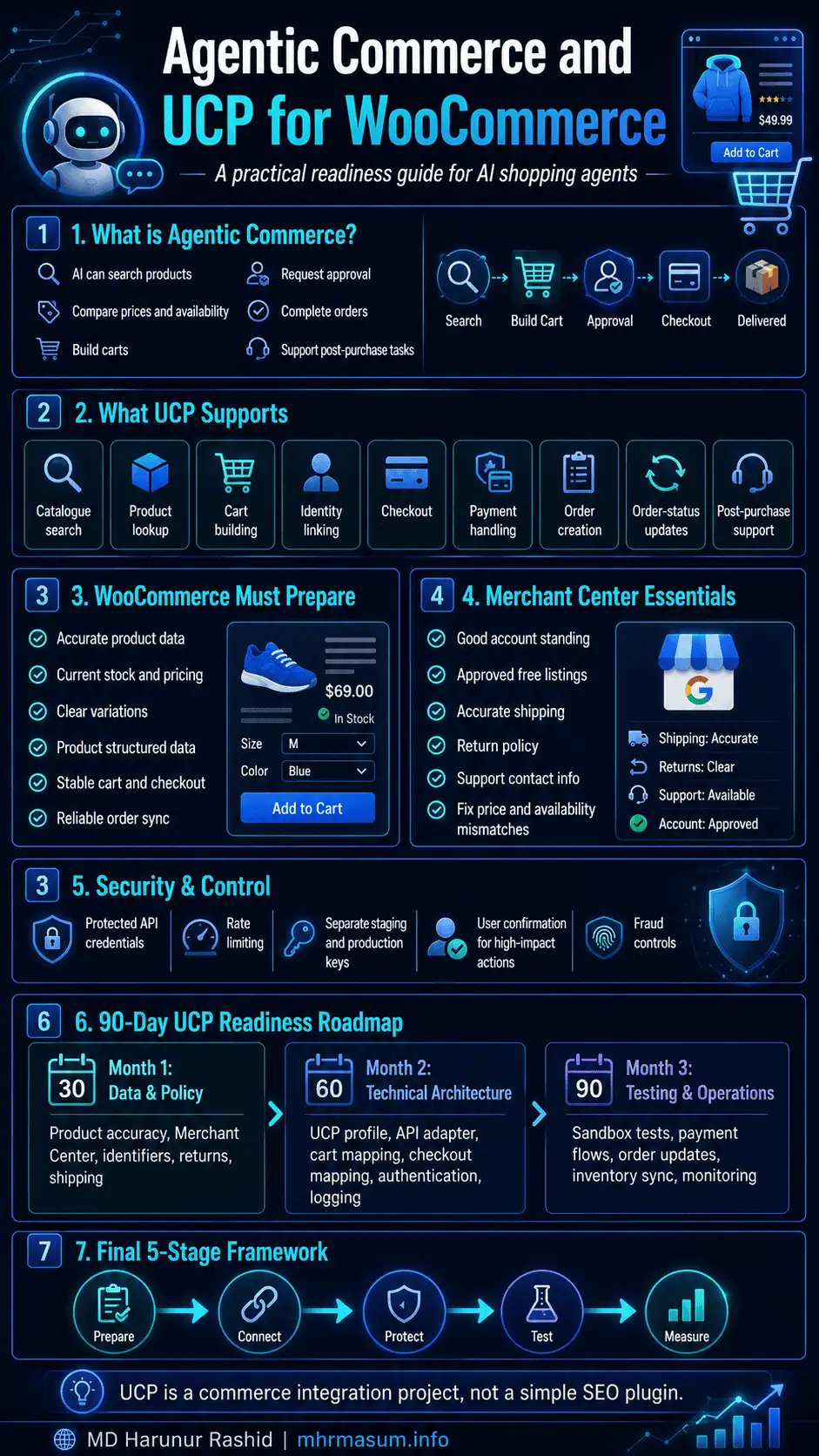
Final Agentic Commerce Framework for WooCommerce
A practical WooCommerce Agentic Commerce strategy can be summarised in five stages.
Prepare
Clean product data, identifiers, variations, inventory, shipping, returns and Merchant Center.
Connect
Build or adopt a secure integration layer that maps UCP capabilities to WooCommerce.
Protect
Use authentication, payment tokenisation, user confirmation, fraud controls, idempotency and privacy safeguards.
Test
Validate products, checkout, failures, payments and order updates through sandbox and conformance testing.
Measure
Track technical performance, checkout completion, revenue, refunds, returns and customer outcomes.
Final Thoughts
Agentic Commerce represents a significant change in how products may be discovered and purchased.
The traditional model asks the customer to:
- Search
- Open several websites
- Compare products
- Select a variation
- Add to cart
- Enter checkout
- Choose delivery
- Enter payment
- Track the order
An agentic commerce journey can potentially coordinate many of those steps through one AI-guided interaction.
UCP provides an open technical framework for connecting agents, commerce platforms, merchants and payment systems across that journey.
For WooCommerce merchants, the opportunity is not simply to install an “AI commerce” badge.
The real work involves:
- Accurate product data
- Reliable inventory
- Clear variations
- Merchant Center eligibility
- Secure APIs
- Deterministic checkout
- Payment protection
- Order synchronisation
- Customer support
- Trustworthy brand information
UCP should therefore be viewed as an extension of strong eCommerce operations.
A store with inconsistent data, broken checkout or unreliable fulfilment will not become ready merely by publishing a protocol file.
A store with strong commerce foundations will be in a much better position to adopt UCP, ACP and future agentic standards as platform support matures.
For mhrmasum.info, this topic connects naturally with:
- Agentic SEO for AI agents
- AI SEO for Google AI Overviews, ChatGPT, Gemini and Perplexity
- Technical SEO for WordPress
- Entity SEO
- Multimodal SEO for AI Search
- Brand authority for AI search
For professional support with WooCommerce SEO, AI commerce readiness, Merchant Center, structured product data, custom WordPress integrations, Technical SEO and digital growth, explore my SEO and digital growth services or contact MD Harunur Rashid for a detailed consultation.