SEO has changed. In the past, many businesses focused mainly on keywords, backlinks, title tags, and meta descriptions. These things still matter, but modern search engines are much smarter now. Google, Bing, ChatGPT, Gemini, Perplexity, Copilot, and other AI-powered systems do not only look at words on a page. They try to understand meaning, context, relationships, reputation, expertise, and real-world identity.
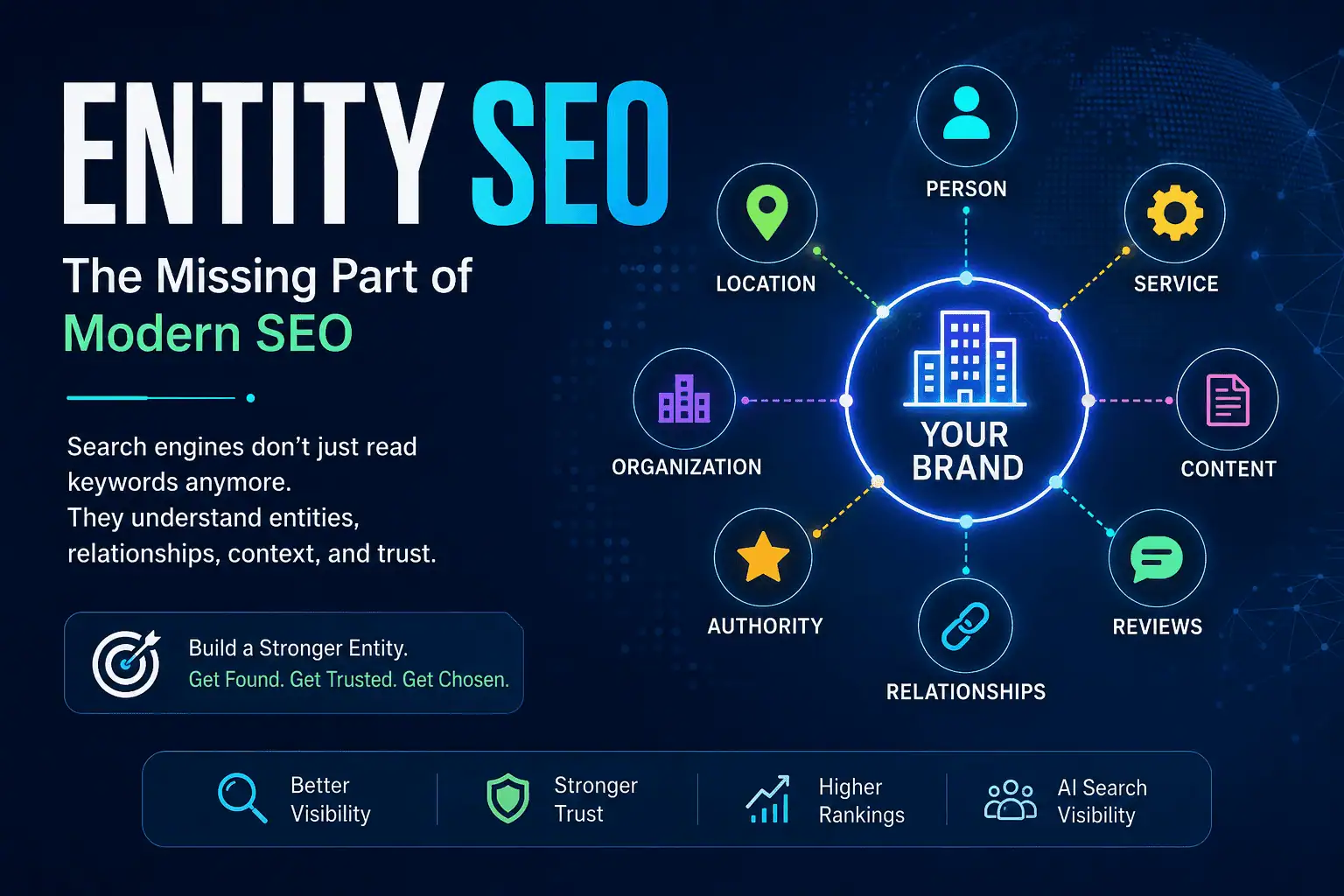
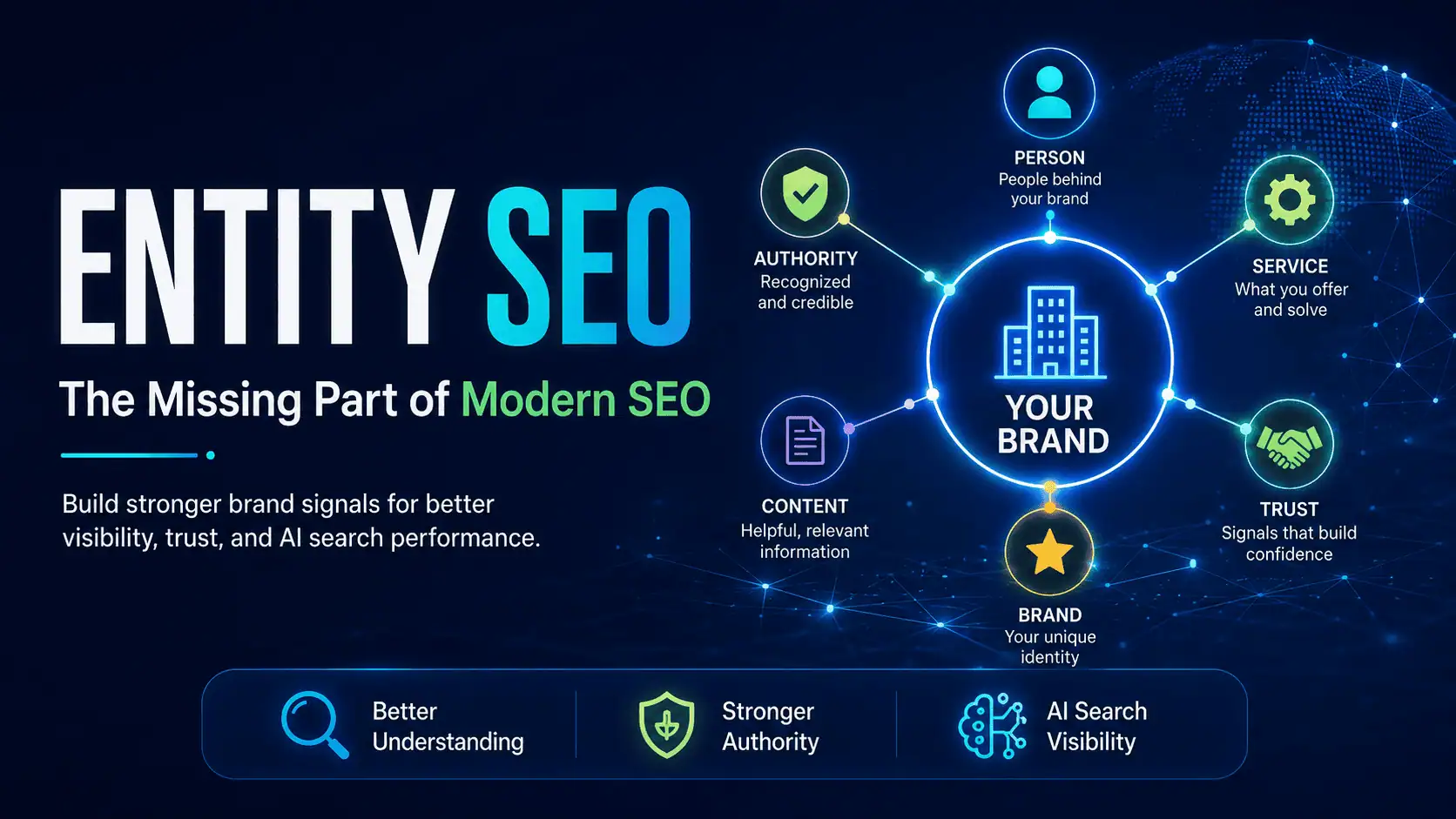
This is where Entity SEO becomes important.Entity SEO is the process of helping search engines and AI systems clearly understand who you are, what your business does, what topics you are connected to, where you operate, what services you provide, and why your brand should be trusted.In simple words, Entity SEO helps search engines understand your brand as a real thing, not just a website with keywords.
For example, “Apple” can mean a fruit or a technology company. “Amazon” can mean a river, rainforest, or eCommerce company. “Jaguar” can mean an animal or a car brand. Search engines use entity understanding to know which meaning is correct.
For businesses, consultants, service providers, local companies, bloggers, eCommerce stores, and personal brands, Entity SEO is now one of the most important parts of modern SEO.
Entity SEO is also closely connected with AI SEO, GEO, AEO, and traditional SEO. Modern search engines and AI platforms need to understand your brand, topics, services, authors, and trust signals before they can confidently rank, cite, or recommend your content.
If Google and AI search engines do not clearly understand your entity, they may not confidently rank, cite, recommend, or display your brand.
That is why Entity SEO is the missing part of modern SEO.
What Is Entity SEO?
Entity SEO is the process of optimizing your website, content, brand information, structured data, and online presence so search engines can understand your business, person, product, service, location, or topic as a distinct entity.
An entity is a specific thing that can be identified and understood.
An Entity Can Be:
- A person
- A company
- A brand
- A product
- A service
- A location
- A place
- An event
- A topic
- An organization
- A book
- A software
- A website
- A restaurant
- A hotel
- A local business
- A professional expert
Examples of Entities
- Mohammad Harunur Rashid is a person entity.
- mhrmasum.info is a website entity.
- Google Business Profile optimization is a service/topic entity.
- Dhaka is a location entity.
- Local SEO is a topic entity.
- Infosystem Technology Ltd is an organization entity.
Entity SEO connects these entities together in a clear and meaningful way.
For example, your website should help search engines understand that Mohammad Harunur Rashid is an SEO and Digital Marketing Consultant who works with Local SEO, Technical SEO, WordPress SEO, AI SEO, Google Business Profile optimization, schema markup, and business growth strategy.
This is why your About page, service pages, author bio, portfolio, blog posts, social profiles, reviews, and structured data should all support the same identity.
Entity SEO vs Traditional SEO
Traditional SEO and Entity SEO are connected, but they are not the same.
Traditional SEO focuses mostly on keywords, pages, rankings, links, and traffic.
Entity SEO focuses on meaning, identity, relationships, context, trust, and authority.
Traditional SEO Focuses On
- Keywords
- Search volume
- Meta titles
- Meta descriptions
- Backlinks
- On-page optimization
- Technical SEO
- Content optimization
- Website traffic
- Ranking positions
Entity SEO Focuses On
- Brand identity
- Topic relationships
- Person entities
- Organization entities
- Service entities
- Location entities
- Knowledge Graph signals
- Schema markup
- Author credibility
- Brand mentions
- SameAs profile connections
- Topical relevance
- Trust and reputation
- AI search visibility
Traditional SEO asks: How can this page rank for this keyword?
Entity SEO asks: Does Google clearly understand who this brand is, what it does, what it is known for, and why it should be trusted?
Both are important. But in modern SEO, keywords without entity clarity are not enough.
Why Entity SEO Is Important in 2026 and Beyond
Search engines are moving from keyword matching to meaning understanding.
When someone searches online, Google does not only match exact words. It tries to understand the user’s intent, the topic, related entities, location, brand trust, and the best answer.
AI search makes this even more important.
When users ask AI tools for recommendations, comparisons, summaries, or explanations, AI systems need trusted sources and clear entities.
Example AI Search Questions
- Who is a reliable Local SEO consultant for small businesses?
- What is the best SEO strategy for local businesses in 2026?
- Which agency provides WordPress SEO and Google Business Profile optimization?
- What is Entity SEO and why does it matter?
- Which consultant understands AI SEO, Local SEO, and Technical SEO?
To answer these questions, AI systems need to understand people, brands, services, locations, and topic relationships.
If your brand is not clearly connected to your expertise, AI systems may ignore you.
Entity SEO Helps You:
- Improve search engine understanding
- Build stronger topical authority
- Strengthen brand authority
- Support AI search visibility
- Improve Knowledge Graph signals
- Improve local SEO relevance
- Improve author credibility
- Make schema markup more meaningful
- Build trust across the web
- Increase your chance of being cited or mentioned by AI tools
If you want stronger visibility in AI-powered search results, you also need to build brand authority for AI search. Entity SEO helps define who you are, while brand authority helps prove why your business deserves trust.
How Search Engines Understand Entities
Search engines understand entities by collecting and connecting information from many sources.
Important Entity Signal Sources
- Your website
- Your homepage
- Your About page
- Your author bio
- Your service pages
- Your blog content
- Your schema markup
- Your Google Business Profile
- Your social profiles
- Your business citations
- Your backlinks
- Your brand mentions
- Your reviews
- Your images and videos
- Your press mentions
- Your directory listings
- Your guest posts
- Your client websites
- Your third-party profiles
- Your content topics
- Your internal links
Search engines look for consistency.
If your brand appears one way on your website, another way on LinkedIn, another way on Google Business Profile, and another way in directories, it becomes harder to understand.
But if your information is consistent everywhere, your entity becomes stronger.
Your Brand Details Should Be Consistent Across the Web
- Name
- Website URL
- Logo
- Phone number
- Address
- Founder name
- Service categories
- Business description
- Social profiles
- Service areas
- Brand positioning
Entity SEO is about making these signals clear and connected.
The Core Elements of Entity SEO
Entity SEO has several important parts. To build strong entity authority, you need to optimize each one.
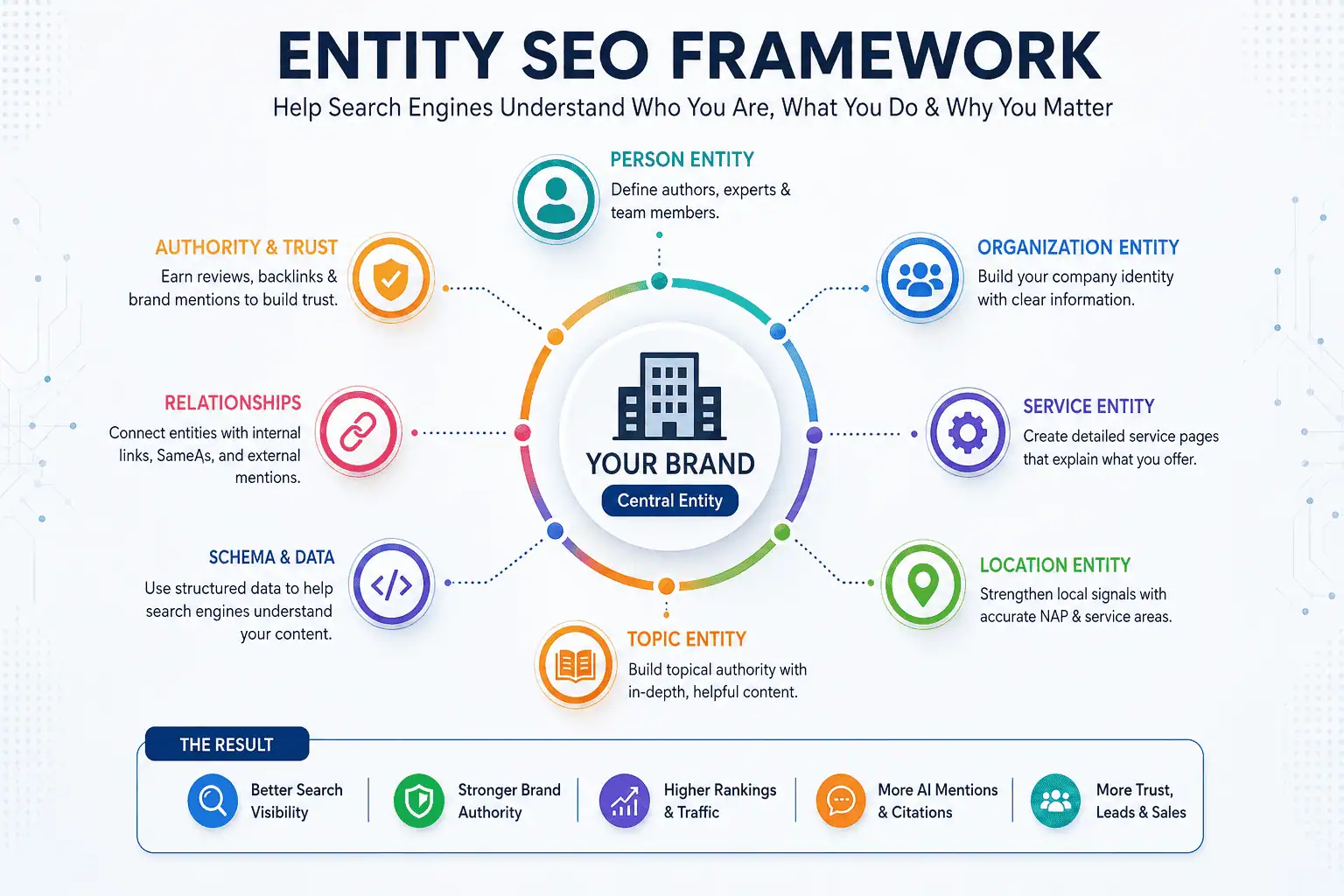
1. Brand Entity
Your brand entity is the core identity of your business or personal brand.
Your Brand Entity Should Answer:
- What is your brand name?
- What does your brand do?
- Who owns or represents the brand?
- What services does the brand offer?
- What topics is the brand known for?
- Where does the brand operate?
- Who does the brand help?
- Why should people trust the brand?
For a business, the brand entity may be the company. For a consultant, the brand entity may be the person.
A strong brand entity should be supported by clear SEO and digital marketing services, portfolio proof, About page content, reviews, and consistent profiles.
2. Person Entity
If your website is connected to a consultant, expert, founder, doctor, lawyer, accountant, trainer, coach, or writer, the person entity is very important.
A Strong Person Entity Should Include:
- Full name
- Professional title
- Photo
- Bio
- Experience
- Areas of expertise
- Website URL
- LinkedIn profile
- Social profiles
- Author page
- Published articles
- Portfolio
- Client examples
- Credentials
- Person schema markup
For personal brand Entity SEO, your About page is one of the most important trust assets. A detailed About page helps search engines and AI systems understand your experience, expertise, services, background, and professional identity.
3. Organization Entity
An organization entity represents a company, agency, brand, institution, or business.
A Strong Organization Entity Should Include:
- Business name
- Logo
- Website
- Contact details
- Address if applicable
- Founder or team details
- Service areas
- Social profiles
- Business description
- Categories
- Reviews
- Case studies
- Awards
- Press mentions
- Organization schema
4. Service Entity
A service entity explains what you offer.
Examples of Service Entities
- Local SEO services
- Google Business Profile optimization
- WordPress SEO
- Technical SEO audit
- Schema markup service
- AI SEO consulting
- Web design
- Digital marketing strategy
- Speed optimization
- Content marketing
Each important service should have a dedicated service page. This helps search engines understand your service relationships and connect your brand with relevant user queries.
Technical SEO also supports Entity SEO because search engines must be able to crawl, index, and understand your website properly. This is why technical SEO and keyword research are important parts of a complete entity-based SEO strategy.
5. Location Entity
For local businesses, location is a major entity signal.
Location Entities Include:
- Country
- City
- Region
- Suburb
- Neighborhood
- Service area
- Physical address
- Office location
- Business coverage area
For small businesses, Entity SEO should also connect with a strong Local SEO strategy. Your business name, service area, reviews, Google Business Profile, citations, and website content should all support the same local entity signals.
6. Topic Entity
Topic entities are the subjects your brand is connected to.
For an SEO Consultant, Topic Entities May Include:
- SEO
- Local SEO
- AI SEO
- Entity SEO
- Technical SEO
- WordPress SEO
- Google Business Profile
- Schema markup
- AEO
- GEO
- Digital marketing
- Content strategy
- Link building
- Core Web Vitals
- Search visibility
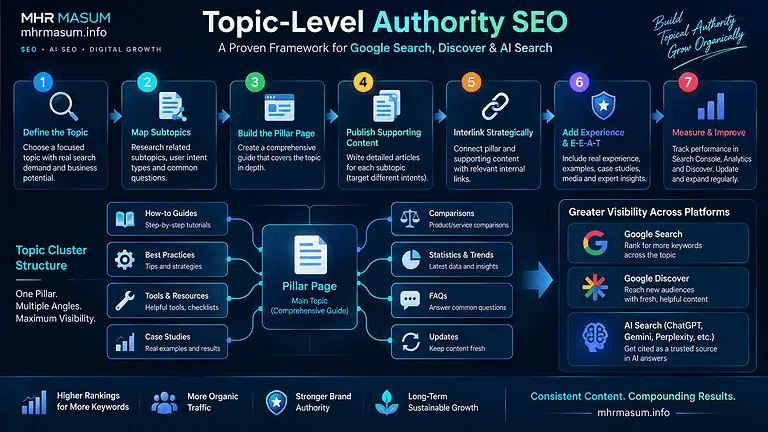
Your website should build topic clusters around these topics. When you cover related topics deeply and consistently, your topical entity authority grows.
Entity SEO and Google Knowledge Graph
The Google Knowledge Graph is a system that helps Google understand entities and their relationships. It helps Google understand people, places, organizations, facts, topics, and connections.
Google May Understand Relationships Like:
- A person works for a company
- A company has a website
- A brand has a logo
- A business has a location
- A service belongs to a business
- An author writes articles
- A topic is related to another topic
- A business has reviews
- A brand has social profiles
Entity SEO helps provide clearer signals for this kind of understanding.
You do not need a visible Knowledge Panel to benefit from Entity SEO. Even without a Knowledge Panel, better entity clarity can help search engines understand your website and brand more accurately.
Entity SEO and AI Search
AI search depends heavily on entity understanding.
AI tools need to understand who is being discussed, what the topic means, which source is trustworthy, which brand is relevant, which service matches the query, which location matters, and which content should be cited.
For example, if someone asks, “Who is an expert in Local SEO and AI SEO?”, an AI system may look for person profiles, author pages, website content, service pages, social profiles, brand mentions, reviews, schema markup, topic clusters, and third-party citations.
If your entity signals are weak, AI systems may not confidently mention your brand.
Entity SEO supports AI visibility by making your identity and expertise clearer.
If you are building a modern SEO strategy, read this guide on AI SEO and how to rank in Google AI Overviews, ChatGPT, Gemini, and Perplexity. It explains how AI search visibility connects with technical SEO, structured content, entity trust, and brand authority.
Entity SEO, AEO, and GEO
Entity SEO is closely connected to AEO and GEO.
Entity SEO
Entity SEO helps search engines understand your brand, services, topics, people, and locations.
AEO
AEO, or Answer Engine Optimization, helps your content become the direct answer to user questions.
GEO
GEO, or Generative Engine Optimization, helps your content and brand appear inside AI-generated answers.
Entity SEO supports both AEO and GEO. If AI systems clearly understand your entity, they are more likely to use your content in answers, citations, summaries, and recommendations.
For a deeper comparison, read GEO vs AEO vs SEO: What Is the Difference?. That article explains how ranking, answering, and AI-generated visibility work together in modern SEO.
A Strong Modern SEO Strategy Should Include:
- SEO for rankings
- AEO for direct answers
- GEO for AI-generated visibility
- Entity SEO for identity, context, and trust
- Brand authority for AI search recommendations
Why Keywords Alone Are Not Enough
Keywords are still useful, but keywords alone do not explain meaning, trust, or relationships.
For example, two websites may both target the keyword “Local SEO consultant.”
One website may have a clear author bio, strong About page, detailed service pages, case studies, Google Business Profile, reviews, schema markup, LinkedIn profile, client mentions, topic clusters, and brand consistency.
The other website may only have a generic landing page with repeated keywords.
The first website has stronger entity signals.
Modern Search Engines Need More Than Keyword Repetition
- Context
- Identity
- Authority
- Relevance
- Trust
- Relationships
- Proof
Entity SEO provides these signals.
Entity SEO and E-E-A-T
E-E-A-T stands for Experience, Expertise, Authoritativeness, and Trustworthiness.
Entity SEO supports E-E-A-T because it helps search engines identify who is behind the content and why they should be trusted.
Experience
Show real experience through:
- Case studies
- Client results
- Screenshots
- Real examples
- Portfolio
- First-hand insights
- Before-and-after results
Proof of work is another important entity signal. My SEO portfolio includes Local SEO, Technical SEO, GMB optimization, WordPress design, speed optimization, and growth-focused SEO projects.
Expertise
Show expertise through:
- Author bio
- Professional credentials
- Detailed guides
- Service pages
- Topic clusters
- Videos
- Tutorials
- Speaking or publication history
Authoritativeness
Show authority through:
- Backlinks
- Brand mentions
- Reviews
- Guest posts
- Media mentions
- Industry profiles
- Awards
- Client references
Trustworthiness
Show trust through:
- Contact details
- Privacy policy
- Terms page
- About page
- Reviews
- Clear business information
- Secure website
- Honest content
- Transparent service descriptions
Entity SEO is also supported by better user experience. That is why HEO, or Human Experience Optimization, is becoming more important for SEO, AI search, trust, engagement, and conversions.
“`
Entity SEO and Schema Markup
Schema markup is one of the most important technical tools for Entity SEO.
Schema markup helps search engines understand the entities on your website.
Common Schema Types for Entity SEO
- Organization
- Person
- LocalBusiness
- ProfessionalService
- WebSite
- WebPage
- Article
- BlogPosting
- Service
- FAQPage
- BreadcrumbList
- Review
- Product
- VideoObject
- ProfilePage
Schema does not replace content. It supports content by making important information machine-readable.
Organization Schema
Organization schema helps define a company or brand.
It Can Include:
- Name
- URL
- Logo
- Contact details
- Social profiles
- Founder
- Address
- SameAs links
- Description
Person Schema
Person schema helps define an individual expert or author.
It Can Include:
- Name
- Job title
- Image
- URL
- SameAs links
- WorksFor
- KnowsAbout
- AlumniOf
- Description
LocalBusiness Schema
LocalBusiness schema helps define a local business.
It Can Include:
- Business name
- Address
- Phone number
- Opening hours
- Geo coordinates
- Service area
- Business type
- Website
- Reviews where valid
- Price range
- Image
- Logo
Article Schema
Article or BlogPosting schema helps define blog content.
It Can Include:
- Headline
- Author
- Date published
- Date modified
- Image
- Publisher
- Main entity of page
- Description
Service Schema
Service schema helps define a service.
It Can Include:
- Service name
- Provider
- Area served
- Description
- Service type
- Offers where relevant
Entity SEO can also connect with product authority. The MHR Product Showcase includes WordPress plugins, SEO tools, reporting systems, and business automation solutions that support the broader MHR brand entity.
Entity SEO and Internal Linking
“`
Internal linking is not only for crawling. It also helps connect entities and topics.
For example, this Entity SEO article should internally connect with related pages about AI SEO, GEO, AEO, Local SEO, Technical SEO, brand authority, portfolio proof, and services.
Good Internal Links Help Search Engines Understand:
- Which topics are related
- Which pages are most important
- Which services your brand provides
- Which content supports your expertise
- Which portfolio items prove your experience
- Which pages should users visit next
Best Internal Link Anchor Examples
- AI SEO
- GEO vs AEO vs SEO
- brand authority for AI search
- Local SEO in 2026
- SEO and digital marketing services
- SEO portfolio
- contact page
Use descriptive anchor text. Avoid generic anchor text like “click here” or “read more” when a more meaningful anchor can be used.
Entity SEO and Topical Authority
Topical authority means your website is deeply connected to a subject.
Entity SEO and topical authority work together.
If your brand wants to be known for SEO, you should publish detailed content around related entities and topics.
AI SEO Cluster
- AI SEO: How to Rank in Google AI Overviews, ChatGPT, Gemini and Perplexity
- GEO vs AEO vs SEO: What Is the Difference?
- How to Build Brand Authority for AI Search
- Entity SEO for AI Search
- How to Optimize for ChatGPT Search
- How to Get Cited by AI Search Engines
Local SEO Cluster
- Local SEO in 2026: Complete Guide for Small Businesses
- Google Business Profile optimization
- Local citation building
- LocalBusiness schema
- Review strategy
- Google Maps SEO
- Service-area business SEO
Technical SEO Cluster
- Technical SEO and keyword research
- Website speed optimization
- Crawlability and indexing
- Core Web Vitals
- Schema markup guide
- Canonical tag guide
- Internal linking strategy
Each article strengthens the topic entity and supports the main brand entity.
Entity SEO for Local Businesses
Entity SEO is very important for local businesses.
A local business needs to be understood as a real business in a real location serving real customers.
For Local Entity SEO, Optimize:
- Google Business Profile
- Name, address, and phone number
- Website URL
- Business categories
- Reviews
- Service areas
- Photos
- Opening hours
- Local citations
- LocalBusiness schema
- Location pages
- Service pages
- Local backlinks
- Local content
- Social profiles
- Directory profiles
For local business entity signals, check this Local SEO portfolio example. It shows how Google Business Profile, citations, reviews, service pages, local content, and trust signals work together to improve local visibility.
Case studies are powerful entity proof. For example, this roofing Local SEO case study shows how local relevance, Google Business Profile optimization, citations, and service-page targeting can improve visibility for a service-area business.
Another example is this pest control GMB and Local SEO case study, where Google Business Profile optimization, review strategy, and suburb-specific targeting helped strengthen local search visibility.
Entity SEO for Personal Brands
Entity SEO is especially powerful for personal brands.
This Applies To:
- SEO consultants
- Digital marketers
- Lawyers
- Accountants
- Doctors
- Coaches
- Trainers
- Authors
- Speakers
- Business consultants
- WordPress experts
- Financial advisors
- Real estate consultants
To Build a Strong Personal Entity, Create:
- Personal homepage
- About page
- Author page
- Professional bio
- Portfolio
- Case studies
- Social profiles
- LinkedIn profile
- YouTube channel
- Guest posts
- Interviews
- Testimonials
- Person schema
- SameAs links
Your name should be consistently connected to your expertise.
For example, “Mohammad Harunur Rashid” should be connected to SEO consultant, digital marketing consultant, Local SEO expert, WordPress SEO expert, Technical SEO consultant, AI SEO strategist, Google Business Profile optimization, and business growth strategy.
This makes the personal brand entity stronger.
Entity SEO for Business Websites
A business website should not only sell services. It should clearly define the business entity.
Homepage
Your homepage should clearly explain:
- Who you are
- What you do
- Who you help
- Where you operate
- Your main services
- Your trust signals
- Your CTA
About Page
Your About page should explain:
- Brand story
- Founder or team
- Experience
- Mission
- Services
- Industries
- Credentials
- Social profiles
- Contact details
Service Pages
Each service page should explain:
- Service name
- Service purpose
- Benefits
- Process
- Target audience
- FAQs
- CTA
- Related services
Contact Page
Your contact page should show:
- Phone number
- Address if applicable
- Service area
- Map if relevant
- Contact form
- Business hours
- Social links
If you need help improving your brand entity, website structure, schema, internal links, technical SEO, or AI search visibility, you can contact me here for a consultation.
How to Build Entity SEO Step by Step
Step 1: Define Your Main Entity
Start by defining your main entity.
Ask These Questions:
- Is the main entity a person, company, product, or service?
- What is the exact name?
- What is the official website?
- What is the main description?
- What topics should it be connected to?
- What locations should it be connected to?
- What proof supports the entity?
Step 2: Build a Strong About Page
Your About page should be one of the strongest entity pages on your website.
Include full brand or person name, professional title, experience, services, industries, service areas, achievements, portfolio, testimonials, social links, and contact details.
Step 3: Create Author Pages
If your website publishes articles, create author pages.
An Author Page Should Include:
- Author name
- Photo
- Job title
- Bio
- Expertise
- Social links
- Articles written
- Contact or profile link
- Person schema
Step 4: Add Structured Data
Add schema markup to important pages.
- Organization schema for company
- Person schema for personal brand
- LocalBusiness schema for local business
- Article schema for blog posts
- Service schema for service pages
- FAQPage schema for FAQs
- BreadcrumbList schema for navigation
Step 5: Connect Official Profiles
Use sameAs links in schema and link to official profiles from your website.
- YouTube
- X/Twitter
- Google Business Profile
- Business directories
- Professional profiles
Step 6: Create Topic Clusters
Choose your main topics and create supporting content around them.
For example, Entity SEO should connect with AI SEO, AEO, GEO, Local SEO, Technical SEO, schema markup, brand authority, and content strategy.
Step 7: Strengthen Internal Links
Connect related pages with descriptive anchor text.
Internal links should guide users and search engines from blog posts to service pages, from guides to case studies, from portfolio examples to contact pages, and from supporting content to pillar pages.
Step 8: Build External Mentions
Your entity becomes stronger when other websites mention it.
Build Mentions Through:
- Guest posts
- Business directories
- Press releases
- Podcast interviews
- YouTube collaborations
- Client case studies
- Partner websites
- Industry roundups
- LinkedIn articles
- Local citations
- Review platforms
Step 9: Collect Reviews and Testimonials
Reviews help build trust and prove that your business is real, active, and useful.
Collect Reviews On:
- Google Business Profile
- Trustpilot
- Clutch
- Upwork
- Industry platforms
- Website testimonial section
Step 10: Monitor Entity Accuracy
Search your brand name on Google, Bing, ChatGPT, Gemini, Perplexity, and Copilot.
Check:
- Is your brand described correctly?
- Are your services accurate?
- Is your location correct?
- Are your social profiles connected?
- Are competitors being confused with your brand?
- Are old details showing?
- Are AI tools mentioning you correctly?
Entity SEO Checklist
Brand Entity Checklist
- Clear brand name
- Clear tagline
- Clear homepage positioning
- Detailed About page
- Accurate business description
- Consistent logo
- Contact details
- Service pages
- Social profiles
- Testimonials
- Case studies
- Brand mentions
Person Entity Checklist
- Full name
- Professional title
- Author bio
- Author page
- Professional photo
- Experience
- Expertise
- LinkedIn profile
- Website profile
- Published articles
- Person schema
- SameAs links
Organization Entity Checklist
- Company name
- Logo
- Website URL
- Business description
- Address if applicable
- Phone number
- Founder/team details
- Organization schema
- Social profiles
- Business listings
- Reviews
- Press mentions
Local Entity Checklist
- Google Business Profile
- Business address or service area
- LocalBusiness schema
- Consistent NAP
- Local citations
- Reviews
- Location pages
- Local content
- Local backlinks
- Service area details
- Business categories
Content Entity Checklist
- Topic clusters
- Clear headings
- Helpful definitions
- FAQ sections
- Internal links
- Article schema
- Author information
- Related entities
- Updated content
- Source-worthy explanations
Technical Entity Checklist
- Crawlable website
- Indexed pages
- Clean URL structure
- XML sitemap
- Robots.txt checked
- Canonical tags
- Schema validation
- Internal linking
- Fast loading speed
- Mobile-friendly design
- No duplicate entity confusion
Common Entity SEO Mistakes
Mistake 1: Using Inconsistent Brand Information
If your brand name, address, phone number, or description changes across platforms, search engines may get confused. Fix this by auditing all profiles and citations.
Mistake 2: No About Page
A weak or missing About page hurts entity clarity. Your About page should clearly define your brand, experience, services, and trust signals.
Mistake 3: Anonymous Content
If articles have no author information, expertise becomes harder to verify. Add author bios and author pages.
Mistake 4: Weak Schema Markup
Missing or incorrect schema can reduce machine understanding. Use accurate schema that matches visible content.
Mistake 5: No SameAs Connections
If your official profiles are not connected, search engines may not fully connect your entity. Add official social and profile links.
Mistake 6: Thin Service Pages
A service page with only a few lines of text does not explain the service entity well. Create detailed service pages with FAQs, benefits, process, and proof.
Mistake 7: No Topic Clusters
Publishing random blog posts does not build strong topical authority. Build organized clusters around your core expertise.
Mistake 8: Ignoring Reviews
Reviews are powerful entity trust signals, especially for local businesses. Collect and respond to genuine reviews.
Mistake 9: Duplicate or Confusing Entities
If your business has duplicate listings, old addresses, or multiple inconsistent names, search engines may struggle. Clean up duplicate profiles and outdated data.
Mistake 10: Thinking Entity SEO Is Only Schema
Schema is important, but Entity SEO is bigger than schema. It includes content, brand consistency, reviews, links, mentions, topical authority, and trust.
Entity SEO Strategy for AI Search
To prepare for AI search, your Entity SEO strategy should focus on clarity, trust, and source-worthiness.
Make Your Brand Easy to Understand
- Who you are
- What you do
- What you are expert in
- Who you serve
- Where you operate
- Why you are trustworthy
Make Your Content Easy to Cite
- Clear definitions
- Short explanations
- Bullet points
- FAQs
- Tables
- Examples
- Step-by-step guides
- Original insights
- Updated information
Make Your Expertise Easy to Verify
- Author bios
- Case studies
- Portfolio
- Reviews
- Testimonials
- Credentials
- Published work
- Social profiles
Make Your Entity Easy to Connect
- Schema markup
- Internal links
- SameAs links
- Consistent citations
- Official profiles
- Google Business Profile
- Social profiles
This helps AI search tools understand and trust your brand.
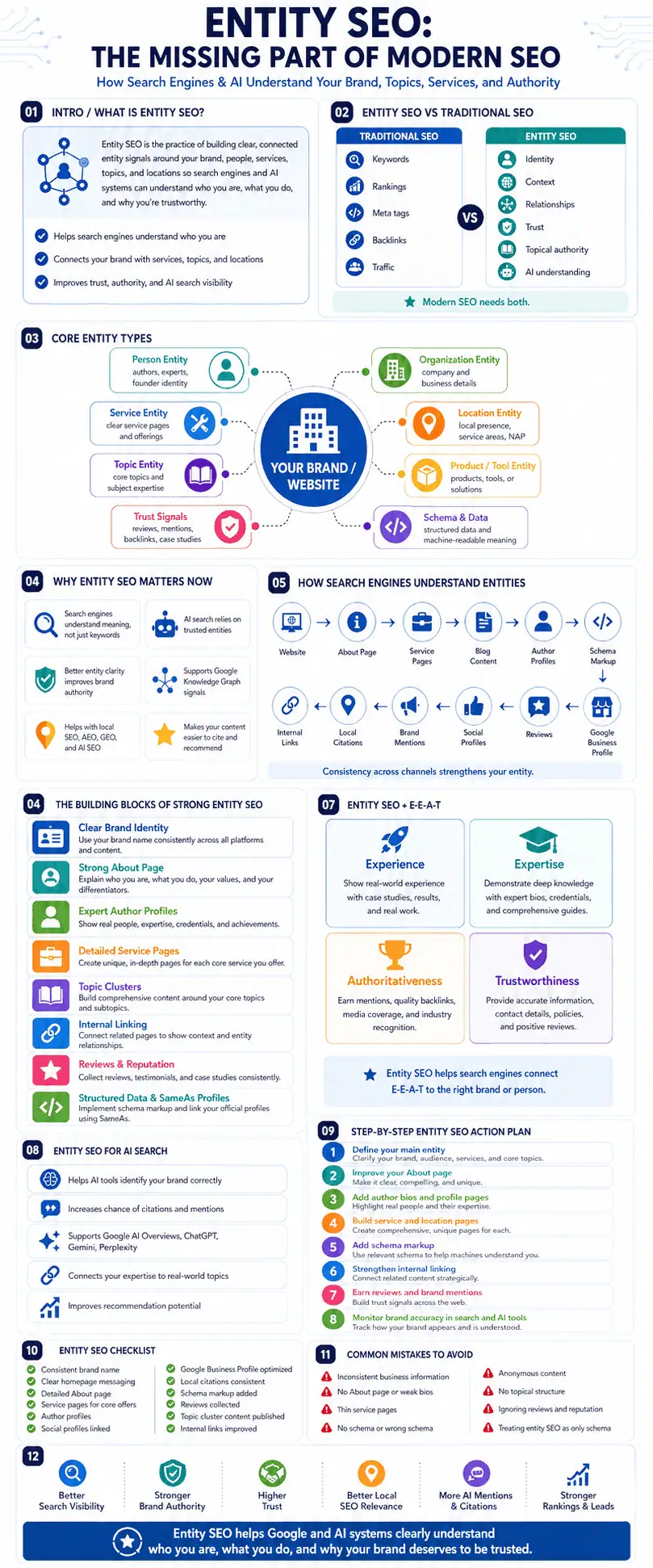
How to Measure Entity SEO Success
Entity SEO is harder to measure than simple keyword rankings, but you can track several signals.
Track These Signals:
- Branded search volume
- Google Search Console impressions
- Brand name rankings
- Knowledge Panel appearance
- Google Business Profile visibility
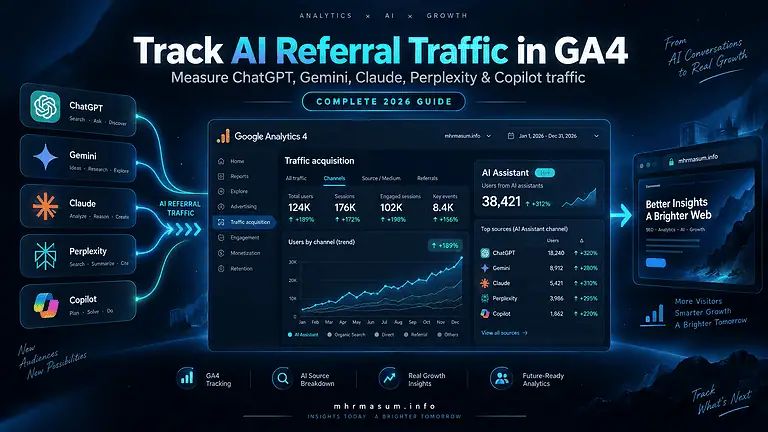
- AI mentions
- Featured snippets
- Organic traffic
- Direct traffic
- Referral traffic
- Backlinks
- Brand mentions
- Review growth
- Local rankings
- Author visibility
- Social profile visibility
- Citation consistency
- Rich result eligibility
- Search result accuracy
You can also manually test AI tools. Search your name, brand, services, and topic areas in ChatGPT, Gemini, Perplexity, Copilot, Google Search, and Bing.
90-Day Entity SEO Action Plan
Entity SEO works best when it is implemented step by step. This 90-day action plan will help you audit your current brand signals, improve your website structure, add schema markup, strengthen author and business profiles, build topic clusters, earn reviews, and monitor how your brand appears in Google and AI search results.
Days 1–15: Entity Audit
- Audit your brand name
- Check Google search results for your brand
- Review your About page
- Review author bios
- Check business citations
- Check social profiles
- Check Google Business Profile
- Check schema markup
- Find inconsistent business information
- Identify duplicate profiles
Days 16–30: Website Entity Optimization
- Improve homepage messaging
- Rewrite About page
- Add author profile
- Improve service pages
- Add contact details
- Add testimonials
- Add internal links
- Add schema markup
- Add sameAs links
- Update footer business information
Days 31–45: Content Entity Building
- Create topic clusters
- Publish detailed guide content
- Add FAQs
- Add definitions
- Add related internal links
- Improve old posts
- Add author information
- Add case studies
- Add clear CTAs
Days 46–60: Local and External Entity Signals
- Update Google Business Profile
- Fix citations
- Add business to trusted directories
- Request reviews
- Publish guest posts
- Build partner mentions
- Update social profiles
- Add LinkedIn articles
- Create YouTube content if relevant
Days 61–90: Authority and AI Visibility
- Monitor branded searches
- Test AI search prompts
- Track mentions
- Build backlinks
- Publish case studies
- Refresh old content
- Improve schema
- Add more sameAs links
- Track Google Search Console data
- Plan the next topic cluster
FAQs About Entity SEO
Entity SEO can feel technical at first, but the idea is simple: search engines need to clearly understand who you are, what you do, what topics you are connected with, and why your brand should be trusted. These FAQs explain the most important parts of Entity SEO in a simple and practical way.
What is Entity SEO?
Entity SEO is the process of optimizing your website and online presence so search engines can clearly understand your brand, person, business, services, locations, and topics as distinct entities.
Why is Entity SEO important?
Entity SEO is important because modern search engines and AI systems do not only match keywords. They try to understand meaning, identity, relationships, authority, and trust.
Is Entity SEO the same as semantic SEO?
They are related. Semantic SEO focuses on meaning and topic relationships. Entity SEO focuses on identifiable people, brands, places, services, and organizations. Both work together.
Does schema markup help Entity SEO?
Yes. Schema markup helps search engines understand entities on your website. However, schema must be supported by visible content and consistent online signals.
What is a brand entity?
A brand entity is your business or personal brand as understood by search engines. It includes your name, website, services, reputation, profiles, mentions, and related topics.
What is a person entity?
A person entity is an identifiable individual, such as an author, consultant, founder, doctor, lawyer, coach, or expert. Person schema, author pages, bios, and social profiles help strengthen person entities.
What is an organization entity?
An organization entity is a company, agency, institution, or business. Organization schema, About page, logo, contact details, reviews, and external profiles help define it.
Is Entity SEO important for Local SEO?
Yes. Local SEO depends heavily on business, service, and location entities. Google needs to understand what your business does, where it operates, and why it is trustworthy.
Can Entity SEO help AI search visibility?
Yes. AI search systems need clear and trusted entities to generate answers, citations, recommendations, and summaries. Entity SEO helps make your brand easier to understand and trust.
How long does Entity SEO take?
Entity SEO is a long-term process. You may improve clarity quickly through schema, About page updates, and profile consistency, but stronger authority usually takes months of content, mentions, reviews, and trust-building.
Need Help Building Stronger Entity SEO?
Entity SEO is not only about adding schema markup. It is about helping Google, AI search engines, and real customers clearly understand who you are, what you do, where you operate, and why your brand should be trusted.
If you want to improve your entity signals, internal linking, schema markup, technical SEO, AI search visibility, and brand authority, explore my SEO services or book a consultation.
Conclusion
Entity SEO is one of the most important parts of modern SEO.
Keywords, backlinks, and technical SEO still matter. But search engines and AI systems now need more than keywords. They need to understand meaning, identity, relationships, authority, and trust.
Entity SEO helps your brand become clearer.
It Helps Search Engines Understand:
- Who you are
- What you do
- What you are known for
- Where you operate
- What services you provide
- What topics you are expert in
- Why users should trust you
For businesses, consultants, local companies, bloggers, and personal brands, Entity SEO is no longer optional.
It supports traditional SEO, Local SEO, AI SEO, AEO, GEO, brand authority, Knowledge Graph visibility, and AI search visibility.
The future of SEO is not only about ranking pages. It is about building trusted entities.
If you want stronger long-term search visibility, start building your entity today. Clarify your brand, strengthen your About page, improve author profiles, add schema markup, build topic clusters, earn reviews, get mentioned on trusted websites, and keep your information consistent across the web.
Modern SEO belongs to brands that search engines and AI systems can clearly understand and confidently trust.