Why Local SEO Matters More Than Ever in 2026
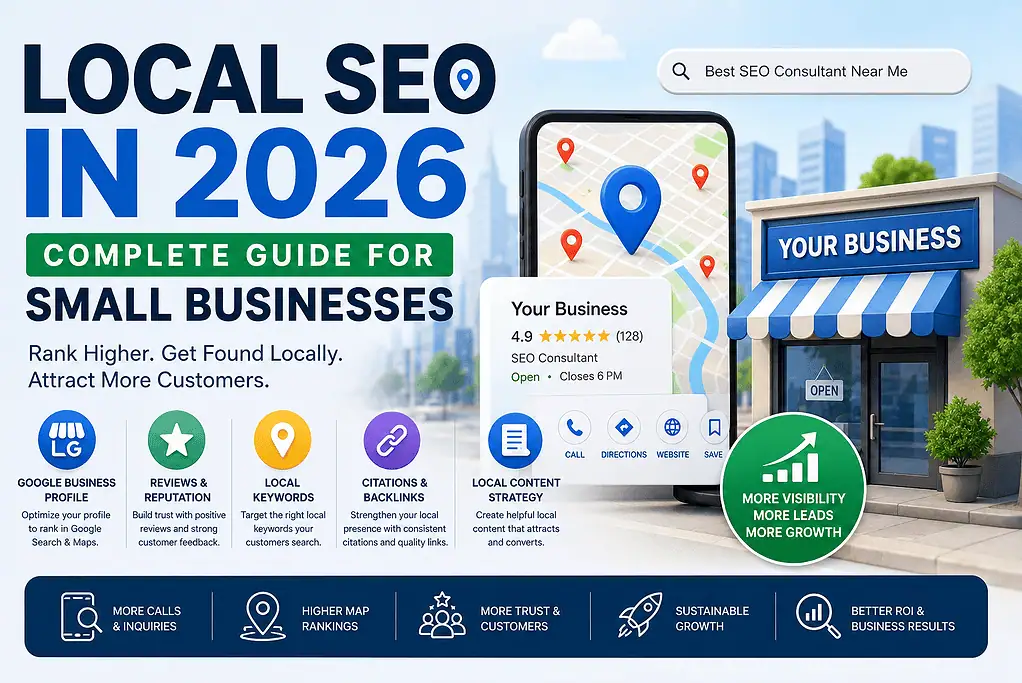
Local SEO is one of the most important digital marketing strategies for small businesses in 2026.
When people need a nearby service, they usually search online first. They search for things like “roof repair near me,” “best dentist in my area,” “carpet cleaning in Brisbane,” “restaurant near me,” “SEO consultant near me,” “plumber open now,” or “best accounting firm for small business.”
These searches are high-intent searches. The customer is not just browsing. They are looking for a solution, a provider, a location, a price, a review, a phone number, a booking option, or a direction.
That is why Local SEO is powerful.
Local SEO helps your business appear in Google Search, Google Maps, local pack results, AI Overviews, voice search, and other location-based search experiences. It helps nearby customers find your business when they are ready to call, visit, book, or buy.
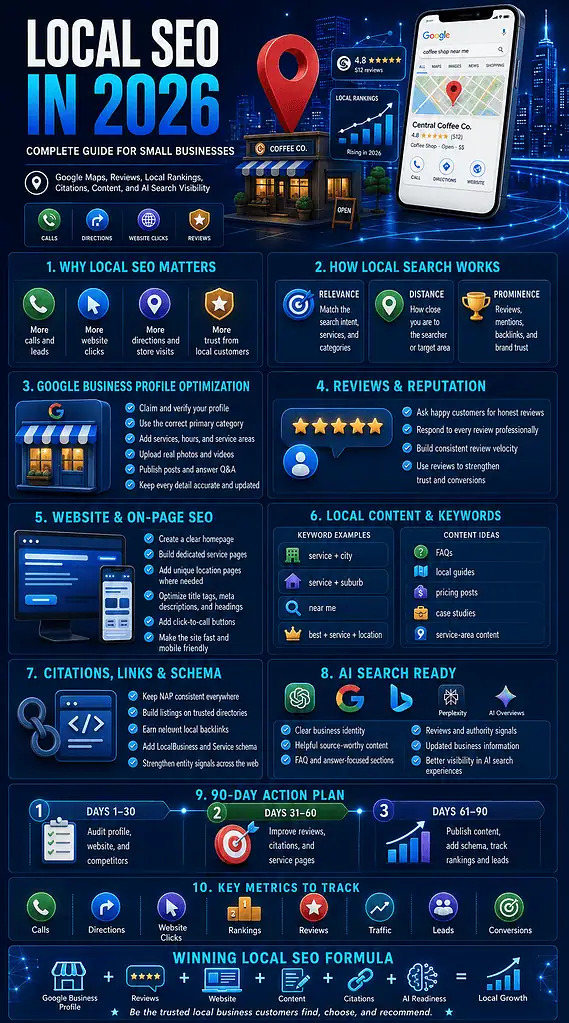
In 2026, Local SEO is no longer only about adding your business name to Google Maps. It is now a complete strategy that includes your Google Business Profile, website, reviews, local content, citations, backlinks, schema markup, user experience, brand authority, and AI search visibility.
Small businesses that invest in Local SEO can compete with bigger brands because local search is based on relevance, distance, prominence, trust, and customer experience.
If your business serves a specific city, suburb, neighborhood, region, or service area, Local SEO should be a core part of your marketing strategy.
What Is Local SEO?
Local SEO means optimizing your online presence so your business can appear in local search results when people search for products or services near a specific location.
It helps your business show up for searches like:
- “SEO consultant in Dhaka”
- “best pest control company in Sydney”
- “carpet cleaner near me”
- “roof restoration Brisbane”
- “tax consultant for small business”
- “restaurant open now”
- “emergency plumber near me”
- “digital marketing agency near me”
- “WordPress expert in Bangladesh”
- “local electrician in Melbourne”
Local SEO focuses on helping search engines understand:
- What your business does
- Where your business is located
- Which areas you serve
- What services you provide
- Whether your business is trustworthy
- What customers say about you
- Whether your website supports your business profile
- Whether your business information is consistent across the web
The goal is simple: make your business easier to find for nearby customers.
How Local SEO Is Different from Traditional SEO
Traditional SEO focuses on improving website visibility in organic search results.
Local SEO focuses on improving visibility in location-based search results.
For example, traditional SEO may target a keyword like:
- “how to improve website speed”
- “best SEO tools”
- “what is technical SEO”
Local SEO targets keywords like:
- “technical SEO consultant near me”
- “SEO expert in Dhaka”
- “local SEO services Australia”
- “WordPress SEO consultant for small businesses”
The biggest difference is local intent.
A local search usually includes:
- A city name
- A suburb name
- “Near me”
- “Open now”
- “Best”
- “Nearby”
- A service + location
- A business category + location
Local SEO also depends strongly on your Google Business Profile, customer reviews, map visibility, business categories, local citations, and proximity to the searcher.
Why Local SEO Is Important for Small Businesses
Small businesses need Local SEO because customers often prefer nearby, trusted, and easily accessible providers.
Local SEO can help your business:
- Get more phone calls
- Get more website visits
- Get more direction requests
- Get more bookings
- Get more store visits
- Build trust through reviews
- Compete with larger companies
- Increase brand visibility
- Appear in Google Maps
- Appear in local pack results
- Improve AI search visibility
- Generate more qualified leads
- Reduce dependency on paid ads
- Build long-term organic growth
For a small business, Local SEO is not only about traffic. It is about leads, calls, visits, bookings, and real customers.
A well-optimized local business can receive leads every day from Google Search and Maps without paying for every click.
How Local Search Works in 2026
Local search works by matching a user’s query with businesses that are relevant, nearby, and trustworthy.
When someone searches for a local service, Google may show:
- Google Maps results
- Local pack results
- Organic search results
- Business Profile results
- Reviews
- Photos
- Business hours
- Direction buttons
- Call buttons
- Website links
- Service details
- AI-generated answers
- People Also Ask results
- Local business knowledge panels
For example, if someone searches “best carpet cleaner near me,” Google may consider:
- Searcher’s location
- Business location
- Business category
- Services listed
- Website content
- Review quality
- Review quantity
- Business hours
- Photos
- Local citations
- Backlinks
- User behavior
- Profile completeness
- Relevance of the business to the query
Local SEO helps improve these signals.
The Three Main Local Ranking Factors
Google’s local ranking system is commonly explained through three core factors:
1. Relevance
Relevance means how well your business matches what the user is searching for.
If someone searches “emergency plumber,” Google wants to show businesses that clearly provide emergency plumbing services.
To improve relevance, you need:
- Correct Google Business Profile category
- Detailed business description
- Accurate service list
- Relevant website content
- Service pages
- Location pages
- FAQ content
- LocalBusiness schema
- Clear headings and page titles
- Consistent business information
If your profile and website do not clearly explain your services, Google may not understand when to show your business.
2. Distance
Distance means how close your business is to the searcher or to the location mentioned in the search.
For example, if someone searches “dentist near me,” Google may prioritize nearby dental clinics.
For service-area businesses, distance can still matter based on your business base and service areas.
You cannot fully control distance, but you can improve location clarity by:
- Adding accurate business address
- Setting correct service areas
- Creating location-specific pages
- Adding local content
- Building local citations
- Using embedded maps where appropriate
- Making your contact details clear
3. Prominence
Prominence means how well-known and trusted your business appears online.
Prominence can be influenced by:
- Reviews
- Ratings
- Backlinks
- Brand mentions
- Local citations
- Website authority
- Content quality
- Directory listings
- News mentions
- Social profiles
- Offline reputation
- Customer engagement
A business with many genuine reviews, strong local mentions, and a trusted website may perform better than a business with weak reputation signals.
Local SEO in 2026: What Has Changed?
Local SEO in 2026 is more competitive than before.
Small businesses now need to think beyond basic map listing optimization. The search environment includes traditional search, AI search, voice search, mobile search, map search, and review-driven decision-making.
Important changes include:
- AI-powered search results are becoming more common
- Users expect fast and direct answers
- Reviews influence trust more than ever
- Google Business Profile completeness matters
- Local content must be useful, not generic
- Service pages need stronger detail
- Brand authority affects search visibility
- Schema markup supports machine understanding
- Mobile experience is critical
- Fake review tactics are risky
- Businesses need consistent information across the web
- Local SEO and AI SEO are becoming connected
In 2026, Local SEO is not only about ranking. It is about being selected.
People compare reviews, photos, services, prices, availability, and trust signals before contacting a business.
Local SEO and AI Search in 2026
AI search is changing how people find local businesses.
Users may now ask AI tools questions like:
- “Who is the best SEO consultant for small businesses?”
- “Find a reliable pest control company near me”
- “Compare top-rated roof restoration companies in Brisbane”
- “What should I check before hiring a carpet cleaner?”
- “Which local business has the best reviews?”
- “Recommend a WordPress SEO expert”
This means your business must be visible not only in Google Maps but also in AI-powered answers.
AI search tools may use information from:
- Your website
- Google Business Profile
- Reviews
- Business directories
- Local citations
- Social profiles
- Third-party mentions
- Structured data
- Author profiles
- Case studies
- Blog content
To prepare for AI search, your business needs:
- Clear brand identity
- Strong service pages
- Local content
- Reviews and reputation signals
- Accurate citations
- Schema markup
- Expert content
- Business authority
- Consistent information across the web
Local SEO, AEO, GEO, and AI SEO now work together.
Google Business Profile Optimization
Google Business Profile is one of the most important Local SEO assets for any small business.
Your profile can appear in Google Search and Google Maps. It can show your business name, category, reviews, photos, services, opening hours, phone number, website link, directions, and posts.
A complete and accurate profile helps customers understand your business quickly.
Claim and Verify Your Profile
The first step is to claim and verify your Google Business Profile.
Without verification, you may not have full control over your profile.
After verification, you can manage:
- Business name
- Address
- Service areas
- Phone number
- Website
- Business hours
- Categories
- Services
- Products
- Photos
- Videos
- Posts
- Reviews
- Questions and answers
Use the Correct Business Name
Your business name should match your real-world business name.
Do not stuff keywords into your business name.
Bad example:
“ABC Plumbing Best Emergency Plumber Sydney Cheap Plumbing Services”
Better example:
“ABC Plumbing”
Using fake keyword-stuffed names can create guideline issues and damage trust.
Choose the Right Primary Category
Your primary category is one of the strongest relevance signals in Google Business Profile.
Choose the category that best describes your main business.
Examples:
- Dentist
- Accountant
- Pest control service
- Carpet cleaning service
- Roofing contractor
- Digital marketing agency
- SEO consultant
- Restaurant
- Hotel
- Tour operator
- Real estate agency
If your main service is Local SEO consulting, your primary category should be as close as possible to that business type.
Add Secondary Categories
Secondary categories help describe additional services.
For example, a digital marketing business may include related categories such as:
- Internet marketing service
- Marketing consultant
- Website designer
- Advertising agency
Do not add unrelated categories. Use only categories that represent real services you offer.
Write a Strong Business Description
Your business description should clearly explain:
- Who you are
- What you do
- Who you serve
- Where you serve
- Your main services
- Your experience
- Your value proposition
Example:
“ABC Carpet Cleaning provides professional carpet cleaning, rug cleaning, upholstery cleaning, stain removal, and end-of-lease cleaning services across Brisbane. Our team helps homeowners, renters, real estate agents, and businesses keep their spaces clean, fresh, and healthy.”
Avoid keyword stuffing. Write naturally.
Add Accurate Business Hours
Business hours are important for local search and customer trust.
Add:
- Regular opening hours
- Holiday hours
- Special hours
- Temporary closure updates
- Emergency availability if relevant
If your profile says you are open but customers cannot reach you, it can damage trust.
Add Services
Service-based businesses should add all relevant services.
Examples for a local SEO consultant:
- Local SEO audit
- Google Business Profile optimization
- Citation building
- Review strategy
- Local keyword research
- Technical SEO audit
- On-page SEO
- Local landing pages
- Schema markup
- WordPress SEO
- AI SEO consultation
Examples for a carpet cleaner:
- Carpet cleaning
- Rug cleaning
- Upholstery cleaning
- Mattress cleaning
- Stain removal
- End-of-lease cleaning
- Commercial carpet cleaning
- Pet stain treatment
Each service should have a clear description.
Add Products Where Relevant
Even service businesses can sometimes use products to showcase packages, offers, or service bundles.
For example:
- Local SEO Starter Package
- Google Business Profile Optimization
- Technical SEO Audit
- WordPress SEO Package
- Monthly SEO Maintenance
For restaurants, bakeries, retailers, and shops, products can be very useful.
Add Photos and Videos
Photos help customers trust your business.
Add:
- Logo
- Cover photo
- Exterior photos
- Interior photos
- Team photos
- Work photos
- Product photos
- Before-and-after photos
- Service process photos
- Customer experience photos
- Short videos
For local service businesses, real photos are better than stock images.
Photos can show authenticity.
Use Google Business Profile Posts
Business Profile posts can help share updates, offers, events, announcements, and service highlights.
Use posts for:
- Special offers
- Seasonal services
- New blog posts
- New products
- Events
- Business updates
- Case studies
- Service promotions
- Holiday opening hours
- New locations
Posting regularly shows that your business is active.
Manage Questions and Answers
Customers may ask questions on your profile.
Answer them clearly and professionally.
You can also add common questions and answers yourself where allowed.
Examples:
- Do you offer emergency service?
- Which areas do you serve?
- Do you provide free quotes?
- How can I book?
- What payment methods do you accept?
- Do you offer same-day service?
- Are your services available on weekends?
Q&A content can improve user experience and reduce friction.
Review Strategy for Local SEO
Reviews are one of the strongest trust signals for local businesses.
Customers often compare businesses based on:
- Review rating
- Number of reviews
- Review recency
- Review quality
- Review keywords
- Business responses
- Negative review handling
- Customer experience patterns
A business with strong reviews can win more leads even if it is not the cheapest option.
Ask for Reviews Professionally
Ask satisfied customers to leave honest reviews.
Good times to ask:
- After successful service completion
- After product delivery
- After a positive customer interaction
- After a repeat purchase
- After a client gives positive feedback
Keep the request simple.
Example:
“Thank you for choosing us. We are glad we could help. If you are happy with our service, we would appreciate an honest Google review. Your feedback helps other customers find us.”
Do Not Offer Incentives for Reviews
Do not offer money, discounts, gifts, or rewards in exchange for reviews.
Reviews should be genuine and based on real customer experiences.
Incentivized reviews can create trust and policy issues.
Respond to Every Review
Responding to reviews shows that your business cares.
For positive reviews:
- Thank the customer
- Mention the service naturally
- Keep it professional
- Avoid over-optimization
Example:
“Thank you for your kind review. We are glad you were happy with our carpet cleaning service in Brisbane. We appreciate your support.”
For negative reviews:
- Stay calm
- Be professional
- Apologize if appropriate
- Offer to resolve the issue
- Avoid arguments
- Do not reveal private information
Example:
“Thank you for your feedback. We are sorry to hear about your experience. Please contact our team so we can review the issue and work toward a solution.”
Use Review Keywords Naturally
Customer reviews may naturally include useful keywords such as:
- Service name
- Location
- Staff name
- Problem solved
- Quality of service
- Speed
- Price
- Professionalism
Do not tell customers exactly what to write. But you can encourage them to share their real experience.
Build Review Velocity
Review velocity means how consistently you receive new reviews.
A business that gets reviews regularly may look more active than one that received many reviews years ago but no recent feedback.
Create a review process:
- Ask after every successful job
- Send follow-up message
- Add review link in email signature
- Add QR code on receipt
- Train staff to request reviews
- Monitor reviews weekly
- Respond quickly
Website Optimization for Local SEO
Your Google Business Profile is important, but your website is still the foundation of your Local SEO strategy.
Your website should support your profile and prove your authority.
Create a Clear Homepage
Your homepage should quickly explain:
- Who you are
- What you do
- Where you serve
- Why customers should trust you
- How to contact you
- Your main services
- Your reviews or testimonials
- Your business location or service area
Example homepage headline:
“Local SEO Consultant Helping Small Businesses Grow Through Google Search and Maps”
Or:
“Professional Carpet Cleaning Services Across Brisbane”
Do not make your homepage vague.
Create Service Pages
Each important service should have its own page.
For example, a pest control business can create pages for:
- General pest control
- Termite inspection
- Termite treatment
- Cockroach control
- Rodent control
- Ant control
- Spider control
- End-of-lease pest treatment
- Commercial pest control
A digital marketing consultant can create pages for:
- Local SEO services
- Google Business Profile optimization
- Technical SEO audit
- WordPress SEO
- AI SEO
- SEO consulting
- Citation building
- Schema markup
- Content strategy
Each service page should include:
- Clear service explanation
- Who needs the service
- Benefits
- Process
- Service area
- FAQs
- CTA
- Testimonials
- Internal links
- Schema markup
Create Location Pages
If your business serves multiple cities or suburbs, location pages can help.
Examples:
- Local SEO Services in Dhaka
- Carpet Cleaning in Brisbane
- Pest Control in Sydney
- Roof Restoration in Gold Coast
- WordPress SEO Consultant in Australia
But location pages must be unique and useful.
Do not create duplicate pages where only the city name changes.
A good location page should include:
- Local introduction
- Services available in that area
- Local customer problems
- Local testimonials
- Local FAQs
- Area-specific information
- Contact details
- Internal links
- Map if relevant
- Real photos if available
Add Contact Information Clearly
Your website should show your contact information clearly.
Include:
- Phone number
- Address if applicable
- Service areas
- Contact form
- Google map
- Business hours
- Social links
- Booking link
This information should be consistent with your Google Business Profile.
Add Click-to-Call Buttons
Mobile users often want to call quickly.
Add click-to-call buttons on:
- Header
- Footer
- Contact page
- Service pages
- Location pages
- Sticky mobile bar if appropriate
Make it easy for customers to take action.
Local Keyword Research
Local keyword research helps you understand what nearby customers search for.
Local keywords usually include:
- Service + city
- Service + suburb
- Service + near me
- Best + service + location
- Emergency + service + location
- Affordable + service + location
- Open now + business type
- Business type + near me
- Service provider + location
Examples for a Local SEO Consultant
- local SEO consultant
- local SEO consultant in Bangladesh
- local SEO expert Australia
- Google Business Profile optimization
- Google Maps SEO expert
- local SEO services for small businesses
- WordPress SEO consultant
- SEO consultant near me
- AI SEO consultant
- technical SEO consultant
Examples for a Roofing Business
- roof restoration Brisbane
- roof repair near me
- metal roof repair
- tile roof restoration
- roof painting Brisbane
- emergency roof repair
- roofing contractor near me
- best roofer in Brisbane
Examples for a Carpet Cleaning Business
- carpet cleaning Brisbane
- carpet cleaner near me
- rug cleaning service
- upholstery cleaning Brisbane
- stain removal carpet cleaning
- end-of-lease carpet cleaning
- commercial carpet cleaning
Keyword Intent Types
Local keywords can have different intent.
Informational Intent
The user wants information.
Examples:
- How much does carpet cleaning cost?
- How often should pest control be done?
- What is Local SEO?
Commercial Intent
The user is comparing options.
Examples:
- Best carpet cleaner in Brisbane
- Best local SEO consultant
- Top pest control company near me
Transactional Intent
The user is ready to act.
Examples:
- Book carpet cleaning near me
- Emergency plumber open now
- Hire SEO consultant
Your content should target all three types.
On-Page SEO for Local Pages
On-page SEO helps search engines understand each page.
Optimize Title Tags
Your title tag should include your service and location.
Examples:
- Local SEO Services for Small Businesses in Bangladesh
- Carpet Cleaning Brisbane | Professional Carpet Cleaners
- Pest Control Sydney | Safe and Reliable Pest Treatment
- WordPress SEO Consultant for Local Businesses
Keep it natural and click-worthy.
Write Strong Meta Descriptions
Your meta description should explain the value and encourage clicks.
Example:
“Need Local SEO services for your small business? Improve Google Maps visibility, optimize your Google Business Profile, build reviews, and attract more local customers.”
Use Proper Heading Structure
Use one H1 per page.
Then use H2 and H3 headings for sections.
Example:
H1: Local SEO Services for Small Businesses
H2: What Is Local SEO?
H2: Why Local SEO Matters
H2: Our Local SEO Process
H3: Google Business Profile Optimization
H3: Local Citation Building
H3: Review Strategy
H2: Local SEO FAQs
Add Internal Links
Internal links help search engines and users navigate your site.
Link between:
- Homepage
- Service pages
- Location pages
- Blog posts
- Case studies
- Contact page
- About page
- FAQ pages
Example:
From a blog post about reviews, link to your Google Business Profile optimization service page.
Optimize Images
Image optimization helps SEO and user experience.
Use:
- Descriptive file names
- Alt text
- Compressed images
- WebP format where possible
- Proper image dimensions
- Lazy loading
- Original photos when available
Example file name:
local-seo-consultant-google-business-profile-audit.webp
Example alt text:
“Local SEO consultant reviewing Google Business Profile performance for a small business”
Local Content Strategy
Content helps your business rank for more local searches.
A strong local content strategy includes:
- Service guides
- Local FAQs
- Comparison posts
- Pricing guides
- Case studies
- Location guides
- Problem-solution articles
- Seasonal content
- Industry updates
- Customer education posts
Blog Topic Ideas for Local Businesses
For SEO consultants:
- Local SEO Checklist for Small Businesses
- How to Optimize Google Business Profile
- Why Reviews Matter for Local SEO
- Google Maps SEO Guide
- LocalBusiness Schema Guide
- AI SEO for Local Businesses
- How to Rank for “Near Me” Searches
For carpet cleaners:
- How Much Does Carpet Cleaning Cost in Brisbane?
- How Often Should You Clean Your Carpet?
- Carpet Cleaning vs Steam Cleaning
- How to Remove Common Carpet Stains
- End-of-Lease Carpet Cleaning Checklist
For pest control companies:
- How Often Should Pest Control Be Done?
- Signs You Need Termite Treatment
- Best Time of Year for Pest Control
- How to Prevent Cockroaches at Home
- Pest Control Checklist for Landlords
For restaurants:
- Best Family-Friendly Dining Tips
- How to Choose a Restaurant for Events
- Seasonal Menu Updates
- Local Food Guides
- Behind-the-Scenes Kitchen Stories
Create Helpful Local Guides
Local guides can build trust and topical relevance.
Examples:
- Best Areas in Brisbane for Family Homes
- Home Maintenance Checklist for Sydney Residents
- Small Business SEO Guide for Bangladesh
- Local Marketing Guide for Australian Service Businesses
Local content should not be thin. It should genuinely help local users.
Citation Building for Local SEO
Citations are online mentions of your business name, address, and phone number.
They can appear on:
- Business directories
- Local directories
- Industry directories
- Chamber of commerce websites
- Review platforms
- Social profiles
- Map platforms
- Data aggregators
- Partner websites
Why Citations Matter
Citations help confirm that your business is real and consistent.
They can support:
- Local trust
- Brand recognition
- Search engine confidence
- Referral traffic
- Map visibility
- Entity understanding
Citation Consistency
Your business information should be consistent.
Check:
- Business name
- Address
- Phone number
- Website URL
- Opening hours
- Business category
- Description
Inconsistent citations can confuse search engines and customers.
Important Citation Sources
Citation sources vary by country and industry.
Common types include:
- Google Business Profile
- Bing Places
- Apple Business Connect
- Yelp
- Yellow Pages
- TrueLocal
- Hotfrog
- Foursquare
- Industry-specific directories
- Local chamber websites
- Professional associations
Choose relevant and trusted citation sources. Do not submit to spammy directories.
Local Link Building
Backlinks from relevant local websites can strengthen your local authority.
Good Local Link Sources
- Local news websites
- Local blogs
- Business associations
- Chamber of commerce
- Sponsorship pages
- Event websites
- Charity websites
- Partner businesses
- Supplier websites
- Client websites
- Local directories
- Community websites
- Industry blogs
- Podcast pages
Local Link Building Ideas
You can earn local links by:
- Sponsoring a local event
- Publishing local research
- Creating useful local guides
- Partnering with local businesses
- Offering expert commentary
- Joining business associations
- Publishing case studies
- Supporting community initiatives
- Hosting workshops
- Getting featured in local news
Avoid buying spammy links. Focus on relevance and trust.
LocalBusiness Schema Markup
Schema markup helps search engines understand your business information.
For local businesses, LocalBusiness schema can include:
- Business name
- Address
- Phone number
- Website
- Opening hours
- Business type
- Service area
- Logo
- Image
- SameAs social profiles
- Geo coordinates
- Reviews where appropriate
- Price range where appropriate
Schema does not guarantee rankings, but it supports machine understanding.
Useful Schema Types for Local SEO
- LocalBusiness
- Organization
- ProfessionalService
- Service
- WebSite
- WebPage
- BreadcrumbList
- FAQPage
- Review
- Product
- Article
- BlogPosting
- Person
- VideoObject
For a local consultant, Person schema and ProfessionalService schema can also be useful.
AI SEO, AEO, and GEO for Local Businesses
Local SEO in 2026 should include AI SEO, AEO, and GEO.
AI SEO
AI SEO helps your business become visible in AI-powered search experiences.
To improve AI SEO:
- Make your website crawlable
- Create clear service pages
- Build strong brand authority
- Add schema markup
- Publish helpful content
- Earn reviews and mentions
- Keep information updated
- Build entity signals
AEO
AEO means Answer Engine Optimization.
It helps your content answer direct questions.
Use AEO for questions like:
- What is Local SEO?
- How much does SEO cost?
- How do I choose a pest control company?
- How often should carpets be cleaned?
- What is Google Business Profile?
Add FAQ sections to service pages and blog posts.
GEO
GEO means Generative Engine Optimization.
It helps your brand appear in AI-generated answers.
To improve GEO:
- Build brand mentions
- Publish source-worthy content
- Add expert author profiles
- Create case studies
- Use structured data
- Strengthen reviews
- Improve entity consistency
- Get listed on trusted sources
Local SEO for Service-Area Businesses
Service-area businesses visit customers instead of serving them at a storefront.
Examples:
- Plumbers
- Electricians
- Pest control companies
- Carpet cleaners
- Roofers
- Mobile mechanics
- Cleaning companies
- Home repair services
- Locksmiths
- SEO consultants
- Digital marketing consultants
Service-Area Business Optimization Tips
- Set accurate service areas
- Do not create fake office locations
- Use a real business address if required
- Hide address if customers do not visit you
- Add service area pages on your website
- Add local testimonials
- Add service-specific FAQs
- Use local photos
- Build local citations
- Get reviews from different service areas
Service-area businesses should be honest and accurate. Fake locations can create problems.
Local SEO for Storefront Businesses
Storefront businesses serve customers at a physical location.
Examples:
- Restaurants
- Clinics
- Dental offices
- Retail stores
- Salons
- Gyms
- Hotels
- Bakeries
- Training centers
- Real estate offices
Storefront Optimization Tips
- Add accurate address
- Add business hours
- Add exterior and interior photos
- Add parking information if useful
- Add accessibility information if relevant
- Add menu or product details
- Encourage customers to upload photos
- Respond to reviews
- Use posts for offers and events
- Add direction links
- Keep holiday hours updated
For storefront businesses, photos, reviews, and accurate hours are extremely important.
Local SEO for Multi-Location Businesses
Multi-location businesses need a clear structure.
Each location should have:
- Separate Google Business Profile
- Unique location page
- Accurate address
- Local phone number if possible
- Location-specific content
- Location-specific reviews
- Location-specific photos
- LocalBusiness schema
- Internal links
- Staff information if relevant
Avoid using the same content for every location page.
Each page should be genuinely useful for that location.
Local SEO Tracking and Reporting
You need to track results to understand what is working.
Important Local SEO Metrics
Track:
- Google Business Profile views
- Calls from profile
- Direction requests
- Website clicks
- Bookings
- Messages
- Review growth
- Average rating
- Local keyword rankings
- Google Maps rankings
- Organic traffic
- Landing page traffic
- Conversion rate
- Form submissions
- Click-to-call actions
- Local pack visibility
- Branded searches
- Citation consistency
- Backlink growth
Useful Tools
Useful tools may include:
- Google Search Console
- Google Analytics 4
- Google Business Profile insights
- Bing Webmaster Tools
- Screaming Frog
- Ahrefs
- Semrush
- BrightLocal
- Whitespark
- Local Falcon
- Places Scout
- Rank tracking tools
- WordPress SEO plugins
- Schema testing tools
For small businesses, start with Google Search Console, GA4, and Google Business Profile performance data.
Common Local SEO Mistakes to Avoid
Mistake 1: Ignoring Google Business Profile
Many small businesses create a profile and forget it.
Your profile should be updated regularly.
Mistake 2: Using Wrong Categories
Wrong categories can hurt relevance.
Choose the most accurate primary category.
Mistake 3: Keyword Stuffing the Business Name
Adding keywords to your business name can violate guidelines and damage trust.
Use your real business name.
Mistake 4: Not Asking for Reviews
Reviews are important for trust and conversion.
Create a simple review request process.
Mistake 5: Having Duplicate Listings
Duplicate Google Business Profiles can confuse customers and search engines.
Find and clean up duplicates.
Mistake 6: Inconsistent NAP Information
Your name, address, and phone number should be consistent across the web.
Mistake 7: Thin Location Pages
Do not create low-quality city pages with copied content.
Make each location page useful.
Mistake 8: Ignoring Mobile Users
Most local searches happen on mobile devices.
Your website must be fast and mobile-friendly.
Mistake 9: Not Tracking Calls and Leads
Ranking is not enough.
Track phone calls, forms, bookings, and conversions.
Mistake 10: Ignoring AI Search
AI search is growing.
Small businesses should build content, reviews, schema, and authority that help AI tools understand and trust the brand.
Local SEO Checklist for Small Businesses
Google Business Profile Checklist
- Claim and verify profile
- Use real business name
- Choose correct primary category
- Add relevant secondary categories
- Add accurate address or service area
- Add phone number
- Add website URL
- Add business hours
- Add holiday hours
- Add services
- Add products if relevant
- Add photos
- Add videos
- Write business description
- Publish posts
- Answer Q&A
- Request reviews
- Respond to reviews
- Monitor profile updates
Website Checklist
- Clear homepage
- Dedicated service pages
- Location pages where needed
- Contact page
- Click-to-call buttons
- Fast loading speed
- Mobile-friendly design
- Internal links
- Optimized title tags
- Meta descriptions
- Local keywords
- Image alt text
- Testimonials
- Case studies
- FAQs
- Schema markup
- Blog content
- Clear CTA
Review Checklist
- Ask customers for reviews
- Use direct review link
- Respond to all reviews
- Monitor negative reviews
- Do not offer incentives
- Do not use fake reviews
- Train staff to request reviews
- Add testimonials to website
- Track review growth
- Improve customer experience
Citation Checklist
- Audit existing citations
- Fix incorrect NAP
- Add business to trusted directories
- Use consistent categories
- Add website URL
- Add business description
- Add photos where possible
- Remove duplicates
- Monitor changes
- Avoid spammy directories
Content Checklist
- Publish service guides
- Publish FAQ content
- Publish pricing guides
- Publish local guides
- Publish case studies
- Add local examples
- Update old posts
- Add internal links
- Optimize for AEO
- Create source-worthy content for AI search
Technical SEO Checklist
- Fix crawl errors
- Submit XML sitemap
- Check robots.txt
- Fix broken links
- Improve page speed
- Optimize Core Web Vitals
- Use HTTPS
- Fix duplicate content
- Add canonical tags
- Improve mobile usability
- Add structured data
- Compress images
- Clean URL structure
90-Day Local SEO Action Plan
Days 1–15: Foundation Audit
- Audit Google Business Profile
- Check business name, address, and phone
- Review categories
- Check business hours
- Add missing services
- Add photos
- Review existing citations
- Check website speed
- Check indexing
- Check mobile usability
- Review competitors
Days 16–30: Website Optimization
- Update homepage
- Create or improve service pages
- Optimize title tags
- Write meta descriptions
- Add internal links
- Improve contact page
- Add click-to-call buttons
- Add FAQs
- Add testimonials
- Add LocalBusiness schema
Days 31–45: Review and Reputation Building
- Create review request process
- Ask recent happy customers for reviews
- Respond to old reviews
- Add testimonials to website
- Train team to request reviews
- Monitor negative feedback
- Improve customer follow-up process
Days 46–60: Citation and Link Building
- Fix incorrect citations
- Add high-quality business listings
- Remove duplicates
- Join local directories
- Contact partners for links
- Publish a local guide
- Create a case study
- Look for local PR opportunities
Days 61–75: Content Expansion
- Publish local blog posts
- Add location pages if needed
- Add service-specific FAQs
- Create comparison content
- Add pricing guidance
- Add original images
- Add internal links from blogs to services
- Update old content
Days 76–90: Tracking and AI Search Optimization
- Review Google Search Console data
- Review GA4 traffic
- Review Business Profile actions
- Track local rankings
- Test AI search prompts
- Update schema
- Improve brand mentions
- Add author bio
- Add more proof and case studies
- Plan next 90 days
Local SEO Strategy by Business Type
Restaurants and Cafes
Focus on:
- Menu
- Photos
- Reviews
- Opening hours
- Location
- Directions
- Popular dishes
- Online ordering
- Reservation links
- Local posts
- Food images
Home Service Businesses
Focus on:
- Service pages
- Service areas
- Reviews
- Before-and-after photos
- Emergency service pages
- Local citations
- Call buttons
- Trust badges
- FAQs
- Google Maps visibility
Professional Services
Examples include lawyers, accountants, consultants, and agencies.
Focus on:
- Expertise
- Author profiles
- Service pages
- Case studies
- Reviews
- Thought leadership content
- LocalBusiness or ProfessionalService schema
- LinkedIn presence
- Trust signals
- Consultation CTA
Healthcare and Dental Clinics
Focus on:
- Accurate business information
- Practitioner profiles
- Reviews
- Appointment booking
- Service pages
- Insurance/payment information
- Clinic photos
- FAQs
- Local schema
- Trust and compliance
Retail Stores
Focus on:
- Product information
- Store hours
- Photos
- Offers
- Inventory where possible
- Reviews
- Directions
- Local promotions
- Events
- Google Business Profile posts
Local SEO and WordPress
Many small businesses use WordPress, so WordPress SEO is important for Local SEO.
WordPress Local SEO Tips
- Use a lightweight theme
- Use a reliable SEO plugin
- Add schema markup
- Optimize page speed
- Compress images
- Use caching
- Create clean URLs
- Add internal links
- Use proper heading structure
- Add location pages
- Add service pages
- Add FAQ blocks
- Add click-to-call buttons
- Keep plugins updated
- Improve security
- Avoid unnecessary scripts
A slow WordPress website can hurt user experience and conversions.
How to Optimize for “Near Me” Searches
“Near me” searches are very important for local businesses.
To improve near-me visibility:
- Optimize Google Business Profile
- Add accurate location/service area
- Use local keywords naturally
- Build reviews
- Add local citations
- Add location pages
- Improve mobile experience
- Add schema markup
- Use clear contact details
- Build local backlinks
- Add locally relevant content
Do not overuse “near me” unnaturally in content.
Better content:
“Looking for a reliable carpet cleaner in Brisbane? Our team provides professional carpet cleaning across Brisbane suburbs.”
Bad content:
“We are the best carpet cleaner near me for carpet cleaning near me in Brisbane near me.”
Write naturally.
How to Build Trust for Local SEO
Trust is central to Local SEO.
Customers want to know:
- Are you real?
- Are you experienced?
- Do other people trust you?
- Are your reviews genuine?
- Can they contact you easily?
- Do you serve their area?
- Are your prices clear?
- Do you solve their problem?
- Are your photos real?
- Is your website professional?
Build trust with:
- Reviews
- Testimonials
- Case studies
- Clear contact details
- Real photos
- Team bios
- Business address
- Certifications
- Awards
- Guarantees where appropriate
- Transparent service descriptions
- Helpful content
- Professional website design
Trust helps both rankings and conversions.
Local SEO FAQs
What is Local SEO?
Local SEO is the process of optimizing your business online so customers in your area can find you through Google Search, Google Maps, local pack results, and other location-based search platforms.
Why is Local SEO important for small businesses?
Local SEO helps small businesses attract nearby customers who are actively searching for their products or services. It can increase calls, visits, bookings, website traffic, and leads.
How long does Local SEO take?
Local SEO can start showing improvements within a few weeks, but strong results usually take several months. The timeline depends on competition, website quality, reviews, citations, content, and Google Business Profile strength.
What is Google Business Profile?
Google Business Profile is a free business listing that allows your business to appear on Google Search and Maps with details such as phone number, address, reviews, photos, hours, services, and website link.
Do reviews help Local SEO?
Yes. Reviews help build trust and may influence local visibility and customer decisions. Review quality, quantity, recency, and responses all matter.
What are local citations?
Local citations are online mentions of your business name, address, and phone number on directories, websites, maps, and platforms.
Do small businesses need location pages?
If a business serves multiple cities or suburbs, useful location pages can help. Each location page should be unique, helpful, and locally relevant.
Is schema markup important for Local SEO?
Yes. Schema markup helps search engines understand your business details, services, location, opening hours, and website structure.
Can Local SEO help service-area businesses?
Yes. Service-area businesses can use Google Business Profile, service area settings, service pages, local content, reviews, and citations to improve local visibility.
Is AI search important for Local SEO in 2026?
Yes. AI search is becoming part of the customer discovery journey. Small businesses should build clear content, reviews, schema, citations, and brand authority so AI tools can understand and recommend them.
Conclusion
Local SEO in 2026 is one of the best growth strategies for small businesses.
It helps your business appear when local customers are searching for your services, comparing options, reading reviews, asking AI tools, or looking for a nearby provider.
A strong Local SEO strategy includes:
- Google Business Profile optimization
- Website optimization
- Local keyword research
- Service pages
- Location pages
- Reviews
- Citations
- Local backlinks
- Schema markup
- Helpful content
- Mobile performance
- AI search readiness
- Tracking and reporting
Small businesses that focus on Local SEO can build stronger visibility, more trust, and more qualified leads.
The goal is not only to rank higher.
The goal is to become the business customers trust, choose, and recommend.
In 2026, Local SEO is not just about Google Maps.
It is about local trust, brand authority, customer experience, and visibility across traditional search, AI search, and real-world customer decision-making.