Why Brand Authority Matters in AI Search
Search is no longer only about ranking on Google.
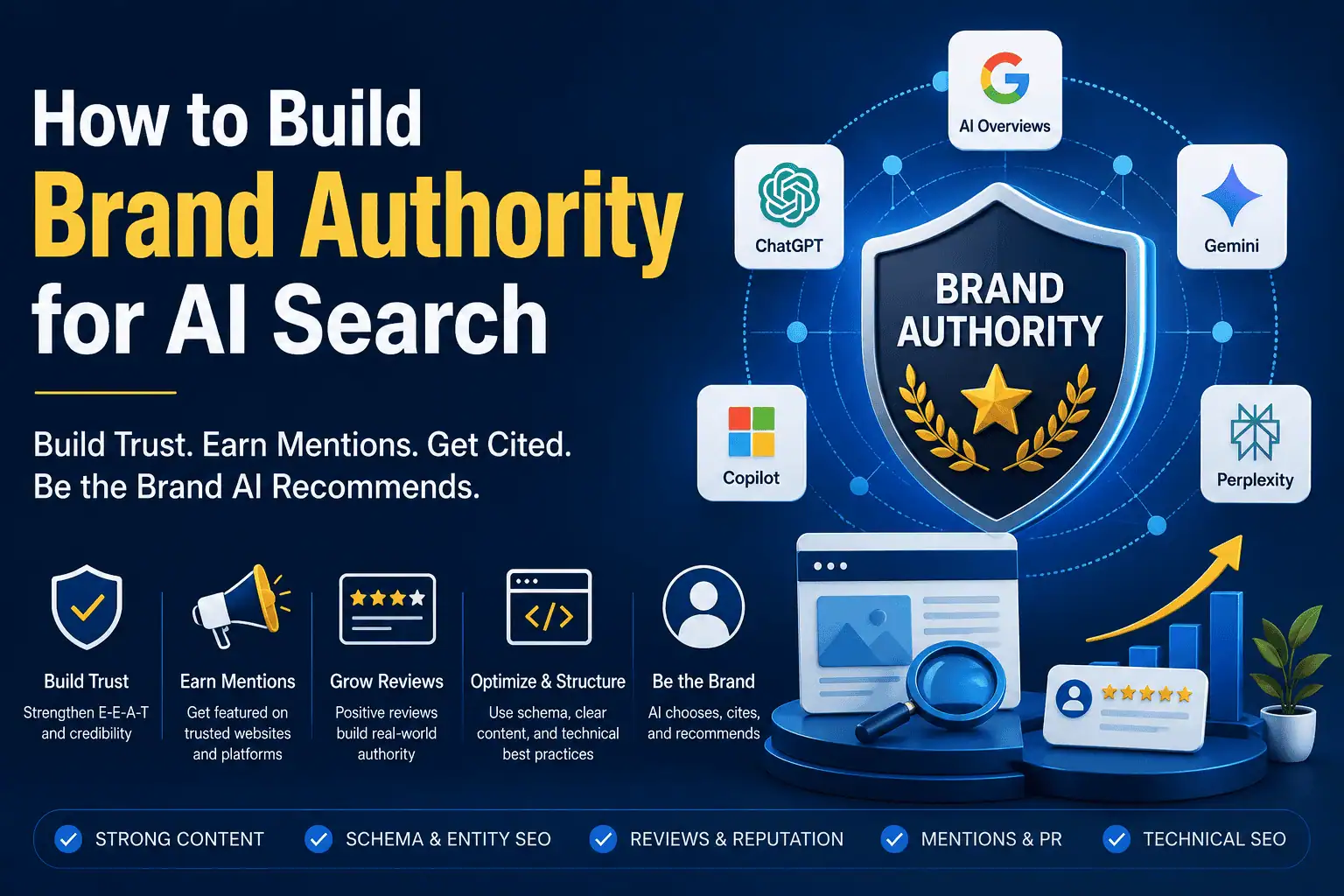
Today, users are asking questions directly to Google AI Overviews, Google AI Mode, ChatGPT, Gemini, Perplexity, Copilot, voice assistants, and other AI-powered answer engines. These platforms do not only show traditional search results. They summarize information, compare options, mention brands, cite sources, and sometimes recommend businesses directly.
This means your brand must be more than keyword-optimized.
Your brand must be understandable, trustworthy, visible, and consistent across the web.
That is where brand authority for AI search becomes important.
Brand authority means that search engines and AI systems can clearly understand who you are, what you do, who you help, why you are trustworthy, and why your content or business deserves to be mentioned.
In traditional SEO, brand authority helped with rankings, backlinks, trust, and conversion. In AI search, brand authority becomes even more important because AI systems need confidence before they cite, mention, summarize, or recommend a brand.
If your brand is weak, inconsistent, or invisible outside your own website, AI tools may ignore you. If your brand is clear, trusted, well-mentioned, and supported by strong content, AI tools have more signals to understand and recommend you.
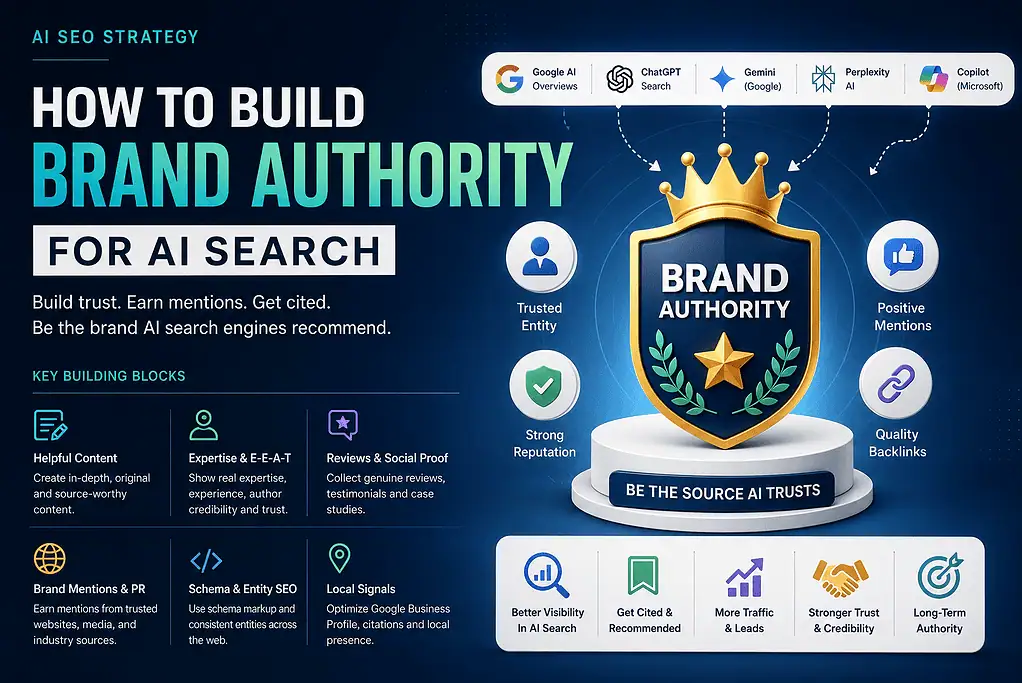
What Is Brand Authority for AI Search?
Brand authority for AI search is the level of trust, recognition, and credibility your brand has across search engines, AI platforms, websites, reviews, social profiles, directories, content, and third-party mentions.
It is not only about having a beautiful website.
It includes:
- Your website content
- Your About page
- Your author profile
- Your service pages
- Your reviews
- Your case studies
- Your backlinks
- Your brand mentions
- Your social profiles
- Your Google Business Profile
- Your business citations
- Your schema markup
- Your media mentions
- Your YouTube presence
- Your LinkedIn presence
- Your customer testimonials
- Your online reputation
For AI search, your brand authority tells AI systems:
- Who you are
- What you are known for
- What topics you are expert in
- Whether people trust your brand
- Whether other websites mention you
- Whether your information is consistent
- Whether your content is useful enough to cite
- Whether your business is real and active
The stronger these signals are, the better your chance of being included in AI-generated answers.
Why AI Search Needs Brand Authority
AI search engines generate answers by collecting, interpreting, and summarizing information from different sources. They need to decide which sources are reliable enough to use.
This is where brand authority matters.
AI systems do not want to recommend unknown, low-quality, misleading, or inconsistent sources. They prefer sources that are clear, credible, useful, and supported by trust signals.
For example, if someone asks:
“Who is a reliable SEO consultant for local businesses?”
An AI system may look for signals such as:
- Does the person have a clear website?
- Does the website explain SEO services properly?
- Is there an About page?
- Are there client examples or case studies?
- Are there reviews?
- Is the person mentioned on other websites?
- Are their social profiles active?
- Is the brand connected to SEO topics?
- Is the content helpful and current?
- Is the business information consistent?
- Does the website use structured data?
If these signals are strong, your brand becomes easier to trust.
If these signals are missing, AI systems may choose a competitor.
Many people confuse brand authority, topical authority, and domain authority. They are related, but they are not the same.
Brand Authority
Brand authority is about how trusted and recognized your brand is. It includes reputation, mentions, reviews, visibility, identity, and credibility.
Example:
A digital marketing consultant who is mentioned on client websites, has strong reviews, publishes expert content, and has active social profiles has stronger brand authority.
Topical Authority
Topical authority is about how deeply your website covers a subject.
Example:
A website that publishes detailed content about Local SEO, AI SEO, Technical SEO, Google Business Profile, schema markup, and WordPress SEO can build topical authority in SEO.
Domain Authority
Domain authority is a third-party SEO metric used by SEO tools to estimate the strength of a website’s backlink profile. Google does not use “Domain Authority” as an official ranking score, but backlinks and overall site reputation still matter.
Simple Difference
Brand authority = Who trusts your brand
Topical authority = What topics your site is known for
Domain authority = How strong your link profile appears in SEO tools
For AI search, all three can help. But brand authority is becoming more important because AI systems need to understand and trust real-world entities, not only web pages.
AI search systems may understand a brand from multiple sources.
These can include:
- Your website
- Google Search results
- Google Business Profile
- Reviews
- Business directories
- News mentions
- Social media profiles
- LinkedIn pages
- YouTube videos
- Podcast appearances
- Author profiles
- Guest posts
- Press releases
- Industry citations
- Structured data
- Knowledge Graph-style entity signals
The more consistent your brand information is across these sources, the easier it is for AI systems to understand you.
For example, your brand should clearly answer:
- What is the brand name?
- Who owns or represents the brand?
- What services does the brand provide?
- Where does the brand operate?
- Who are the target customers?
- What topics is the brand expert in?
- What proof supports the brand’s expertise?
- What do customers say about the brand?
If this information is unclear, AI systems may not confidently mention your brand.
To build brand authority for AI search, you need to strengthen several areas together.
1. Clear Brand Identity
Your brand identity must be simple, clear, and consistent.
Your website should clearly show:
- Brand name
- Founder or team
- Main services
- Target audience
- Service areas
- Experience
- Contact details
- Social profiles
- Business values
- Proof of work
Do not make AI systems guess what your brand does.
For example, if you are an SEO consultant, your website should clearly say:
“Mohammad Harunur Rashid is an SEO and Digital Marketing Consultant specializing in Local SEO, AI SEO, WordPress SEO, Technical SEO, and business growth strategy.”
This is much clearer than saying:
“We help businesses grow online.”
The first version gives strong entity signals. The second version is too generic.
2. Strong About Page
Your About page is one of the most important pages for brand authority.
A strong About page should include:
- Who you are
- What you do
- Your experience
- Your background
- Your mission
- Your expertise
- Your services
- Your industries
- Your achievements
- Your client types
- Your service areas
- Your personal or company story
- Your social links
- Your contact details
For personal brands, the About page should also include a professional bio.
For companies, it should include founder details, team information, company history, and business credibility.
AI search systems need identity clarity. Your About page helps provide that clarity.
3. Expert Author Profiles
Author profiles are very important for AI search, especially for professional topics such as SEO, finance, legal, health, technology, tax, and business consulting.
Each important blog post should show:
- Author name
- Author photo
- Professional title
- Short bio
- Experience
- Area of expertise
- LinkedIn profile
- Website profile link
- Related credentials
- Other published content
Example author bio:
“Mohammad Harunur Rashid is an SEO and Digital Marketing Consultant with 16+ years of experience in Local SEO, Technical SEO, WordPress SEO, AI SEO, and business growth strategy. He helps businesses improve organic visibility, search performance, and lead generation.”
This kind of bio helps both users and search engines understand why the author is qualified to write on the topic.
4. Helpful, Source-Worthy Content
Brand authority is built through useful content.
AI tools prefer content that is:
- Clear
- Helpful
- Accurate
- Original
- Well-structured
- Easy to summarize
- Easy to cite
- Written with expertise
- Supported by examples
- Updated regularly
Do not publish generic content only for keywords.
Instead, publish content that answers real questions and proves expertise.
Good content types for AI search include:
- Complete guides
- How-to articles
- Case studies
- Original research
- Comparison posts
- FAQ pages
- Glossary pages
- Industry reports
- Checklists
- Tutorials
- Pricing guides
- Service guides
- Local business guides
- Expert opinion articles
For example, instead of writing a weak post like:
“Why SEO is important”
Write a stronger post like:
“How Local SEO, Google Business Profile, Reviews, Schema, and AI Search Help Small Businesses Generate More Leads”
The second topic is more specific, useful, and source-worthy.
5. Consistent Entity Signals
Entity SEO is a major part of brand authority.
An entity is a clearly identifiable thing, such as a person, company, place, service, product, or organization.
For AI search, your brand should be treated as a clear entity.
To improve entity signals, keep these details consistent everywhere:
- Brand name
- Founder name
- Website URL
- Phone number
- Email address
- Business address
- Logo
- Social profile links
- Service categories
- Business description
- Opening hours
- Location or service area
This consistency should appear across:
- Website
- Google Business Profile
- YouTube
- X/Twitter
- Business directories
- Local citations
- Guest post bios
- Press releases
- Client websites
- Review platforms
- Schema markup
If your brand appears differently everywhere, AI systems may struggle to connect the signals.
6. Reviews and Reputation Signals
Reviews are powerful trust signals.
For local businesses, consultants, agencies, restaurants, hotels, clinics, law firms, and service providers, reviews can strongly influence how users and AI systems understand your brand.
Focus on reviews from:
- Google Business Profile
- Trustpilot
- Clutch
- Upwork
- GoodFirms
- DesignRush
- Industry-specific platforms
- Local directories
- Client testimonials on your website
Strong reviews help show:
- Customer satisfaction
- Service quality
- Business legitimacy
- Real-world trust
- Problem-solving ability
- Local relevance
But reviews should be genuine. Do not use fake reviews. Fake reputation building can damage trust.
Also, respond to reviews professionally. Your responses can show expertise, care, and active business management.
7. Case Studies and Proof of Work
AI search rewards brands that provide evidence.
Case studies help prove that you are not just making claims.
A good case study should include:
- Client type
- Problem
- Strategy
- Work completed
- Tools used
- Results
- Screenshots
- Timeline
- Lessons learned
- Testimonial if available
For SEO and digital marketing, case studies can include:
- Ranking improvements
- Traffic growth
- Google Business Profile improvements
- Technical SEO fixes
- Page speed improvements
- Conversion improvements
- Local visibility growth
- Content performance
- Schema implementation
- Before-and-after examples
Case studies are excellent for AI SEO because they provide original, experience-based content.
They also support E-E-A-T.
8. Digital PR and Brand Mentions
Your website alone is not enough.
AI systems may look at how the wider web talks about your brand.
Brand mentions from trusted sources help strengthen authority.
You can build mentions through:
- Guest posts
- Press releases
- Podcast interviews
- YouTube interviews
- Industry blogs
- Local news
- Business directories
- Partner websites
- Client websites
- Association profiles
- Event pages
- Award pages
- Expert roundups
- LinkedIn articles
- Community websites
For example, if you are an SEO consultant serving Australian businesses, you should aim to be mentioned on:
- Australian business directories
- Marketing blogs
- Client case study pages
- Local business websites
- Industry-specific platforms
- LinkedIn posts
- SEO-related publications
AI systems are more likely to trust a brand that appears across relevant trusted sources.
9. Backlinks from Relevant Websites
Backlinks still matter.
But for AI search, relevance and context are very important.
A backlink from a highly relevant website can support both SEO and brand authority.
Good backlink sources include:
- Industry blogs
- Business directories
- Local directories
- Partner websites
- Guest posts
- Resource pages
- Case study pages
- News sites
- Professional associations
- Client websites
- Podcast show notes
- Event pages
- Educational resources
Avoid spammy link building.
Low-quality backlinks may not help and can damage your brand’s trust.
The best backlinks come from real relationships, useful content, expert contribution, and genuine authority.
10. Structured Data and Schema Markup
Schema markup helps search engines understand your content and entities.
It does not guarantee AI search visibility, but it supports machine understanding.
Important schema types for brand authority include:
- Organization schema
- Person schema
- LocalBusiness schema
- ProfessionalService schema
- WebSite schema
- WebPage schema
- Article schema
- BlogPosting schema
- FAQPage schema
- Service schema
- Review schema
- BreadcrumbList schema
- VideoObject schema
For a personal brand, Person schema is very useful.
For a company, Organization or LocalBusiness schema is important.
For service pages, Service schema can help clarify what you offer.
For blog posts, Article or BlogPosting schema helps define the content.
For FAQs, FAQPage schema can support answer-based visibility where appropriate.
Schema should always match visible content. Do not add fake ratings, fake reviews, or misleading information.
11. Google Business Profile Optimization
For local businesses, Google Business Profile is one of the strongest brand authority assets.
Optimize your profile with:
- Correct business name
- Primary category
- Secondary categories
- Business description
- Services
- Products if relevant
- Photos
- Videos
- Opening hours
- Service areas
- Website link
- Appointment link
- Phone number
- FAQs
- Regular posts
- Reviews
- Review responses
Your Google Business Profile helps Google understand your business entity.
It also supports local SEO, map rankings, reputation, and AI search visibility.
For local AI search, your Google Business Profile can help answer questions like:
- Who provides this service near me?
- Which business has better reviews?
- What services does this company offer?
- Where is this business located?
- Is this business active?
- What do customers say?
12. Social Proof and Community Presence
AI search visibility is not only about websites.
Social platforms help build brand recognition and trust.
Important platforms include:
- YouTube
- X/Twitter
- Quora
- Medium
- Industry communities
- Niche forums
For consultants and agencies, LinkedIn is especially important.
Publish content that shows:
- Expertise
- Case studies
- Client wins
- Industry opinion
- Practical tips
- Personal brand story
- Service knowledge
- Thought leadership
When your brand is active across trusted platforms, AI systems have more context to understand you.
How to Build Brand Authority for AI Search Step by Step
Step 1: Define Your Brand Positioning
Start by defining exactly what your brand should be known for.
Answer these questions:
- Who are you?
- What do you do?
- Who do you help?
- What problem do you solve?
- What makes you different?
- What topics should your brand be associated with?
- What services should AI tools connect with your name?
- What locations or markets do you serve?
Example:
“I help small and medium businesses grow through Local SEO, AI SEO, WordPress SEO, Technical SEO, and Google Business Profile optimization.”
Clear positioning makes every other step easier.
Step 2: Build a Strong Brand Entity Page
Create a strong About page or brand profile page.
This page should include:
- Brand story
- Founder bio
- Experience
- Services
- Industries
- Locations served
- Client types
- Achievements
- Testimonials
- Social links
- Contact information
- Schema markup
This page becomes the central source of truth for your brand.
For a personal brand, it should clearly describe the person.
For a company, it should clearly describe the organization.
Step 3: Create Topic Clusters Around Your Expertise
Do not publish random content.
Build content clusters around your core expertise.
For example, an SEO consultant can build clusters around:
AI SEO Cluster
- What is AI SEO?
- How to rank in Google AI Overviews
- ChatGPT SEO guide
- Gemini SEO guide
- Perplexity SEO guide
- GEO vs AEO vs SEO
- Brand authority for AI search
- Entity SEO for AI search
Local SEO Cluster
- Complete Local SEO guide
- Google Business Profile optimization
- Local citations guide
- Review generation strategy
- LocalBusiness schema guide
- Local SEO for service businesses
- Google Maps ranking factors
Technical SEO Cluster
- Technical SEO audit checklist
- Crawlability and indexing guide
- Core Web Vitals guide
- Schema markup guide
- WordPress speed optimization
- Duplicate content fixes
- Internal linking strategy
These clusters help AI systems understand your topical authority.
Step 4: Publish Content That AI Can Cite
AI-friendly content should be easy to extract, summarize, and cite.
Use:
- Clear definitions
- Short paragraphs
- Descriptive headings
- Bullet points
- Tables
- FAQs
- Examples
- Step-by-step processes
- Checklists
- Original insights
- Case studies
- Updated information
Each important article should answer:
- What is the topic?
- Why does it matter?
- How does it work?
- What should the user do?
- What mistakes should they avoid?
- What are the best practices?
- What are the FAQs?
This format helps both human readers and AI tools.
Step 5: Strengthen Your Author and Expert Signals
Every important article should have an author.
For personal brands, show:
- Name
- Photo
- Job title
- Short bio
- Experience
- Expertise
- LinkedIn link
- Website profile link
For company blogs, show:
- Author name
- Reviewer name if needed
- Editorial policy
- Update date
- Expert credentials
- Relevant experience
This is especially important for YMYL topics such as health, legal, finance, tax, insurance, and high-stakes business advice.
Step 6: Build Reviews and Testimonials
Collect real reviews from real clients.
Use them across:
- Google Business Profile
- Website testimonial section
- Case study pages
- Service pages
- LinkedIn recommendations
- Industry platforms
- Local directories
A strong testimonial should mention:
- Service provided
- Problem solved
- Result achieved
- Client experience
- Business name if allowed
Example:
“We worked with Mohammad Harunur Rashid for Local SEO and WordPress SEO. He improved our website structure, optimized our Google Business Profile, fixed technical issues, and helped us generate better local visibility.”
This kind of review gives strong context.
Step 7: Earn Third-Party Mentions
AI systems may trust third-party sources more than brand-owned claims.
To earn mentions:
- Write guest posts
- Join expert roundups
- Publish case studies with clients
- Get listed in business directories
- Collaborate with partners
- Appear on podcasts
- Publish LinkedIn articles
- Share expert commentary
- Submit press releases
- Create original research
- Sponsor local events
- Join professional associations
Your brand should not only talk about itself. Other relevant sources should also talk about your brand.
Step 8: Improve Technical SEO
Brand authority cannot work well if your website is technically weak.
Check:
- Crawlability
- Indexing
- Robots.txt
- XML sitemap
- Canonical tags
- Broken links
- Redirect chains
- Page speed
- Mobile usability
- Core Web Vitals
- Schema validation
- Duplicate content
- Internal linking
- URL structure
- Image optimization
- JavaScript rendering
AI search still needs access to your content. If your important pages are blocked, broken, slow, or hidden, visibility becomes harder.
Step 9: Optimize for AI Crawlers and Search Access
Different AI platforms may use different crawlers or browsing systems.
Make sure you understand whether your website allows or blocks:
- Googlebot
- Bingbot
- OAI-SearchBot
- ChatGPT-User
- PerplexityBot
- Perplexity-User
- Other relevant AI crawlers
Do not block AI search crawlers unless you have a clear reason.
If your goal is AI search visibility, your useful public content should be accessible.
Always review your robots.txt file carefully.
Step 10: Use Schema Markup to Connect Your Brand
Add structured data to connect your brand identity.
For a consultant, use:
- Person schema
- WebSite schema
- WebPage schema
- Article schema
- FAQPage schema
- Service schema
- BreadcrumbList schema
For a company, use:
- Organization schema
- LocalBusiness schema
- ProfessionalService schema
- WebSite schema
- Service schema
- Review schema
- Article schema
- BreadcrumbList schema
Use sameAs links to connect official social profiles.
Example sameAs profiles:
- YouTube
- X/Twitter
- Google Business Profile
- Crunchbase if available
- Other trusted profiles
This helps search engines connect your website with your wider brand presence.
Step 11: Build a Brand Mention Strategy
Do not wait for people to mention your brand naturally.
Create a brand mention strategy.
Monthly actions can include:
- Publish one expert article
- Publish one LinkedIn thought leadership post
- Add one case study
- Get one guest post
- Update business directories
- Request new client reviews
- Create one YouTube video
- Answer industry questions
- Add internal links to older posts
- Refresh outdated content
- Reach out for podcast or interview opportunities
Consistency matters.
AI systems need repeated, consistent signals over time.
Step 12: Monitor AI Search Visibility
AI search tracking is still developing, but you can monitor manually.
Search your brand in:
- Google AI Overviews
- ChatGPT
- Gemini
- Perplexity
- Copilot
Test prompts like:
- Who is [your name]?
- What does [your brand] do?
- Best SEO consultant for Local SEO
- Best AI SEO consultant
- Best WordPress SEO expert
- Who provides Google Business Profile optimization?
- What are the best SEO agencies for small businesses?
- Compare [your brand] with competitors
Check:
- Does your brand appear?
- Is the description accurate?
- Are your services correct?
- Are competitors mentioned instead?
- Are old details showing?
- Are sources citing your website?
- Are third-party sources accurate?
- Are reviews and reputation reflected?
If AI tools describe your brand incorrectly, improve the source material across your website and third-party profiles.
Brand Authority Checklist for AI Search
Website Authority Checklist
- Clear homepage positioning
- Strong About page
- Detailed service pages
- Clear contact page
- Author profiles
- Case studies
- Testimonials
- Blog content
- FAQs
- Internal links
- Updated content
- Mobile-friendly design
- Fast loading speed
- Schema markup
Entity SEO Checklist
- Consistent brand name
- Consistent logo
- Consistent phone number
- Consistent email
- Consistent address
- Consistent service descriptions
- Same social profile links
- Organization schema
- Person schema
- LocalBusiness schema
- sameAs profile links
- Google Business Profile connection
Content Authority Checklist
- Topic clusters
- Complete guides
- Case studies
- Original examples
- Expert insights
- Data-backed content
- FAQs
- Comparison pages
- Updated posts
- Clear definitions
- Source-worthy writing
- Helpful content structure
Reputation Checklist
- Google reviews
- Website testimonials
- LinkedIn recommendations
- Case study proof
- Third-party reviews
- Directory ratings
- Client mentions
- Social proof
- Media mentions
- Professional profiles
AI Search Checklist
- Important pages indexed
- Robots.txt reviewed
- OAI-SearchBot not blocked if ChatGPT visibility is desired
- Perplexity access reviewed
- Googlebot allowed
- Content easy to summarize
- Brand identity clear
- Schema added
- FAQs added
- AI prompts tested manually
- Brand descriptions monitored
Common Mistakes That Hurt Brand Authority in AI Search
Mistake 1: Having an Unclear Brand Message
If your website does not clearly explain who you are and what you do, AI systems may not understand your brand.
Fix this by writing a clear homepage headline, About page, service descriptions, and author bio.
Mistake 2: Publishing Generic AI Content
Generic AI content does not build authority.
Your content should include expert insight, real examples, case studies, original thinking, and practical advice.
Mistake 3: Ignoring Reviews
Reviews are powerful trust signals.
If your competitors have strong reviews and you do not, AI systems may be more likely to mention them.
Mistake 4: Inconsistent Business Information
Different names, phone numbers, addresses, or service descriptions across the web can confuse search engines and AI systems.
Keep your NAP and brand data consistent.
Mistake 5: No Third-Party Mentions
If only your own website talks about your brand, your authority may look weak.
Build mentions on trusted external platforms.
Mistake 6: Weak Author Profiles
Content without author identity can look less trustworthy.
Add expert author bios and connect them to real profiles.
Mistake 7: Blocking Important Crawlers
If your robots.txt blocks search or AI crawlers, your content may not be discoverable.
Review your crawler access carefully.
Mistake 8: Not Updating Content
AI search often needs fresh information.
Update important posts, service pages, statistics, screenshots, and recommendations regularly.
Brand Authority Strategy for Local Businesses
Local businesses need strong brand authority because customers often ask AI tools for recommendations.
Examples:
- Best pest control company near me
- Reliable carpet cleaner in Brisbane
- Best roof restoration company in Sydney
- Trusted accountant for small business
- Best SEO consultant for local business
- Family-friendly resort in Sajek
- Best digital marketing agency for small businesses
To build local brand authority, focus on:
- Google Business Profile
- Local reviews
- Local service pages
- Location pages
- Local citations
- Local backlinks
- Local photos
- Community mentions
- Service-specific FAQs
- LocalBusiness schema
- Case studies from local clients
- Local landing pages
Local AI visibility depends heavily on trust, relevance, proximity, reviews, and clear business information.
Brand Authority Strategy for Personal Brands
Personal brands can perform very well in AI search when their identity is clear.
This applies to:
- SEO consultants
- Digital marketing consultants
- Lawyers
- Accountants
- Doctors
- Coaches
- Trainers
- Real estate consultants
- Financial advisors
- WordPress experts
- Business consultants
To build personal brand authority, create:
- Strong personal homepage
- Detailed About page
- Professional photo
- Author bio
- Portfolio
- Case studies
- Testimonials
- LinkedIn profile
- YouTube videos
- Guest posts
- Podcast appearances
- Service pages
- Person schema
- sameAs links
Your name should be consistently connected with your expertise.
For example:
“Mohammad Harunur Rashid” should be connected with “SEO consultant,” “Local SEO expert,” “AI SEO,” “WordPress SEO,” “Technical SEO,” and “Digital Marketing Consultant.”
This helps AI systems understand the personal brand entity.
Best Content Ideas to Build Brand Authority for AI Search
Here are content topics that can help build authority:
- What Is AI SEO?
- GEO vs AEO vs SEO: What Is the Difference?
- How to Rank in Google AI Overviews
- How to Optimize for ChatGPT Search
- How to Build Brand Authority for AI Search
- Entity SEO Guide for Business Websites
- Local SEO Checklist for Small Businesses
- Google Business Profile Optimization Guide
- Schema Markup Guide for Local Businesses
- How Reviews Help AI Search Visibility
- Technical SEO Checklist for WordPress
- How to Build Topical Authority
- How to Improve E-E-A-T
- AI SEO for Local Businesses
- AI Search Visibility Checklist
- How to Get Cited by AI Search Engines
- Brand Mentions vs Backlinks
- How to Optimize Your About Page for SEO
- Personal Branding for SEO Consultants
- How to Create Source-Worthy Content
These topics help your brand become associated with modern SEO, AI search, authority, and trust.
How Long Does It Take to Build Brand Authority?
Brand authority does not happen overnight.
It takes time because AI systems and search engines need repeated trust signals.
You may see progress in phases.
First 30 Days
- Fix technical SEO
- Update About page
- Improve homepage messaging
- Add author bio
- Add schema markup
- Optimize Google Business Profile
- Fix business information consistency
First 60 to 90 Days
- Publish topic cluster content
- Add FAQs
- Build internal links
- Collect reviews
- Add testimonials
- Create case studies
- Update old content
- Start guest posting or PR outreach
First 6 to 12 Months
- Earn backlinks
- Build third-party mentions
- Grow branded searches
- Improve AI visibility
- Publish original insights
- Strengthen social proof
- Expand content clusters
- Build stronger entity recognition
Brand authority is a long-term asset. The earlier you start, the stronger your future search visibility becomes.
How to Measure Brand Authority for AI Search
You can measure brand authority using a mix of SEO, reputation, and AI visibility signals.
Track:
- Branded search volume
- Organic traffic
- Google Search Console impressions
- Keyword rankings
- Backlinks
- Referring domains
- Brand mentions
- Google reviews
- Average review rating
- Direct traffic
- Referral traffic
- LinkedIn engagement
- YouTube visibility
- Local pack rankings
- AI mentions
- AI citations
- Accuracy of AI-generated brand descriptions
Manual AI testing is also useful.
Ask ChatGPT, Gemini, Perplexity, and Google AI results questions about your brand and niche.
Check whether your brand appears and how it is described.
Final Brand Authority Framework for AI Search
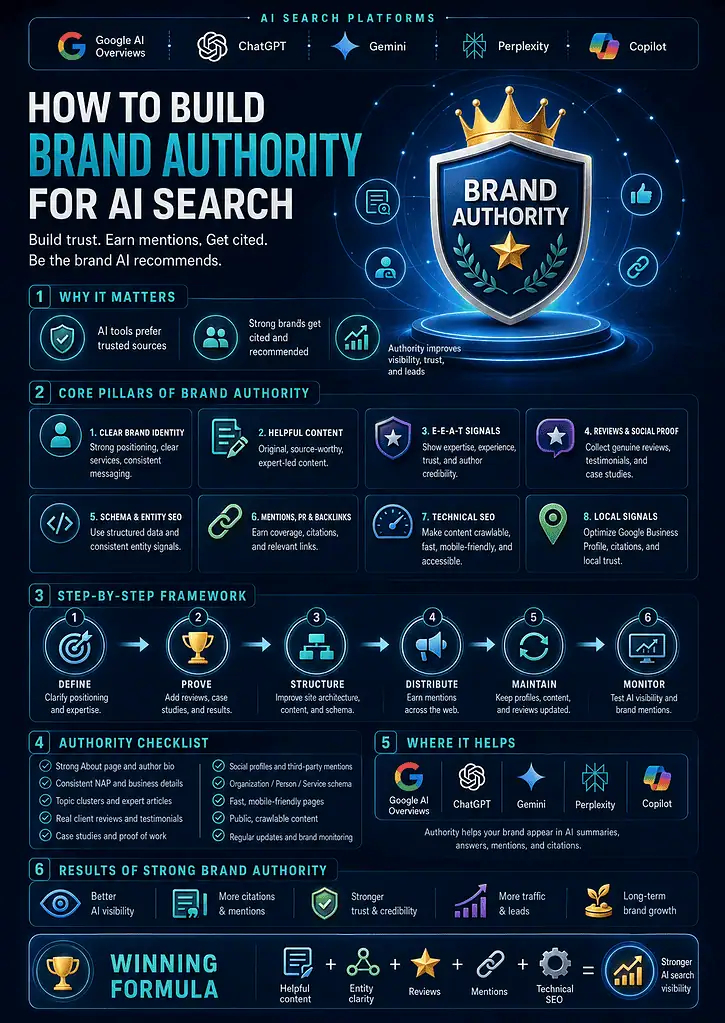
To build brand authority for AI search, follow this framework:
1. Define
Clarify your brand positioning, services, audience, expertise, and location.
2. Prove
Show proof through case studies, testimonials, reviews, portfolio, and expert content.
3. Structure
Use proper website architecture, headings, schema markup, internal links, and content formatting.
4. Distribute
Get your brand mentioned across trusted websites, directories, social platforms, podcasts, and industry sources.
5. Maintain
Keep your content, business information, profiles, reviews, and schema updated.
6. Monitor
Track Google rankings, AI mentions, brand descriptions, reviews, citations, and competitor visibility.
This framework helps your brand become easier for AI systems to find, understand, trust, and recommend.
What is brand authority in AI search?
Brand authority in AI search means how much AI systems trust and understand your brand based on your website, content, reviews, mentions, schema, backlinks, social profiles, and online reputation.
Why does brand authority matter for AI SEO?
Brand authority matters because AI tools need trusted sources before they cite, mention, summarize, or recommend a brand. A strong brand authority increases your chance of appearing in AI-generated answers.
Is brand authority the same as SEO authority?
Not exactly. SEO authority often focuses on rankings, backlinks, and organic visibility. Brand authority includes wider trust signals such as reviews, mentions, reputation, entity consistency, social proof, and expert identity.
How can I make my brand visible in ChatGPT, Gemini, and Perplexity?
Create source-worthy content, allow relevant crawlers, build strong entity signals, publish expert content, earn third-party mentions, collect reviews, use schema markup, and keep your brand information consistent across the web.
Does schema markup help brand authority?
Yes. Schema markup helps search engines understand your brand, services, authors, business details, articles, FAQs, reviews, and relationships between entities.
Do reviews help AI search visibility?
Yes. Reviews help prove that your business is real, active, and trusted by customers. They are especially important for local businesses and service providers.
Are backlinks still important for AI search?
Yes. Backlinks still help with authority, but brand mentions, citations, reviews, content quality, and entity consistency are also very important for AI search.
How often should I update brand authority content?
Important service pages, AI SEO articles, technical guides, and industry trend posts should be reviewed regularly. Fast-changing topics may need updates every few months.
Can small businesses build brand authority for AI search?
Yes. Small businesses can build authority through local SEO, Google Business Profile optimization, reviews, service pages, local citations, case studies, and helpful content.
What is the best first step?
The best first step is to fix your brand identity. Make sure your homepage, About page, service pages, author bio, Google Business Profile, and social profiles clearly explain who you are, what you do, and why people should trust you.
AI search is changing how people discover brands, compare services, and make decisions.
In the past, businesses mainly focused on ranking in Google. Today, they must also focus on being understood and trusted by AI-powered answer engines.
Brand authority is one of the strongest assets for this new search environment.
To build brand authority for AI search, you need clear positioning, helpful content, entity consistency, reviews, schema markup, case studies, backlinks, brand mentions, social proof, and technical accessibility.
The goal is simple:
Make your brand easy to find.
Make your brand easy to understand.
Make your brand easy to trust.
Make your brand easy for AI systems to recommend.
Businesses that build brand authority now will have a stronger chance to appear in Google AI Overviews, ChatGPT, Gemini, Perplexity, Copilot, and future AI search platforms.
AI search is not only about content.
It is about trust, proof, reputation, and brand clarity.