HEO: The New Era of Human-Centered SEO and Digital Growth
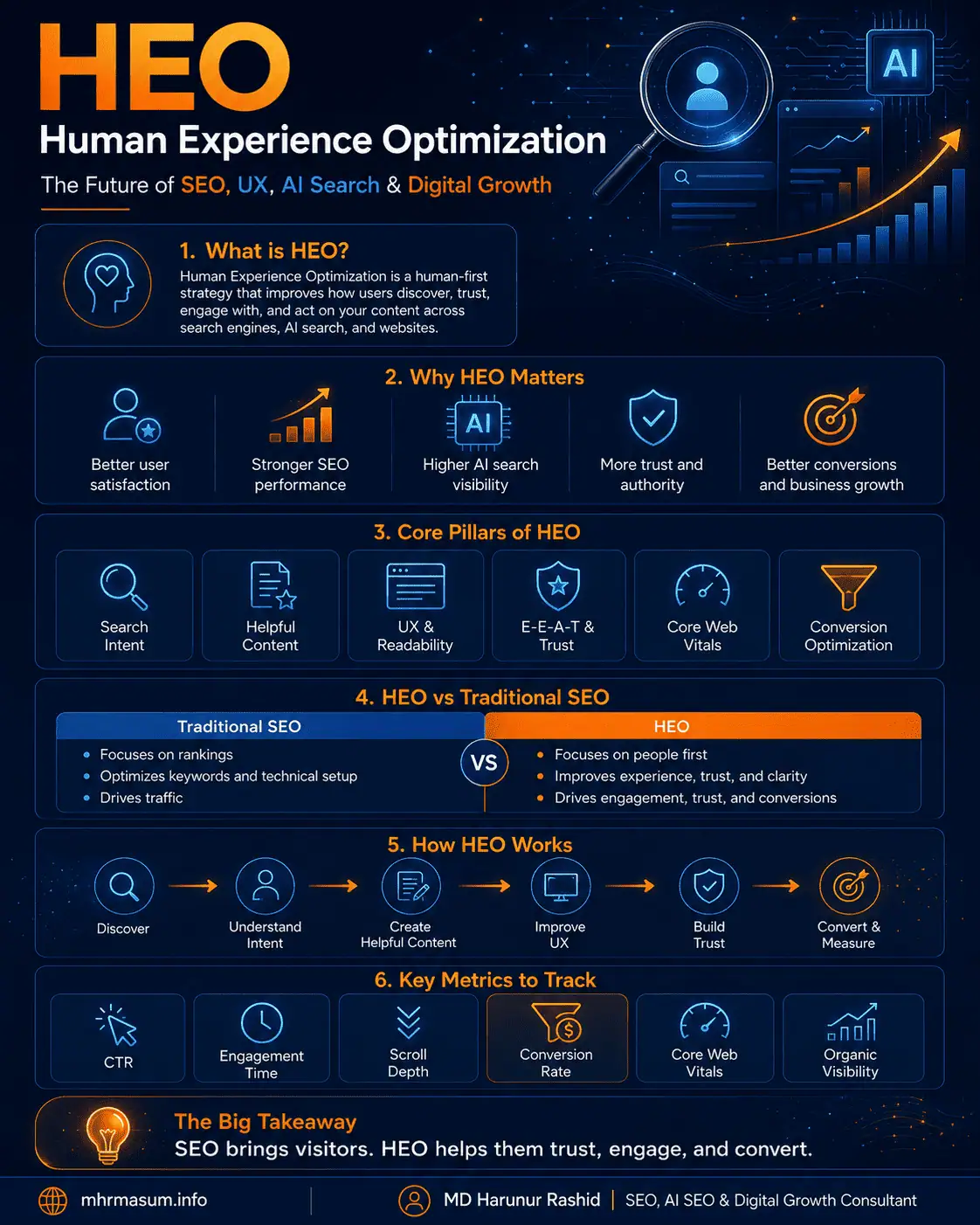
HEO stands for Human Experience Optimization. It is a modern digital marketing approach that focuses on improving the complete experience of real users when they interact with a website, brand, product, service, or online content.
Traditional SEO mainly focuses on search engine visibility. It includes keyword research, backlinks, metadata, technical SEO, internal linking, schema markup, crawlability, and ranking improvement. HEO goes one step further. It asks a deeper question:
After people find your website, do they actually trust it, understand it, enjoy it, and take action?
That is the core purpose of Human Experience Optimization.
HEO connects SEO, UX, content quality, conversion optimization, brand trust, accessibility, page speed, and customer psychology. It is not only about bringing visitors to a website. It is about helping those visitors complete their goal with confidence.
Google’s own search guidance also supports this direction by encouraging creators to publish helpful, reliable, people-first content rather than content created mainly to manipulate rankings.
Why HEO Matters in Modern SEO
Search behavior has changed. Users no longer simply type short keywords and click the first blue link. Today, people search through Google, YouTube, TikTok, Reddit, Facebook groups, AI tools, voice search, local maps, review platforms, and answer engines.
That means SEO is no longer only about ranking a page. A business must now create a complete experience that satisfies human intent across multiple touchpoints.
HEO matters because it helps businesses improve:
- User trust
- Content engagement
- Lead quality
- Conversion rate
- Brand authority
- Repeat visits
- Customer satisfaction
- AI search visibility
- Local SEO performance
- Long-term organic growth
Search Engine Land describes this shift as a move from pure algorithm-focused SEO toward trust, usefulness, user engagement, and post-click experience.
HEO vs SEO: What Is the Difference?
SEO and HEO are connected, but they are not the same.
SEO, Search Engine Optimization focuses on making a website discoverable, crawlable, indexable, and rankable in search engines.
HEO, Human Experience Optimization focuses on making the website useful, trustworthy, easy to use, emotionally convincing, and conversion-friendly for real people.
A simple way to understand the difference:
SEO brings the visitor. HEO satisfies the visitor.
A website can rank well but still fail if users leave quickly, cannot find information, do not trust the business, or feel confused by the page. HEO solves this problem by improving the full user journey.
HEO vs AEO vs GEO vs Hybrid Engine Optimization
Modern digital marketing now includes several related optimization terms.
SEO focuses on traditional organic search visibility.
AEO, Answer Engine Optimization focuses on getting content selected as a direct answer in featured snippets, AI answers, voice search, and question-based results.
GEO, Generative Engine Optimization focuses on improving visibility in generative AI platforms such as ChatGPT, Gemini, Claude, Perplexity, and AI-powered search experiences.
HEO, Human Experience Optimization focuses on the human user experience behind all of these channels.
Hybrid Engine Optimization, another use of the HEO acronym, means optimizing for both search engines and AI engines together. Recent 2026 sources define Hybrid Engine Optimization as a strategy for visibility across Google, Bing, ChatGPT, Gemini, Perplexity, and similar discovery platforms.
For practical SEO content, the strongest approach is to combine all of them:
SEO + AEO + GEO + HEO = Modern Organic Growth Strategy
The Core Idea Behind HEO
The core idea of HEO is simple:
Design every page, paragraph, feature, button, and content element around the real needs of the user.
That means your website should not only answer search intent. It should also reduce confusion, build trust, solve problems, guide action, and create a smooth journey.
A strong HEO-focused page should answer these questions:
- Who is the user?
- What problem are they trying to solve?
- What level of knowledge do they already have?
- What information do they need first?
- What objections or doubts might stop them?
- What proof do they need before trusting the brand?
- What action should they take next?
- Is the page easy to read on mobile?
- Does the page load quickly?
- Is the content genuinely helpful?
- Is the business clearly credible?
When a page answers these questions well, it becomes stronger for both humans and search systems.
Main Components of HEO
1. Search Intent Satisfaction
Search intent is the reason behind a user’s search. If someone searches “best pest control service near me, ” they probably want a trusted local service, pricing guidance, reviews, service areas, and quick contact options. If someone searches “how to remove carpet stains, ” they may want a step-by-step guide.
HEO starts with understanding the intent behind the search. The content should match the user’s real goal, not just the keyword.
There are four common types of search intent:
Informational intent: The user wants to learn something.
Example: “What is local SEO? ”
Commercial intent: The user is comparing options.
Example: “Best SEO consultant in Bangladesh. ”
Transactional intent: The user is ready to buy, book, call, or submit a form.
Example: “Hire WordPress SEO expert. ”
Navigational intent: The user is looking for a specific brand, website, or page.
Example: “SEO Squirrel Ultimate plugin. ”
A strong HEO strategy maps content to each intent type.
2. Helpful, Reliable, People-First Content
Content is the foundation of HEO. But not all content is useful. Thin, generic, AI-looking, keyword-stuffed content often fails because it does not create trust or solve the user’s real problem.
HEO content should be:
- Clear
- Practical
- Original
- Specific
- Well-structured
- Easy to scan
- Written for humans
- Supported by real expertise
- Updated when information changes
- Connected to the user’s next step
Google’s helpful content guidance says content should primarily benefit people, not be created mainly to gain search engine rankings.
3. E-E-A-T and Trust Building
E-E-A-T stands for Experience, Expertise, Authoritativeness, and Trustworthiness. It is not a simple plugin setting. It is a quality framework that helps evaluate whether a page and its creator are credible.
For HEO, E-E-A-T is very important because users do not convert when they do not trust the website.
A website can improve trust by adding:
- Author bio
- Business address
- Real team photos
- Case studies
- Testimonials
- Certifications
- Client logos
- Before/after results
- Clear privacy policy
- Refund policy
- Contact information
- Transparent pricing where possible
- Real examples and screenshots
- Updated content dates
- Expert review notes
Google’s guidance about AI-generated content also says quality, originality, and E-E-A-T matter more than how the content is produced.
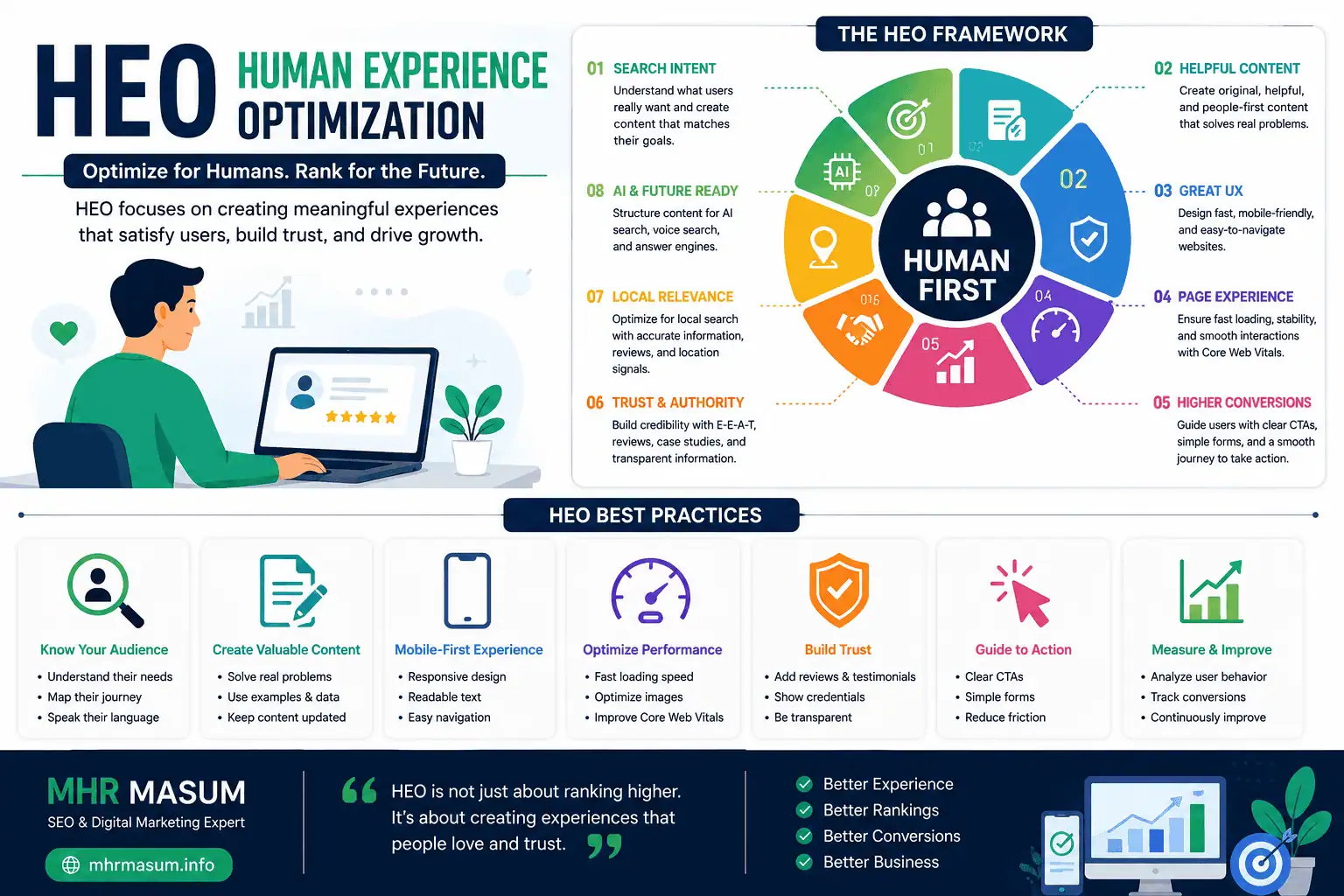
4. Page Experience and Usability
A page may have excellent content, but if the design is messy, slow, hard to read, or broken on mobile, users will leave.
HEO requires strong page experience.
Important page experience factors include:
- Fast loading speed
- Mobile-friendly layout
- Clear font size
- Good spacing
- Easy navigation
- Visible call-to-action buttons
- No intrusive popups
- Clean design
- Accessible color contrast
- Simple forms
- Logical heading structure
- Proper image optimization
Google’s page experience documentation asks site owners to consider Core Web Vitals, mobile display, HTTPS, intrusive ads, interstitials, and whether the main content is easy to distinguish.
5. Core Web Vitals
Core Web Vitals are performance metrics that measure real-world user experience, including loading performance, interactivity, and visual stability. Google recommends that site owners achieve good Core Web Vitals for better user experience and search success.
The three main Core Web Vitals are:
LCP, Largest Contentful Paint
Measures how quickly the main content loads.
INP, Interaction to Next Paint
Measures how responsive the page is when users interact.
CLS, Cumulative Layout Shift
Measures visual stability and whether elements move unexpectedly.
For HEO, performance is not only a technical issue. It directly affects user confidence. A slow website can make a business look less professional.
6. Content Structure and Readability
HEO content should be easy to read. Many users do not read every word. They scan headings, bullet points, bold text, tables, FAQs, and summaries.
A good HEO page should include:
- Clear H1 title
- Logical H2 and H3 headings
- Short paragraphs
- Bullet lists
- Summary sections
- Comparison tables
- Step-by-step instructions
- FAQs
- Internal links
- Strong CTA sections
- Visual examples where useful
The goal is to make the page useful for both quick readers and detailed readers.
7. Emotional Relevance
Human decisions are not only logical. People also respond to emotion, trust, comfort, clarity, and confidence.
HEO content should understand the user’s emotional state.
For example:
A user searching for “emergency plumber near me” may feel stressed.
A user searching for “best SEO consultant” may feel uncertain and compare options.
A user searching for “China visa requirements” may feel confused and need clear guidance.
A user searching for “WordPress plugin developer” may want confidence that the developer can handle technical problems safely.
HEO improves content by matching both the logical and emotional needs of the user.
8. Conversion Experience
HEO is not complete unless it improves conversion.
A conversion can be:
- Phone call
- Form submission
- Product purchase
- Booking
- Quote request
- Email signup
- WhatsApp message
- Download
- Consultation request
- Demo request
To improve conversion, the page should include:
- Clear CTA buttons
- Trust signals near CTA
- Simple contact forms
- Click-to-call buttons on mobile
- WhatsApp chat option where relevant
- Benefit-focused button text
- Service area clarity
- Pricing or quote guidance
- FAQ before the final CTA
- Social proof before decision points
Instead of only saying “Contact Us, ” an HEO-focused CTA may say:
Get a Free SEO Consultation
Request a Website Audit
Book a Local SEO Strategy Call
Download the Full Checklist
Talk to a WordPress Expert
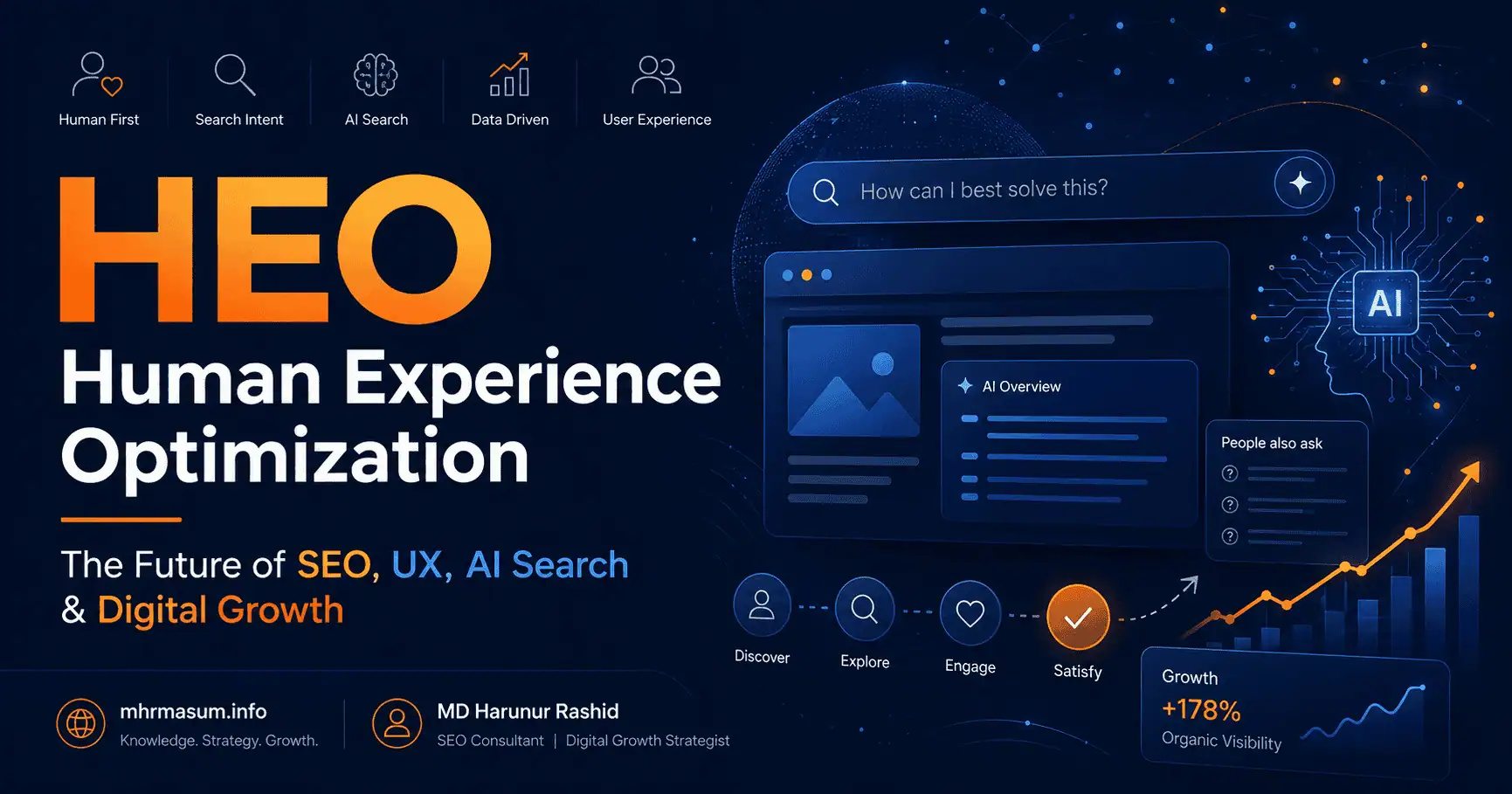
How HEO Improves SEO Performance
HEO improves SEO indirectly and strategically by improving the quality of user interaction with a website.
When users find content useful, they are more likely to:
- Stay longer
- Visit more pages
- Share the content
- Return later
- Trust the brand
- Convert into leads
- Mention the brand elsewhere
- Engage with local listings
- Search the brand name directly
This creates stronger brand signals, engagement signals, and business outcomes.
SEO without HEO may bring traffic but fail to create business value. HEO makes SEO more profitable.
HEO for AI Search and AI Overviews
AI search has changed the way users discover information. Many users now ask full questions instead of typing short keywords. AI systems often summarize answers from multiple sources.
This makes HEO more important because AI systems need clear, structured, trustworthy, and well-organized information.
To optimize content for AI search and human experience:
- Use clear definitions
- Answer common questions directly
- Add short summaries
- Include FAQ sections
- Use schema markup
- Mention entities clearly
- Add author and business details
- Avoid vague claims
- Use examples and comparisons
- Keep content updated
- Structure content by topic clusters
- Make the content easy to quote, summarize, and understand
Google says structured data helps Google understand page content and can make pages eligible for rich results, although structured data does not guarantee rich result visibility.
HEO for Local SEO
HEO is extremely powerful for local SEO because local customers care about trust, distance, reviews, service quality, and fast contact options.
A local business HEO strategy should include:
- Accurate business name, address, and phone number
- Google Business Profile optimization
- Local service pages
- Service area pages
- Real customer reviews
- Local photos
- Map embed
- Driving direction information
- Opening hours
- Emergency service details
- Local FAQs
- Location-specific testimonials
- Click-to-call button
- WhatsApp or quick inquiry option
- Trust badges and licenses
For example, a local pest control business should not only target “pest control Brisbane. ” The page should also explain service areas, treatment methods, safety process, pricing factors, response time, customer reviews, and why the company is trustworthy.
That is HEO in action.
HEO for Service Pages
A high-performing service page should not only describe the service. It should guide the user from problem awareness to decision.
A strong HEO service page structure can include:
- Clear service headline
- Short benefit-focused intro
- Problem explanation
- Service solution
- Who the service is for
- Key benefits
- Process or steps
- Why choose us
- Case study or result
- Testimonials
- Pricing guidance or quote CTA
- FAQs
- Final CTA
Example:
Instead of:
“We provide SEO services. ”
Better HEO version:
“We help small businesses improve Google visibility, attract qualified leads, fix technical SEO issues, and build a long-term organic growth system through data-driven SEO strategy. ”
The second version is more human-focused because it explains the outcome, not just the service.
HEO for Blog Content
For blog content, HEO means creating articles that fully satisfy the reader’s question.
A strong HEO blog post should include:
- Clear introduction
- Direct answer early
- Helpful examples
- Step-by-step explanation
- Real-world use cases
- Common mistakes
- Tools or resources
- Expert tips
- FAQ section
- Internal links to related pages
- Clear next step
Blog content should not be written only to match a keyword. It should help the reader finish their task.
For example, a blog post titled “How to Optimize Product Descriptions for SEO” should include examples, product page structure, keyword placement, image SEO, schema, FAQs, internal linking, and conversion tips.
HEO for E-commerce Websites
For e-commerce, HEO directly affects sales.
An e-commerce HEO strategy should improve:
- Product titles
- Product descriptions
- Product images
- Size guides
- Reviews
- FAQs
- Shipping details
- Return policy
- Product comparison
- Category descriptions
- Brand pages
- Internal search
- Filters
- Checkout process
- Trust badges
- Mobile buying experience
A product page should answer every buyer question before checkout.
For example:
- What is this product?
- Who is it for?
- What problem does it solve?
- What are the key features?
- What are the technical specifications?
- How is it different from similar products?
- Is it safe and reliable?
- What do customers say?
- How fast is delivery?
- What is the return policy?
This is how HEO increases both SEO value and conversion rate.
HEO Content Optimization Checklist
Use this checklist before publishing any page:
Content Quality
- Is the content useful?
- Does it answer the main search intent?
- Is the information accurate?
- Is it written for humans?
- Does it avoid unnecessary fluff?
- Does it include examples?
- Does it show expertise?
User Experience
- Is the page mobile-friendly?
- Is the font readable?
- Is the layout clean?
- Are headings clear?
- Are buttons easy to find?
- Is the page fast?
- Are images optimized?
Trust
- Is the author or business clearly visible?
- Are testimonials included?
- Are policies available?
- Is contact information easy to find?
- Are claims supported?
- Is the content updated?
SEO
- Is the title optimized?
- Is the meta description clear?
- Are keywords used naturally?
- Is internal linking added?
- Is schema markup included?
- Are images using alt text?
- Is the URL clean?
Conversion
- Is there a clear CTA?
- Is the form simple?
- Is the phone number clickable?
- Are trust signals near the CTA?
- Is the next step obvious?
Example HEO Page Structure
Here is a practical structure for an HEO-optimized page:
H1: Main service or topic title
Intro: Explain the problem and promise a useful solution
H2: What is this service/topic?
H2: Why it matters
H2: Who needs it
H2: Key benefits
H2: Step-by-step process
H2: Common mistakes
H2: Why choose us
H2: Case study or example
H2: FAQs
H2: Final CTA
This structure works well for service pages, SaaS pages, local SEO landing pages, and detailed blog posts.
Common HEO Mistakes
Many websites fail at HEO because they focus too much on search engines and not enough on people.
Common mistakes include:
- Writing only for keywords
- Publishing generic AI content
- Hiding important information
- Using weak CTAs
- Having slow page speed
- Poor mobile design
- No trust signals
- No clear author or business identity
- Too many popups
- Complicated navigation
- Thin service pages
- No FAQs
- No proof of experience
- No internal linking strategy
- Poor visual hierarchy
A website can have good SEO settings but still fail if the human experience is weak.
How to Measure HEO Success
HEO should be measured using both SEO and user behavior metrics.
Important metrics include:
- Organic traffic
- Keyword rankings
- Click-through rate
- Bounce rate
- Average engagement time
- Pages per session
- Scroll depth
- Form submissions
- Phone calls
- Conversion rate
- Returning visitors
- Branded searches
- Google Business Profile actions
- Core Web Vitals
- Revenue from organic traffic
The goal is not only more traffic. The real goal is better traffic, better trust, and better business results.
Final Thoughts
HEO is the next natural evolution of SEO. It reminds us that websites are not built only for algorithms. They are built for people.
Search engines, AI engines, and users all prefer content that is clear, helpful, trustworthy, and easy to understand. That is why Human Experience Optimization should be part of every modern digital marketing strategy.
SEO helps users find your website. HEO helps them trust your website. CRO helps them take action. When these three work together, a business can build stronger visibility, better engagement, and higher conversion.
In simple words:
HEO means optimizing for humans first, because humans are the real reason search engines exist.
FAQs About HEO
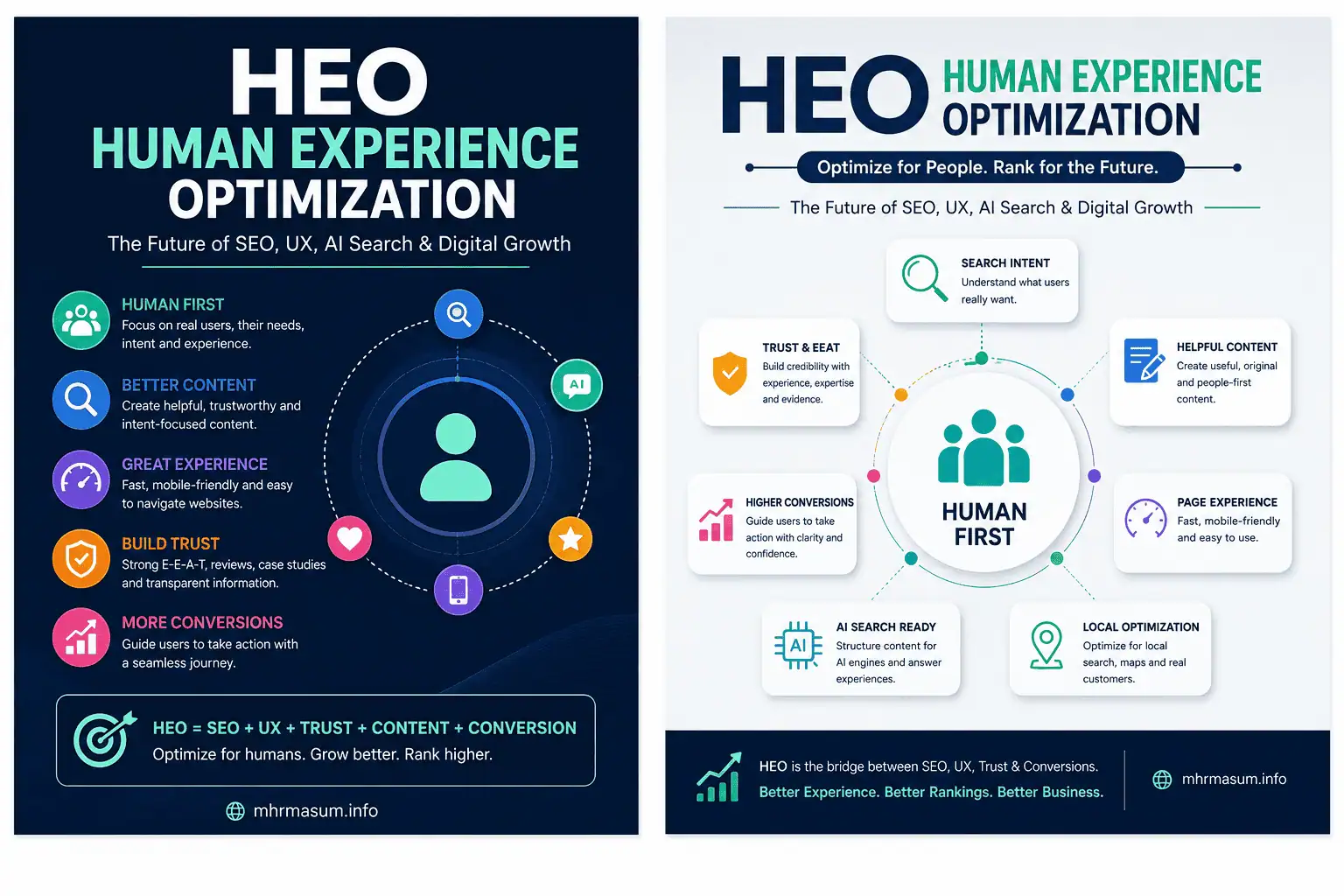
What does HEO stand for?
HEO usually stands for Human Experience Optimization in SEO and digital marketing. It means optimizing a website, content, and user journey for real human satisfaction, trust, and conversion.
Is HEO replacing SEO?
No. HEO does not replace SEO. It expands SEO by adding user experience, trust, content quality, conversion, and customer journey optimization.
Why is HEO important?
HEO is important because ranking alone is not enough. A website must also satisfy users, answer their questions, build trust, and guide them toward action.
How does HEO help SEO?
HEO helps SEO by improving content usefulness, page experience, engagement, trust, and conversion. These improvements can support stronger long-term organic performance.
Is HEO useful for AI search?
Yes. HEO is useful for AI search because AI systems prefer clear, structured, trustworthy, and helpful information that can be easily understood and summarized.
What is the difference between HEO and UX?
UX focuses mainly on user experience design and usability. HEO is broader. It includes UX, SEO, content quality, trust, conversion, brand experience, and customer satisfaction.
What type of websites need HEO?
Every website can benefit from HEO, especially service websites, local businesses, e-commerce stores, SaaS websites, blogs, agency websites, portfolio websites, and lead generation sites.