AI has changed content creation forever.
Today, anyone can open an AI tool and generate a 1,500-word article in a few seconds. This has made content production faster, cheaper, and easier than ever before.
But there is a problem.
Most AI-generated content sounds the same.
It uses the same structure, the same phrases, the same examples, the same surface-level explanations, and the same generic advice. It may look polished, but it does not add anything new. It may answer a topic broadly, but it does not show real experience, original insight, expert judgment, brand perspective, case studies, or practical depth.
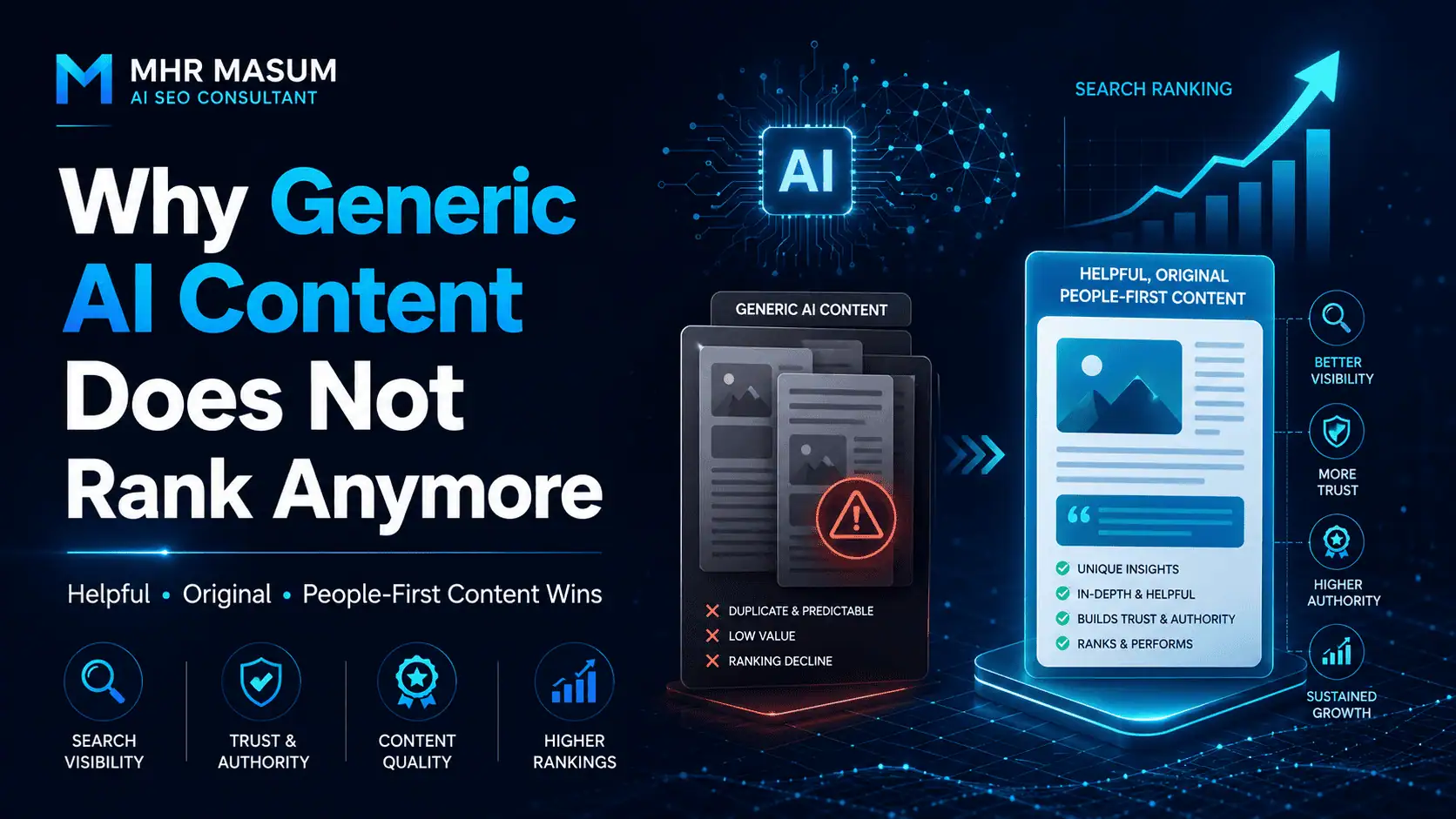
That is why generic AI content does not rank anymore.
Google does not rank content simply because it is long. AI search engines do not cite content simply because it is well formatted. Users do not trust content simply because it sounds professional.
Modern SEO is moving toward helpful, reliable, people-first content.
This does not mean AI content is bad. AI can be useful for research, outlines, structure, content improvement, editing, and idea generation. The real problem is generic, low-value, unoriginal, people-last AI content.
If you want your content to rank today, you need more than AI-generated paragraphs. You need human experience, original examples, strong topical authority, trust signals, proper internal linking, clear entity signals, and real value for the reader.
This is also why modern content strategy should connect with AI SEO, Entity SEO, brand authority for AI search, and a complete Local SEO strategy where relevant.
The future belongs to content that combines AI efficiency with human expertise, real experience, original analysis, technical SEO, entity clarity, and user-focused value.
What Is Generic AI Content?
Generic AI content is content that looks complete but does not provide unique value.
It usually gives basic information that can be found everywhere else. It may use proper headings and bullet points, but it does not show first-hand experience, original examples, expert opinions, real data, screenshots, case studies, local context, or brand-specific insight.
Generic AI content often feels like it was written for a topic, not for a reader.
It may be grammatically correct, but it is not memorable. It may be long, but it is not deep. It may mention keywords, but it does not fully satisfy search intent.
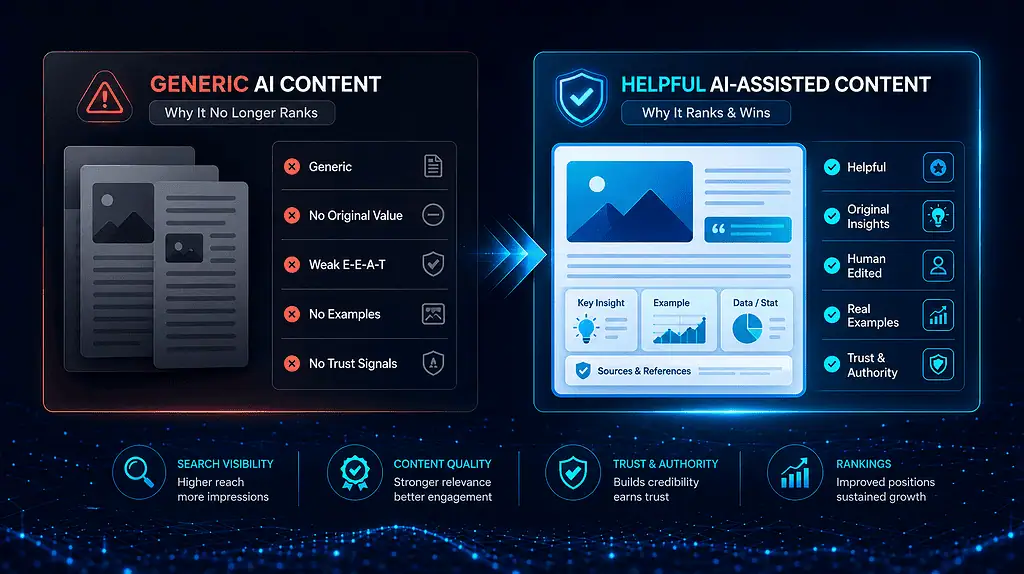
Common Signs of Generic AI Content
Generic AI content often includes:
- Broad definitions without depth
- Repeated phrases
- No real examples
- No original screenshots
- No case studies
- No expert opinion
- No personal or business experience
- No unique process
- No local context
- No brand voice
- No strong point of view
- No data or evidence
- No source references
- No clear audience targeting
- No practical next steps
- No proof that the writer understands the topic
- No reason for Google or AI tools to choose it over another article
For example, a generic AI article about Local SEO may say:
“Local SEO helps businesses appear in local search results. You should optimize your Google Business Profile, get reviews, use local keywords, and build citations.”
That is true, but it is not enough.
Thousands of websites already say the same thing.
A better article would explain how to optimize Google Business Profile categories, how reviews influence local trust, how to build service-area landing pages, how to avoid duplicate location pages, how to use LocalBusiness schema, how to track calls and direction requests, and how small businesses can use Local SEO with AI search visibility.
That is the difference between generic content and useful content.
If you want to see this type of deeper topic coverage, read this full guide on Local SEO in 2026.
Why Generic AI Content Became a Problem
AI tools made content creation very easy.
Before AI, creating a detailed article required research, planning, writing, editing, formatting, and SEO optimization. Now, many website owners generate dozens or hundreds of articles quickly.
This created a flood of similar content across the web.
Many websites started publishing AI-generated posts that:
- Repeat the same basic information
- Target keywords without adding value
- Use similar headings
- Use generic examples
- Lack original research
- Lack expert input
- Lack real experience
- Lack fact-checking
- Lack trust signals
- Exist mainly to capture search traffic
As a result, Google and users became better at identifying low-value content.
The issue is not that AI wrote the content. The issue is that the content does not deserve to rank.
So the question is not:
“Was this content written by AI?”
The better question is:
“Does this content provide real value that users cannot easily get from every other page?”
If the answer is no, the content will struggle.
Why Generic AI Content Does Not Rank Anymore
Generic AI content fails because modern search engines and AI systems need more than words.
They need helpfulness, originality, trust, expertise, context, entity clarity, and user satisfaction.
1. It Does Not Add New Value
The biggest problem with generic AI content is that it does not add anything new.
Search engines already have millions of pages explaining common topics. If your content only repeats what already exists, why should Google rank it?
A generic article may explain:
- What SEO is
- Why SEO matters
- Basic benefits of SEO
- General SEO tips
- A short conclusion
But this is not enough anymore.
A strong article should add:
- Original examples
- Step-by-step process
- Expert opinion
- Case studies
- Data
- Screenshots
- Templates
- Mistakes to avoid
- Checklists
- Industry-specific advice
- Local context
- Updated insights
- Practical implementation guidance
Content that adds new value gives search engines and users a reason to trust it.
2. It Lacks Real Experience
Google’s quality expectations strongly value content that shows real experience.
Experience means the writer has actually done the work, used the product, served the client, solved the problem, tested the method, visited the place, or handled the situation.
Generic AI content cannot naturally provide real experience unless a human adds it.
For example, if you are writing about Google Business Profile optimization, real experience may include:
- A real ranking improvement example
- A screenshot of profile performance
- A mistake you fixed for a client
- A category selection issue
- A review strategy that worked
- A local citation problem
- A service-area business challenge
- A before-and-after case study
Without these details, the content feels theoretical.
Users want content written by someone who understands the problem in the real world.
This is why a strong SEO portfolio and real project examples can support content trust.
3. It Sounds Like Every Other Article
AI tools often produce similar phrasing.
Generic AI content often uses phrases like:
- In today’s digital world
- It is important to note
- By leveraging these strategies
- This comprehensive guide
- Unlock the power of
- In conclusion
- Whether you are a beginner or an expert
- Businesses can stay ahead of the competition
These phrases are not always bad, but when the entire article sounds like this, it becomes forgettable.
Google has many options. Users have many options. AI search tools have many sources.
If your content sounds exactly like every other page, it becomes replaceable.
Ranking content needs a clear reason to exist.
4. It Does Not Fully Satisfy Search Intent
Search intent means what the user actually wants when they search.
Generic AI content often answers the topic broadly but misses the real intent.
For example, if someone searches “why AI content does not rank,” they may want to know:
- Is AI content penalized?
- What makes AI content low quality?
- How does Google judge AI content?
- How can I improve AI content?
- What examples show good vs bad AI content?
- Can AI content rank if edited properly?
- How do E-E-A-T and helpful content apply?
- What should writers and SEOs do differently?
A generic answer may only say:
“AI content does not rank because it lacks originality. You should add human touch and optimize for SEO.”
That is too shallow.
A useful article must answer the full intent.
5. It Has Weak E-E-A-T Signals
E-E-A-T stands for Experience, Expertise, Authoritativeness, and Trustworthiness.
Generic AI content often has weak E-E-A-T because it lacks:
- Author bio
- Real expertise
- First-hand experience
- Source references
- Case studies
- Client examples
- Review signals
- Brand identity
- Clear About page
- Editorial standards
- Updated information
- Contact details
- Transparent business information
For sensitive topics like finance, health, legal, and safety, weak trust signals are even more damaging.
But E-E-A-T is not only for high-risk topics. It matters for business, SEO, local services, software, travel, education, and product recommendations too.
Your About page is one of the most important trust assets because it helps users and search engines understand who is behind the content.
6. It Has No Strong Entity Signals
Modern SEO is not only about keywords. It is also about entities.
An entity can be a person, brand, business, service, location, product, or topic.
Generic AI content often lacks clear entity signals.
It may not clearly show:
- Who wrote the content
- What the brand is known for
- What services the business provides
- Where the business operates
- What topics the website has authority in
- Which author has expertise
- How the content connects to other pages
- What proof supports the claims
This is where Entity SEO becomes important.
Entity SEO helps search engines understand your brand, authors, services, locations, and topical authority.
If your content is generic and disconnected from your website’s entity, it becomes weaker.
For example, an SEO consultant’s article should connect naturally with:
- About page
- Service pages
- Portfolio
- Case studies
- AI SEO content
- Local SEO content
- Technical SEO content
- Author profile
- Contact page
This creates meaning and trust.
7. It Is Often Created for Search Engines First
Many AI articles are created only to target keywords.
They are not created because the business has something useful to say.
This creates content that is technically optimized but not genuinely helpful.
If your content makes users return to Google to find a better answer, that is a bad signal.
The best content should make users feel:
“This answered my question clearly.”
8. It Has No Original Research or Proof
AI can summarize what already exists, but it cannot create real proof unless a human adds it.
Strong content often includes:
- Original screenshots
- Real examples
- Internal data
- Client results
- Process images
- Before-and-after comparisons
- Testing results
- Expert quotes
- Survey insights
- Review analysis
- Field experience
- Product testing
- Custom checklists
Generic AI content rarely includes these.
That is why it struggles against content that has real proof.
For example, a roofing Local SEO case study or a pest control GMB case study can provide stronger evidence than a generic article that only explains SEO theory.
9. It Is Too Similar to Existing Content
Search engines do not need to rank ten pages that say the same thing.
If your article is just another version of existing top-ranking pages, it may not perform.
Generic AI content often copies the structure of common content:
- Introduction
- What is X?
- Why X matters
- Benefits of X
- Tips for X
- Conclusion
This structure is not wrong, but it is not enough.
You need a unique angle.
For example, instead of writing:
“What Is Local SEO?”
A better angle may be:
“Local SEO in 2026: How Small Businesses Can Rank in Google Maps and AI Search”
Instead of writing:
“What Is AI SEO?”
A better angle may be:
“AI SEO: How to Rank in Google AI Overviews, ChatGPT, Gemini, and Perplexity”
Specific angles are more useful than generic topics.
10. It Ignores User Experience
Some AI content is long but hard to read.
It may have:
- Huge paragraphs
- Repeated sections
- No visual breaks
- No examples
- No summary
- No tables
- No screenshots
- No clear next steps
- Weak formatting
- No internal links
- No CTA
Good content is not only about words.
It is also about presentation.
Users need to scan, understand, and act.
That means strong content should include:
- Clear headings
- Short paragraphs
- Bullet points
- Tables where useful
- Examples
- FAQs
- Visuals
- Internal links
- CTA
- Summary sections
- Practical checklists
Helpful formatting improves user experience and engagement.
This is also why HEO, or Human Experience Optimization, matters for modern SEO and content performance.
Is AI Content Bad for SEO?
No, AI content is not automatically bad for SEO.
AI can help with:
- Topic research
- Outline creation
- Keyword grouping
- Drafting
- Summarizing notes
- Rewriting unclear text
- Creating FAQs
- Formatting content
- Generating title ideas
- Building content briefs
- Creating schema drafts
- Repurposing content
- Finding content gaps
The problem is low-value AI content.
AI should support human expertise, not replace it completely.
A good content process uses AI as an assistant, not as the final authority.
For businesses that want to grow in both traditional search and AI-powered search, content should also support AI SEO, GEO vs AEO vs SEO, and brand authority.
What Type of AI Content Can Still Rank?
AI-assisted content can rank when it is useful, accurate, original, and improved by human expertise.
AI Content Can Rank When It Has
- Clear search intent match
- Human editing
- Expert review
- Real examples
- Original insights
- Accurate facts
- Updated information
- Source references
- Strong internal links
- Helpful structure
- Brand voice
- Author credibility
- First-hand experience
- Proper schema
- Practical steps
- User-focused writing
- Unique value
For example, an AI-assisted article about “review strategy for Local SEO” can rank if it includes:
- Google review policy explanation
- Local ranking context
- Review request templates
- Response examples
- Fake review risks
- Google Business Profile advice
- AI search visibility connection
- Local business examples
- Internal links to Local SEO and AI SEO guides
- FAQs
- CTA
- Expert review
This is why a detailed article like How Reviews Help Local SEO and AI Search Visibility is stronger than a generic article about “why reviews matter.”
What Type of AI Content Fails?
AI content fails when it is shallow, generic, mass-produced, and not improved.
AI Content Usually Fails When It Has
- No original value
- No expert input
- No fact-checking
- No examples
- No internal links
- No external references
- No unique angle
- No author trust
- No first-hand experience
- No brand voice
- No clear audience
- No practical application
- No helpful conclusion
- No real problem-solving
- No reason to exist
A 3,000-word generic article can still be low quality.
Length does not equal value.
A 900-word expert article with original experience can be stronger than a 3,000-word generic AI article.
The Difference Between Generic AI Content and Helpful AI-Assisted Content
Generic AI Content
Generic AI content usually says what everyone already knows.
It is broad, safe, and forgettable.
Example:
“SEO is important for businesses because it helps improve visibility and attract more customers.”
This is true, but it is basic.
Helpful AI-Assisted Content
Helpful AI-assisted content uses AI to support structure, but the real value comes from human input.
Example:
“For a local roofing business in Brisbane, SEO should not only target ‘roofing Brisbane.’ The website should build separate pages for roof repairs, roof restoration, gutter replacement, emergency roof leaks, and suburb-level service areas. Google Business Profile categories, local citations, review strategy, and service-page internal links should all support the same local entity.”
This is more useful because it gives practical context.
The difference is depth, specificity, and experience.
Why Google Prefers Helpful, People-First Content
Google wants to satisfy users.
If users search for something and find a helpful result, they trust Google more.
If users find shallow, generic, copied, or AI-spun content, they lose trust.
Helpful content usually has:
- Clear purpose
- Accurate information
- First-hand experience
- Expert explanation
- Original insight
- Strong structure
- Trust signals
- Practical answers
- Good user experience
- Clear next steps
People-first content is not written just to rank.
It is written to help the reader solve a real problem.
This is why your content should connect education with useful service pages such as SEO and digital marketing services when the reader needs professional support.
How AI Search Changed the Content Game
AI search has made generic content even weaker.
In traditional search, a user may click several results and compare them.
In AI search, tools may summarize answers directly.
This creates a new challenge.
If your content is generic, AI can summarize the same information without needing your page.
To be cited, referenced, recommended, or trusted, your content needs something more.
AI Search Needs Source-Worthy Content
Source-worthy content includes:
- Original definitions
- Unique frameworks
- Data
- Examples
- Checklists
- Expert opinion
- Case studies
- Clear explanations
- Brand experience
- First-hand knowledge
- Specific answers
- Updated insights
Generic content is easy to replace.
Source-worthy content is harder to replace.
For a deeper explanation of AI-powered visibility, read this guide on AI SEO.
Why AI Search Engines Ignore Generic Content
AI search engines need sources that help produce reliable answers.
Generic content is less useful because it does not provide unique evidence or authority.
AI Search May Ignore Generic Content Because
- It repeats common knowledge
- It lacks unique facts
- It lacks expertise
- It lacks citations
- It lacks entity clarity
- It lacks topical authority
- It lacks trust signals
- It does not answer specific questions deeply
- It does not provide examples or proof
- It is similar to thousands of other pages
AI tools may prefer content that is clearer, more authoritative, more specific, and more useful.
This is why generic content is losing value in both traditional SEO and AI search visibility.
If your brand wants to appear in AI-generated recommendations, you need stronger brand authority for AI search.
The Role of E-E-A-T in AI Content Ranking
E-E-A-T is very important for AI-assisted content.
Experience
Experience means the content shows the writer has real-world knowledge.
Add:
- Personal examples
- Client examples
- Process insights
- Case studies
- Product usage
- Screenshots
- Real mistakes
- Lessons learned
- Before-and-after results
Expertise
Expertise means the content shows deep understanding.
Add:
- Detailed explanations
- Correct terminology
- Practical advice
- Advanced insights
- Expert review
- Industry-specific examples
- Clear recommendations
Authoritativeness
Authoritativeness means others recognize your knowledge.
Add:
- Backlinks
- Brand mentions
- Testimonials
- Reviews
- Portfolio
- Media mentions
- Guest posts
- Case studies
- Social proof
Trustworthiness
Trustworthiness means users can trust your content and business.
Add:
- Author bio
- Contact page
- About page
- Privacy policy
- Sources
- Updated dates
- Transparent claims
- Honest limitations
- Real business details
Generic AI content usually misses these signals.
Helpful AI-assisted content includes them.
How Entity SEO Helps AI Content Rank
Entity SEO helps search engines understand who is behind the content and what the website is known for.
A strong content piece should connect to your website’s main entities.
Important Entities for a Business Website
- Brand entity
- Person entity
- Organization entity
- Service entity
- Location entity
- Topic entity
- Product entity
- Review entity
- Author entity
For example, an SEO consultant website should connect AI content to:
- The consultant’s About page
- SEO and digital marketing services
- Local SEO strategy
- AI SEO content
- Case studies and SEO portfolio
- Technical SEO and keyword research
- Contact page
- Author bio
- Social profiles
This helps search engines understand that the content is not random.
It belongs to a trusted topical and brand ecosystem.
Why Topical Authority Beats Random AI Articles
Many websites publish random AI articles across different topics.
One day they publish about SEO. The next day about fitness. Then about travel. Then about finance. Then about home repair.
This weakens topical authority.
Search engines need to understand what your website is truly about.
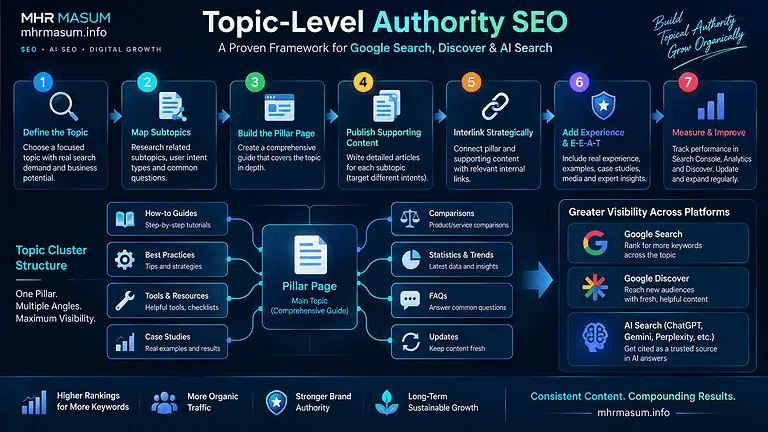
A website with strong topical authority has organized content clusters.
AI SEO Cluster
- What is AI SEO?
- How to rank in Google AI Overviews
- ChatGPT SEO
- Gemini SEO
- Perplexity SEO
- GEO vs AEO vs SEO
- Brand authority for AI search
- Why generic AI content does not rank anymore
Local SEO Cluster
- Local SEO in 2026
- Google Business Profile optimization
- Review strategy for Local SEO
- Local citation building
- LocalBusiness schema
- Google Maps SEO
Technical SEO Cluster
- Technical SEO and keyword research
- Website speed optimization
- Crawlability and indexing
- Core Web Vitals
- Schema markup
- Internal linking
- Canonical tags
When your website covers a topic deeply, search engines can understand your topical expertise better.
Random AI articles do not build this kind of authority.
Why Human Editing Is No Longer Optional
AI drafts need human editing.
Without editing, AI content often includes:
- Factual errors
- Repetition
- Weak examples
- Generic phrases
- Missing context
- Poor flow
- Unsupported claims
- Overly broad advice
- No brand voice
- No practical depth
Human editing improves:
- Accuracy
- Tone
- Structure
- Originality
- Examples
- Search intent
- Readability
- Trust
- Conversion
- Brand positioning
- User value
A good editor should ask:
- Is this accurate?
- Is this useful?
- Is this original?
- Is this specific?
- Does it answer the search intent?
- Does it show experience?
- Does it include examples?
- Does it support the brand?
- Does it deserve to rank?
If the answer is no, the content needs improvement.
How to Turn Generic AI Content into Ranking Content
Generic AI content can be improved.
The goal is not to delete AI content blindly. The goal is to upgrade it.
Step 1: Identify the Search Intent
Before editing, ask:
- What does the reader really want?
- Are they looking for a definition?
- Are they looking for a checklist?
- Are they comparing options?
- Are they ready to buy?
- Are they trying to solve a problem?
- Are they looking for examples?
- Are they looking for expert guidance?
Content should be built around intent, not only keywords.
Step 2: Add a Unique Angle
A unique angle makes your content more useful.
Examples:
- For small businesses
- For Local SEO
- For AI search visibility
- For WordPress websites
- For service-area businesses
- For Google Business Profile owners
- For consultants and agencies
- For eCommerce brands
Instead of writing:
“Benefits of Reviews”
Write:
“How Reviews Help Local SEO and AI Search Visibility”
That angle is more specific and more valuable.
Step 3: Add Real Examples
Examples make content practical.
Add examples from:
- Client work
- Your own website
- Industry experience
- Common mistakes
- Real business situations
- Local markets
- Tools
- Reports
- Case studies
Examples prove that the content is not just theory.
Step 4: Add Expert Opinion
Do not be afraid to take a clear position.
Generic AI content often avoids strong opinions.
Expert content says:
- What works
- What does not work
- What is risky
- What is outdated
- What should be prioritized
- What should be avoided
- What small businesses should do first
Expert judgment creates trust.
Step 5: Add Original Structure
Do not always copy the same article format.
Create useful frameworks.
Examples:
- 90-day action plan
- Checklist
- Audit framework
- Step-by-step process
- Beginner vs advanced comparison
- Mistakes table
- Decision tree
- Ranking factor map
- Content improvement scorecard
Original structure makes content more useful and memorable.
Step 6: Add Internal Links
Internal links connect your content to the rest of your website.
A post about generic AI content should link to:
- AI SEO guide
- GEO vs AEO vs SEO article
- Entity SEO article
- Brand authority for AI search
- Local SEO guide
- Technical SEO and keyword research
- SEO and digital marketing services
- Contact page
Internal links help users and search engines understand your topical ecosystem.
Step 7: Add Trust Signals
Trust signals improve credibility.
Add:
- Author bio
- Date updated
- Sources
- Case studies
- Portfolio links
- Reviews
- Screenshots
- Contact details
- About page link
- Business details
- Clear CTA
Trust signals are especially important for AI-assisted content.
Step 8: Improve Formatting
Make content easy to read.
Use:
- Short paragraphs
- H2 and H3 headings
- Bullet points
- Numbered lists
- Tables
- Examples
- CTA blocks
- FAQ sections
- Summary boxes
- Images
- Infographics
Good formatting helps users stay longer and understand faster.
Step 9: Fact-Check Everything
AI can make mistakes.
Always check:
- Dates
- Statistics
- Tool names
- Policy claims
- Technical steps
- Legal, medical, or financial advice
- Product details
- Pricing
- Google guidelines
- Platform policies
Never publish AI content without review.
Step 10: Add a Strong Conclusion and CTA
A generic conclusion says:
“In conclusion, AI content can help businesses improve SEO.”
A better conclusion says:
“AI can help create content faster, but rankings now require human expertise, original value, trust signals, and real problem-solving. If your AI content is generic, it will be ignored. If it is improved with experience, examples, entity signals, and user-focused strategy, it can still perform.”
A good CTA should tell the reader what to do next.
AI Content Quality Checklist
Use this checklist before publishing any AI-assisted article.
Search Intent Checklist
- Does the content answer the main query?
- Does it answer related questions?
- Does it go deeper than basic definitions?
- Does it help the user take action?
- Does it reduce the need for another search?
Originality Checklist
- Does it include original examples?
- Does it include expert opinion?
- Does it include brand experience?
- Does it include unique structure?
- Does it avoid repeating the same information found everywhere?
E-E-A-T Checklist
- Is there an author?
- Is the author qualified?
- Does the content show real experience?
- Are claims supported?
- Are sources included where needed?
- Is the content accurate?
- Is the website trustworthy?
Entity SEO Checklist
- Does the content connect to the brand?
- Does it link to the About page?
- Does it link to related service pages?
- Does it support topic clusters?
- Does it use clear internal links?
- Does it strengthen the website’s topical identity?
User Experience Checklist
- Is the content easy to scan?
- Are paragraphs short?
- Are headings clear?
- Are lists useful?
- Are examples included?
- Are visuals added where helpful?
- Is there a clear CTA?
Technical SEO Checklist
- Is the page indexable?
- Is the URL clean?
- Is the title optimized?
- Is the meta description useful?
- Are headings properly structured?
- Are internal links added?
- Is schema markup considered?
- Is the page mobile-friendly?
- Does it load fast?
For stronger technical foundations, review your technical SEO and keyword research process and improve website speed optimization where needed.
Good AI Content vs Bad AI Content
Bad AI Content Example
Title: What Is SEO?
Content:
“SEO is search engine optimization. It helps websites rank higher in search engines. Businesses should use keywords, backlinks, and good content. SEO is important for online success.”
This is too basic.
Good AI-Assisted Content Example
Title: Local SEO in 2026: Complete Guide for Small Businesses
Content includes:
- Google Business Profile optimization
- Local ranking factors
- Review strategy
- Citation building
- Service-area pages
- LocalBusiness schema
- AI search visibility
- Local content strategy
- Tracking methods
- Common mistakes
- 90-day action plan
- FAQs
- CTA
This is more useful because it solves real problems.
Why Content Depth Matters More Than Word Count
Many people think long content ranks better.
That is not always true.
A long generic article can fail. A shorter expert article can rank.
Content depth means the content fully answers the topic.
Depth includes:
- Clear explanation
- Complete intent coverage
- Practical steps
- Examples
- Context
- Expert insight
- Supporting evidence
- Related questions
- Use cases
- Mistakes
- Tools
- Templates
- Next steps
Word count is not the goal.
Usefulness is the goal.
Why Original Experience Is the New SEO Advantage
AI can generate general information.
But it cannot replace your real-world experience.
Your experience is your advantage.
Add:
- What you have tested
- What worked for clients
- What failed
- What changed after an update
- What mistakes you see often
- What you recommend first
- What tools you use
- What your process looks like
- What results you achieved
- What lessons you learned
This makes content more trustworthy.
For example, instead of saying:
“Internal links are important for SEO.”
Say:
“When I optimize service business websites, I always connect homepage sections, service pages, blog posts, and case studies with descriptive internal links. This helps Google understand the business topics and also helps users move from education to conversion.”
That sounds like experience.
Why Brand Voice Matters
Generic AI content has no personality.
Brand voice makes content recognizable.
Your brand voice should reflect:
- Your expertise
- Your audience
- Your service style
- Your values
- Your market
- Your communication tone
- Your level of detail
- Your practical approach
For an SEO consultant, the voice should be:
- Clear
- Practical
- Direct
- Helpful
- Experience-based
- Business-focused
- Easy to understand
- Trust-building
Brand voice helps users remember you.
Why Internal Linking Helps AI Content Perform
Internal linking helps generic content become part of a stronger website system.
A standalone AI article is weak.
A connected article is stronger.
Internal links help:
- Search engines discover pages
- Users move to related content
- Build topical authority
- Support entity relationships
- Pass relevance between pages
- Improve engagement
- Guide users toward services
- Strengthen conversion paths
For example, a post about generic AI content should link naturally to related topics like AI SEO, Entity SEO, brand authority for AI search, and Local SEO.
This shows that the website has depth, not just one random article.
Why Generic AI Content Fails in Competitive Niches
In competitive industries, generic content has almost no chance.
Competitive niches include:
- SEO
- Digital marketing
- Finance
- Health
- Legal
- Real estate
- Software
- Insurance
- Education
- Travel
- Local services
- eCommerce
- SaaS
- Home improvement
These topics already have many strong websites.
To compete, content must show:
- Better expertise
- Better structure
- Better freshness
- Better proof
- Better examples
- Better authority
- Better topical coverage
- Better user experience
Generic AI content cannot compete with expert content in these spaces.
How to Use AI the Right Way for SEO Content
AI is still useful.
The best workflow is not “AI writes, human publishes.”
The best workflow is:
- Human chooses the topic.
- Human defines the audience.
- Human defines the search intent.
- AI helps create the outline.
- Human adds expertise and examples.
- AI helps improve structure and clarity.
- Human fact-checks.
- Human adds internal links.
- Human adds images, schema, and CTA.
- Human reviews before publishing.
- Human updates the article over time.
This workflow creates AI-assisted content, not generic AI content.
How to Audit Existing AI Content
If you already published AI content, audit it.
Questions to Ask
- Is this content useful?
- Does it answer the full search intent?
- Does it include real examples?
- Does it show experience?
- Is it different from competitors?
- Is it connected to internal pages?
- Does it have sources?
- Does it have a clear CTA?
- Does it support my brand authority?
- Would I trust this content if I were the reader?
- Would I bookmark it?
- Would I share it?
- Would another website cite it?
If most answers are no, improve the content.
What to Do With Weak AI Content
You can:
- Rewrite it
- Merge it with a stronger page
- Add examples
- Add expert commentary
- Add sources
- Add internal links
- Add visuals
- Add FAQs
- Add schema
- Update facts
- Delete it if it has no value
Not every old article needs to stay.
Low-quality content can weaken the overall perception of your site.
Content Upgrade Framework for Generic AI Articles
Use this framework to improve any weak AI article.
1. Clarify the Reader
Who is the article for?
Examples:
- Small business owners
- Local SEO clients
- WordPress website owners
- eCommerce brands
- Travel business owners
- Digital marketers
- Consultants
- Agencies
2. Clarify the Problem
What problem does the reader need to solve?
Examples:
- My AI content is not ranking
- My blog posts get no traffic
- My content sounds generic
- My website has many posts but no leads
- My competitors outrank me
- My AI articles are indexed but not visible
3. Add Practical Steps
Give the reader a process.
Do not only explain the topic.
Tell them what to do.
4. Add Proof
Add:
- Case study
- Data
- Screenshot
- Example
- Template
- Checklist
- Comparison
- Expert opinion
5. Add Related Pages
Add internal links to related guides, services, case studies, and contact pages.
Important internal links can include:
6. Add CTA
Tell the user what to do next.
A strong CTA turns content into business value.
Common Mistakes When Publishing AI Content
Mistake 1: Publishing Without Editing
AI drafts should never be published without human review.
Mistake 2: Creating Too Many Similar Articles
Publishing many overlapping articles can create keyword cannibalization and weak content.
Mistake 3: Ignoring Search Intent
A keyword is not enough. You must understand what the user wants.
Mistake 4: No Internal Links
A content page without internal links is disconnected from the website.
Mistake 5: No Author or Trust Signals
Anonymous content is weaker than expert content.
Mistake 6: No Original Examples
Generic explanations are easy to replace.
Mistake 7: Not Updating Content
Old AI content can become outdated quickly.
Mistake 8: Overusing AI Phrases
AI-style writing can reduce trust and readability.
Mistake 9: No Clear CTA
Content without a CTA may educate but not convert.
Mistake 10: Writing for Bots Instead of People
SEO content should serve users first.
How to Future-Proof AI Content
To future-proof AI content, focus on quality, trust, and originality.
Build Content Around Real Expertise
Do not publish content just because a keyword exists.
Publish content where your brand has something useful to say.
Create Topic Clusters
Build authority by covering related topics deeply.
Add First-Hand Experience
Experience is hard for competitors and AI tools to copy.
Keep Content Updated
Refresh old content with new examples, screenshots, data, and insights.
Strengthen Author Profiles
Show who created the content and why they are qualified.
Improve Entity Signals
Connect your content with your brand, services, author, and topics.
Use AI for Efficiency, Not Replacement
AI should speed up content creation, but humans should add the value.
FAQs About Generic AI Content and SEO
Generic AI content can confuse business owners because some AI-assisted content ranks while other AI content fails. These FAQs explain the most common questions about AI content, SEO rankings, helpful content, and content quality.
Does Google Penalize AI Content?
Google does not automatically penalize content just because it was generated with AI. The issue is whether the content is helpful, reliable, original, and created for people instead of being created mainly to manipulate rankings.
Why Is My AI Content Not Ranking?
Your AI content may not rank because it is too generic, lacks original value, does not show experience, has weak trust signals, misses search intent, or is too similar to existing content.
Can AI Content Rank on Google?
Yes, AI-assisted content can rank if it is helpful, accurate, original, edited by humans, supported by expertise, and useful to readers.
Is Human Editing Required for AI Content?
Yes. Human editing is strongly recommended because AI can produce errors, generic advice, repeated phrases, and unsupported claims.
How Can I Make AI Content Better?
Add real examples, expert insight, original data, internal links, sources, case studies, clear formatting, FAQs, visuals, author trust signals, and a unique angle.
Should I Delete Old AI Content?
Not always. If the content has potential, improve it. If it is thin, duplicated, outdated, or completely useless, consider merging, rewriting, or removing it.
What Is the Difference Between AI Content and Generic AI Content?
AI content means content created with AI assistance. Generic AI content means low-value content that lacks originality, experience, depth, and trust. AI-assisted content can be useful if humans improve it properly.
Does AI Content Work for Local SEO?
Yes, but only if it includes local context, service details, real examples, Google Business Profile strategy, reviews, location relevance, and useful guidance for local customers.
Does AI Content Help AI Search Visibility?
It can, but only when the content is trustworthy, source-worthy, structured, and connected to strong entity and brand signals.
What Is the Best AI Content Strategy?
The best strategy is to use AI for research, structure, and drafting, then add human expertise, examples, proof, internal links, trust signals, and final editorial review.
Need Help Creating AI Content That Actually Ranks?
Generic AI content will not build long-term search visibility.
If your website has AI-generated articles that are not ranking, the problem may be weak search intent, poor topical authority, missing internal links, thin content, lack of E-E-A-T, or no original value.
A strong AI SEO strategy should combine content quality, entity signals, technical SEO, internal linking, topical authority, brand authority, and human expertise.
If you need help improving your AI content, building SEO content clusters, optimizing existing posts, or creating a content strategy for Google and AI search visibility, explore my SEO and digital marketing services or contact me here for a consultation.
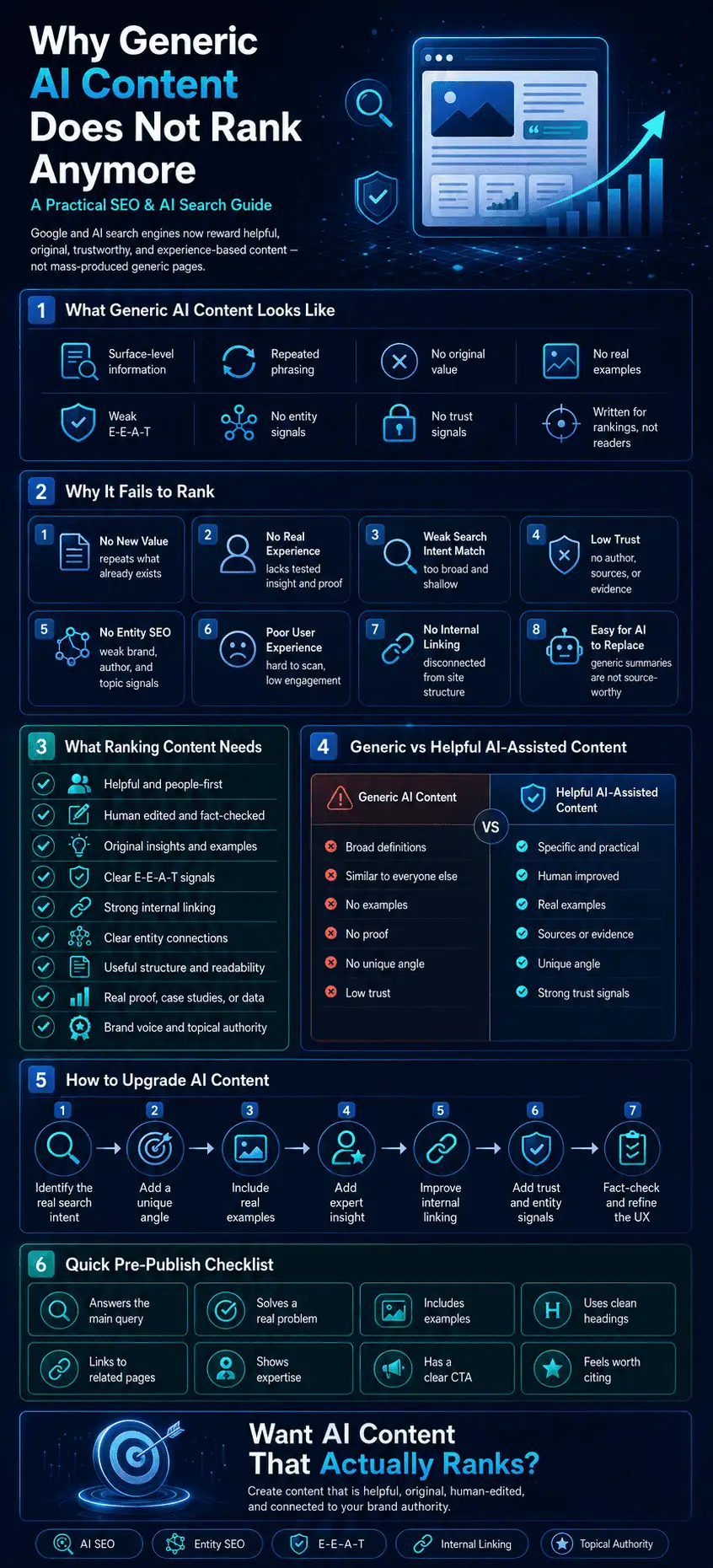
Conclusion
Generic AI content does not rank anymore because the web is full of similar, shallow, and repetitive articles.
Google and AI search engines are looking for content that is useful, trustworthy, original, and created for people.
AI is not the enemy.
Low-value content is the enemy.
AI can help you create better content faster, but it cannot replace real experience, expert judgment, brand voice, original proof, and human strategy.
If you want your content to rank, do not publish AI drafts as final articles.
Improve them.
Add real examples.
Add expert insight.
Add internal links.
Add trust signals.
Add original value.
Add better structure.
Add your experience.
Add a reason for users to choose your content over every other page.
Modern SEO is no longer about publishing more content.
It is about publishing better content.
And in the age of AI search, better content means content that is helpful, experience-based, source-worthy, entity-connected, and truly useful for people.