Managing an education consultancy is not only about collecting student inquiries. Every lead moves through many steps before becoming a successful student. There are counseling sessions, university selection, offer letters, visa files, document checks, payments, invoices, follow-ups, branch-level reporting and staff activities
When all these tasks are managed manually through spreadsheets, notebooks, WhatsApp messages or scattered files, it becomes difficult to track everything properly. Important applicants can be missed. Payment records can become confusing. Follow-ups may be delayed. Branch managers may not get clear reports. The whole team may lose time searching for simple information.
That is why I developed MHR EduQuest CRM, a custom CRM system designed especially for education consultancies, language training centers and student admission agencies.
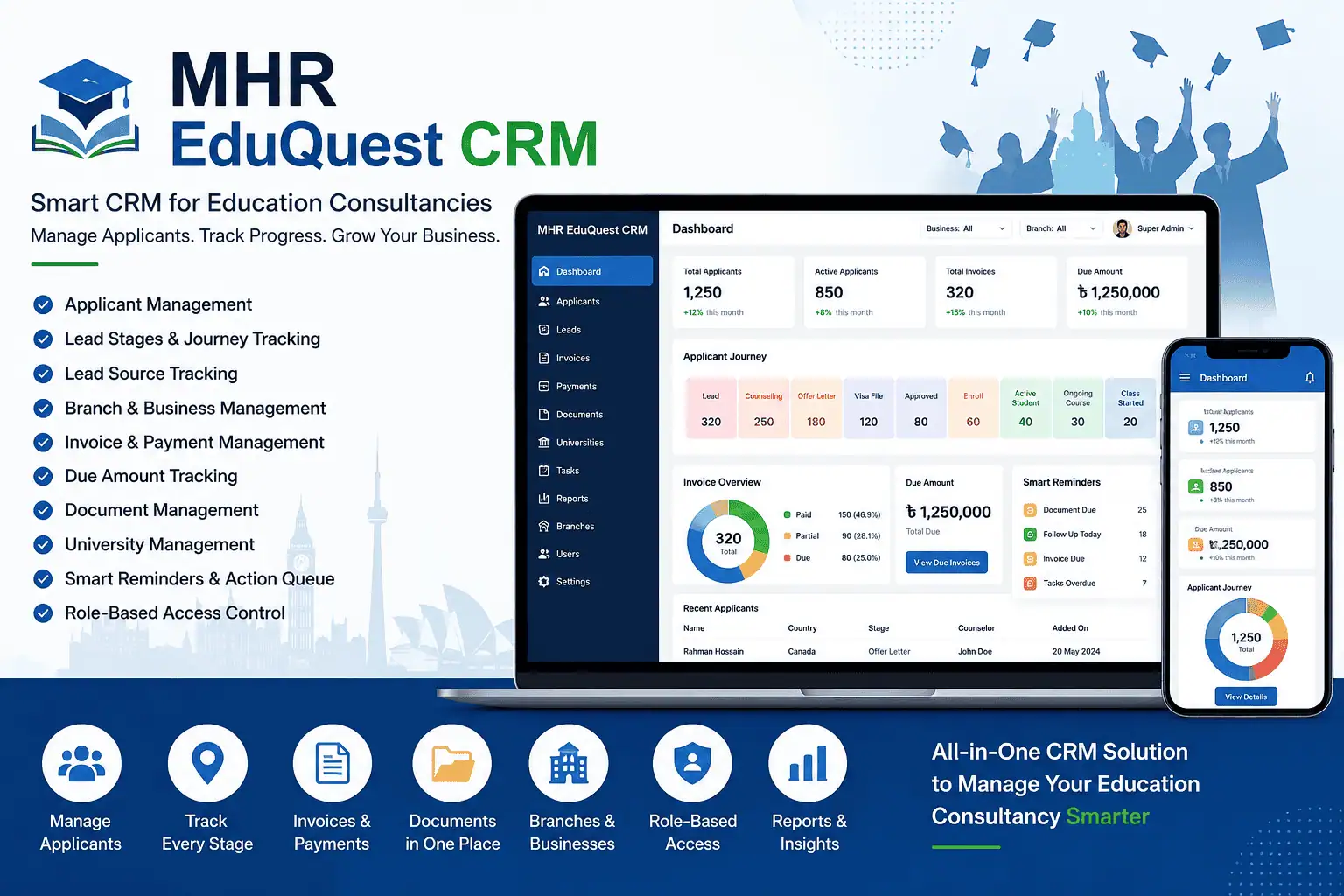
This CRM is built to make daily admission work easier, faster and more organized. It helps the team manage applicants, lead stages, documents, invoices, payments, universities, branches, business units and staff roles from one clean dashboard.
What Is MHR EduQuest CRM?
MHR EduQuest CRM is a custom web-based customer relationship management system for education-related businesses. It is designed for organizations that handle student inquiries, admission processing, visa file management, course enrollment, document collection and financial tracking.
Unlike a general CRM, this system is focused on the real workflow of an education consultancy. It includes applicant journey tracking, lead source management, branch-wise data, business-wise reporting, invoice due tracking, payment records, university catalog management and staff role access.
The goal is simple: keep everything in one place so the team can work faster and management can see accurate data anytime.
Why Education Consultancies Need a CRM
Most education consultancies deal with many types of inquiries every day. Some students come from Facebook groups. Some come from WhatsApp. Some are referred by previous students. Some come from paid ads, personal references, websites or walk-ins.
After the first inquiry, each applicant needs proper follow-up. The team needs to know the student’s preferred country, program, university, budget, document status, payment status and current stage.
Without a CRM, these details are often stored in separate files or personal messages. This creates many problems.
A CRM solves this by creating one central system for all applicants and related tasks. It helps the team avoid missed leads, duplicate entries, unclear payment records and poor communication.
Key Features of MHR EduQuest CRM
MHR EduQuest CRM includes the important features needed to run an education consultancy more professionally.
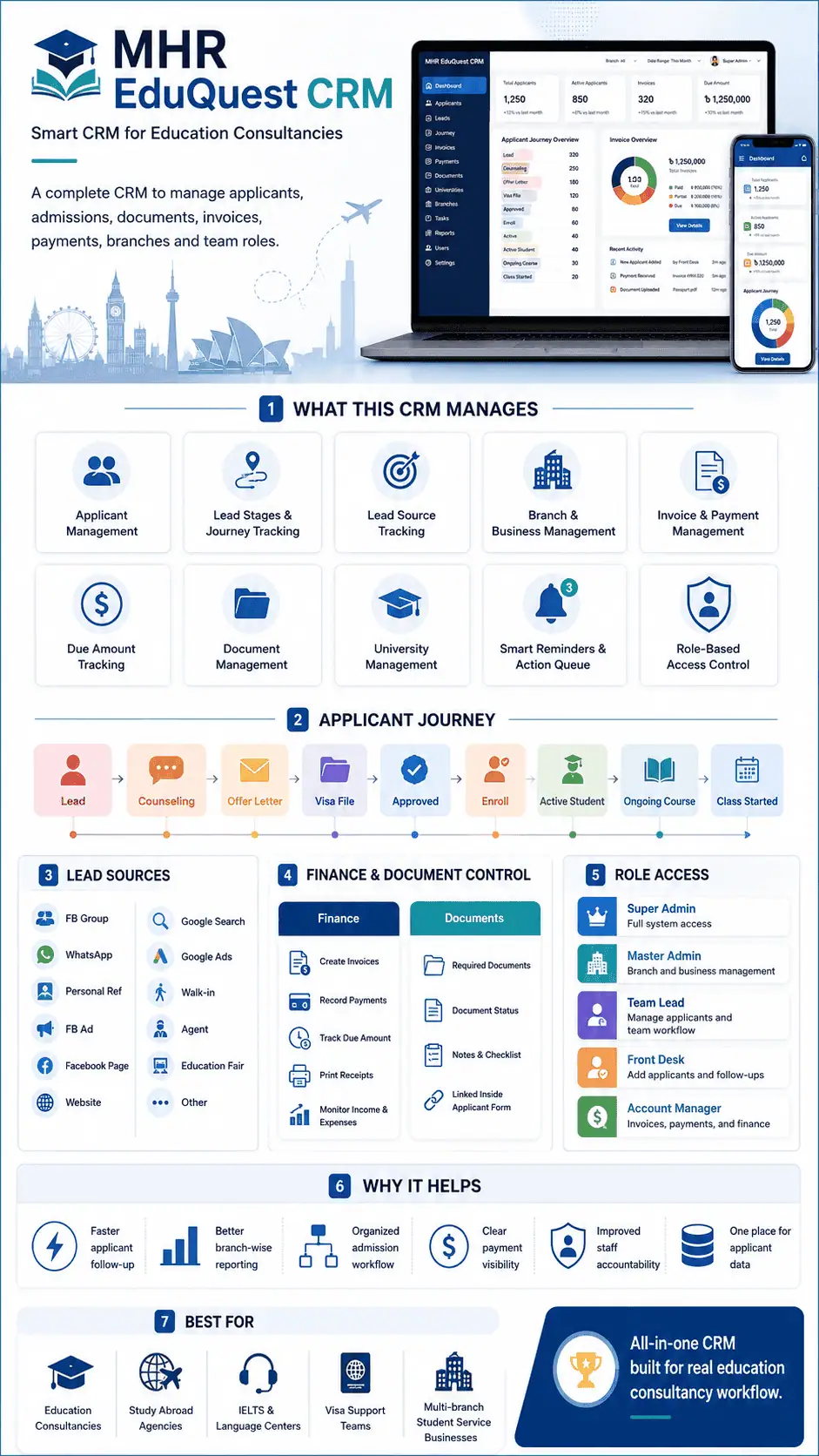
1. Applicant Management
The applicant module is the core part of the CRM. It allows the team to add, edit and manage student profiles.
Each applicant can include important details such as name, contact information, preferred country, preferred course, assigned counselor, lead source, current stage, document status and notes.
This helps the team quickly understand where each applicant stands and what action is needed next.
2. Applicant Journey Board
The CRM includes an applicant journey view where leads are grouped by stage. This gives the team a visual overview of the admission pipeline.
Example stages include:
- Lead
- Counseling
- Offer Letter
- Visa File
- Approved
- Enroll
- Active Student
- Ongoing Course
- Class Started
- Closed
- Rejected
This makes it easy to see how many applicants are in each stage and which students need attention.
3. Lead Source Tracking
Every education consultancy needs to know where quality leads are coming from. MHR EduQuest CRM includes lead source tracking so the team can record the source of each applicant.
Lead source options include:
- FB Group
- Personal Ref
- FB Ad
- Facebook Page
- Website
- Google Search
- Google Ads
- Walk-in
- Agent
- Education Fair
- Other
This helps management understand which marketing channels are producing real inquiries and which sources need improvement.
4. Branch-Wise and Business-Wise Data
Many education businesses operate with multiple branches or multiple business units. MHR EduQuest CRM supports branch-wise and business-wise data filtering across the CRM.
This means applicant records, invoices, payments, reminders, reports and dashboard data can be viewed based on selected business and branch.
For example, if a company has a Dhaka branch and Sylhet branch, the CRM can show separate data for each branch. This makes reporting more accurate and helps each branch manager track performance clearly.
5. Invoice and Payment Management
The CRM includes a dedicated invoice module to create invoices, record payments and monitor due amounts.
The payment system is designed to avoid confusion. When adding a payment, the CRM can show:
- Total invoice amount
- Already paid amount
- Due amount
- New payment amount
This makes it easier for the account team to record partial payments and track outstanding balances.
The system also supports receipt generation and invoice printing, which helps maintain professional financial documentation.
6. Due Amount Tracking
One of the most useful parts of the CRM is due amount visibility. The system can show invoice due amounts clearly so the account team can follow up with applicants when payment is pending.
This is important for education consultancies because many students pay in installments. Without a proper due tracking system, it is easy to lose control of receivables.
7. Document Management Inside Applicant Form
In education consultancy work, documents are extremely important. Students may need passports, academic certificates, transcripts, photos, bank statements, offer letters and visa-related files.
Instead of keeping documents as a separate confusing section, MHR EduQuest CRM includes document options inside the applicant form. This keeps document information directly connected with the applicant profile.
The team can track required documents, document status and document notes from the same applicant record.
8. University Catalog Management
The CRM includes a university module where partner universities can be added and maintained.
This can include university name, country, number of programs, tuition information, contact email and partner status.
For education consultancies, this makes university information easier to manage and access during counseling sessions.
9. Smart Reminders and Action Queue
Follow-up is one of the most important parts of student admission. If a counselor forgets to follow up, a potential student may choose another agency.
MHR EduQuest CRM includes smart reminder and action queue sections to help the team stay updated about invoices, document risks and deadlines.
This helps reduce missed follow-ups and improves the overall admission workflow.
10. Role-Based Access Control
Not every staff member should have access to every part of the CRM. That is why the CRM includes role-based access control.
The current role structure includes:
- Super Admin
- Master Admin
- Team Lead
- Front Desk
- Account Manager
- Read Only
Each role has different permissions based on the work they need to perform.
CRM Role Access Structure
Super Admin
The Super Admin has full access to the CRM. This role can manage all branches, businesses, users, applicants, invoices, payments, reports, settings and system data.
This role is best for the business owner or main system controller.
Master Admin
The Master Admin can manage major CRM operations for assigned business or branch. This role can manage applicants, invoices, documents, reports, universities and team users.
This role is best for branch managers or senior administrators.
Team Lead
The Team Lead can manage applicants, update lead stages, assign work, add follow-ups, manage application tasks and support the admission team.
This role is useful for admission team leaders or senior counselors.
Front Desk
The Front Desk role can add applicants, edit basic applicant details, update lead source, add notes and manage daily follow-ups.
This role is useful for reception, inquiry handling and first-level student communication.
Account Manager
The Account Manager role is focused on finance. This role can manage invoices, payments, due amounts, receipts, income, expenses and finance reports.
This role should not add or edit applicant admission details.
Read Only
The Read Only role is for users who need to view data but should not change records. This is useful for observers, management reviewers or temporary access.
Why Role-Based Access Is Important
Role-based access protects the CRM from mistakes and unauthorized changes. For example, a front desk user should not delete invoices. An account manager should not change applicant admission stages. A team lead should not change system settings.
By giving each user the correct access, the CRM becomes safer, cleaner and easier to manage.
Dashboard Overview
The CRM dashboard gives a quick snapshot of the business. It can show active applicants, invoice due amount, net position, document risks, applicant journey, smart reminders, action queue and invoice pulse.
This helps management understand the current situation without opening every module manually.
A good dashboard saves time because the most important information is visible in one place.
Financial Tracking for Education Consultancies
Education consultancies need clear financial control. They may receive consultation fees, admission service charges, visa processing fees, course fees or other payments.
MHR EduQuest CRM helps manage:
- Invoice creation
- Paid amount
- Due amount
- Payment records
- Receipts
- Income tracking
- Expense tracking
- Net position
- Branch-wise finance data
This makes the CRM useful not only for admission teams but also for the accounts department.
How This CRM Helps Daily Operations
MHR EduQuest CRM improves daily work in several ways.
First, it keeps all applicant data in one place. Staff do not need to search through Excel sheets or old messages.
Second, it makes follow-up easier. The team can see which applicants need action and which stage they are currently in.
Third, it improves financial clarity. The account manager can see paid and due amounts without asking counselors for updates.
Fourth, it improves branch control. Management can check data by business and branch.
Fifth, it improves staff accountability. Each role has clear permissions, so everyone knows what they can manage.
Benefits of MHR EduQuest CRM
The main benefits of this CRM include:
- Better applicant tracking
- Faster student follow-up
- Clear admission pipeline
- Organized document status
- Accurate invoice and payment records
- Branch-wise and business-wise reporting
- Better team accountability
- Safer role-based access
- Cleaner university management
- Improved daily productivity
For an education consultancy, these benefits can directly improve lead conversion, student service quality and internal management.
Who Can Use This CRM?
MHR EduQuest CRM is suitable for:
- Education consultancy firms
- Student admission agencies
- Visa processing agencies
- Language training centers
- IELTS and English training centers
- Study abroad consultants
- Branch-based education service businesses
- University admission support companies
- Overseas education marketing teams
Any business that manages student inquiries, applications, documents and payments can benefit from this CRM.
Why I Built This CRM
As a digital marketing consultant and WordPress/CRM solution developer, I have worked with many businesses that struggle with data management. Education consultancies especially need a system that matches their real workflow.
Generic CRMs can be powerful, but they are often too complex or not focused on student admission work. Many consultancies need a simple, practical and customized CRM that their team can actually use every day.
MHR EduQuest CRM was created with that practical goal in mind. It focuses on the real needs of education consultancy teams: applicant management, stage tracking, document control, payment records, branch filtering and role-based staff access.
Future Improvement Possibilities
The CRM can be improved further with more advanced features in the future, such as:
- Email and SMS notification
- WhatsApp follow-up integration
- Advanced admission reports
- Counselor performance reports
- Student portal
- Document upload system
- University-wise conversion tracking
- Automated reminder system
- Lead import from website forms
- Marketing source ROI report
- Advanced permission settings
These features can make the CRM even more powerful for growing education businesses.
Final Thoughts
MHR EduQuest CRM is built to make education consultancy management more organized and professional. It brings applicants, documents, invoices, payments, lead sources, branches, universities and team roles into one system.
For any education consultancy that wants to reduce manual work, improve follow-up, track payments and manage branch-wise performance, a custom CRM like this can be a strong business asset.
A good CRM does not only store data. It helps the team take action at the right time. That is exactly what MHR EduQuest CRM is designed to do.
FAQs About MHR EduQuest CRM
What is MHR EduQuest CRM?
MHR EduQuest CRM is a custom web-based CRM system for education consultancies, language training centers and student admission agencies. It helps manage applicants, lead stages, documents, invoices, payments, universities, branches and staff roles.
Who should use this CRM?
This CRM is suitable for education consultancy firms, study abroad agencies, IELTS centers, language training centers, visa processing agencies and branch-based student service businesses.
Can the CRM manage student applicants?
Yes. The CRM can manage applicant profiles, lead stages, lead sources, assigned staff, preferred course, country, document status and follow-up notes.
Does the CRM support branch-wise data?
Yes. The CRM supports branch-wise and business-wise data filtering. This allows management to view applicants, invoices, payments, reports and dashboard data by selected branch or business.
Can the CRM track invoice due amounts?
Yes. The invoice module can show invoice amount, paid amount and due amount. This helps the account team monitor pending receivables clearly.
Can staff add partial payments?
Yes. The CRM supports payment entry where the user can add a new payment amount while viewing the current due amount. This is useful when students pay in installments.
Does the CRM include document tracking?
Yes. Document options are included inside the applicant form so the team can manage required documents, document status and document notes directly from the applicant profile.
What user roles are available in the CRM?
The CRM includes Super Admin, Master Admin, Team Lead, Front Desk, Account Manager and Read Only roles.
Can front desk staff add applicants?
Yes. Front desk users can add applicants, update basic information, record lead source and manage daily follow-up tasks based on their permission level.
Can account managers add applicants?
No. Account managers are mainly responsible for finance-related tasks such as invoices, payments, due amounts, receipts, expenses and financial reports.
Can the CRM manage universities?
Yes. The CRM includes a university catalog module where partner universities can be added and maintained.
Is this CRM customizable?
Yes. Since it is a custom CRM, features, roles, reports, stages and workflows can be adjusted based on business needs.
Why is a custom CRM better for education consultancies?
A custom CRM can match the exact workflow of an education consultancy. It can include applicant stages, document tracking, branch-wise data, payment management and role access in a way that general CRMs may not provide by default.
Can this CRM help improve student follow-up?
Yes. By showing applicant stages, reminders and action queues, the CRM helps staff follow up with students more consistently and reduce missed opportunities.
Does the CRM help with financial reporting?
Yes. It helps track invoices, payments, due amounts, income, expenses and net position. This makes financial monitoring easier for management and account teams.