Ranking one strong article is useful.
Building a website that Google repeatedly understands as a reliable source on an entire subject is much more powerful.
That is the idea behind topic-level authority SEO.
The concept became particularly important in 2026 when Google explicitly said that its Discover systems can understand website expertise topic by topic.
In the February 2026 Discover core update, Google said it wanted to show more in-depth, original and timely content from websites with expertise in a given area. Google also clarified that a site does not need to focus on only one subject: its systems are designed to identify expertise at the topic level.
This distinction matters.
A digital marketing website can potentially establish strong expertise in:
- Technical SEO
- Local SEO
- WooCommerce SEO
- AI SEO
- WordPress optimisation
without becoming equally authoritative on unrelated subjects such as medicine, sports or cryptocurrency.
The objective is not to publish the largest possible number of pages.
The objective is to build enough depth, originality, structure, experience and internal relationships around a subject that both users and search systems can understand what your website genuinely knows.
This guide explains how to develop that topic-level authority for Google Search, Discover and increasingly AI-driven discovery systems.
For more SEO, AI search, WooCommerce and WordPress resources, visit the MD Harunur Rashid SEO and AI SEO homepage.
What Is Topic-Level Authority SEO?
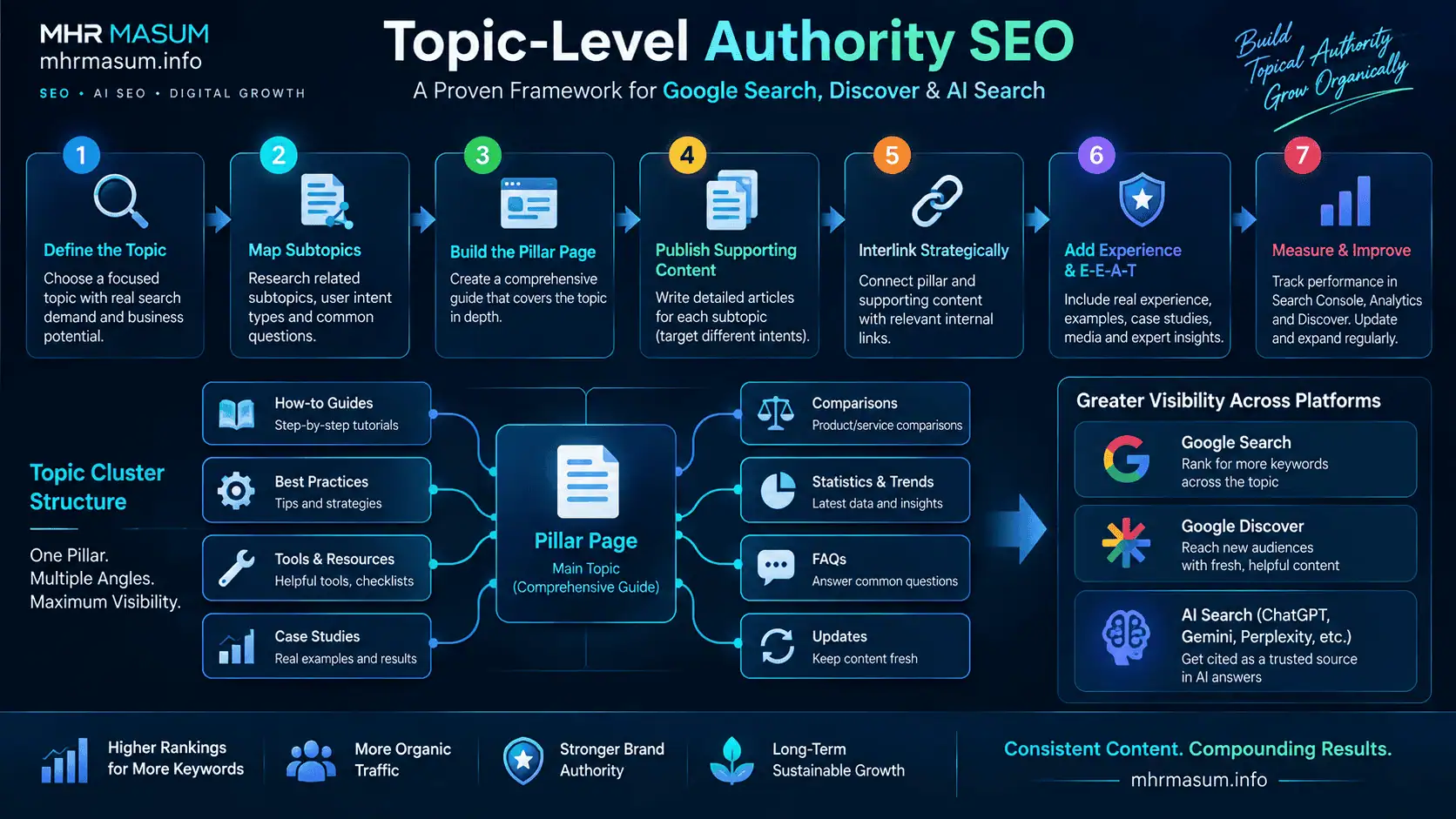
Topic-level authority SEO is a strategic approach to building strong relevance and demonstrated expertise around a defined subject rather than attempting to rank isolated articles independently.
A topic may contain:
- A broad pillar
- Important subtopics
- Supporting questions
- Technical explanations
- Case studies
- Comparisons
- Updates
- First-hand experience
- Tools or checklists
Together, those resources create a body of knowledge.
For example:
Technical SEO
│
├── Technical SEO Checklist
├── Crawlability
├── Indexing
├── Canonical URLs
├── Internal Linking
├── Structured Data
├── Core Web Vitals
├── JavaScript SEO
├── XML Sitemaps
└── Technical SEO Case Studies
One checklist alone may be useful.
A complete, interconnected body of genuinely useful content gives users and search systems much more information about the site’s expertise.
Topic-Level Authority Is Not a Public Google Score
There is no public Search Console metric called:
Topical Authority Score: 87/100
Google does not provide a general website-wide topical-authority score that SEOs can directly optimise.
That distinction is important because many SEO tools create proprietary authority scores that should not be presented as Google metrics.
Google Does Have an Official Topic Authority System for News
Google has publicly described a topic authority system specifically designed to surface knowledgeable sources for news-related queries.
Google says that system can consider signals such as:
- A source’s relevance to a topic or location
- Original reporting
- Citations from other publishers
- Source reputation
The system is particularly relevant to specialised and local news coverage.
That official news system should not be confused with a universal SEO score.
Discover Uses Topic-by-Topic Expertise
The 2026 development is broader.
Google said its Discover systems can identify expertise on a topic-by-topic basis.
Google even gave an example of a general local-news publication having established gardening expertise because it regularly maintains a strong gardening section, while a movie-review site publishing one random gardening article probably would not demonstrate the same relationship.
That provides a useful framework for modern content strategy.
Why Topic-Level Authority Matters in 2026
Search behaviour is becoming less page-centric.
People increasingly discover information through:
- Traditional Google Search
- Google Discover
- AI Overviews
- AI Mode
- ChatGPT
- Gemini
- Claude
- Perplexity
These systems need to determine not only:
Is this page relevant?
but increasingly:
Is this source consistently useful for this subject?
That makes coherent subject coverage more valuable.
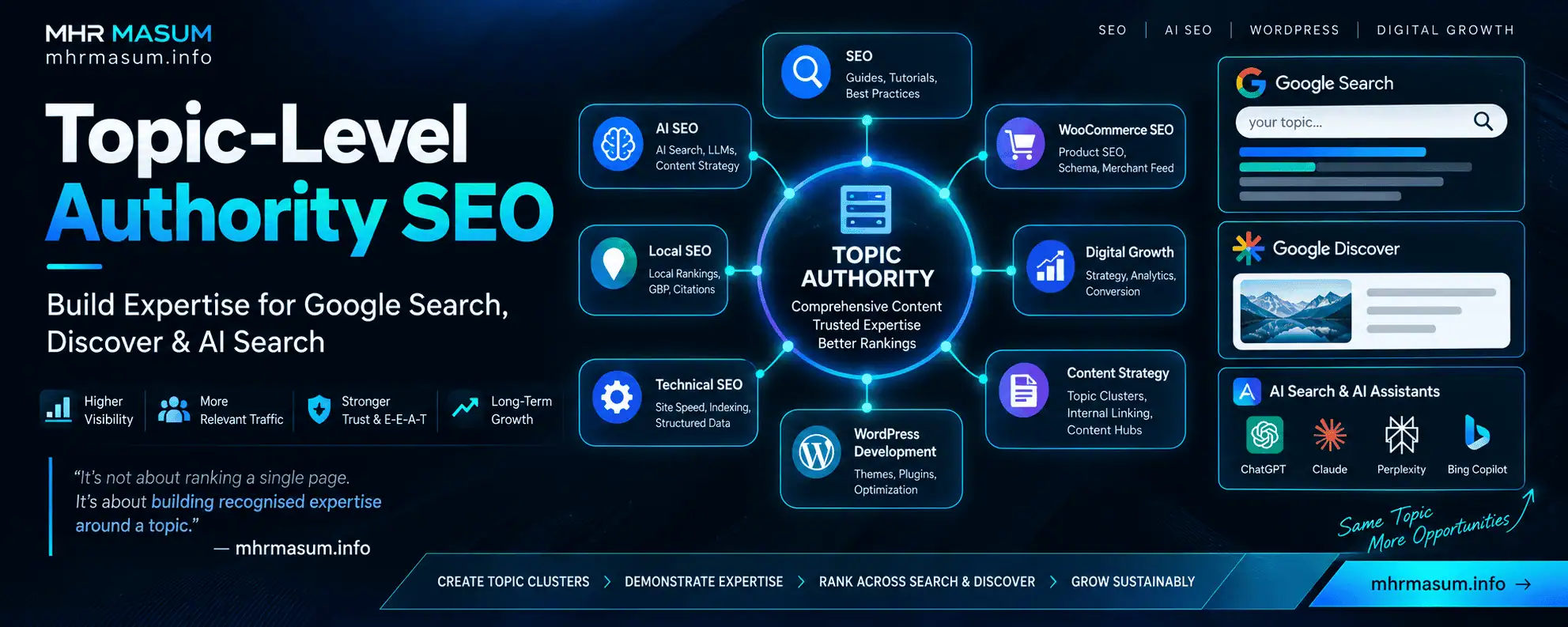
Google’s People-First Guidance Supports Focus
Google’s helpful-content guidance asks website owners whether their site has a primary purpose or focus.
It also warns against producing large volumes of content across many unrelated topics primarily in the hope that some pages will gain search traffic.
This does not mean a site can cover only one topic.
It means the topics it covers should make sense for the site, audience and expertise.
Topic-Level Authority vs Keyword Coverage
Keyword coverage asks:
Have we published pages targeting these keywords?
Topic-level authority asks:
Have we provided a useful body of knowledge that actually explains this subject?
Those are not the same.
Consider an SEO website publishing:
What Is Local SEO?
Local SEO Checklist
Local SEO Pricing
Local SEO Tips
Local SEO Agency
Best Local SEO
Local SEO 2026
That creates keyword coverage.
But genuine topic depth might additionally require:
- Google Business Profile optimisation
- Local citations
- Reviews
- Local landing pages
- Service-area businesses
- Local schema
- Map Pack tracking
- GBP suspensions
- Local link acquisition
- Review-response strategy
- Case studies
- Local Search Console analysis
Authority develops from solving the subject comprehensively—not from producing minor keyword variations.
Topic-Level Authority vs E-E-A-T
Topic expertise and E-E-A-T overlap, but they are not identical concepts.
Google uses the E-E-A-T framework to describe:
- Experience
- Expertise
- Authoritativeness
- Trust
Google recommends evaluating content around Who, How and Why: who created it, how it was produced and why it exists.
Topic Coverage Answers “What Do You Know?”
Your content architecture demonstrates which subjects you understand deeply.
E-E-A-T Helps Answer “Why Should Someone Trust You?”
Signals may include:
- Author identity
- First-hand experience
- Professional background
- Original research
- Case studies
- References
- Reputation
- Accurate sourcing
Strong topic coverage without trust can still be weak.
Strong credentials with shallow content can also be weak.
The strongest combination is:
Topic Depth
+
First-Hand Experience
+
Clear Authorship
+
External Reputation
+
Accurate Information
Topic-Level Authority Starts With Clear Site Focus
Before building a content cluster, define what the website should reasonably be known for.
For mhrmasum.info, for example, logical core areas include:
SEO
AI SEO
Local SEO
Technical SEO
WooCommerce SEO
WordPress Optimisation
Digital Growth
Custom WordPress Development
These subjects naturally relate to the professional services and experience represented on the site.
Publishing hundreds of articles about unrelated subjects purely because they have search volume would weaken the site’s editorial clarity.
Build a Topic Map Before Writing More Content
A topic map shows the relationship between a main subject and its important subtopics.
Start with one central entity or problem.
For example:
AI SEO
Then map the major supporting areas.
AI SEO
│
├── Google AI Overviews
├── AI Mode
├── ChatGPT Visibility
├── Gemini
├── Perplexity
├── Entity SEO
├── Brand Authority
├── AI Citations
├── AI Referral Traffic
├── AI Conversion Tracking
├── llms.txt
├── Multimodal SEO
└── AI-Ready Content
This provides a much stronger editorial framework than asking:
What keyword should I write about tomorrow?
Use Pillar Pages to Define Core Topics
A pillar page should provide the central overview of an important subject.
For example:
AI SEO: How to Rank in Google AI Overviews, ChatGPT, Gemini and Perplexity
Supporting articles can then explore specific parts of that topic.
Examples:
- Entity SEO
- Brand Authority for AI Search
- Multimodal SEO
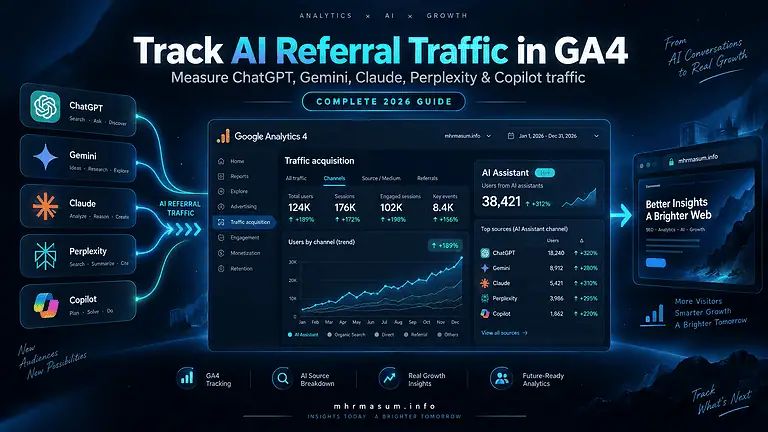
- Track AI Referral Traffic in GA4
- AI Search Conversion Tracking
- Why Generic AI Content Does Not Rank
The pillar gives the cluster a logical centre.
Supporting Content Should Add New Information
Do not build topical authority by rewriting the same article 20 times.
Each supporting page should solve a different problem.
A strong cluster contains distinct intent.
For example:
| Article | Intent |
|---|---|
| What Is AI SEO? | Understand |
| AI SEO Checklist | Implement |
| Track AI Traffic | Measure |
| AI Conversion Tracking | Measure revenue |
| Entity SEO | Build machine understanding |
| AI Citation Gap Analysis | Competitor analysis |
| Multimodal SEO | Image/video optimisation |
Each resource strengthens the broader subject while serving a unique user need.
Avoid Keyword Cannibalisation Inside Topic Clusters
Publishing deeply does not mean creating several pages competing for the same search intent.
For example:
/topic-authority-seo/
/topical-authority-seo/
/how-to-build-topical-authority/
/google-topical-authority/
could become unnecessary duplication if all four pages answer the same question.
A better approach is one strong primary resource supported by narrower articles covering genuinely different subtopics.
Decide the Primary URL
For each intent, identify:
- Primary page
- Supporting pages
- Internal-link relationship
- Search intent
- Target audience
This keeps the architecture understandable.
Internal Linking Is Critical to Topic Architecture
Google says links help it discover pages and determine page relevance.
Google also recommends linking important pages from other relevant pages and using descriptive, concise anchor text.
Internal linking should therefore reflect topical relationships.
Link Supporting Articles to the Pillar
For example:
AI citation article
      ↓
AI SEO guide
Link the Pillar Back to Important Supporting Articles
The relationship should not be one-way.
AI SEO pillar
│
├── AI referral tracking
├── Entity SEO
├── Brand authority
└── Multimodal SEO
Link Supporting Articles to Each Other When Useful
For example, an AI referral article naturally relates to AI conversion tracking.
The link should exist because it helps the reader continue the journey—not because an SEO plugin demands a specific number of internal links.
Use Descriptive Internal-Link Anchor Text
Avoid relying heavily on anchors such as:
- Click here
- Read this
- Learn more
Google recommends descriptive, concise anchor text that helps both people and Google understand the destination.
For example:
Better:
AI search conversion tracking
Less descriptive:
Click here
The anchor should make sense even when read outside the surrounding paragraph.
Every Important Page Should Receive Internal Links
Google explicitly recommends that every page you care about should have a link from at least one other page on the site.
An article with no meaningful incoming internal links can become an orphan.
For important topic clusters, make sure pages are connected from:
- Pillar pages
- Relevant articles
- Category pages
- Service pages
- Portfolio pages
- Navigation where appropriate
Site Structure Should Reflect Subject Relationships
A logical architecture helps users understand how information fits together.
For example:
SEO
│
├── Technical SEO
│   ├── Crawlability
│   ├── Indexing
│   ├── Structured Data
│   └── Core Web Vitals
│
├── Local SEO
│   ├── Google Business Profile
│   ├── Reviews
│   ├── Local Citations
│   └── Location Pages
│
└── AI SEO
    ├── AI Overviews
    ├── ChatGPT
    ├── Entity SEO
    └── AI Analytics
Google analyses links between pages to understand site relationships and relative importance.
Topic Authority Requires Content Depth, Not Word Count
A 5,000-word article is not automatically more authoritative than a 1,500-word article.
The better question is:
Has the content answered the user’s problem sufficiently?
Google’s people-first-content guidance asks whether someone reading the content will leave feeling they learned enough to achieve their goal.
That can require 800 words for one topic and 5,000 for another.
Do not add unnecessary sections simply to increase article length.
Cover the Decision Journey Around a Topic
Strong topic coverage often reflects multiple stages of user intent.
For example, around WooCommerce SEO:
Awareness
What is WooCommerce SEO?
Diagnosis
Why are WooCommerce products not ranking?
Implementation
WooCommerce Technical SEO Checklist
Advanced Optimisation
WooCommerce Product Variant SEO
Integration
Merchant API Migration
Future Technology
WooCommerce MCP
Agentic Commerce
AI Shopping
This forms a more useful body of knowledge than writing several introductory articles.
Original Information Strengthens Topic Expertise
Google’s Discover guidance emphasises content that provides unique insights, while its February 2026 Discover update specifically highlighted original and in-depth material.
Original information may include:
- Case studies
- Screenshots
- Testing
- Experiments
- Before-and-after results
- Original frameworks
- Client experience
- Custom tools
- Code
- Industry observations
- Proprietary data
Example
Instead of writing only:
Local SEO helps companies appear in Maps.
show:
Client:
Brisbane roofing company

Problem:
Weak Map Pack visibility

Work:
GBP optimisation
Service-page improvements
Citation cleanup
Review strategy

Result:
Improved visibility for priority roofing terms
That adds experience competitors cannot simply reproduce by asking an AI model for another generic article.
First-Hand Experience Makes Content More Defensible
Google’s E-E-A-T framework includes Experience specifically because some topics benefit from evidence that the creator has actually used, tested or encountered what they describe.
Useful first-hand signals can include:
- Screenshots
- Original photographs
- Code examples
- Test results
- Client outcomes
- Practical limitations
- Lessons learned
- Failed approaches
- Implementation details
This is particularly useful in technical topics.
Authorship Should Be Clear
Users should be able to determine who created important content.
Google’s people-first guidance recommends thinking about Who created the content and making authorship clear when readers would reasonably expect it.
For expert-led websites, articles should connect naturally to:
- Author name
- Author page
- Professional experience
- Relevant portfolio
- Company information
- Social/professional profiles
For mhrmasum.info, technical SEO and AI SEO articles should clearly connect to MD Harunur Rashid and the relevant professional background.
Topic Authority and Entity SEO Work Together
Topic-level authority explains:
What subjects does this source demonstrate knowledge about?
Entity SEO helps clarify:
Who or what is the source?
A strong entity framework can connect:
MD Harunur Rashid
      ↓
mhrmasum.info
      ↓
SEO
AI SEO
Local SEO
Technical SEO
WooCommerce SEO
WordPress
Supporting information may come from:
- About page
- Author page
- Portfolio
- Schema
- Service pages
- Articles
- External profiles
- Mentions
- Citations
For the wider entity strategy, read Entity SEO: The Missing Part of Modern SEO.
External Reputation Can Reinforce Expertise
Internal content alone does not create every authority signal.
External evidence can reinforce credibility.
Examples include:
- Industry citations
- Interviews
- Professional profiles
- Client references
- Case-study mentions
- Conference participation
- Links from relevant publications
- Expert recommendations
For Google’s news-specific topic authority system, Google explicitly mentions influence, original reporting and source reputation among important signals.
Do not buy irrelevant links simply to simulate reputation.
Earn signals that make sense for the subject.
Topic-Level Authority and Google Discover
Discover differs from normal query-based Search.
Google describes Discover as a personalised feed based on users’ interests and activity.
Content is automatically eligible when indexed and compliant with Discover policies; no special structured-data type is required simply to become eligible.
Discover Is Interest-Based
Traditional Search often starts with:
User query
→ Google results
Discover can work more like:
Known user interest
→ Relevant content recommendation
That increases the importance of understanding what a website consistently covers.
The February 2026 Discover Update Made Topic Expertise Explicit
Google’s February 5, 2026 Discover core update highlighted four particularly important directions:
- Greater local relevance
- Less clickbait
- Less sensational content
- More original, timely, in-depth content from sources with expertise in a subject
Most importantly for this article, Google said expertise may be understood topic by topic rather than only site-wide.
This directly supports a cluster-based editorial strategy.
Discover Success Does Not Require a Single-Topic Website
A common misunderstanding is:
Google Discover only rewards niche websites.
Google’s 2026 explanation contradicts that simplification.
A site can demonstrate expertise across several areas if each subject is supported by meaningful coverage.
The practical requirement is coherence.
For example:
SEO website
├── Local SEO ✓
├── Technical SEO ✓
├── AI SEO ✓
├── WordPress ✓
└── Celebrity gossip ✗
The first four subjects have a natural professional relationship.
The last does not.
Timeliness Matters for Discover
Google recommends publishing content that is timely for current interests or provides unique insights.
This does not mean every Discover article must cover breaking news.
Timeliness might involve:
- A Google update
- A new WooCommerce release
- A Merchant Center change
- A major industry development
- A seasonal issue
- A recently changing user need
Older evergreen content can also appear in Discover when relevant to a person’s interests.
Avoid Clickbait Discover Headlines
Google explicitly advises against misleading, exaggerated or sensational titles designed mainly to increase engagement.
Avoid:
Google Just DESTROYED SEO Forever!
Prefer:
Google Discover Core Update 2026: What Changed and How to Respond
The second title still creates interest while accurately describing the content.
Images Matter for Discover
Google recommends high-quality relevant images for Discover.
Its current guidance recommends images that are:
- At least 1200 pixels wide
- More than 300,000 total pixels
- Ideally suitable for a 16:9 presentation
- Eligible for large previews through
max-image-preview:largeor AMP
For mhrmasum.info, your existing premium dark navy, cyan and teal article visuals can support this strategy when the graphics accurately represent the topic.
Use max-image-preview:large
Google’s robots documentation supports:
<meta name="robots" content="max-image-preview:large">
This allows Google to use a larger image preview where eligible.
Do not add this blindly if you intentionally restrict image-preview usage, but for normal Discover-focused publishing it is worth checking.
Topic-Level Authority and Google Search
Search remains query-driven, but many of the same quality principles apply.
Google recommends:
- Helpful content
- Clear site purpose
- Logical structure
- Crawlable internal links
- Descriptive anchors
- Meaningful improvements rather than quick-fix SEO tactics
Topic-level strategy provides the architecture through which those principles can work together.
Topic-Level Authority and AI Search
AI systems also need to identify reliable sources and relationships between concepts.
A strong topical architecture can make it easier to understand:
Who the source is
What subjects it covers
Which pages are central
Which pages support them
How concepts relate
Where first-hand expertise exists
This does not mean that publishing a content cluster guarantees ChatGPT, Gemini or Google AI citations.
There is no such guarantee.
It does, however, create a much stronger information architecture than isolated, disconnected posts.
For the broader AI visibility strategy, read my AI SEO guide.
Avoid Topic Dilution
Topic dilution happens when a website expands into too many unrelated areas without meaningful expertise.
For example, imagine an SEO consultant site publishing:
Technical SEO
Local SEO
WooCommerce SEO
WordPress
AI Search
Best Dog Food
Cryptocurrency Predictions
Celebrity News
Weight Loss Diets
The first five have a clear professional relationship.
The last four do not.
Google’s people-first guidance specifically warns against producing large amounts of content on many topics primarily because some of it might perform in Search.
Do Not Confuse Topic Expansion With Topic Dilution
Adding a related subject is not automatically dilution.
For example:
WooCommerce SEO
→ Merchant Center
→ Merchant API
→ Product Schema
→ Product Variant SEO
→ AI Shopping
→ Agentic Commerce
is logical expansion.
Each subject connects to ecommerce search and product discovery.
A useful test is:
Would the existing audience reasonably expect this website to provide expert information on the new topic?
If yes, the expansion may be appropriate.
Use Search Console Query Data to Find Topic Gaps
Search Console can show which queries and pages already earn visibility.
Google recommends using the Performance report to identify top queries, evaluate performance changes and analyse page performance.
Look for:
- High impressions but weak CTR
- Queries ranking on the edge of page one
- Questions without a dedicated resource
- Multiple pages appearing for the same intent
- Growing query themes
These can reveal opportunities to expand existing clusters.
Group Similar Queries Into Topics
Do not treat every Search Console query as a separate content requirement.
Queries such as:
track chatgpt traffic
chatgpt traffic ga4
measure chatgpt referrals
chatgpt analytics
may represent one underlying topic.
Building one strong resource is usually better than producing four thin pages.
Your existing Search Console Query Groups and Content Strategy guide provides a practical framework for this analysis.
Measure Search and Discover Separately
Google provides separate Performance reports for Search and Discover.
Google notes that these data sources cannot currently be combined into a single browser report inside Search Console, although they can be exported and compared externally.
That separation is useful.
A topic may perform differently across the two systems.
Search Performance
Monitor:
- Clicks
- Impressions
- CTR
- Average position
- Queries
- Pages
Discover Performance
Monitor:
- Clicks
- Impressions
- CTR
- Pages
- Countries
- Dates
Search Console’s Discover report assigns data to canonical URLs and is available only when a property reaches sufficient Discover impressions.
Measure Topic-Level Performance, Not Only Individual URLs
A powerful reporting method is to group URLs by content cluster.
For example:
AI SEO Cluster
might contain:
/ai-seo-.../
/entity-seo-.../
/multimodal-seo-.../
/track-ai-referral-traffic-ga4/
/ai-search-conversion-tracking/
Then report:
| Metric | Current Period | Previous Period |
|---|---|---|
| Search clicks | — | — |
| Search impressions | — | — |
| Discover clicks | — | — |
| Discover impressions | — | — |
| AI referrals | — | — |
| Leads | — | — |
This tells you whether the topic cluster is becoming stronger, not merely whether one article moved from position 8 to position 5.
Use Discover Generative AI Reporting Where Available
Search Console now also provides a Generative AI performance report for Discover.
Google says the report shows impressions from generative AI features in Discover and can be analysed by page, location and time. The rollout reached websites worldwide by August 31, 2026, subject to sufficient impression thresholds.
This creates another useful dimension for topic-cluster reporting.
You can compare:
Traditional Search
Discover
Generative AI in Discover
External AI referrals
to identify which subject areas perform across multiple discovery surfaces.
Topic-Level Authority Audit Framework
A proper audit should evaluate the whole subject rather than reviewing pages individually.
Use the following framework.
Topic Definition
Ask:
- What is the main topic?
- Does it fit the website?
- Who is the intended audience?
- What problems should this cluster solve?
Content Coverage
Check:
- Pillar page
- Major subtopics
- Supporting questions
- Commercial intent
- Informational intent
- Advanced topics
- Case studies
- Updates
Content Quality
Review:
- Original information
- Accuracy
- Practical depth
- Examples
- First-hand experience
- Sources
- Freshness
Internal Linking
Check:
- Pillar-to-supporting links
- Supporting-to-pillar links
- Contextual cross-links
- Descriptive anchors
- Orphan pages
Entity and Authorship
Verify:
- Author identity
- Author page
- Relevant professional experience
- Organisation/site relationship
- Schema
- External profiles
Search Performance
Evaluate:
- Query growth
- Ranking distribution
- Clicks
- Impressions
- CTR
- Landing pages
Discover Performance
Evaluate:
- Discover impressions
- Discover clicks
- CTR
- Pages receiving exposure
- Content patterns
How to Find Weak Topic Clusters
A weak cluster often has one or more of these symptoms:
- One article carrying almost all traffic
- Several thin supporting posts
- Duplicate intent
- No clear pillar
- Poor internal linking
- No original evidence
- Weak authorship
- Old information
- Topics unrelated to the site’s expertise
Do not automatically solve these issues by creating more pages.
Sometimes consolidation is the better choice.
Consolidate Overlapping Content
Suppose a site has:
What Is Entity SEO?
Entity SEO Guide
Entity SEO Explained
How Entity SEO Works
Entity SEO for Beginners
If these pages largely repeat each other, consider combining them into one stronger resource.
Then redirect or repurpose weaker pages appropriately.
The objective is:
Fewer weak pages
+
Stronger useful resources
not maximum URL count.
Update Existing Authority Assets
Older articles that already earn:
- Backlinks
- Rankings
- Discover history
- Engagement
- Brand mentions
can be valuable cluster assets.
Update them when the topic materially changes.
Do not change successful articles simply to alter their publication date.
Google’s core-update guidance recommends making meaningful, sustainable improvements rather than quick-fix changes.
Use Case Studies as Authority Bridges
Case studies can connect informational expertise with real-world evidence.
For example:
Local SEO Guide
       ↓
Local SEO Case Study
       ↓
Local SEO Service
This shows the relationship between:
Knowledge
Experience
Service
Result
For an expert-led consulting website, this is particularly powerful.
Link Content With Services and Portfolio Pages
Topic authority should not exist only inside the blog.
Connect informational articles to the business entity.
For example:
Technical SEO Article
      ↓
Technical SEO Portfolio
      ↓
SEO Services
      ↓
Contact
Useful mhrmasum.info pages include:
- SEO and Digital Growth Services
- Technical SEO and Keyword Research Portfolio
- Local SEO Portfolio
- SEO and WordPress Portfolio
This strengthens both user journeys and site relationships.
A Practical Topic-Cluster Example
Consider building authority around:
WooCommerce AI and Agentic Commerce
The pillar could be:
WooCommerce AI & Agentic Commerce
Supporting resources might include:
WooCommerce AI Product Advisor
Content API → Merchant API Migration
Merchant API for WooCommerce
WooCommerce MCP
Product Variant SEO
AI Shopping
UCP
AI Product Data Quality
Merchant Center Diagnostics
Each page solves a separate problem.
Together they demonstrate much deeper subject coverage.
90-Day Topic-Level Authority Roadmap
Topic authority is built through sustained improvement rather than publishing dozens of articles in one week.
A 90-day implementation can be divided into three phases.
Days 1–30: Audit and Map
Start by identifying your priority subject.
Audit:
- Existing articles
- Search Console queries
- Current rankings
- Internal links
- Duplicate content
- Missing subtopics
- Case studies
- Author signals
Then create the topic map.
Classify every existing page as:
Keep
Improve
Merge
Redirect
Create
Do not begin mass production until this map is clear.
Days 31–60: Strengthen the Cluster
Improve the most important existing assets first.
Work on:
- Pillar page
- High-impression articles
- Internal linking
- Authorship
- Original examples
- Screenshots
- Case studies
- Outdated sections
- Missing supporting articles
Prioritise quality over publication frequency.
Days 61–90: Expand and Measure
Publish genuinely missing resources.
Then monitor:
- Search query growth
- Cluster impressions
- Cluster clicks
- Discover visibility
- AI referral traffic
- Leads
- Conversions
Look for improvements across the whole cluster rather than obsessing over one keyword.
Common Topic-Level Authority SEO Mistakes
Topic-based SEO becomes ineffective when it is reduced to mechanical content production.
Avoid the following mistakes.
Publishing Hundreds of AI-Generated Articles
Volume is not authority.
Google’s guidance specifically warns against extensive automated content production across many topics when the purpose is primarily search traffic.
Use AI to support research, structure and workflows—but maintain genuine expertise and editorial control.
Creating a Page for Every Keyword Variation
Several keywords may represent the same search intent.
Consolidate when appropriate.
Covering Unrelated High-Volume Topics
Search volume alone should not determine editorial strategy.
The subject should fit the site’s audience and expertise.
Ignoring Internal Links
A collection of disconnected articles is not a strong content cluster.
Build logical relationships.
Using Generic Anchor Text Everywhere
Use descriptive internal-link anchors rather than repeated “read more” links.
Publishing Without First-Hand Evidence
Add original examples, testing, cases, screenshots or practical experience where appropriate.
Treating E-E-A-T as Schema Markup
Schema can clarify entities.
It does not manufacture expertise or trust.
Treating Topical Authority as a Numeric Google Score
No general public Google topical-authority score exists.
Measure actual Search, Discover, engagement and business performance instead.
Updating Dates Without Improving Content
Freshness should represent meaningful updating, not cosmetic timestamp changes.
Focusing Only on Google Search
Modern content may be discovered through Search, Discover, AI assistants, social platforms and video.
Measure the wider ecosystem.
Frequently Asked Questions
Topic-level authority is frequently misunderstood because SEO tools, Google systems and industry terminology do not always use the same language. The following answers clarify the most important concepts.
What is topic-level authority SEO?
Topic-level authority SEO is the process of demonstrating deep, useful and interconnected expertise around a defined subject through high-quality content, site structure, first-hand evidence, internal links and clear entities.
Does Google use topical authority?
Google does not publish a universal “topical authority score.”
However, Google has an official topic authority system for specialised news contexts and has explicitly said that Discover systems can recognise expertise on a topic-by-topic basis.
Is topical authority a ranking factor?
It is better not to describe “topical authority” as one simple ranking factor.
Google uses many systems and signals.
A topic-focused strategy aligns with Google’s public guidance around helpful content, site focus, internal linking, expertise and Discover’s topic-by-topic understanding.
Does my website need to focus on only one topic?
No.
Google explicitly said that sites can demonstrate deep knowledge across multiple subjects and that Discover systems can identify expertise topic by topic.
How many articles are needed to build topic authority?
There is no required number.
A narrow subject might be covered thoroughly with several strong resources.
A complex topic may require dozens.
Coverage quality and usefulness matter more than URL count.
What is a topic cluster?
A topic cluster is a collection of related pages covering different aspects of one subject and connected through logical internal links.
Do I need a pillar page?
Not always, but pillar pages are useful when a broad topic contains many related subtopics.
They give users and search engines a clear central resource.
Does internal linking improve topical relevance?
Internal links help Google discover pages, understand relationships and determine relevance. Google recommends linking important pages from other relevant pages with descriptive anchor text.
Can AI-generated content build topical authority?
AI-assisted content can contribute when it is accurate, useful, well edited and adds genuine value.
Publishing large volumes of generic automated content across topics is not the same as demonstrating expertise.
Is E-E-A-T the same as topical authority?
No.
E-E-A-T concerns experience, expertise, authoritativeness and trust, while topic-level authority focuses more specifically on depth and demonstrated knowledge around a subject.
They reinforce each other.
Does topic authority matter for Google Discover?
Yes, especially after Google’s February 2026 Discover core update explicitly highlighted in-depth, original and timely content from sites with expertise in particular areas.
Do I need structured data for Discover?
No special structured data is required solely for Discover eligibility.
Indexed content that follows Discover policies is automatically eligible, although eligibility does not guarantee exposure.
What image size should I use for Discover?
Google recommends relevant high-quality images at least 1200 pixels wide and eligible for large previews, with current guidance also recommending more than 300,000 total pixels and suitable 16:9 presentation.
How should I measure topic authority?
Measure actual performance across the topic cluster, including:
- Search impressions
- Search clicks
- Ranking coverage
- Discover impressions
- Discover clicks
- AI referrals
- Internal engagement
- Leads
- Revenue
Avoid relying only on proprietary SEO authority scores.
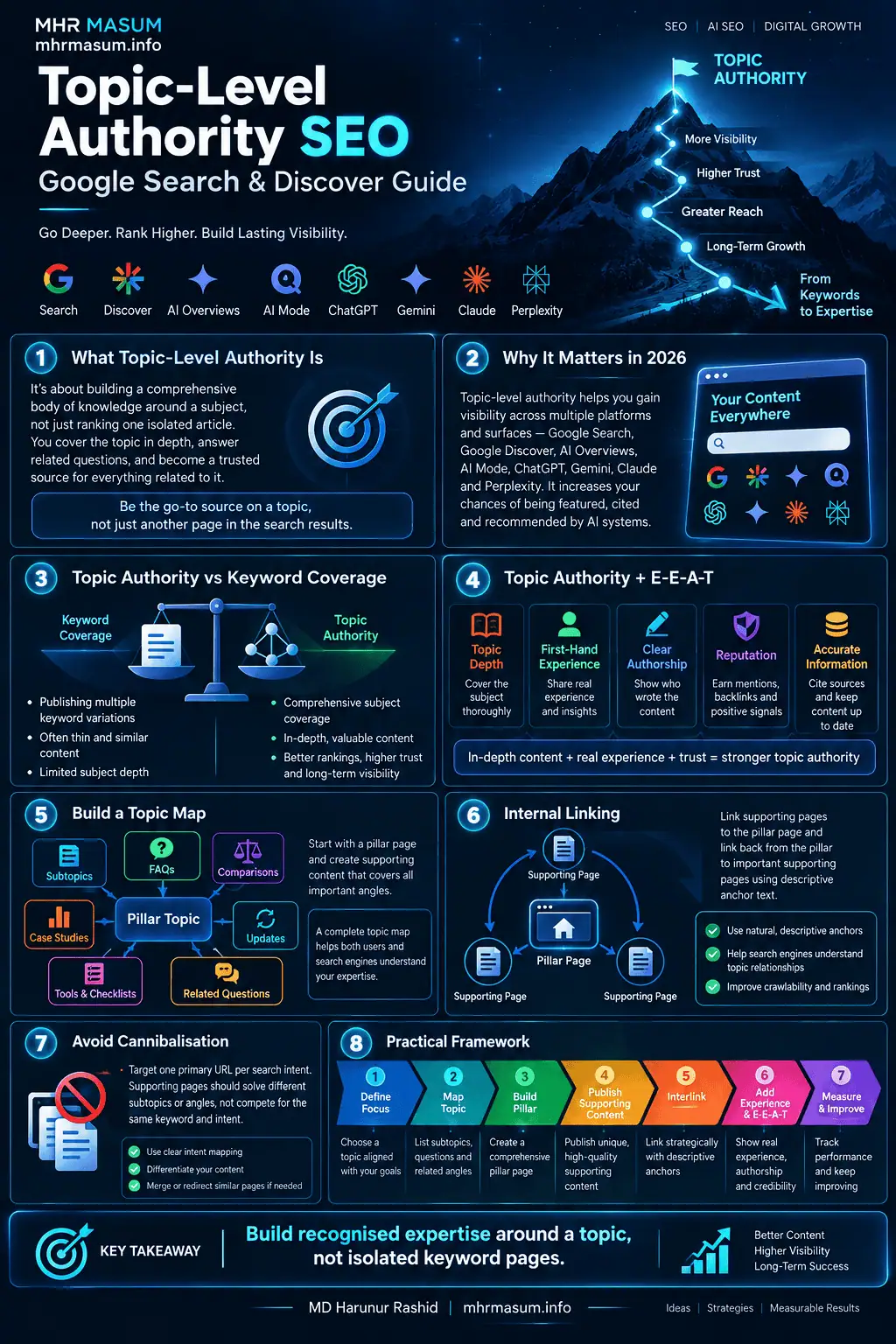
Official Resources
The following first-party Google resources provide the most authoritative foundation for the strategies discussed in this guide.
Google: February 2026 Discover Core Update
Google’s announcement is particularly important because it explicitly describes topic-by-topic expertise and the move toward more original, in-depth and timely Discover content. Google February 2026 Discover Core Update
Google: Creating Helpful, Reliable, People-First Content
Google’s official guidance covers site focus, search-engine-first publishing, E-E-A-T and the Who, How and Why framework. Google People-First Content Guidance
Google: Discover and Your Website
This documentation explains Discover eligibility, editorial guidance, headlines, original content and large-image recommendations. Google Discover Documentation
Google: Topic Authority for News
Google’s official explanation of its news topic authority system covers topic/location relevance, original reporting, citations and source reputation. Google News Topic Authority Documentation
Google: Link Best Practices
Google explains crawlable links, descriptive anchors and why important pages should receive relevant internal links. Google Link Best Practices
Google: Search Core Updates
Google’s core-update documentation explains how to evaluate sustained ranking changes and focus on meaningful, people-first improvements rather than quick fixes. Google Core Update Guidance
Google Search Console: Discover Performance Report
This resource explains Discover clicks, impressions, CTR, page reporting, canonical attribution and report limitations. Search Console Discover Performance Report
Search Console: Generative AI Performance in Discover
Google’s current documentation explains the dedicated generative AI impression reporting now available for Discover. Generative AI Performance Report for Discover
Final Thoughts
Topic-level authority should not be approached as a trick for manipulating Google.
It is better understood as a way of building a website that makes sense.
A strong topic cluster tells users and machines:
This is what we specialise in.
These are the major parts of the subject.
Here is our detailed guidance.
Here is our practical experience.
Here is the evidence.
Here are the related resources.
Here is who created them.
Google’s 2026 Discover update made one part of that particularly clear:
Expertise can be understood topic by topic.
That means websites do not need to become artificially narrow.
But they do need meaningful depth.
For an SEO consultant, that might mean building substantial bodies of knowledge around:
- Technical SEO
- Local SEO
- AI SEO
- WooCommerce SEO
- WordPress optimisation
Each cluster should combine:
Useful content + original experience + clear authorship + logical internal links + strong entity relationships + measurable performance.
The objective is not to publish the most pages.
The objective is to become one of the most useful sources available when someone—or an AI/search system—needs reliable information about the topic.
Need Help Building Topic Authority for Search, Discover and AI?
I am MD Harunur Rashid, an SEO, AI SEO and Digital Growth Consultant with more than 17 years of experience helping local businesses, ecommerce brands, agencies and website owners improve organic visibility.
My work can include:
- Topic-authority audits
- Content-cluster strategy
- Technical SEO
- AI SEO
- Entity SEO
- Search Console analysis
- Google Discover optimisation
- Local SEO
- WooCommerce SEO
- Internal-link optimisation
- Content consolidation
- WordPress optimisation
Visit the mhrmasum.info homepage for practical resources covering SEO, AI search, WooCommerce and WordPress.
You can also explore:
- SEO and Digital Growth Services
- About MD Harunur Rashid
- SEO and WordPress Portfolio
- Technical SEO and Keyword Research Portfolio
- Local SEO Portfolio
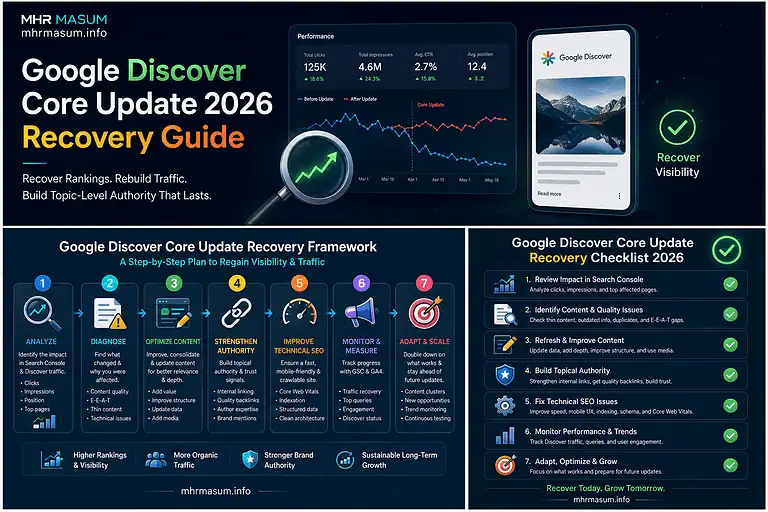
- Google Discover Core Update 2026 Recovery Guide
- Entity SEO Guide
- Brand Authority for AI Search
- Search Console Query Groups
For a topic-authority audit, content-cluster strategy or Search/Discover recovery project, contact MD Harunur Rashid.