Google Discover can send significant traffic to publishers, specialist websites, ecommerce brands, local businesses and content-led companies.
Unlike traditional Google Search, Discover does not wait for a user to type a keyword. It proactively recommends articles, videos and other content based on a person’s interests, activity and preferences.
That opportunity also makes Discover traffic less predictable.
A website can experience rapid growth, sudden declines or major changes in the types of content receiving visibility. In some cases, a site may continue performing normally in traditional Google Search while losing a substantial percentage of its Discover traffic.
Google’s February 2026 Discover core update made this distinction even more important.
Google said the update was designed to improve Discover by:
- Showing more locally relevant content
- Reducing sensational content and clickbait
- Rewarding more in-depth, original and timely content
- Better recognising expertise within individual topics
- Continuing to personalise results according to creator and source preferences
Google also clarified that a website does not need to specialise in only one subject to establish expertise. Its systems may understand expertise on a topic-by-topic basis, allowing a particular category or section to perform even when the broader website covers several subjects.
This creates an important opportunity for businesses and publishers.
You do not necessarily need to turn your entire website into a single-topic publication. However, each important topic must demonstrate sufficient depth, consistency, originality, author expertise, internal structure and audience value.
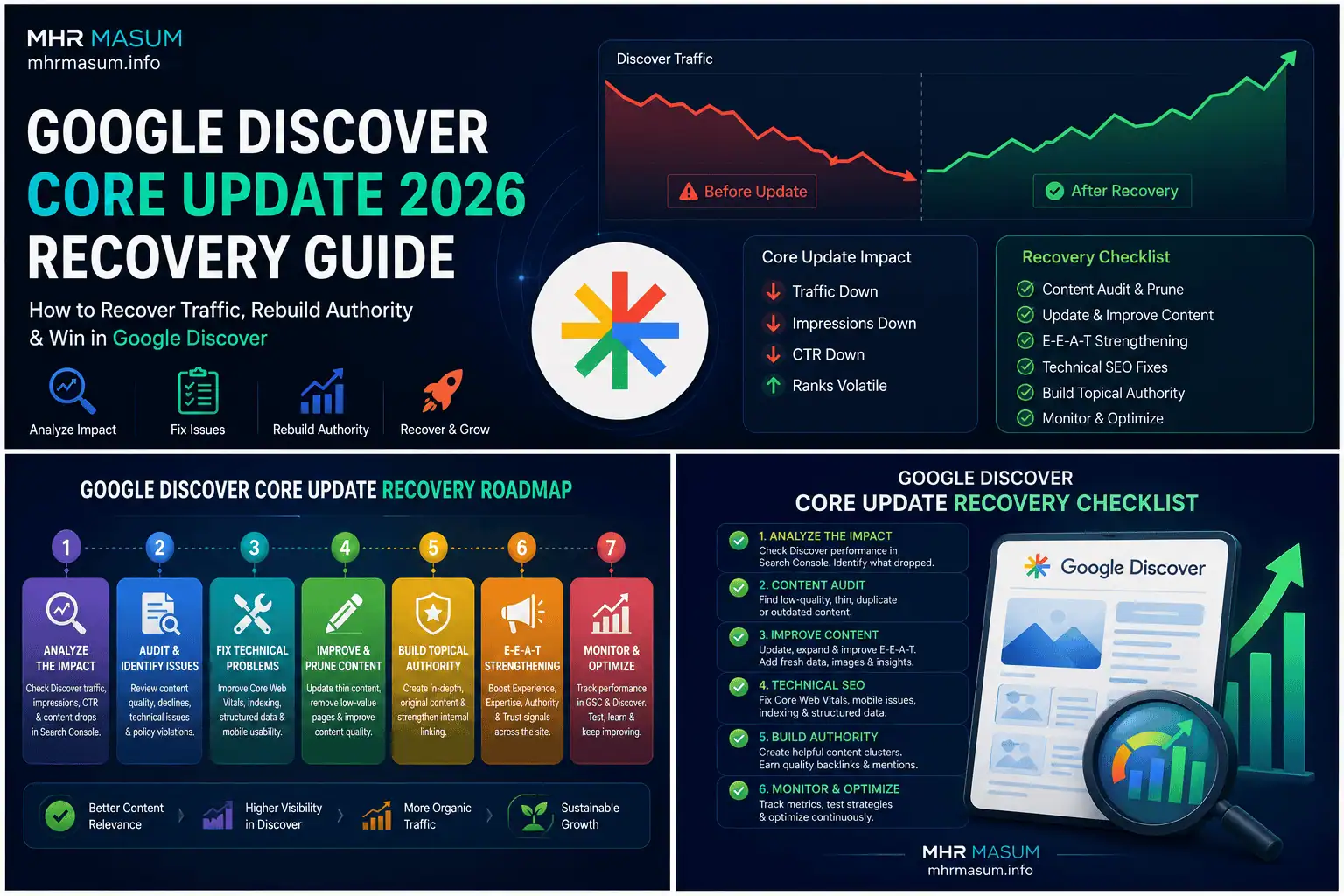
This guide explains what changed in the Google Discover core update 2026, how to diagnose a Discover traffic decline and how to build sustainable topic-level authority.
For more practical resources covering SEO, AI search, WordPress, Local SEO and digital growth, visit the MD Harunur Rashid SEO and AI SEO website.
Google Discover Core Update 2026: Key Facts
Here is a summary of the official update.
| Update detail | Information |
|---|---|
| Update name | February 2026 Discover core update |
| Start date | February 5, 2026 |
| Completion date | February 27, 2026 |
| Initial audience | English-language users in the United States |
| Initial rollout duration | Approximately 22 days |
| Main objective | Improve the quality and usefulness of Discover |
| Major changes | Local relevance, less clickbait, more original and in-depth content, topic-level expertise |
| Recovery guidance | Google’s general core-update and Discover guidance |
The update began on February 5, 2026, and Google’s Search Status Dashboard marked the rollout complete on February 27, 2026. It initially applied to English-language users in the United States, with Google stating that expansion to additional countries and languages was planned.
Website owners should therefore analyse the update according to their audience.
A US-focused English publication may have experienced a more direct initial impact. A website serving other countries or languages should continue monitoring performance as Google expands and adjusts its Discover systems.
What Is Google Discover?
Google Discover is a personalised content feed that displays articles, videos and other content related to a user’s interests.
Recommendations can be influenced by a person’s Web and App Activity, interests and previous interactions with Google services. Unlike normal Search, a user does not have to enter a query before seeing Discover content.
Discover may surface:
- News stories
- Evergreen guides
- Videos
- Product information
- Travel content
- Local stories
- Sports updates
- Health and lifestyle content
- Technology articles
- Entertainment content
- Personal-interest content
- Previously published content that remains relevant
Content is automatically eligible for Discover when it is indexed by Google and complies with Discover’s policies. No special Discover structured data or application process is required.
Eligibility does not guarantee visibility. Google decides whether content is useful and relevant for a particular user at a particular time.
Is the February 2026 Update a Normal Google Core Update?
The February update was specifically described as a Discover core update.
It was a broad change to the systems Google uses to surface articles in Discover. It was not presented as a traditional website-wide penalty or a manual action against particular publishers.
Google’s core updates are broad reassessments designed to improve the quality and usefulness of results. They do not normally target individual pages or websites. A site that declines is not necessarily considered bad or penalised; competing content may simply be judged more suitable under the updated systems.
This distinction matters during recovery.
The correct response is not to search for a single hidden penalty or attempt random technical changes. The goal is to understand why other content may now be considered:
- More relevant
- More original
- More trustworthy
- More timely
- More locally useful
- More complete
- Better aligned with the user’s interests
- Better supported by topic-level expertise
For a complete diagnostic process covering wider ranking updates, read my Google Core Update Recovery Checklist.
What Changed in the Google Discover Core Update 2026?
Google identified several major areas of improvement.
1. More Locally Relevant Content
Google said the update would show users more locally relevant content from websites based in their country.
This does not mean that international websites can no longer appear in Discover.
It means that geographic relevance may become more important when a topic has a meaningful local dimension.
Examples include:
- Local news
- Weather events
- Business regulations
- Education
- Employment
- Travel
- Restaurants
- Local services
- Property markets
- Community events
- Regional product availability
- Healthcare information
- Government announcements
A locally relevant article should offer more than inserting a city or country name into the title.
It may include:
- Local statistics
- Regional laws or requirements
- Local prices
- Area-specific recommendations
- First-hand local knowledge
- Local photos
- Local case studies
- Local organisations
- Local expert commentary
- Accurate service-area information
- Country-specific availability
For local companies, this update reinforces the importance of aligning website content with real locations, customer needs and business operations.
Read my complete Local SEO strategy for small businesses for a broader location-based visibility framework.
2. Less Sensational Content and Clickbait
Google specifically said the update aims to reduce sensational content and clickbait in Discover.
Clickbait can include titles, descriptions or images that artificially increase curiosity without accurately explaining the content.
Examples include:
- “You Won’t Believe What Happened Next”
- “Experts Are Terrified About This New Update”
- “Google Just Destroyed Every Small Website”
- “This One SEO Trick Changes Everything”
- “The Secret Google Does Not Want You to Know”
- “Everyone Is Making This Dangerous Mistake”
A headline can still be persuasive and interesting.
The problem begins when the headline:
- Exaggerates the facts
- Hides essential information
- Promises information that the page does not provide
- Creates unnecessary outrage or fear
- Uses an unrelated or misleading image
- Distorts a quote or statistic
- Suggests certainty when the information is speculative
- Manipulates curiosity rather than communicating value
Google’s current Discover guidance recommends titles that capture the essence of the content and warns against misleading previews, withheld information and sensational tactics based on outrage, morbid curiosity or titillation.
A better Discover headline is clear, specific and useful.
Instead of:
Google’s New Update Just Destroyed SEO Forever
Use:
Google Discover Core Update 2026: What Changed and How to Recover
The second title still creates interest, but it accurately communicates what the reader will receive.
3. More In-Depth Content
The update aims to surface more in-depth content from websites with relevant expertise.
Depth does not mean adding unnecessary words.
A 4,000-word article can still be thin when it repeats generic information. A shorter article can be valuable when it provides precise, original and actionable information.
Content depth may come from:
- Detailed explanations
- First-hand experience
- Original research
- Clear examples
- Screenshots
- Data analysis
- Expert commentary
- Comparisons
- Step-by-step processes
- Templates
- Case studies
- Mistakes to avoid
- Limitations
- Alternative solutions
- Local context
- Practical recommendations
The objective is to help readers understand and act—not to reach an arbitrary word count.
Google’s people-first content guidance explicitly says there is no preferred word count. It encourages content that leaves the reader feeling they have learned enough to achieve their goal.
4. Greater Emphasis on Original Content
Originality is one of the clearest themes of the update.
Content that simply rewrites what other websites have already published provides limited additional value.
Original content may include:
- Personal experience
- Client results
- Testing
- Screenshots
- Custom data
- Unique workflows
- Professional analysis
- Industry observations
- Original images
- Interviews
- Surveys
- Expert opinions
- Before-and-after comparisons
- Lessons from failed approaches
Google’s current AI-search guidance similarly recommends creating non-commodity content with unique viewpoints, first-hand experience and useful information that cannot be easily reproduced by summarising other sources or prompting a generative AI tool.
For example, an article titled “10 Basic SEO Tips” may contain accurate information but still provide little original value.
A more distinctive article could be:
How I Recovered a Local Roofing Website After a Core Update: Audit Findings, Changes and Results
The second topic offers:
- A real situation
- A defined website type
- Direct professional experience
- Evidence
- A process
- A measurable outcome
This is harder to replace with generic content.
5. Timely Content
Discover is highly influenced by current interests.
Google said the update would give greater visibility to timely content. It also recommends publishing content that is relevant to current interests, tells a story well or provides unique insights.
Timely content can include:
- Industry developments
- Product launches
- Algorithm updates
- Seasonal advice
- Local events
- New regulations
- Emerging customer problems
- Updated research
- Recent case studies
- Changes in software or technology
Timely does not mean changing an article’s date without updating its substance.
Google advises against changing publication dates merely to make unchanged content look fresh.
A legitimate content refresh should update meaningful elements such as:
- Facts
- Screenshots
- Product information
- Recommendations
- Statistics
- External sources
- Internal links
- Examples
- Processes
- Conclusions
6. Topic-Level Expertise
Topic-level expertise is one of the most important concepts introduced in Google’s announcement.
Google clarified that its systems can identify expertise on a topic-by-topic basis.
A website can cover several subjects and still establish strong expertise in an individual section.
Google gave the example of a local news website with a dedicated gardening section. That section may demonstrate sufficient gardening expertise even though the site also covers politics, business, sports and community news.
In contrast, a movie-review website publishing a single unrelated gardening article would be less likely to demonstrate meaningful gardening expertise.
This means that website authority is not always all-or-nothing.
A website may have:
- Strong authority in Technical SEO
- Moderate authority in Local SEO
- Emerging authority in AI search
- Limited authority in ecommerce
- No established authority in unrelated health or travel topics
The practical goal is to strengthen the subjects that genuinely align with your experience, audience and business.
Site Authority vs Topic-Level Authority
Site authority refers to the overall reputation, trust and expertise associated with a website.
Topic-level authority refers to the depth and credibility a website demonstrates within a specific subject.
A site may build topic-level authority through:
- Multiple related articles
- Logical content clusters
- Consistent author expertise
- Original evidence
- Strong internal linking
- Detailed category pages
- Relevant case studies
- Regular updates
- Clear topical boundaries
- External citations and mentions
- User recognition within that subject
For example, mhrmasum.info covers several related areas:
- Local SEO
- Technical SEO
- AI SEO
- Google Search Console
- WordPress optimisation
- WooCommerce SEO
- Entity SEO
- Digital growth
- Custom WordPress products
These subjects are broad, but they share a coherent professional context.
An article about Search Console reporting can naturally connect to Technical SEO, AI visibility and content strategy.
A random article about celebrity fashion would not support the same topical ecosystem.
For a deeper standalone explanation, read Entity SEO: The Missing Part of Modern SEO.
Why Discover Traffic Can Change Suddenly
Discover traffic is inherently less predictable than keyword-driven Search traffic.
Google describes Discover traffic as supplemental because it is influenced by changing interests, content types, personalisation and updates to Google’s systems. A traffic change does not always indicate that the website published lower-quality content.
Discover visibility may change because of:
- A core update
- A Discover-specific update
- Changing user interests
- Seasonal demand
- News cycles
- Increased competition
- Reduced relevance
- Content ageing
- Headline or image performance
- Country-level relevance
- Topic-level authority changes
- Policy violations
- Technical indexing problems
- Search Console reporting anomalies
The last point is important.
Search Console documented Discover data-logging issues affecting May 21 and June 24, 2026. Those incidents caused reporting decreases but did not necessarily represent real visibility losses. Website owners should therefore check Search Console’s data-anomaly documentation before concluding that every reporting decline reflects an algorithmic loss.
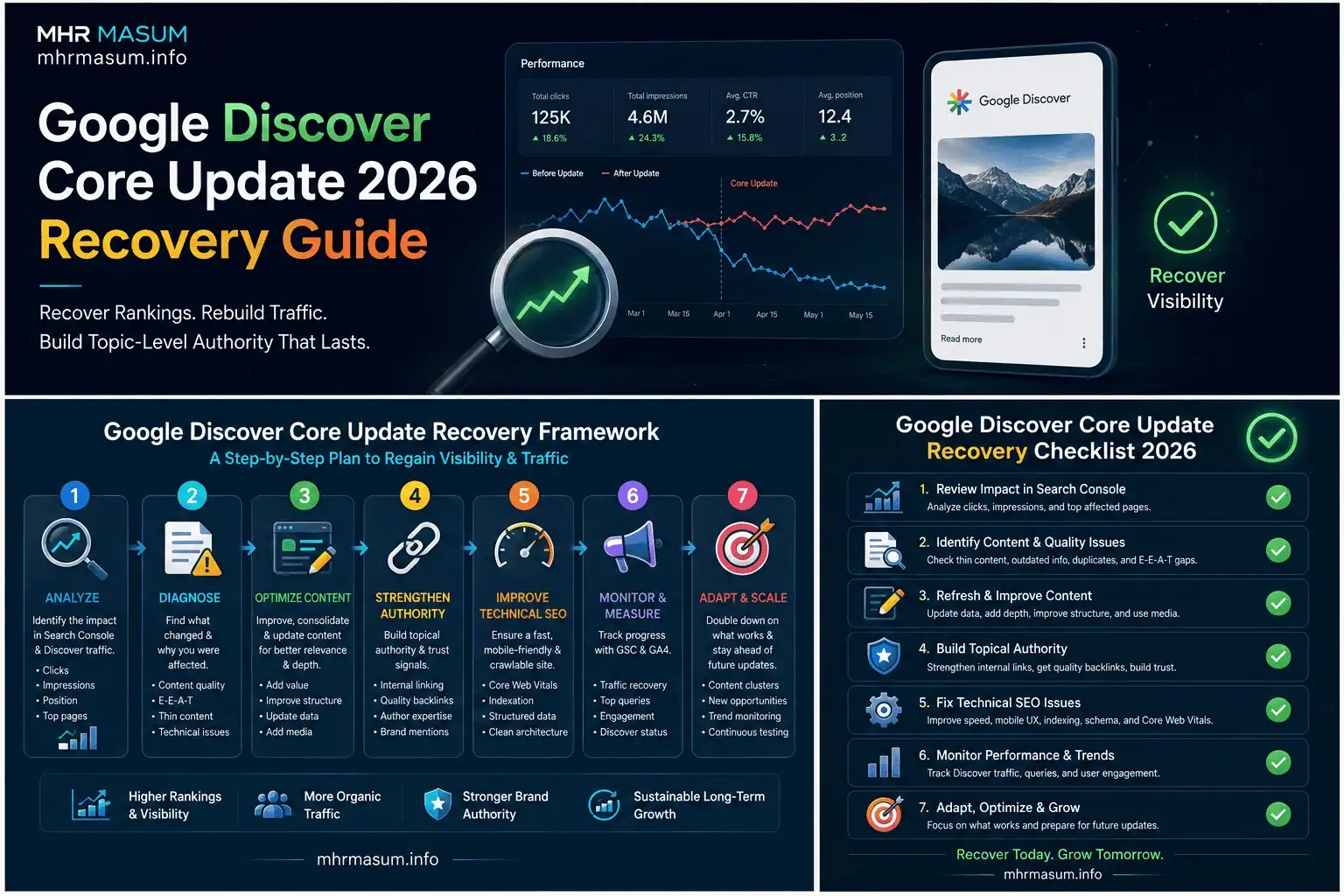
How to Diagnose a Google Discover Traffic Drop
Do not begin recovery by rewriting every article.
Start with diagnosis.
Step 1: Confirm the Update Timeline
The February Discover update ran from February 5 to February 27, 2026.
Compare your traffic pattern against:
- The period before February 5
- The rollout period
- The week after February 27
- The following 28 days
- The same period in the previous year, where available
Google recommends waiting until a core update finishes and then allowing at least one full week before analysing the impact.
Because the update is complete, website owners can now conduct a more stable post-update comparison.
Step 2: Open the Discover Performance Report
In Google Search Console, navigate to:
Performance → Discover
The report may show:
- Total clicks
- Total impressions
- Average click-through rate
- Pages
- Countries
- Devices
- Dates
- Discover appearance types, where applicable
The Discover report provides up to 16 months of performance data when the website reaches the minimum reporting threshold.
The report may disappear when a website no longer meets Google’s minimum data threshold. That does not necessarily mean every page has been permanently removed from Discover.
Step 3: Separate Discover From Google Search
Do not combine Search and Discover performance into one graph.
A site may experience:
- Stable Search traffic and declining Discover traffic
- Declining Search traffic and stable Discover traffic
- Growth in both
- A temporary Discover spike with no Search growth
These patterns have different causes.
Traditional Search is query-driven. Discover is interest-driven and personalised.
Analyse the two channels independently before combining them in an executive report.
Step 4: Identify the Exact Date of the Decline
Determine whether the drop happened:
- Before the rollout
- During the rollout
- Immediately after completion
- Several weeks later
- On one isolated reporting date
- Gradually over several months
A decline that began before February 5 is unlikely to be caused entirely by the February update.
A one-day decline may indicate:
- Reporting delay
- Data anomaly
- Weekend behaviour
- Seasonal demand
- Technical outage
A sustained decline beginning during or shortly after the rollout requires deeper content and topic analysis.
Step 5: Compare Pages, Not Only Site Totals
Sitewide totals can hide important patterns.
Segment your URLs into groups such as:
- News
- Evergreen articles
- Reviews
- Product guides
- Local content
- Opinion pieces
- Tutorials
- Videos
- Category sections
- Recently updated articles
- AI-assisted content
Then ask:
- Which sections declined?
- Which sections improved?
- Did one author lose more visibility?
- Did clickbait-style titles decline?
- Did local articles improve?
- Did generic summaries decline?
- Did original case studies improve?
- Did timely articles perform better?
- Did large-image pages outperform small-image pages?
This is how you move from an update theory to an actionable diagnosis.
Step 6: Review Manual Actions and Security Issues
Open:
Search Console → Security & Manual Actions → Manual Actions
Discover manual actions may be issued for violations involving:
- Misleading content
- Transparency
- Dangerous content
- Manipulated media
- Harassment
- Hateful content
- Medical misinformation
- Violence
- Explicit content
- Deceptive practices
Discover’s transparency requirements include clear dates, bylines, author information, publisher information and contact details.
An algorithmic decline and a manual action are different.
If Search Console displays a manual action, correct the policy issue and submit a review request. If there is no manual action, focus on quality, relevance and technical diagnosis.
Step 7: Check Indexing and Technical SEO
A page must be indexed and compliant with Discover policies to be eligible for Discover.
Check:
- Indexing status
- Canonical tags
- Robots directives
- HTTP status codes
- Mobile rendering
- Image accessibility
- JavaScript rendering
- Page speed
- Core Web Vitals
- Intrusive interstitials
- HTTPS
- Structured data validity
- Sitemap inclusion
- Duplicate content
- Server stability
Discover recovery is not achieved through Technical SEO alone, but technical problems can prevent strong content from being discovered or displayed.
Use my Technical SEO Checklist for WordPress Websites to inspect the technical foundation.
You can also review my website speed optimisation portfolio to understand how performance improvements support better user experiences.
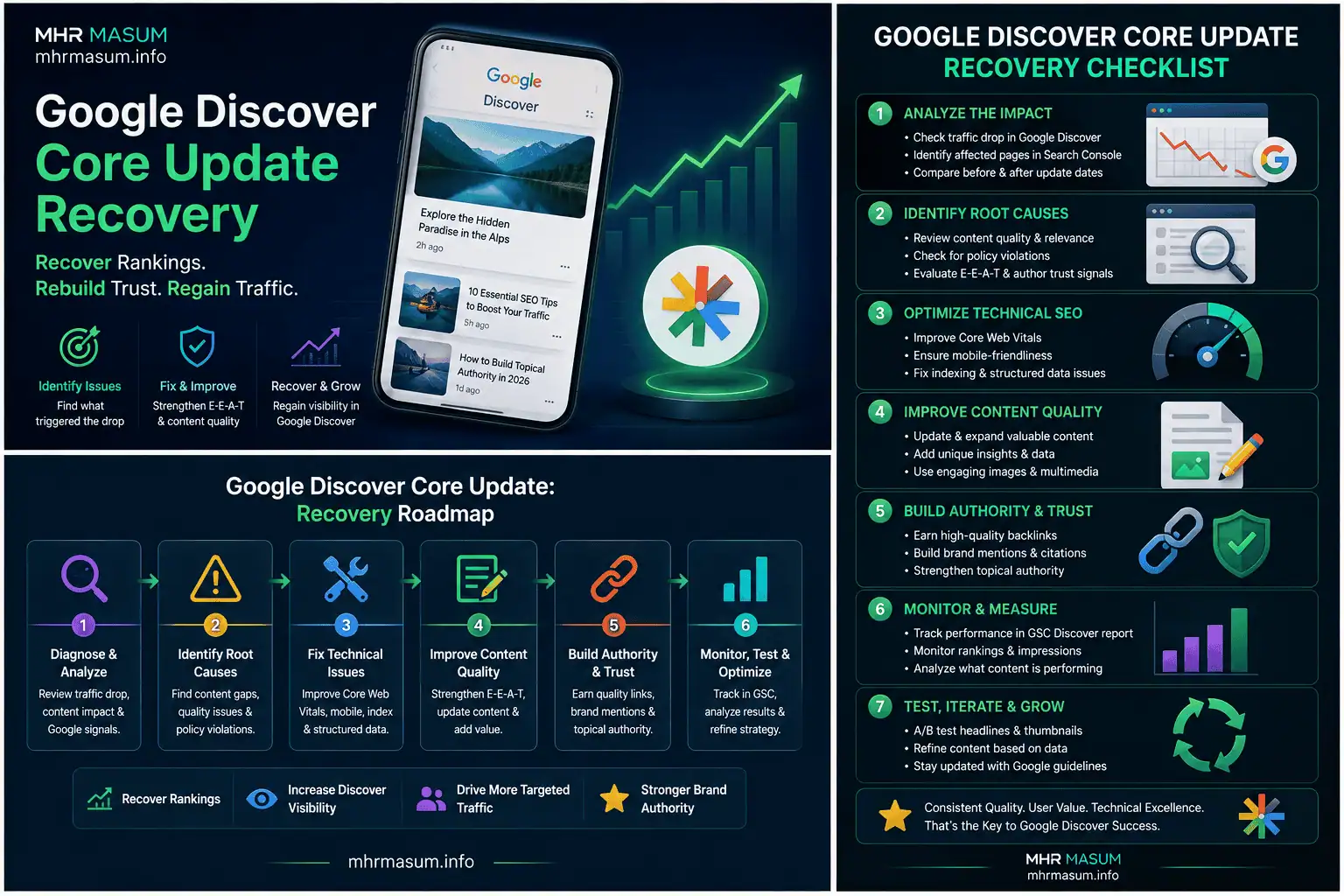
Google Discover Recovery Checklist
Use the following recovery process after diagnosis.
1. Remove Clickbait Without Making Titles Boring
Audit titles, featured images, social previews and opening paragraphs.
Replace:
- Unverified claims
- Excessive urgency
- Misleading curiosity gaps
- Unnecessary capitalisation
- Sensational emotional language
- Extreme conclusions
- Unsupported fear
- Images unrelated to the article
With:
- Clear outcomes
- Specific topics
- Accurate descriptions
- Useful numbers
- Appropriate dates
- Real benefits
- Honest limitations
- Strong but supportable language
A title should create a reason to click while accurately representing the page.
2. Add Original Evidence
Ask what your article contributes that competing pages do not.
Possible additions include:
- Screenshots
- Original photographs
- Search Console examples
- Client data
- Test results
- Custom frameworks
- Templates
- Expert commentary
- Personal experience
- Before-and-after examples
- Local evidence
- Product testing
- Failure analysis
- Implementation notes
Do not invent evidence.
First-hand information must be real, relevant and clearly explained.
3. Improve Topic Depth
A strong article should address the user’s entire practical need.
For a Discover recovery guide, depth may include:
- What changed
- Who was affected
- How to diagnose the impact
- How to audit content
- How to improve images
- How to avoid clickbait
- How to build authority
- How long recovery may take
- What not to change
- How to measure progress
Depth is created by completeness and usefulness, not repetition.
4. Strengthen Author Expertise
Every important article should make it clear who created the content.
Use:
- A visible author name
- A descriptive author biography
- A linked author page
- Relevant credentials
- Professional experience
- Areas of expertise
- Portfolio examples
- Social or professional profiles
- Editorial review information where appropriate
Google encourages clear authorship information and recommends evaluating content according to Who, How and Why.
On mhrmasum.info, articles should naturally connect to the About MD Harunur Rashid page and relevant SEO portfolio examples.
5. Improve Publisher Transparency
A reader should be able to understand:
- Who owns the website
- Who writes the content
- Why the website exists
- How to contact the publisher
- Whether content is sponsored
- Whether affiliate relationships exist
- When the content was published
- When it was meaningfully updated
Include clear links to:
- About page
- Contact page
- Editorial policy
- Privacy policy
- Disclaimer
- Author profiles
- Advertising or affiliate disclosure
Discover policy requires sponsored relationships to be clearly disclosed and warns against advertising that overwhelms the primary content.
6. Use Better Discover Images
Images can strongly influence Discover visibility and CTR.
Google recommends images that are:
- At least 1,200 pixels wide
- High resolution
- Relevant to the article
- Suitable for landscape presentation
- Enabled for large previews
- Correctly specified through structured data or
og:image
Google also recommends avoiding generic logos and excessively text-heavy images as the main Discover thumbnail.
Use:
<meta name="robots" content="max-image-preview:large">For WordPress, also verify that:
- The featured image is high resolution
- The image URL is crawlable
- The Open Graph image is correct
- The image is not blocked by robots.txt
- The main subject remains visible after cropping
- The image file is compressed appropriately
- Width and height attributes are defined
- The image does not create a poor Largest Contentful Paint result
7. Improve Page Experience
Discover traffic is predominantly mobile-oriented, so the page must work well on smaller screens.
Review:
- Mobile layout
- Font readability
- Loading speed
- Content stability
- Intrusive pop-ups
- Ad density
- Navigation
- Main-content visibility
- Image loading
- Accidental clicks
- Sticky elements
- Cookie notices
- Video embeds
Google recommends an overall good page experience rather than optimising one isolated metric.
A fast page with overwhelming ads is not a good experience. A visually attractive page that takes ten seconds to load is also not a good experience.
8. Build Strong Internal Linking
Internal links help readers and search systems understand relationships between topics.
Create links between:
- Pillar pages
- Supporting articles
- Case studies
- Service pages
- Author pages
- Category pages
- Relevant tools
- Portfolio examples
Use descriptive anchor text.
Avoid repeatedly using generic anchors such as:
- Click here
- Read more
- Learn more
- Visit this page
For example, an article about Discover recovery can naturally link to:
- Google Core Update Recovery Checklist
- Entity SEO
- AI SEO
- Brand authority for AI search
- Technical SEO for WordPress
- Local SEO strategy
Internal links should support the reader’s next logical question rather than being added only to manipulate rankings.
9. Strengthen Entity Signals
Entity SEO helps search systems understand:
- Who the author is
- What the business does
- Which topics the website covers
- How the author relates to the organisation
- Which social profiles are official
- Where the company operates
- Which services it provides
- What evidence supports its expertise
Useful actions include:
- Consistent author and business names
- Accurate Person schema
- Accurate Organization or ProfessionalService schema
- Appropriate
sameAslinks - Detailed About page
- Complete author profiles
- Relevant portfolio pages
- External professional profiles
- Case studies
- Reviews
- Consistent contact information
This wider entity system can support traditional Search, Discover and AI-powered discovery.
Read how to build brand authority for AI search for a connected brand-authority framework.
10. Review Generic AI-Assisted Content
Google does not prohibit content merely because AI was involved.
The critical issue is whether the final content is original, reliable, people-first and useful.
Problems arise when AI is used to produce:
- Repetitive summaries
- Unsupported claims
- Invented statistics
- Fake experience
- Generic introductions
- Unnecessary sections
- Large volumes of similar pages
- Content outside the publisher’s expertise
- Reworded competitor articles
- Articles created only to attract traffic
Google’s guidance warns against extensive automation across many topics and content that mainly summarises other sources without adding value.
Read Why Generic AI Content Does Not Rank Anymore for a more detailed quality-improvement process.
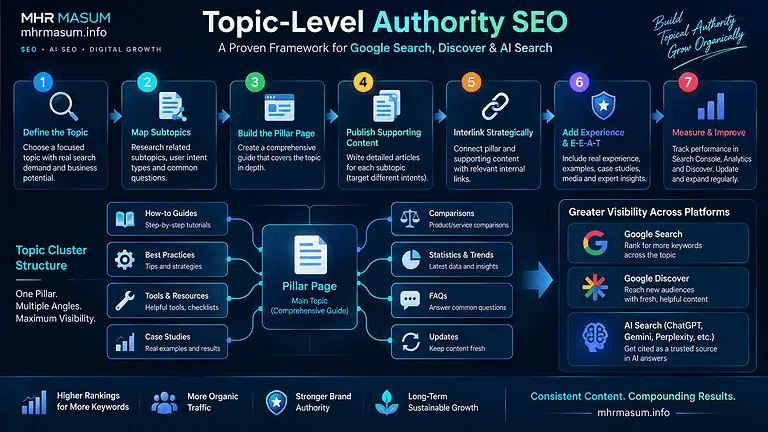
How to Build Topic-Level Authority
Recovering one article is useful.
Building a recognisable area of expertise is more sustainable.
Step 1: Define Your Core Topics
Create a list of subjects directly connected to:
- Your professional expertise
- Your products or services
- Your audience’s needs
- Your original experience
- Your business objectives
For an SEO consultancy, the core topics may include:
- Local SEO
- Technical SEO
- Google Search Console
- AI SEO
- Entity SEO
- WordPress
- WooCommerce SEO
- Core-update recovery
- Search analytics
- Digital growth
Avoid publishing on unrelated subjects merely because they appear to have traffic potential.
Step 2: Create a Topic Map
For each core topic, define:
- Main pillar guide
- Supporting informational articles
- Practical tutorials
- Case studies
- Frequently asked questions
- Comparison content
- Tools and templates
- Service pages
- Portfolio evidence
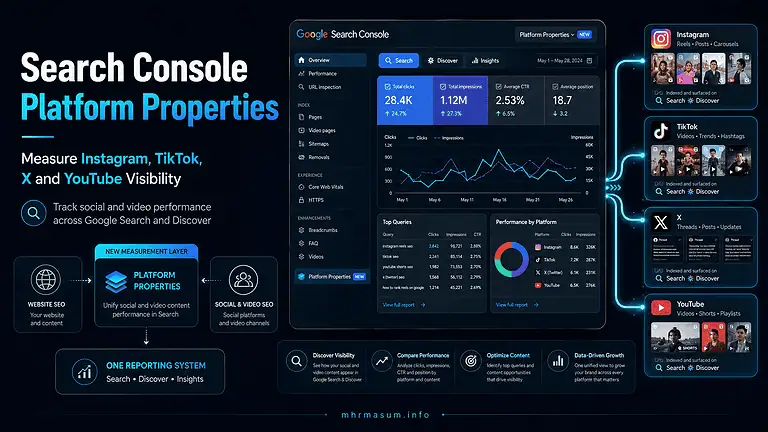
For example, a Google Search Console cluster could include:
- Search Console Platform Properties
- Core-update diagnosis
- Branded vs non-branded queries
- Query Groups
- Search annotations
- Weekly and monthly data
- Hourly data
- AI-powered report configuration
- Search Console AI performance reports
This creates breadth and depth within one coherent subject.
Step 3: Build Strong Category Pages
Do not treat category archives as empty lists of article titles.
A useful category page can include:
- Introductory topic summary
- Key guides
- Beginner resources
- Advanced resources
- Case studies
- Latest updates
- Author expertise
- Related services
- Clear navigation
Category pages can serve as topical hubs that help users understand what the website offers.
Step 4: Match Authors With Real Expertise
Assign content to authors with relevant knowledge.
Do not use a generic author profile across unrelated subjects without explaining the connection.
An SEO professional may appropriately write about:
- Search Console
- Local SEO
- Technical SEO
- WordPress optimisation
- Search analytics
That same professional should not automatically be presented as an expert in medicine, law or financial investment.
Topic-author alignment strengthens trust.
Step 5: Add First-Hand Experience
For every content cluster, identify what evidence you can provide.
Examples include:
- Client projects
- Website audits
- Screenshots
- Analytics
- Development work
- Campaign outcomes
- Testing
- Custom code
- Tools
- Mistakes
- Lessons learned
My Technical SEO and Keyword Research portfolio and Local SEO portfolio provide examples of connecting professional claims with relevant work.
Step 6: Interlink the Cluster
Each supporting article should link to:
- The pillar guide
- Closely related articles
- Relevant case studies
- Appropriate service pages
The pillar guide should link back to the supporting resources.
This creates a logical learning path and reduces isolated content.
Step 7: Maintain the Topic
Topic authority is not built through one publishing campaign and then abandoned.
Maintain important clusters by:
- Updating major guides
- Adding new examples
- Publishing timely developments
- Fixing outdated links
- Adding new screenshots
- Reviewing declining pages
- Consolidating overlap
- Improving category navigation
- Monitoring Search Console data
Consistency matters more than publishing a high volume of low-value content.
Topic Dilution: When Publishing More Can Hurt
Topic dilution occurs when a website expands into too many unrelated subjects without sufficient expertise or structure.
Warning signs include:
- Publishing on every trending topic
- Using AI to enter unrelated niches
- Creating single articles in dozens of categories
- No clear audience
- No recognisable site purpose
- Authors without relevant experience
- Weak internal links
- Thin category pages
- No original evidence
- Content that exists only for search traffic
Google’s people-first guidance asks whether a website has a primary purpose or focus and warns against publishing large amounts of content across many topics in the hope that some will rank.
A multi-topic website is not automatically a problem.
The topics should have a logical relationship, a real audience and enough depth to establish expertise within each important area.
Google Discover Recovery by Website Type
Publishers and News Websites
Focus on:
- Clear editorial ownership
- Reporter and author pages
- Accurate timestamps
- Original reporting
- Local correspondents
- Newsroom transparency
- Source disclosure
- Non-sensational headlines
- High-quality images
- Topic-specific desks or sections
Local Businesses
Focus on:
- Local case studies
- Service-area expertise
- Local images
- Customer questions
- Regional regulations
- Community involvement
- Reviews
- Local authorship
- Complete Google Business Profile information
- Accurate contact details
See how local evidence supports visibility in my Roofing Brisbane Local SEO case study and Pest Control Melbourne Google Business Profile case study.
Reviews can also strengthen customer trust, local prominence and broader brand signals. Read how reviews help Local SEO and AI search visibility.
Ecommerce Websites
Focus on:
- Original product photography
- First-hand product testing
- Useful comparisons
- Buying guides
- Accurate product data
- Product availability
- Customer questions
- Authentic reviews
- Demonstration videos
- Clear returns and shipping information
- Specialist category expertise
Avoid creating hundreds of generic AI-generated buying guides that repeat manufacturer descriptions.
Consultants and Personal Brands
Focus on:
- Real professional experience
- Author-led analysis
- Portfolio evidence
- Original frameworks
- Client problems
- Case studies
- Personal observations
- Demonstrated expertise
- Consistent topic coverage
- Clear service connections
A personal brand should make it easy for readers and search systems to connect the content with the professional behind it.
30–90 Day Google Discover Recovery Roadmap
Days 1–15: Diagnose
- Confirm the update timeline.
- Check Search Console data anomalies.
- Compare Discover separately from Search.
- Group affected pages by topic.
- Check manual actions.
- Check indexing and security.
- Review countries and devices.
- Identify the exact sections that declined.
- Export Discover data.
- Preserve a baseline report.
Days 16–30: Audit
- Audit headlines for clickbait.
- Review featured images.
- Evaluate originality.
- Check author information.
- Review publisher transparency.
- Identify thin content.
- Find overlapping articles.
- Assess page experience.
- Review advertising density.
- Check internal linking.
- Identify weak topic clusters.
Days 31–60: Improve
- Rewrite misleading headlines.
- Add original evidence.
- Update outdated articles.
- Improve large images.
- Strengthen author biographies.
- Expand useful sections.
- Consolidate overlapping content.
- Build category hubs.
- Add relevant internal links.
- Improve mobile performance.
- Connect articles to services and case studies.
Days 61–90: Build Authority
- Publish supporting cluster content.
- Add original case studies.
- Develop a consistent editorial schedule.
- Build local or specialist evidence.
- Strengthen entity information.
- Promote useful content to relevant audiences.
- Monitor Discover and Search independently.
- Record meaningful changes.
- Continue improving weak sections.
Do not expect every improvement to produce an immediate recovery.
Google says some improvements may be reflected within days, while broader reassessment can take several months as its systems evaluate whether a website is consistently producing helpful and reliable content.
Google Discover Performance KPIs
Track more than total clicks.
A useful monthly dashboard should include:
| KPI | Purpose |
| Discover impressions | Measures content exposure |
| Discover clicks | Measures visits from the feed |
| Discover CTR | Indicates preview effectiveness |
| Active Discover pages | Shows content distribution |
| New pages entering Discover | Tracks emerging visibility |
| Pages losing visibility | Identifies decline patterns |
| Top topics | Reveals audience interest |
| Top countries | Measures geographic relevance |
| Mobile engagement | Evaluates post-click experience |
| Engaged sessions | Measures visitor quality |
| Conversions | Connects traffic to outcomes |
| Branded-search growth | Measures possible brand demand |
| Returning visitors | Indicates audience development |
Discover traffic should be treated as one component of a wider search and content strategy.
Do not build a business model that depends entirely on unpredictable Discover spikes.
Common Google Discover Recovery Mistakes
Avoid these mistakes:
Changing Everything at Once
Mass changes make it difficult to identify what improved or harmed performance.
Deleting Content Only to Make the Site Look Fresh
Removing content without considering its value, links, traffic and purpose can create additional problems.
Republishing the Same Article With a New Date
A date change without meaningful improvement does not make content genuinely fresh.
Adding More Clickbait
A temporary CTR increase does not justify misleading users.
Copying Current Discover Winners
Competitor imitation does not create originality or expertise.
Publishing Large Volumes of AI Content
Quantity does not automatically build topic authority.
Ignoring Images
Weak, generic or badly cropped images can reduce the appeal of otherwise strong content.
Treating Discover Like Keyword Rankings
Discover is personalised and interest-driven. It should not be analysed exactly like a conventional SERP position.
Expecting Structured Data to Guarantee Discover Traffic
No special structured data is required for Discover, and adding schema does not guarantee selection.
Ignoring Business Outcomes
A traffic spike has limited value when it does not produce meaningful engagement, leads, subscribers or sales.
Frequently Asked Questions
What was the Google Discover core update 2026?
The February 2026 Discover core update was a broad change to Google’s systems for surfacing articles in Discover. It aimed to improve local relevance, reduce clickbait and show more original, timely and in-depth content from websites with relevant expertise.
When did the February 2026 Discover update start?
The update started on February 5, 2026.
When did the Discover update finish?
Google marked the rollout complete on February 27, 2026.
Did the update initially affect every country?
Google initially released the update to English-language users in the United States and said it planned to expand it to other countries and languages.
What is topic-level authority?
Topic-level authority is the expertise and credibility a website demonstrates within a specific subject or section. A site can establish authority in one topic even when it covers several broader categories.
Can a multi-topic website appear in Google Discover?
Yes. Google said its systems can recognise expertise on a topic-by-topic basis. A multi-topic website can therefore perform within a subject where it demonstrates sufficient depth and expertise.
Does Google Discover require structured data?
No special Discover structured data is required. Content must be indexed and comply with Google’s policies to be eligible.
Why did my Discover report disappear?
The Discover report only appears when a property reaches Google’s minimum reporting threshold. A decline below that threshold may cause the report to disappear.
Does a Discover traffic drop mean my website was penalised?
Not necessarily. Discover traffic can change because of user interests, competition, content types, algorithm updates, technical issues, policies or normal volatility.
Can clickbait reduce Discover visibility?
Google’s February 2026 update specifically aimed to reduce sensational content and clickbait. Misleading preview content can also violate Discover policies.
What image size is recommended for Google Discover?
Google recommends relevant, high-resolution images that are at least 1,200 pixels wide and enabled for large previews.
How long does Google Discover recovery take?
There is no guaranteed recovery period. Some improvements may be recognised relatively quickly, while larger site or topic-level reassessments may take several months.
Should I publish more content to recover?
Publish only when new content adds useful depth, evidence or coverage to a relevant topic. Publishing more generic content is unlikely to solve a quality or authority problem.
Does AI-generated content qualify for Discover?
AI involvement does not automatically disqualify content. The final article should still be original, accurate, useful, transparent and created primarily for people rather than ranking manipulation.
Final Thoughts
The Google Discover core update 2026 is not simply another headline-quality adjustment.
It reflects a wider change in how Google evaluates content ecosystems.
The strongest opportunities now belong to websites that combine:
- Original information
- Relevant expertise
- Topic depth
- Accurate headlines
- Strong visual presentation
- Local usefulness
- Clear authorship
- Publisher transparency
- Good page experience
- Logical internal linking
- Sustainable editorial standards
The update also provides an important message for multi-topic websites.
You do not need to be an expert in everything.
You need to clearly demonstrate where your expertise exists.
Build complete topic clusters. Publish evidence. Connect authors with their real experience. Create useful category hubs. Improve content because it serves your audience—not merely because an SEO tool recommends adding more words.
That is how a website develops topic-level authority capable of supporting Google Search, Google Discover and emerging AI-powered discovery.
Need Help Recovering Google Search or Discover Visibility?
I am MD Harunur Rashid, an SEO, AI SEO and Digital Growth Consultant with more than 17 years of experience helping local businesses, ecommerce brands, agencies and website owners improve organic visibility.
My services include:
- Google core-update diagnosis
- Google Discover content audits
- Technical SEO
- Local SEO
- AI SEO
- Entity SEO
- WordPress optimisation
- WooCommerce SEO
- Content strategy
- Search Console analysis
- Website speed optimisation
- Custom WordPress development
Explore the mhrmasum.info homepage for more practical SEO, AI search and digital-growth resources.
You can also review my:
- SEO and Digital Growth Services
- Professional Background
- SEO and WordPress Portfolio
- Technical SEO and Keyword Research Portfolio
- Local SEO Portfolio
- Roofing Brisbane Local SEO Case Study
- Pest Control Melbourne GMB Case Study
For a customised Google Discover audit, core-update recovery plan or long-term SEO strategy, contact MD Harunur Rashid.