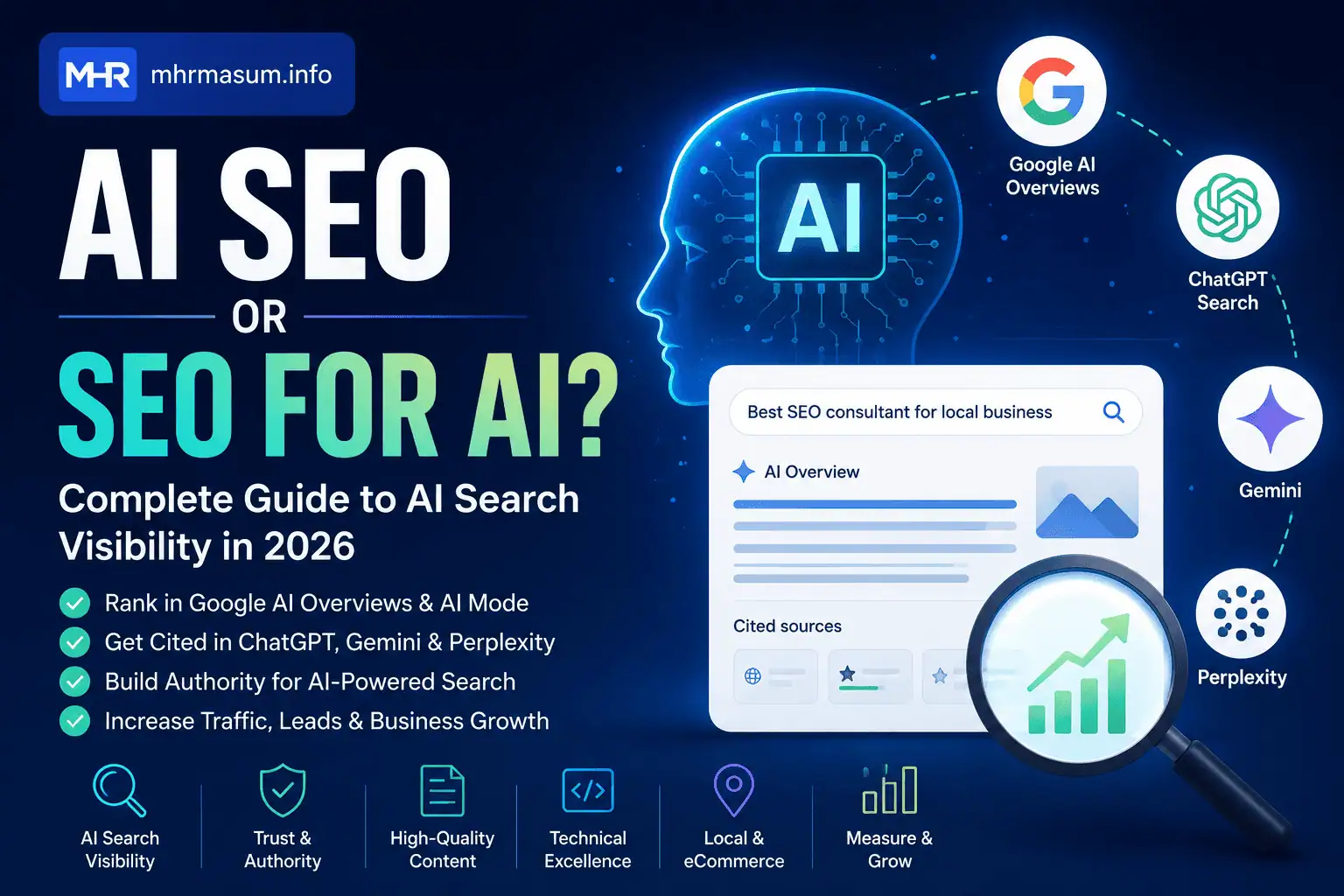
Search engine optimization is entering a new stage.
People are no longer discovering websites only through traditional lists of search results. They are increasingly asking complete questions, requesting comparisons, seeking recommendations, exploring follow-up queries, and receiving summarized answers from AI-powered search experiences.
These experiences include:
-
Google AI Overviews
-
Google AI Mode
-
ChatGPT Search
-
Microsoft Copilot
-
Perplexity
-
Gemini
-
AI-powered shopping tools
-
AI agents that can research and complete tasks
This change has introduced several new terms, including:
-
AI SEO
-
SEO for AI
-
Generative Engine Optimization
-
GEO
-
Answer Engine Optimization
-
AEO
-
Large Language Model Optimization
-
LLMO
-
AI Search Optimization
-
Agentic SEO
The terminology can make the subject appear more complicated than it needs to be.
The central objective remains understandable:
Create a technically accessible, trustworthy, authoritative, useful, and well-connected website that traditional search engines and AI-powered systems can discover, understand, retrieve, reference, recommend, and use.
Google’s official guidance states that established SEO best practices remain relevant because its generative AI features are rooted in Google’s core Search ranking and quality systems. Google also says that terms such as AEO and GEO describe work focused on AI search visibility, but from Google Search’s perspective, this work remains part of SEO. Read Google’s official guide to optimizing for generative AI Search.
Therefore, AI SEO should not be treated as a complete replacement for traditional SEO.
It is more accurate to think of AI SEO as an expansion of SEO that considers how information is discovered, selected, synthesized, cited, and acted upon within AI-powered experiences.
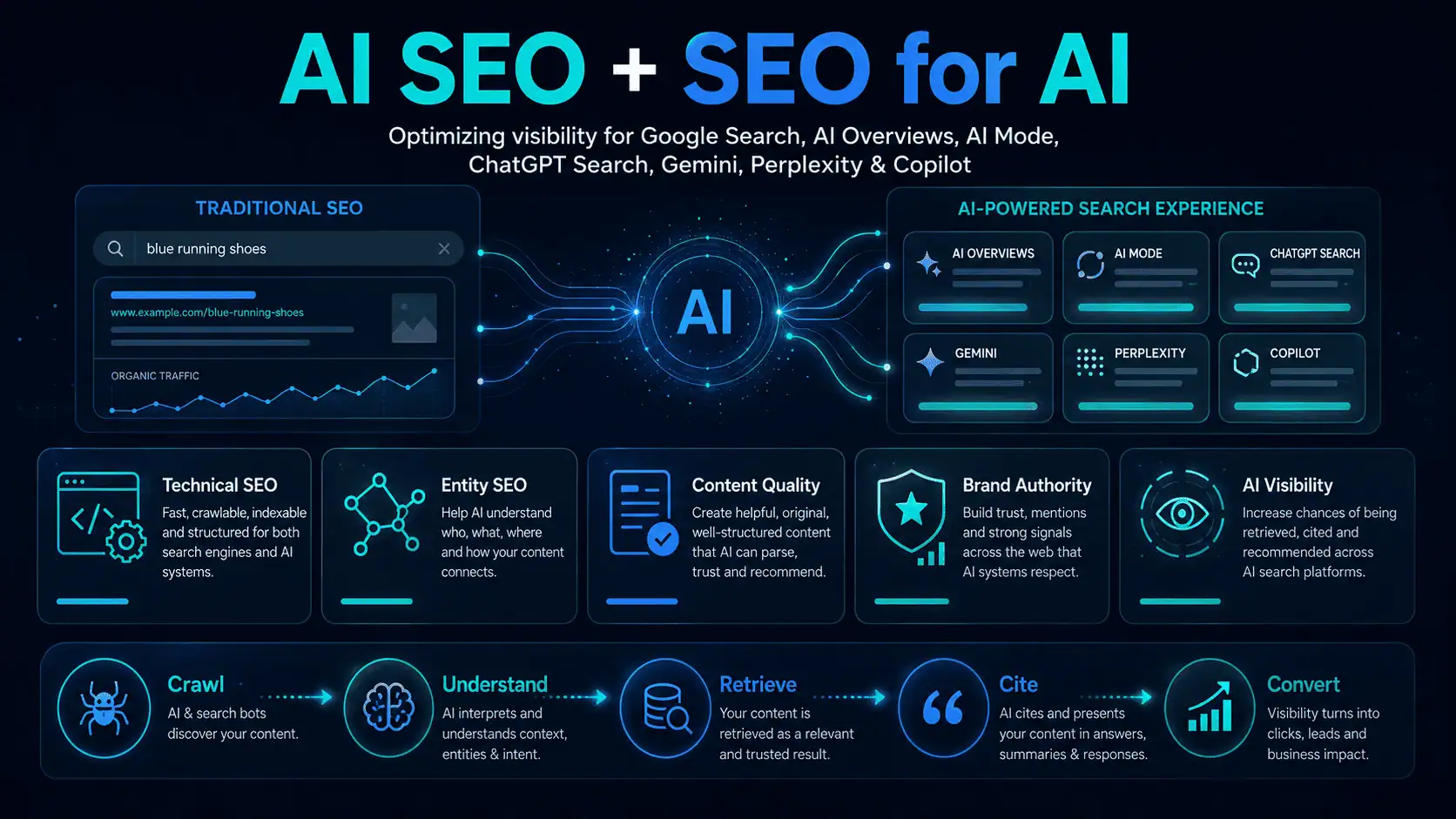
What Does AI SEO Mean?
AI SEO is an industry term with two different meanings.
The first meaning is using artificial intelligence to perform SEO work.
This may include using AI for:
-
Keyword classification
-
Content research
-
Search-intent analysis
-
Content briefs
-
Schema generation
-
Internal-link suggestions
-
Technical audit assistance
-
Data analysis
-
Competitor research
-
Reporting
-
Workflow automation
The second meaning is optimizing websites for visibility in AI-powered search and answer platforms.
This may include optimizing for:
-
Google AI Overviews
-
Google AI Mode
-
ChatGPT Search
-
Microsoft Copilot
-
Perplexity
-
Gemini
-
AI assistants
-
AI agents
-
Generative shopping experiences
These meanings are connected but should not be confused.
A company can use AI tools to automate SEO work without improving its visibility in AI search. Similarly, a website can gain AI-search visibility without using AI to produce its content.
For greater clarity, the following terminology is useful:
-
AI-assisted SEO: Using AI tools to perform or support SEO work
-
AI SEO: A broad strategy for organic visibility across traditional and AI-powered search
-
SEO for AI search: Optimizing content and websites specifically for AI-driven discovery
-
Agentic SEO: Making websites understandable and usable by AI agents
My detailed guide to AI SEO for Google AI Overviews, ChatGPT, Gemini and Perplexity explains how these search environments are changing organic visibility.
What Does SEO for AI Mean?
SEO for AI means applying search optimization principles so that AI-powered systems can discover, interpret, retrieve, trust, cite, and recommend website information.
Traditional SEO commonly focuses on helping a page:
-
Get crawled
-
Get indexed
-
Rank for relevant searches
-
Earn organic clicks
-
Generate conversions
SEO for AI expands those goals.
A page may now need to support situations where an AI system:
-
Uses it as a supporting source
-
Extracts a relevant passage
-
Includes it among cited links
-
Mentions its brand
-
Recommends its product
-
Summarizes its research
-
Compares its service with competitors
-
Uses its business information in a local answer
-
Allows an agent to interact with its website
SEO for AI is therefore concerned with both visibility and machine interpretation.
The website must make its meaning, expertise, services, entities, evidence, and relationships sufficiently clear for both people and automated systems.
Is AI SEO or SEO for AI the Better Term?
Both terms are useful, but they emphasize different aspects.
AI SEO is the broader and more commercially recognizable term. It can describe the complete discipline of building visibility across AI-influenced search experiences.
SEO for AI more clearly describes the intended outcome: optimizing a website for discovery and use by AI-powered search systems.
A practical way to use the terms is:
| Term | Best Use |
|---|---|
| AI SEO | Overall service or strategic discipline |
| SEO for AI | Educational explanation of the optimization objective |
| AI-assisted SEO | Using AI tools to improve SEO workflows |
| GEO | Visibility in generative answers |
| AEO | Visibility in direct-answer experiences |
| Agentic SEO | Preparing interfaces for AI-agent interaction |
For your business or service positioning, AI SEO is usually the stronger primary term.
For a detailed article, guide, or educational resource, SEO for AI search can be used to clarify what the work involves.
A suitable professional service description might say:
AI SEO helps businesses improve organic visibility across Google Search, AI Overviews, AI Mode, ChatGPT, Gemini, Perplexity, Copilot, and other generative discovery platforms.
Is AI SEO Different from Traditional SEO?
AI SEO is different in scope, but it is not separate from traditional SEO foundations.
Traditional SEO remains responsible for:
-
Crawling
-
Indexing
-
Technical accessibility
-
Search-intent alignment
-
Content quality
-
Internal linking
-
Website architecture
-
Structured data
-
Authority
-
User experience
-
Mobile usability
-
Search performance measurement
AI SEO adds further considerations, including:
-
Whether content can support generated answers
-
Whether entities are clearly established
-
Whether claims are backed by evidence
-
Whether the brand is recognized beyond its website
-
Whether information can be extracted accurately
-
Whether content answers related follow-up questions
-
Whether products and local business data are complete
-
Whether AI crawlers can access the website
-
Whether AI referral and citation visibility can be measured
-
Whether an AI agent can interact with important website features
Google confirms that pages must still be indexed and eligible to appear in Search with a snippet before they can appear in Google’s generative AI features. Meeting the requirements does not guarantee inclusion, crawling, indexing, or visibility.
A website cannot avoid foundational SEO problems by adding an “AI optimization” layer.
If Google cannot crawl or index a page correctly, that page is unlikely to become a reliable supporting source in Google’s AI-powered search experiences.
Use my Technical SEO Checklist for WordPress Websites to review the technical foundations required for traditional and AI-driven search.
AI SEO, GEO, AEO and LLMO Compared
The AI-search industry uses several overlapping labels.
Understanding their differences can help businesses avoid purchasing multiple services that are essentially performing similar work.
SEO Improves Organic Search Visibility
Search engine optimization helps search engines discover, understand, index, rank, and present website content.
SEO includes:
-
Technical SEO
-
Keyword research
-
On-page optimization
-
Content
-
Internal linking
-
Local SEO
-
eCommerce SEO
-
Authority building
-
Search performance analysis
SEO remains the core discipline beneath most AI-search optimization work.
AEO Improves Answer Visibility
Answer Engine Optimization focuses on making information clear and extractable for direct answers.
AEO strategies may include:
-
Direct definitions
-
Question-based sections
-
Concise explanations
-
Structured information
-
Clear factual answers
-
Useful summaries
-
Appropriate structured data
AEO can support featured snippets, voice assistants, knowledge results, and AI-generated answers.
GEO Improves Generative Visibility
Generative Engine Optimization focuses on how information, brands, products, and experts appear within generated responses.
GEO may emphasize:
-
Brand mentions
-
Citations
-
Supporting sources
-
Entity authority
-
Expert content
-
Original evidence
-
Topic coverage
-
Trusted third-party recognition
LLMO Targets Large Language Model Understanding
Large Language Model Optimization is usually used to describe efforts to make content more understandable or retrievable by language-model-powered systems.
However, individual AI platforms use different search indexes, crawlers, retrieval systems, ranking processes, and source-selection methods.
There is no single universal optimization switch for every large language model.
Agentic SEO Supports Task Completion
Agentic SEO focuses on whether an AI agent can navigate and interact with a website.
An agent may need to:
-
Search products
-
Check availability
-
Compare services
-
Complete a form
-
Add products to a cart
-
Book an appointment
-
Request a quote
This requires accessible interfaces, semantic HTML, clear labels, stable layouts, and secure workflows.
These Disciplines Should Work Together
A business does not need completely separate strategies for SEO, AEO, GEO, LLMO, and AI SEO.
A practical integrated strategy should focus on:
-
Strong technical foundations
-
Valuable content
-
Clear entities
-
Trusted brand signals
-
Good page experience
-
Accurate structured information
-
Search and AI visibility measurement
-
Conversion and business outcomes
For a detailed comparison, read GEO vs AEO vs SEO.
Why AI SEO Matters for Businesses
AI-powered discovery changes how customers interact with information.
A traditional searcher might:
-
Enter a keyword.
-
Review several search results.
-
Open multiple websites.
-
Compare the information manually.
-
Make a decision.
An AI-search user may instead ask:
Which SEO consultant can help a local business recover from a Google core update and improve visibility in AI search?
The system may then:
-
Interpret the request.
-
Search related concepts.
-
Retrieve information from multiple sources.
-
Compare providers or methods.
-
Generate a summarized response.
-
Include supporting links.
-
Allow follow-up questions.
The business may gain value even when the user does not begin with a traditional keyword or view a conventional list of ten blue links.
AI SEO can support business objectives such as:
-
Building brand visibility
-
Attracting qualified research traffic
-
Becoming a cited source
-
Increasing branded searches
-
Supporting product discovery
-
Improving local recommendations
-
Reaching users through complex questions
-
Generating AI referral traffic
-
Building professional authority
The business objective should not simply be “appear in AI.”
The objective should be to appear for relevant topics, products, services, customer problems, and buying decisions that can create measurable commercial value.
How AI-Powered Search Works
AI-search platforms do not all operate identically, but many use a combination of search, retrieval, ranking, language models, and source presentation.
A simplified workflow may include:
-
Understanding the user’s request
-
Expanding the request into related searches
-
Retrieving relevant documents
-
Evaluating possible sources
-
Extracting useful information
-
Generating a response
-
Presenting citations or links
-
Supporting follow-up questions
Query Fan-Out Expands the Original Search
Google explains that its generative search systems may use query fan-out. The model generates several related searches to retrieve different types of information needed to answer the original request.
For example, a user might ask:
How can I improve the Local SEO of a roofing business?
Related searches could involve:
-
Roofing Local SEO keywords
-
Google Business Profile optimization
-
Local roofing citations
-
Roofing customer reviews
-
Local landing pages
-
Roofing schema
-
Mobile website speed
A page does not necessarily need to repeat the user’s exact question to be selected.
It may be useful because it provides strong information about one of the related subtopics.
This means content strategies should cover real topic relationships rather than targeting only one exact-match keyword.
Retrieval Connects the Model with Current Information
A language model may use retrieved web information to ground its response.
Google’s AI features retrieve information from the Google Search index. ChatGPT Search presents cited web sources, while Bing’s guidelines describe content discovery across Bing Search, Microsoft Copilot, and grounding experiences.
AI search visibility therefore depends partly on the platform’s ability to access and evaluate the website.
The Model Synthesizes Information
The system may combine information from multiple pages into one answer.
This means your page may compete not only for one ranking position but also for selection as one of several useful supporting sources.
Citations Provide Supporting Links
AI-search interfaces may provide cited or related sources.
OpenAI explains that ChatGPT Search users can open a Sources panel to view citations and related links used in an answer.
The visibility of citations, links, and brands varies according to the platform and response format.
The Three Stages of AI Search Visibility
A useful AI SEO model separates discovery, selection, and presentation.
Discovery Determines Whether the Platform Can Access the Content
The platform must be able to discover and retrieve the relevant URL.
Discovery can be affected by:
-
Robots.txt
-
Crawl accessibility
-
Internal links
-
XML sitemaps
-
Server status
-
Firewalls
-
CDN settings
-
JavaScript rendering
-
Authentication
-
Canonical tags
-
Indexing directives
Selection Determines Whether the Content Is Useful
The system must determine that the page is relevant and valuable enough to support the user’s request.
Selection may be influenced by:
-
Topic relevance
-
Content quality
-
Originality
-
Factual accuracy
-
Evidence
-
Expertise
-
Freshness
-
Page authority
-
Entity relationships
-
Search-system signals
Presentation Determines How the Information Appears
Even when content is selected, it may appear in different ways:
-
Cited link
-
Supporting source
-
Brand mention
-
Product card
-
Local business result
-
Image
-
Video
-
Generated summary
-
Follow-up recommendation
SEO professionals cannot fully control the final presentation, but they can improve the quality, clarity, and accessibility of the source information.
The Core Pillars of AI SEO
A complete AI SEO strategy should include technical, content, entity, brand, experience, and measurement work.
Build a Strong Technical SEO Foundation
Technical SEO determines whether search and AI systems can access, process, and understand website content.
Important areas include:
-
Valid status codes
-
Crawlable links
-
Correct robots.txt
-
Correct index directives
-
Canonical tags
-
XML sitemaps
-
Mobile accessibility
-
HTTPS
-
JavaScript rendering
-
Structured data validation
-
Server performance
-
Core Web Vitals
Google explains that Search works through crawling, indexing, and serving. Even pages that follow all published requirements are not guaranteed to be crawled, indexed, or displayed. Read Google’s guide to how Search works.
Return Valid Status Codes
Important public pages should normally return an HTTP 200 response.
Review:
-
404 errors
-
Soft 404s
-
Server errors
-
Redirect loops
-
Redirect chains
-
Blocked resources
Use Canonical Tags Correctly
Canonical tags help search systems identify the preferred version of duplicate or similar pages.
Incorrect canonicals can cause an important page to be associated with another URL.
Keep XML Sitemaps Accurate
XML sitemaps should contain canonical, indexable URLs that the business wants search engines to discover.
Avoid including:
-
Redirected URLs
-
noindexURLs -
Broken pages
-
Duplicate parameter URLs
-
Staging URLs
Make Important Links Crawlable
Use normal HTML links with valid href attributes.
Google’s Search Essentials recommends creating crawlable links so that Google can discover related pages.
Check JavaScript Rendering
Important content should be available reliably after rendering.
Do not hide essential business information behind:
-
User interactions
-
Unreliable API requests
-
Hover-only elements
-
Client-side events
-
Broken scripts
Improve Website Speed
Slow server responses, heavy JavaScript, large images, and unstable layouts can create poor experiences for users and automated systems.
Read Why Site Speed Optimization Is Important for a Business and review my Website Speed Optimization portfolio for practical performance guidance.
Create Valuable, Non-Commodity Content
Google’s current generative AI guidance emphasizes useful, original, expert-led content that provides value beyond information already available everywhere. Google describes this as valuable, non-commodity content.
Commodity content usually repeats widely available information without adding:
-
Original analysis
-
Experience
-
Evidence
-
Examples
-
Research
-
Professional judgment
-
Unique data
-
Useful visuals
-
Practical processes
For example, a generic article about Local SEO may contain definitions and standard tips.
A stronger article may include:
-
A real Local SEO audit process
-
Screenshots
-
A prioritization framework
-
Common implementation mistakes
-
Industry-specific examples
-
Case-study evidence
-
Measurement guidance
-
Expert recommendations
Google advises website owners to create helpful, reliable, people-first content rather than content designed mainly to manipulate search rankings. Review Google’s people-first content guidance.
Read Why Generic AI Content Does Not Rank Anymore for a complete quality framework.
Answer the Main Question and Related Questions
AI search supports conversational and follow-up behaviour.
A useful page should answer the primary question while covering the related information a person genuinely needs.
For example, a page about hiring an SEO consultant may also explain:
-
What an SEO consultant does
-
Which services are included
-
How much SEO may cost
-
How long results can take
-
How success is measured
-
Warning signs
-
Consultant versus agency
-
Technical implementation
-
AI SEO experience
This comprehensive structure supports both human research and query fan-out.
However, Google says there is no requirement to divide content into unnaturally small “chunks” or create a separate page for every possible long-tail variation. Google’s systems can understand related meanings and identify relevant sections within longer pages.
The correct goal is comprehensive usefulness, not artificial fragmentation.
Use Clear Heading and Content Structure
Headings help people and machines understand the organization of a page.
Use:
-
One descriptive H1
-
Logical H2 sections
-
Relevant H3 subsections
-
Clear paragraphs
-
Lists when appropriate
-
Tables for genuine comparisons
Every heading should introduce useful explanatory content.
Avoid:
-
Empty headings
-
Headings used only for styling
-
Repeating the same keyword unnaturally
-
Skipping levels without reason
-
Using dozens of vague headings
A strong heading should communicate the purpose of the section.
For example:
How to Measure AI Search Visibility in Google Search Console
is more useful than:
Measurement
Put Important Information in Accessible HTML
Important facts should be available as text, not only inside:
-
Images
-
Videos
-
PDF files
-
Interactive widgets
-
Pop-ups
-
Infographics
-
JavaScript-only interfaces
Visuals can support the content, but the main information should remain accessible in HTML.
This helps:
-
Search crawlers
-
Screen readers
-
AI retrieval systems
-
Mobile users
-
Users with slow connections
-
Browser agents
Demonstrate Experience, Expertise, Authority and Trust
E-E-A-T is not a single visible score. It is a useful framework for evaluating whether content demonstrates experience, expertise, authoritativeness, and trustworthiness.
Practical signals may include:
-
Named author
-
Detailed author biography
-
Relevant professional experience
-
First-hand examples
-
Accurate sources
-
Publication dates
-
Updated dates
-
Editorial review
-
Contact information
-
Business transparency
-
Case studies
-
Policies
-
Corrections
For professional content, clearly identify:
-
Who created it
-
Why they are qualified
-
How the information was developed
-
Which sources support it
-
When it was last reviewed
My About page for MD Harunur Rashid helps establish my professional background across SEO, AI SEO, Local SEO, WordPress optimization, digital growth, and plugin development.
Strengthen Entity SEO
Entity SEO helps search and AI systems understand real-world people, organizations, services, products, locations, and relationships.
A strong entity strategy clarifies:
-
Who the brand is
-
What it does
-
Which topics it specializes in
-
Which people represent it
-
Where it operates
-
Which services it provides
-
Which external profiles belong to it
-
Which evidence supports its expertise
Important entity signals may include:
-
Consistent brand name
-
Detailed About page
-
Author pages
-
Organization schema
-
Person schema
-
Social profiles
-
Google Business Profile
-
Relevant directories
-
Reviews
-
Case studies
-
Media mentions
-
Portfolio projects
-
Consistent contact information
Read Entity SEO: The Missing Part of Modern SEO for a detailed implementation strategy.
Build Brand Authority Beyond Your Website
AI-powered systems may evaluate information published across multiple sources.
A brand that exists only on its own website may be more difficult to verify than a brand supported by:
-
Customer reviews
-
Professional profiles
-
Relevant backlinks
-
Industry mentions
-
Interviews
-
Podcasts
-
Videos
-
News articles
-
Community discussions
-
Partnerships
-
Case studies
Brand authority should be built through genuine professional activity.
Avoid attempting to manufacture large numbers of fake mentions.
Google warns that seeking inauthentic mentions is not an effective shortcut because its AI features rely on core ranking and spam-prevention systems.
Read How to Build Brand Authority for AI Search for a practical authority-building framework.
Publish Evidence That Can Support Recommendations
AI-generated recommendations require reliable supporting information.
A business can strengthen its content by publishing:
-
Case studies
-
Original research
-
Statistics
-
Testing results
-
Detailed comparisons
-
Methodology
-
Screenshots
-
Before-and-after evidence
-
Customer outcomes
-
Professional opinions
-
Limitations
A case study should explain:
-
The original situation
-
The problem
-
The work completed
-
The measurement method
-
The outcome
-
The limitations
Review my SEO and WordPress portfolio for practical examples of evidence-based professional work.
Relevant portfolio projects include:
Build Strong Internal Linking and Topic Clusters
Internal links help search systems and users understand relationships between pages.
An AI SEO topic cluster might connect:
-
AI SEO
-
Entity SEO
-
GEO
-
AEO
-
Brand authority
-
Technical SEO
-
Generic AI content
-
Google update recovery
-
Local SEO
-
Reviews
-
Website speed
A central AI SEO guide can link to specialist supporting articles, while those articles link back to the central guide.
Use descriptive anchor text such as:
-
AI SEO for Google AI Overviews
-
Entity SEO implementation guide
-
Technical SEO Checklist
-
Local SEO strategy
-
Google core-update recovery checklist
Avoid vague anchors such as:
-
Click here
-
Read more
-
This page
-
More information
Internal links should support the reader’s journey rather than exist only to manipulate rankings.
Use Structured Data Accurately
Structured data can help search systems understand information and make pages eligible for supported rich results.
Relevant types may include:
-
Organization
-
Person
-
Article
-
Product
-
Offer
-
LocalBusiness
-
BreadcrumbList
-
VideoObject
-
Event
-
Review
-
AggregateRating
However, Google says that structured data is not required for generative AI search and that no special AI schema markup is necessary.
Structured data should:
-
Match visible content
-
Use accurate values
-
Follow Google policies
-
Avoid misleading claims
-
Be validated after implementation
Do not add random schema types because an AI tool claims they will improve “LLM rankings.”
Add Useful Images and Videos
Google’s generative AI guidance says that relevant images and videos may create additional opportunities for website content to appear within AI-powered Search experiences.
Useful visuals may include:
-
Original screenshots
-
Charts
-
Infographics
-
Product images
-
Process diagrams
-
Tutorial videos
-
Before-and-after examples
-
Data visualizations
Visuals should be:
-
Relevant
-
High quality
-
Properly compressed
-
Mobile-friendly
-
Accompanied by descriptive text
-
Given accurate alt text where appropriate
-
Supported by captions when context is useful
Do not create decorative images that add no information and significantly slow the page.
Optimize Local Business Information
Google’s AI-search guidance confirms that generative responses may include local business information and recommends maintaining accurate information through Google Business Profile.
Local businesses should maintain:
-
Accurate business name
-
Correct primary category
-
Relevant additional categories
-
Address or service area
-
Phone number
-
Website
-
Opening hours
-
Services
-
Photos
-
Reviews
-
Local landing pages
-
LocalBusiness schema
-
Consistent citations
Read Local SEO in 2026: Complete Guide for Small Businesses for a comprehensive strategy.
Customer reviews can also support reputation, conversion, local visibility, and broader AI-search understanding. Review How Reviews Help Local SEO and AI Search Visibility.
Optimize eCommerce Product Information
AI-powered shopping experiences require accurate and consistent product data.
eCommerce websites should maintain:
-
Product name
-
Brand
-
Description
-
Price
-
Availability
-
Product identifier
-
Variants
-
Shipping details
-
Return conditions
-
Product images
-
Product schema
-
Merchant Center feeds
Google’s AI optimization guide recommends using Merchant Center and other relevant product systems to improve product visibility across traditional and generative search experiences.
Information should remain consistent across:
-
Product page
-
Structured data
-
Merchant feed
-
Cart
-
Checkout
Conflicting price or availability information can reduce trust and create customer frustration.
Manage AI Crawlers Correctly
Different AI platforms use different crawlers and access controls.
Website owners should evaluate each crawler according to their goals, privacy requirements, server capacity, and content policies.
OpenAI Crawler Controls
OpenAI documents separate controls for OAI-SearchBot and GPTBot.
OAI-SearchBot supports website inclusion in ChatGPT Search, while GPTBot relates to the potential use of content for training OpenAI’s foundation models. These controls are independent.
A website may choose to allow ChatGPT Search discovery while restricting training access.
Example:
User-agent: OAI-SearchBot
Allow: /

User-agent: GPTBot
Disallow: /
OpenAI states that inclusion in ChatGPT Search requires allowing OAI-SearchBot and ensuring that hosting or CDN security systems permit traffic from OpenAI’s published IP ranges. Top placement cannot be guaranteed.
Perplexity Crawler Controls
Perplexity documents PerplexityBot as its crawler and Perplexity-User as a user-triggered fetch mechanism. Perplexity says Perplexity-User supports user requests and is not used for broad crawling or foundation-model training.
Perplexity states that PerplexityBot respects robots.txt directives, although blocked pages may still have limited domain, headline, or factual-summary information represented.
Bing and Microsoft Copilot
Bing’s Webmaster Guidelines apply to content surfaced across Bing Search, Microsoft Copilot, and grounding experiences.
Businesses should verify their sites in Bing Webmaster Tools, submit accurate sitemaps, review indexing, and monitor performance.
Robots.txt Is Not a Security System
Robots.txt communicates crawling preferences. It does not protect confidential information.
Private or sensitive content should be secured through:
-
Authentication
-
Authorization
-
Password protection
-
Server-side controls
-
Appropriate access permissions
Crawler access decisions should be reviewed periodically because platform documentation and user-agent behaviour may evolve.
Do You Need an llms.txt File?
An llms.txt file is sometimes presented as a required AI SEO file that helps large language models understand a website.
Google explicitly states that it does not use llms.txt files or special AI text files for Google Search, including generative AI features. Creating one neither improves nor harms Google Search visibility because Google ignores it.
An llms.txt file may still be useful for another platform or internal documentation system that explicitly supports it.
However, it should not replace:
-
Robots.txt
-
XML sitemaps
-
Crawlable navigation
-
Good content
-
Structured data
-
Internal linking
-
Search Console
-
Bing Webmaster Tools
Do not present llms.txt as a guaranteed Google AI-ranking method.
Do You Need Special AI Schema?
There is no special universal schema type that guarantees inclusion in AI-generated answers.
Google says that no special structured data is required for its generative AI search experiences.
Continue using supported structured data when it accurately describes visible content and helps the page qualify for traditional rich results.
Schema should clarify existing information rather than invent new claims.
Should Content Be Rewritten Specifically for AI?
Google says that website owners do not need to rewrite content in a special style solely for generative AI search. Its systems can understand synonyms, meaning, and related concepts.
However, this does not mean structure and clarity are unimportant.
Content should still provide:
-
Clear explanations
-
Descriptive headings
-
Logical sections
-
Useful examples
-
Accurate terminology
-
Supporting evidence
-
Readable paragraphs
-
Relevant internal links
Write for people first, while making the information easy for machines to interpret.
Can AI-Generated Content Rank?
Google does not ban content merely because AI was used in its creation.
Google states that generative AI can be useful for research and content organization. However, generating large numbers of pages without adding meaningful value may violate its scaled content abuse policies.
The important question is not:
Was AI used?
The important questions are:
-
Is the information accurate?
-
Is it original?
-
Does it help the reader?
-
Does it demonstrate expertise?
-
Is it reviewed?
-
Does it add value?
-
Is it created mainly for ranking manipulation?
-
Are sources represented correctly?
A responsible AI-assisted content workflow should include:
-
Human topic selection
-
Search-intent research
-
Source research
-
Expert input
-
AI-assisted drafting where useful
-
Factual verification
-
Original examples
-
Editorial review
-
Internal linking
-
Post-publication updates
AI should support expertise rather than imitate it.
Build Content Around Real Customer Journeys
AI SEO content should support the questions customers ask before, during, and after a buying decision.
For an SEO consultancy, the journey may include:
Problem Awareness
The customer searches:
-
Why did my traffic drop?
-
Why is my website not ranking?
-
Why is my Google Business Profile not visible?
-
Why is my website slow?
Solution Research
The customer searches:
-
What is Technical SEO?
-
How does Local SEO work?
-
What is AI SEO?
-
How do I recover from a core update?
Provider Evaluation
The customer searches:
-
Best SEO consultant
-
SEO consultant versus agency
-
SEO portfolio
-
Local SEO case studies
-
SEO consultant experience
Action
The customer searches:
-
Hire SEO consultant
-
Request SEO audit
-
Book SEO consultation
-
Contact SEO specialist
A strong website provides useful content at every stage and connects informational pages with relevant services, case studies, and contact pathways.
Read How an SEO Consultant Helps Businesses Grow to understand how professional SEO supports wider business growth.
Optimize for Brand Mentions and Citations
AI visibility is not limited to clickable referral traffic.
A brand may receive value through:
-
Direct citation
-
Supporting link
-
Brand mention
-
Product recommendation
-
Expert attribution
-
Increased branded search
-
Assisted conversion
A citation is generally stronger when it directs users to the original source.
A mention without a link may still increase awareness, but it is harder to attribute directly.
Improve citation potential by publishing information that is:
-
Specific
-
Original
-
Verifiable
-
Clearly attributed
-
Current
-
Useful
-
Easy to reference
Useful citation assets may include:
-
Original research
-
Statistics
-
Definitions
-
Methodologies
-
Calculators
-
Checklists
-
Case studies
-
Industry benchmarks
-
Expert commentary
Improve Content Freshness Without Manipulating Dates
Some topics require regular updates.
Examples include:
-
Search Console features
-
AI-search capabilities
-
Platform crawler guidance
-
Google updates
-
Software documentation
-
Pricing
-
Regulations
-
Product availability
Update content when:
-
Facts change
-
Features change
-
Links break
-
Recommendations become outdated
-
New evidence becomes available
-
User needs change
Do not change the publication date without making meaningful updates.
A useful update process includes:
-
Reviewing source accuracy
-
Rechecking outbound links
-
Updating examples
-
Adding new official guidance
-
Removing outdated advice
-
Recording the updated date
Improve Page Experience
AI SEO should not ignore the experience of the human who follows a citation.
A page should be:
-
Fast
-
Mobile-friendly
-
Secure
-
Readable
-
Accessible
-
Easy to navigate
-
Free from intrusive overlays
-
Clear about its main content
Google’s page-experience guidance includes Core Web Vitals, HTTPS, mobile usability, and avoiding intrusive experiences as part of evaluating whether users receive a good page experience.
A citation that leads to a poor page may not produce meaningful engagement or conversion.
Prepare for AI Agents
AI search is expanding from information retrieval into task completion.
AI agents may attempt to:
-
Complete contact forms
-
Search products
-
Compare services
-
Check availability
-
Book consultations
-
Add items to carts
-
Navigate account areas
Agent-ready websites should use:
-
Semantic HTML
-
Real buttons and links
-
Connected form labels
-
Clear error messages
-
Clear success messages
-
Stable layouts
-
Accessible menus
-
Secure confirmation steps
-
Predictable workflows
Agentic SEO does not replace AI SEO. It extends the strategy from content discovery into website interaction.
How to Measure AI SEO Performance
AI SEO measurement is more complex than tracking one traditional ranking position.
A complete measurement system should include:
-
Search visibility
-
Generative impressions
-
Citations
-
Brand mentions
-
Referral traffic
-
Engagement
-
Conversions
-
Branded searches
-
Revenue
-
Assisted conversions
Measure Google Generative AI Impressions
Google has introduced a dedicated Search Console Generative AI performance report for eligible properties.
The report includes impressions from:
-
AI Overviews
-
AI Mode
It can show AI impressions by:
-
Page
-
Country
-
Device
-
Date
Google is rolling the report out gradually, and it may not appear for properties without access or sufficient impressions.
The dedicated report is currently impression-focused. Do not assume that every AI impression generated a click, citation, lead, or sale.
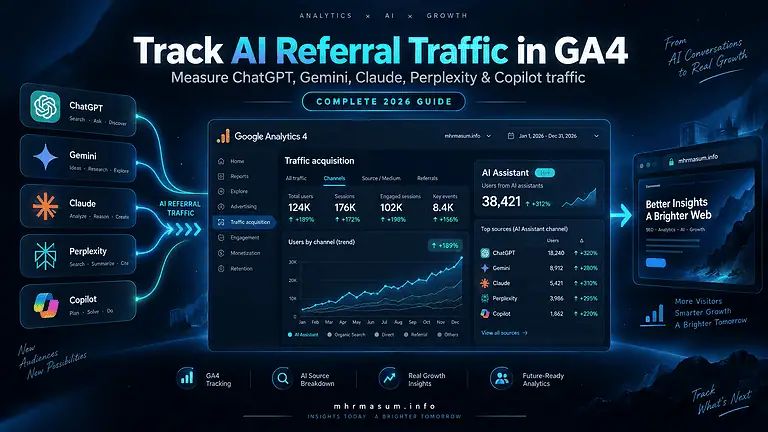
Measure ChatGPT Referral Traffic
OpenAI says publishers that allow OAI-SearchBot can track ChatGPT Search referrals through analytics.
ChatGPT automatically adds:
utm_source=chatgpt.com
to referral links, allowing inbound traffic to be identified in systems such as Google Analytics.
In GA4, review:
-
Traffic acquisition
-
Session source
-
Landing page
-
Engagement
-
Key events
-
Conversions
Referral traffic does not capture every possible brand mention or zero-click exposure, but it provides direct evidence of website visits.
Measure Microsoft Copilot Visibility
Bing Webmaster Tools provides an AI Performance report showing how website content is used in AI-generated answers across Microsoft Copilot and partner experiences.
Businesses should monitor both:
-
Traditional Bing Search performance
-
AI Performance data
This can provide another source of first-party AI-search measurement.
Monitor Brand Mentions
Brand monitoring may include:
-
Manual testing
-
Search queries
-
Social listening
-
Media monitoring
-
Third-party AI visibility tools
-
Branded search trends
Third-party AI-search tools can be useful, but their proprietary visibility scores should not be presented as official platform data.
Google advises website owners to evaluate third-party SEO tools and services critically, particularly when they promise improvements in AI experiences or GEO visibility.
Connect AI Visibility with Business Results
The purpose of AI SEO is not simply to increase an AI visibility score.
Track whether AI-driven discovery contributes to:
-
Qualified leads
-
Calls
-
Form submissions
-
Purchases
-
Bookings
-
Newsletter subscriptions
-
Branded searches
-
Sales-assisted conversations
-
Revenue
-
Customer acquisition
A page with 100 commercially relevant AI referrals may be more valuable than one with thousands of unrelated impressions.
Useful AI SEO Metrics
A practical monthly dashboard may include:
| Metric | Purpose |
|---|---|
| Google generative AI impressions | Visibility in AI Overviews and AI Mode |
| Pages receiving AI impressions | Identifies useful AI-visible assets |
| ChatGPT referral sessions | Tracks direct ChatGPT traffic |
| Copilot citations or appearances | Measures Microsoft AI visibility |
| Perplexity referrals | Tracks direct referral visits where available |
| Branded searches | Indicates brand-demand growth |
| Assisted conversions | Connects AI discovery to later action |
| Qualified leads | Measures commercial value |
| Revenue | Measures financial outcomes |
AI SEO for Local Businesses
Local businesses should combine AI SEO with strong Local SEO.
Important elements include:
-
Google Business Profile
-
Local landing pages
-
Consistent business information
-
Reviews
-
Service descriptions
-
LocalBusiness schema
-
Local case studies
-
Geographic relevance
-
Mobile performance
-
Clear contact options
AI-powered systems may need to understand:
-
What the business offers
-
Where it operates
-
Whether it is open
-
How customers rate it
-
How to contact it
-
Whether it serves a particular location
Review my Roofing Brisbane Local SEO case study and Pest Control Melbourne GMB case study for practical local implementation examples.
AI SEO for eCommerce Businesses
eCommerce businesses should focus on accurate product and merchant information.
Important areas include:
-
Product titles
-
Product descriptions
-
Category pages
-
Product schema
-
Merchant feeds
-
Availability
-
Price
-
Shipping
-
Returns
-
Reviews
-
Product images
-
Variants
-
Brand entities
AI-powered shopping systems need consistent data.
A product should not show:
-
One price on the page
-
Another price in schema
-
An outdated price in Merchant Center
-
Unavailable stock in checkout
Content supporting product research can include:
-
Buying guides
-
Comparisons
-
Compatibility guides
-
Use cases
-
Product videos
-
FAQs
-
Brand pages
AI SEO for Professional Service Businesses
Professional service businesses need to establish expertise, trust, and evidence.
Important content includes:
-
Detailed service pages
-
Professional biography
-
Case studies
-
Portfolio
-
Process
-
Industries served
-
FAQs
-
Contact pathways
-
Reviews
-
Thought leadership
The website should make it easy to determine:
-
Who provides the service
-
What experience they possess
-
Which problems they solve
-
How the engagement works
-
What evidence supports their claims
Explore my complete SEO and Digital Growth Services to see how service pages can connect AI SEO, Technical SEO, Local SEO, WordPress optimization, and business growth.
AI SEO for Publishers and Content Websites
Publishers should prioritize:
-
Original reporting
-
Clear authorship
-
Publication dates
-
Updated dates
-
Source attribution
-
Topic expertise
-
Crawl access
-
Article structure
-
Images and video
-
Subscription pathways
A publisher may need to balance:
-
AI-search visibility
-
Referral traffic
-
Content rights
-
Crawler policies
-
Subscription models
-
Training preferences
OpenAI and Perplexity provide separate crawler controls, allowing publishers to make platform-specific access decisions.
Common AI SEO Mistakes
AI SEO is developing quickly, creating opportunities for unsupported claims and ineffective shortcuts.
Treating AI SEO as a Separate Replacement for SEO
AI visibility still depends heavily on technical SEO, content quality, authority, and indexing.
Ignoring traditional SEO will weaken the AI strategy.
Publishing Large Volumes of Generic AI Content
Generating hundreds of similar pages without unique value may create quality and spam risks.
Google warns that scaled AI content created without adding value can violate its spam policies.
Rewriting Content for Every Prompt Variation
Do not create one page for:
-
Best SEO consultant
-
Top SEO consultant
-
Leading SEO consultant
-
Experienced SEO consultant
-
Professional SEO consultant
Create one strong page that addresses the real topic and user need comprehensively.
Chasing Artificial Brand Mentions
Fake forum discussions, fabricated reviews, and low-quality mentions can create trust and policy risks.
Build real recognition through useful work and credible relationships.
Overusing Schema
Adding excessive or irrelevant structured data does not create AI authority.
Use schema accurately and conservatively.
Blocking AI Crawlers Accidentally
Security services, CDN rules, and robots.txt directives may prevent AI-search crawlers from accessing the website.
Review crawler access before concluding that the content is being ignored.
Measuring Only Manual Prompts
Manual testing can provide useful observations, but AI responses can vary according to:
-
User
-
Location
-
time
-
Context
-
Model
-
Platform
-
Follow-up conversation
-
Search availability
Use manual tests alongside platform reports, referral data, Search Console, Bing Webmaster Tools, and conversions.
Assuming Every Mention Creates Revenue
An AI mention may create awareness without generating a visit or sale.
Connect visibility with business outcomes.
A 90-Day AI SEO Implementation Roadmap
A phased roadmap helps a business build sustainable AI-search visibility without neglecting traditional SEO.
Days 1–30: Audit the Foundation
During the first month:
-
Audit crawling and indexing
-
Review robots.txt
-
Review AI crawler access
-
Validate XML sitemaps
-
Check canonical tags
-
Review Search Console
-
Review Bing Webmaster Tools
-
Identify key business entities
-
Audit content quality
-
Review brand consistency
-
Identify important topic clusters
-
Record baseline traffic and conversions
The output should be a prioritized roadmap.
Days 31–60: Improve Content and Entity Signals
During the second month:
-
Improve core service pages
-
Add author information
-
Update the About page
-
Publish original examples
-
Strengthen case studies
-
Add source citations
-
Improve internal links
-
Correct structured data
-
Optimize Google Business Profile
-
Improve product feeds
-
Add useful visuals
-
Update outdated content
Focus first on pages connected to important products, services, and customer decisions.
Days 61–90: Build Authority and Measurement
During the third month:
-
Promote original research
-
Earn relevant mentions
-
Publish specialist supporting content
-
Monitor ChatGPT referrals
-
Review Google generative impressions
-
Review Bing AI Performance
-
Track branded searches
-
Connect AI referrals with conversions
-
Test agentic journeys
-
Refine the content roadmap
-
Create a monthly reporting dashboard
AI SEO should continue after 90 days because search platforms, AI systems, competitors, and customer behaviour continue to evolve.
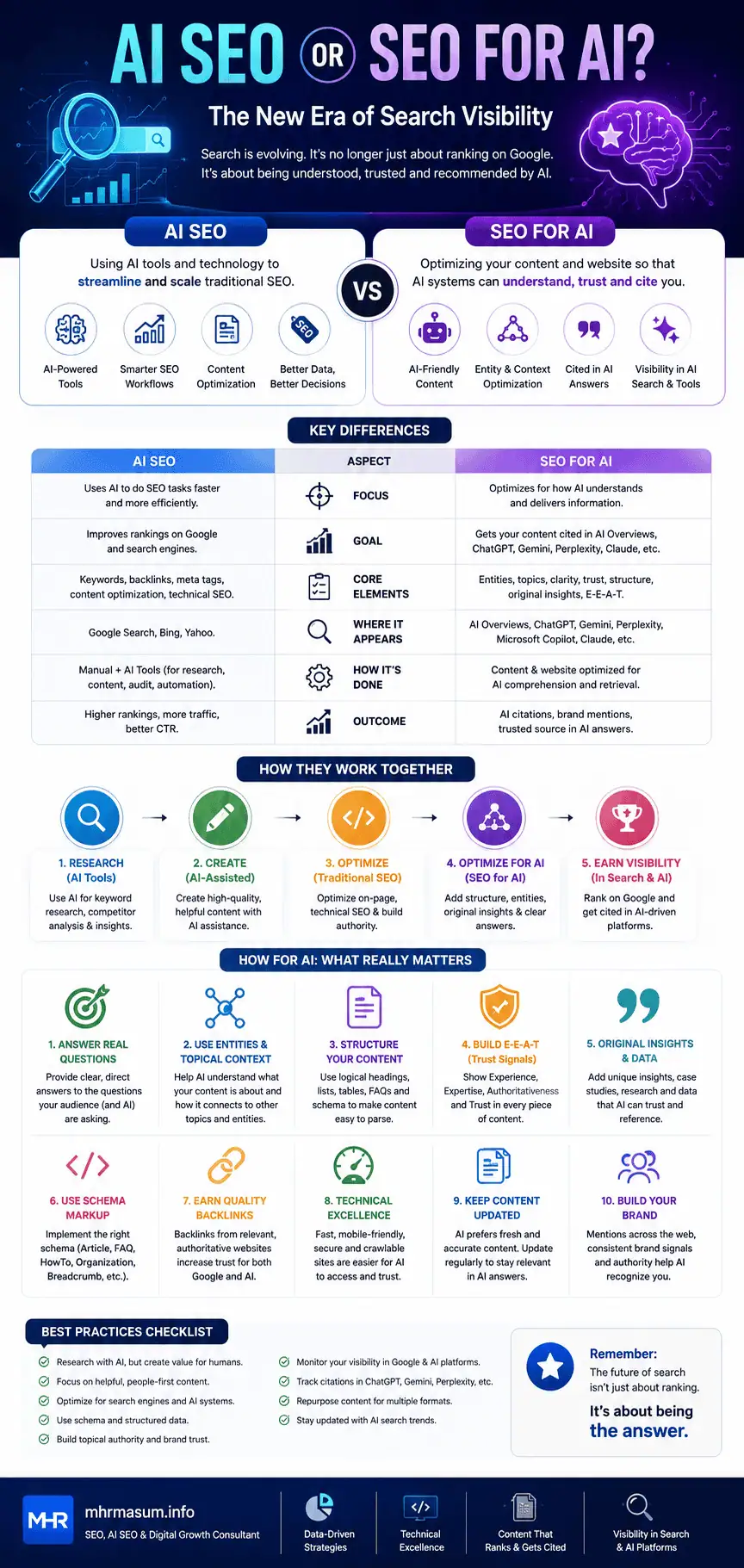
Complete AI SEO Checklist
Use this checklist to evaluate whether a website is prepared for AI-powered discovery.
Technical Foundation
-
Important pages are crawlable
-
Important pages are indexable
-
Canonicals are correct
-
XML sitemaps are current
-
Internal links are crawlable
-
Server responses are stable
-
JavaScript content renders
-
Mobile layout works
-
HTTPS is enabled
-
Core Web Vitals are reviewed
Content Quality
-
Content answers real customer questions
-
Articles provide original value
-
Claims are accurate
-
Sources are cited
-
Authors are identified
-
Headings are descriptive
-
Every heading contains useful text
-
Content covers related questions
-
Thin pages are improved or consolidated
-
Important facts appear in HTML
Entity and Brand
-
Brand name is consistent
-
About page is complete
-
Author profiles are clear
-
Services are described accurately
-
Portfolio supports claims
-
Social profiles are connected
-
Business information is consistent
-
Organization or Person schema is accurate
-
Reviews are genuine
-
Third-party mentions are relevant
AI Crawler Access
-
OAI-SearchBot access is reviewed
-
GPTBot preference is configured
-
PerplexityBot access is reviewed
-
Bingbot access is reviewed
-
CDN and firewall rules are checked
-
Published crawler IP guidance is reviewed
-
Private content remains protected
Local and eCommerce Data
-
Google Business Profile is complete
-
Local information is consistent
-
Reviews are monitored
-
Merchant feeds are current
-
Product data is accurate
-
Price and availability match
-
Shipping and return information is clear
-
Product and LocalBusiness schema are valid
Measurement
-
Google Search Console is configured
-
Generative AI report is reviewed where available
-
Bing Webmaster Tools is configured
-
Bing AI Performance is reviewed
-
ChatGPT referrals are tracked
-
AI landing pages are monitored
-
Conversions are configured
-
CRM outcomes are connected
-
Branded searches are monitored
-
Monthly reporting is documented
Frequently Asked Questions About AI SEO and SEO for AI
The following questions address common confusion about AI SEO, GEO, AEO, AI-generated content, crawlers, schema, and measurement.
What Is AI SEO?
AI SEO is the process of improving organic visibility across AI-influenced and generative search environments.
The term can also refer to using AI tools to support SEO work, so the intended meaning should be clarified.
What Is SEO for AI?
SEO for AI means optimizing website content, technical accessibility, entities, authority, and structured information so AI-powered systems can discover and use the information effectively.
Which Term Is Better: AI SEO or SEO for AI?
AI SEO is stronger as a broad service or industry term.
SEO for AI is clearer when explaining the purpose of the work.
Both can be used naturally within the same article or service page.
Is AI SEO the Same as GEO?
GEO is usually considered one part of AI SEO.
GEO focuses specifically on visibility within generative responses, while AI SEO may also include technical SEO, AI referrals, crawler management, local AI discovery, agentic interfaces, and traditional search visibility.
Is AI SEO the Same as AEO?
No. AEO focuses mainly on direct answers and answer extraction.
AI SEO is broader and includes generative answers, citations, brand mentions, products, local information, traditional search, and agentic experiences.
Does Traditional SEO Still Matter?
Yes. Google states that its generative AI search features remain grounded in its core Search ranking and quality systems.
Technical SEO, content quality, internal linking, crawlability, authority, and user experience remain important.
Can AI SEO Guarantee a Citation?
No. No legitimate consultant can guarantee that a platform will cite a specific website for a particular prompt.
Platforms control source selection and answer generation.
Does Schema Improve AI Visibility?
Accurate structured data can support normal SEO and help systems understand specific information.
Google says no special schema is required for generative AI search.
Is llms.txt Required?
No. Google does not use llms.txt for Google Search or its generative AI features.
Other systems may choose to support it, so use it only where a clear purpose exists.
Should I Allow GPTBot?
That decision depends on whether you want to allow content to be considered for OpenAI model training.
GPTBot and OAI-SearchBot have separate controls. Allowing OAI-SearchBot for ChatGPT Search does not require allowing GPTBot.
How Do I Appear in ChatGPT Search?
OpenAI recommends allowing OAI-SearchBot and ensuring that hosting or CDN security permits traffic from its published IP addresses.
There is no guaranteed placement.
How Do I Track ChatGPT Traffic?
ChatGPT referral links automatically include utm_source=chatgpt.com, which can be tracked in analytics.
Can AI-Generated Content Rank?
Yes, content is not excluded merely because AI assisted its creation.
However, it must provide value and comply with Search Essentials and spam policies. Scaled low-value content may violate Google’s policies.
Do I Need Short Content for AI?
No. Google states that there is no ideal page length and no requirement to divide content into tiny chunks for AI understanding.
Use the length required to satisfy the reader’s needs.
Do I Need to Repeat Every Long-Tail Keyword?
No. Google says its systems can understand synonyms and general meaning.
Write naturally and cover the topic comprehensively.
How Long Does AI SEO Take?
Timelines depend on:
-
Crawling
-
Indexing
-
Website authority
-
Content quality
-
Competition
-
Platform changes
-
Implementation speed
-
Search demand
Some technical improvements may be reflected quickly, while broader authority and content improvements may require several months.
How Can a Local Business Use AI SEO?
A local business should combine:
-
Google Business Profile
-
Local SEO
-
Reviews
-
Local landing pages
-
Consistent business information
-
Entity SEO
-
Helpful content
-
Technical SEO
-
AI crawler accessibility
How Can an eCommerce Business Use AI SEO?
An eCommerce business should prioritize:
-
Product data
-
Merchant feeds
-
Product schema
-
Original product descriptions
-
Buying guides
-
Reviews
-
Price and availability accuracy
-
Images
-
Shipping and return information
Is AI SEO Worth Investing In?
AI SEO can be valuable when it supports relevant visibility, qualified traffic, brand authority, leads, sales, and customer discovery.
It should not be purchased as a collection of unverified hacks or vanity metrics.
Final Thoughts on AI SEO and SEO for AI
AI SEO and SEO for AI describe closely related ideas.
AI SEO is the broader strategy.
SEO for AI describes the process of preparing websites and content for AI-powered discovery, retrieval, recommendation, citation, and interaction.
The most effective strategy does not abandon traditional SEO.
It combines:
-
Technical SEO
-
Helpful content
-
Search intent
-
Entity clarity
-
Brand authority
-
Internal linking
-
Structured data
-
Local or product information
-
AI crawler management
-
Search performance analysis
-
Conversion measurement
Businesses should avoid becoming distracted by unsupported shortcuts such as:
-
Guaranteed AI citations
-
Special AI schema
-
Mandatory llms.txt files
-
Artificial brand mentions
-
Hundreds of thin prompt-targeted pages
-
Automated content without expert review
The strongest long-term approach is to build a website that deserves to be discovered and referenced because it offers something useful, original, trustworthy, and relevant.
MD Harunur Rashid is an SEO, AI SEO and Digital Growth Consultant with 17+ years of experience helping local businesses, eCommerce brands, agencies, and website owners improve visibility through Local SEO, Technical SEO, WooCommerce SEO, WordPress optimization, AI-ready content systems, and custom WordPress development.
Explore my SEO and Digital Growth Services, learn more about MD Harunur Rashid, review completed projects in my portfolio, or contact MD Harunur Rashid to discuss an AI SEO, Technical SEO, Local SEO, or digital growth strategy.
References and resource links
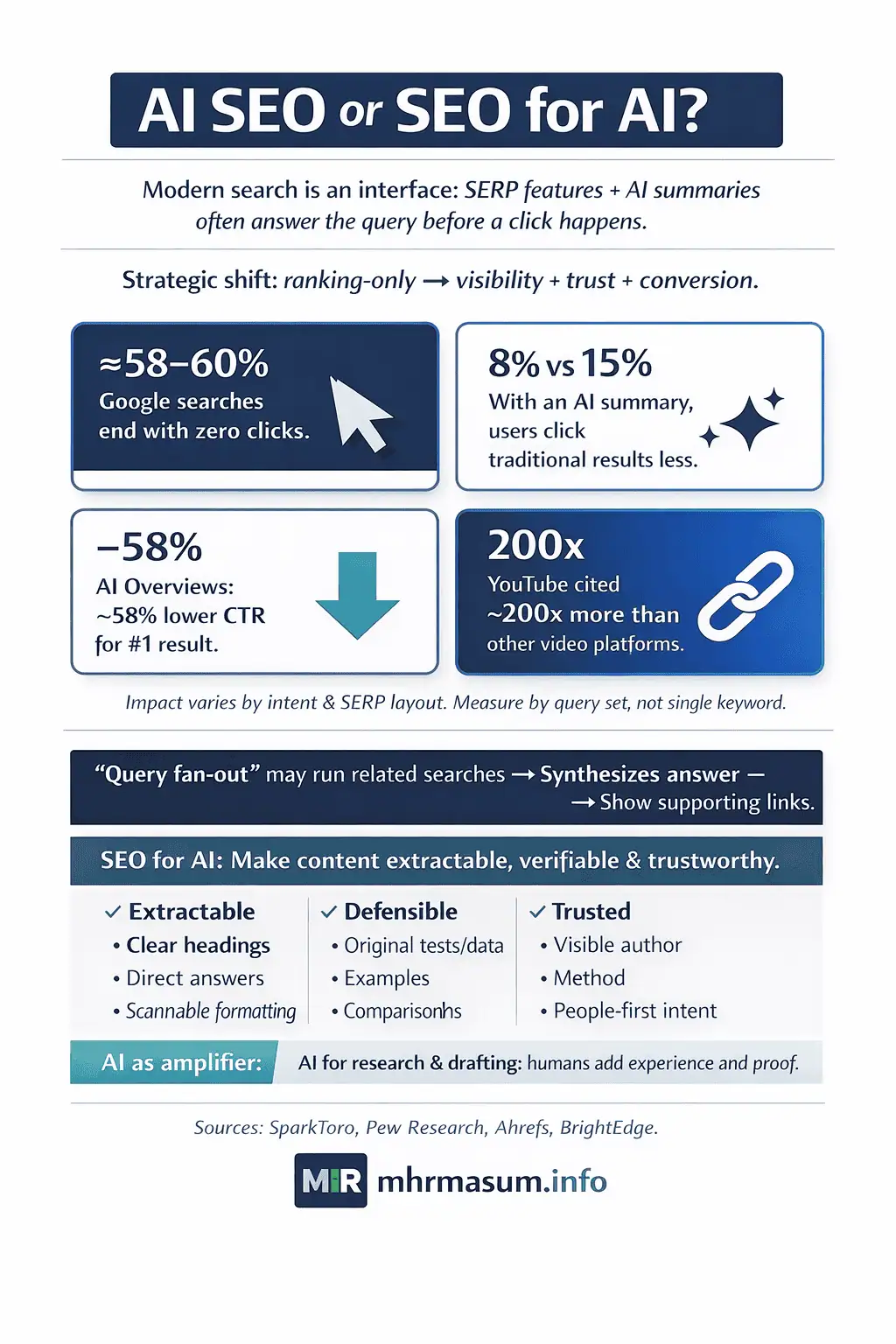
Zero-click search and user behavior
-
SparkToro (2024) — Zero-click search study
https://sparktoro.com/blog/2024-zero-click-search-study-for-every-1000-us-google-searches-only-374-clicks-go-to-the-open-web-in-the-eu-its-360/ -
Wordtracker (2024) — Nearly 60% of searches are zero-click
https://www.wordtracker.com/blog/seo/nearly-60-of-searches-on-google-are-zero-click -
Search Engine Land (2025) — Publishers see search referrals drop
https://searchengineland.com/news-publishers-search-referrals-drop-report-467408
AI summaries and click-through impact
-
Pew Research Center (2025) — Users less likely to click when AI summaries appear
https://www.pewresearch.org/short-reads/2025/07/22/google-users-are-less-likely-to-click-on-links-when-an-ai-summary-appears-in-the-results/ -
Ahrefs (2026) — AI Overviews reduce clicks (updated study)
https://ahrefs.com/blog/ai-overviews-reduce-clicks-update/ -
Seer Interactive (2025) — AI Overview impact on CTR
https://www.seerinteractive.com/insights/aio-impact-on-google-ctr-september-2025-update -
Search Engine Land (2025) — AI Overviews drive CTR decline
https://searchengineland.com/google-ai-overviews-drive-drop-organic-paid-ctr-464212
AI citations and video platform dominance
-
BrightEdge (2025–2026) — YouTube presence in AI search
https://www.brightedge.com/resources/weekly-ai-search-insights/youtube-presence-ai-search -
MediaPost (2025) — YouTube dominates AI search
https://www.mediapost.com/publications/article/389475/youtube-dominates-ai-search.html
Google AI search and query fan-out
-
Google Search Central — AI search features documentation
https://developers.google.com/search/docs/appearance/ai-features -
Google Search Help — AI Mode and query fan-out
https://support.google.com/websearch/answer/14901683 -
Google Blog — How AI powers search results
https://blog.google/products/search/how-ai-powers-great-search-results/
Helpful content and quality guidance
-
Google — Creating helpful, reliable, people-first content
https://developers.google.com/search/docs/fundamentals/creating-helpful-content -
Google Search Blog (2022) — Rater guidelines and EEAT
https://developers.google.com/search/blog/2022/12/google-raters-guidelines-e-e-a-t -
Google Search Blog (2023) — Search and AI content
https://developers.google.com/search/blog/2023/02/google-search-and-ai-content -
Google Search Central — Spam policies
https://developers.google.com/search/docs/essentials/spam-policies
SERP features and CTR research
-
Semrush — SERP features guide
https://www.semrush.com/blog/serp/ -
Semrush (2025) — AI Overviews study
https://www.semrush.com/blog/semrush-ai-overviews-study/ -
arXiv (2023) — Beyond Rankings (SERP features and CTR)
https://arxiv.org/abs/2306.01785
Publisher impact and media coverage
-
Reuters Institute — Digital News Report
https://www.digitalnewsreport.org/ -
The Guardian (2025) — AI Overviews and traffic
https://www.theguardian.com/media/2025/jul/24/google-ai-overviews -
Fortune (2025) — AI search and traffic impact
https://fortune.com/2025/07/24/google-ai-overviews-cut-traffic/ -
Business Insider (2025) — AI search impact on creators
https://www.businessinsider.com/google-ai-search-creators-traffic-impact
Measurement and monitoring tools
-
Google Search Console — Performance report
https://support.google.com/webmasters/answer/7576553 -
Semrush Sensor
https://www.semrush.com/sensor/ -
Advanced Web Ranking — CTR study
https://www.advancedwebranking.com/ctr-study/
Additional foundational SEO documentation (to round out the library)
-
Google Search Central — How Search Works
https://developers.google.com/search/docs/fundamentals/how-search-works -
Google Search Central — Search Essentials
https://developers.google.com/search/docs/essentials -
Google Search Central — Core Web Vitals
https://developers.google.com/search/docs/appearance/core-web-vitals -
web.dev — Learn Core Web Vitals
https://web.dev/explore/learn-core-web-vitals -
web.dev — Web Vitals overview
https://web.dev/articles/vitals -
Google Search Central — Sitemaps
https://developers.google.com/search/docs/crawling-indexing/sitemaps/build-sitemap -
Sitemaps protocol
https://www.sitemaps.org/protocol.html -
Google Search Central — robots.txt intro
https://developers.google.com/search/docs/crawling-indexing/robots/intro -
Google Search Central — robots meta tag
https://developers.google.com/search/docs/crawling-indexing/robots-meta-tag -
Google — robots.txt spec
https://developers.google.com/crawling/docs/robots-txt/robots-txt-spec -
Google Search Central — canonicalization
https://developers.google.com/search/docs/crawling-indexing/canonicalization -
Google Search Central — consolidate duplicate URLs
https://developers.google.com/search/docs/crawling-indexing/consolidate-duplicate-urls -
Google Search Central — structured data intro
https://developers.google.com/search/docs/appearance/structured-data/intro-structured-data -
Google Search Central — structured data policies
https://developers.google.com/search/docs/appearance/structured-data/sd-policies -
Google Search Central — FAQ structured data
https://developers.google.com/search/docs/appearance/structured-data/faqpage -
Schema.org — FAQPage
https://schema.org/FAQPage -
Schema.org — Article
https://schema.org/Article -
Schema.org — Organization
https://schema.org/Organization -
Schema.org — Person
https://schema.org/Person -
Schema.org — Getting started
https://schema.org/docs/gs.html -
Bing — Webmaster Guidelines
https://www.bing.com/webmasters/help/webmaster-guidelines-30fba23a -
Microsoft — How Bing delivers results (incl. generative context)
https://support.microsoft.com/en-us/topic/how-bing-delivers-search-results-d18fc815-ac37-4723-bc67-9229ce3eb6a3 -
IndexNow — documentation
https://www.indexnow.org/documentation -
llms.txt proposal
https://llmstxt.org/