Customers searching for a nearby product or service often want to make a decision quickly.
They may need to know:
- Which businesses offer the required service
- How close each business is
- Whether the business is currently open
- What previous customers say
- How to call the business
- How to get directions
- Whether they can make a booking
- Whether the company looks trustworthy
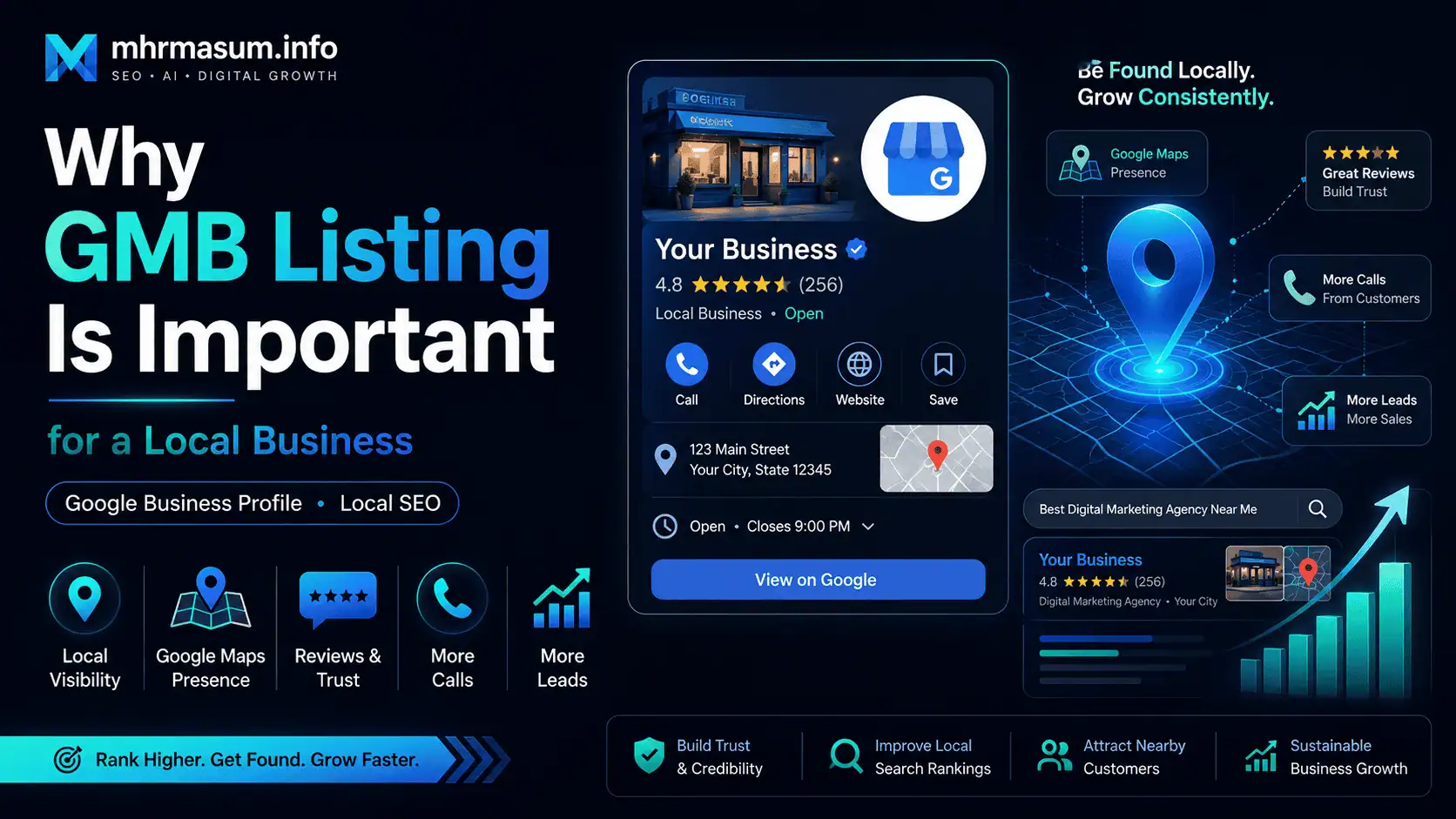
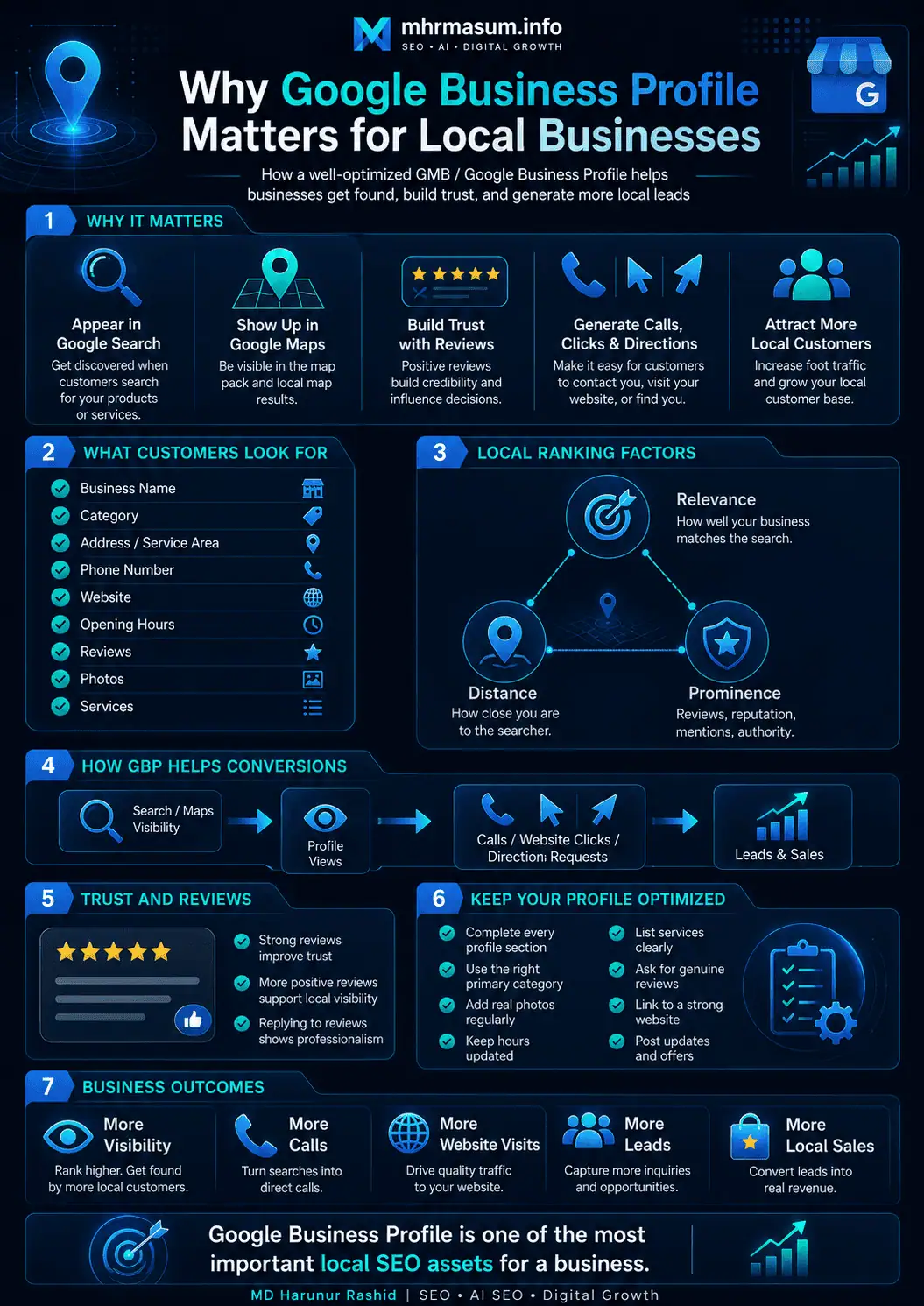
A Google Business Profile can provide much of this information directly within Google Search and Google Maps.
Google Business Profile is the current name for the platform previously known as Google My Business or GMB. Google officially renamed Google My Business to Google Business Profile in 2021, although many business owners, marketers, and customers still use the term “GMB listing.”
For eligible local businesses, a verified Business Profile is one of the most important foundations of a Local SEO strategy. Google allows businesses to manage how they appear in Search and Maps at no charge, including details such as their phone number, website, location, service area, business hours, photos, services, reviews, booking links, and other relevant information.
A properly managed profile can help a local business:
- Become more visible in local search results
- Appear on Google Maps
- Reach customers with local buying intent
- Generate phone calls and website visits
- Receive direction requests
- Collect and respond to customer reviews
- Promote services, products, events, and offers
- Build trust before a customer visits the website
- Measure how customers discover and interact with the business
However, simply creating a profile is not enough. The information must be accurate, complete, verified, compliant with Google’s guidelines, supported by a strong website, and updated regularly.
What Is a Google Business Profile?
A Google Business Profile is a business information panel that eligible companies can create, claim, verify, and manage across Google Search and Google Maps.
The profile can display information such as:
- Business name
- Primary business category
- Additional categories
- Address
- Service areas
- Phone number
- Website
- Business hours
- Special hours
- Services
- Products
- Photos
- Videos
- Customer reviews
- Business description
- Booking links
- Attributes
- Updates and offers
Google states that a verified profile can help customers find a business and build greater trust. The profile can also direct potential customers to a website, booking page, social profile, or other relevant business link.
A Business Profile is therefore more than a basic directory citation. It acts as a local discovery, reputation, communication, and conversion asset.
Is Google My Business the Same as Google Business Profile?
Google My Business and Google Business Profile refer to the same underlying business-listing platform, but Google Business Profile is the current official name.
Google renamed Google My Business in November 2021 and shifted small-business profile management more directly into Google Search and Google Maps.
Older terms that people may still use include:
- Google My Business
- GMB
- Google business listing
- Google Maps listing
- Google local listing
- Google Places
For current content and professional communication, Google Business Profile is the most accurate term.
The abbreviation GBP is also increasingly used, although many business owners still search for “GMB optimization” because the older name remains widely recognized.
Which Businesses Are Eligible for a Google Business Profile?
Google Business Profiles are intended for businesses that interact with customers in person.
Eligible businesses generally include:
- Retail shops
- Restaurants
- Hotels
- Medical practices
- Lawyers
- Accountants
- Consultants who meet customers
- Contractors
- Cleaning companies
- Plumbers
- Electricians
- Roofing companies
- Pest-control businesses
- Mobile service providers
- Other service-area businesses
A business may qualify as either:
- A storefront business that customers visit
- A service-area business that travels to customers
- A hybrid business that receives customers and also travels to them
Google states that online-only businesses without a physical location customers can visit—and that do not meet customers in person—are not eligible for a Business Profile.
Google’s business-representation guidelines also require businesses to use a real-world location or legitimate service area, accurately represent the business, and avoid creating duplicate profiles.
Why a Google Business Profile Is Important for Local Visibility
A local business may provide excellent service but remain invisible when nearby customers search for what it offers.
Google Business Profile helps Google understand:
- What type of business it is
- Which services it provides
- Where it is located
- Which areas it serves
- When it is open
- How customers can contact it
Google explains that businesses with complete and accurate information are more likely to appear in relevant local search results. Inaccurate or incomplete information may prevent a profile from appearing for appropriate searches in its area.
For example, a roofing company may want to appear when nearby customers search for:
- Roofing company near me
- Roof repairs in Brisbane
- Emergency roof repair
- Metal roofing contractor
- Local roof replacement service
A complete profile helps establish the connection between the business, its services, and its location.
For a complete location-based growth strategy, read my Local SEO in 2026 guide for small businesses.
A Google Business Profile Helps Businesses Appear on Google Maps
Google Maps is an important discovery platform for businesses that serve customers in specific locations.
Customers use Maps to:
- Find nearby businesses
- Compare multiple providers
- Review locations
- Check opening hours
- Read reviews
- Request directions
- Call a business
- Visit its website
- View photos
- Make a booking
A verified and optimized Google Business Profile gives a company an opportunity to appear when Google determines that it is a relevant local match.
Google states that local results on Search and Maps are primarily influenced by:
- Relevance
- Distance
- Prominence
A business cannot pay Google to receive a better organic local ranking. Google explicitly states that there is no method to request or purchase a higher local ranking.
Google Business Profile Reaches Customers with Local Intent
Local searches frequently indicate that a customer has an immediate or location-specific need.
A person searching for “emergency plumber near me” is not only researching plumbing. The person is likely trying to identify a business that can provide help within a practical distance and timeframe.
A complete profile can show the customer:
- Whether the company offers the required service
- Whether it serves the customer’s location
- Whether it is currently open
- How to call
- How to get directions
- How previous customers rated it
- Whether it appears active and trustworthy
This reduces the number of steps between discovery and action.
The customer may call or request directions directly from the profile without first navigating through several pages of the company’s website.
A Google Business Profile Provides Essential Business Information
Incorrect business information can cost a company enquiries and customers.
Common problems include:
- Old phone numbers
- Incorrect addresses
- Missing service areas
- Outdated business hours
- Incorrect map pins
- Broken website links
- Wrong categories
- Missing holiday hours
A Business Profile gives the business owner a controlled place to manage important details shown in Google Search and Maps.
Google recommends maintaining complete information, including address where applicable, phone number, business category, and relevant customer-facing details. Google also advises businesses to update both standard and special opening hours.
Accurate information reduces customer frustration and supports trust.
For example, a customer may lose confidence if:
- Google says the business is open, but it is closed
- The phone number does not work
- The listed address is incorrect
- The website leads to an unrelated page
- The profile lists services the company no longer provides
Verification Helps Establish Control and Authenticity
A business should claim and verify its profile instead of leaving it unmanaged.
Verification gives the authorized owner control over core information and allows the business to interact with customers through profile features.
Google states that verification confirms that the person managing the profile is authorized to represent the business. Verified owners can manage information such as the business name and hours and ensure that the profile remains accurate.
Verification methods are selected by Google and may include:
- Video recording
- Phone or text
- Live video call
- Postcard
The options available depend on the business, public information, region, and other profile factors.
Business owners should never give verification codes to an unknown third party. Google states that it will not ask a business to share its verification code.
A Google Business Profile Builds Customer Trust
Customers often compare several local businesses before choosing one.
A complete and active profile can help demonstrate that the business is:
- Genuine
- Established
- Accessible
- Responsive
- Transparent
- Relevant to the customer’s need
Trust signals within a profile may include:
- Verified business information
- Accurate contact details
- Recent photos
- Customer reviews
- Professional review responses
- Current business hours
- Clear service descriptions
- Consistent branding
- Recent business updates
A customer may hesitate to contact a business whose profile contains no photos, no reviews, missing hours, and outdated information.
By contrast, a well-maintained profile can provide reassurance before the customer visits the website or makes contact.
Reviews Influence Reputation and Customer Decisions
Google reviews allow previous customers to share experiences publicly.
Prospective customers may use reviews to assess:
- Service quality
- Professionalism
- Reliability
- Communication
- Value
- Response to problems
- Suitability for a particular need
Google advises businesses to respond to customer reviews because responses demonstrate that the business values customer feedback. Positive reviews and helpful responses can also help a business stand out in local results.
Business replies are publicly displayed beneath customer reviews, and the reviewer is notified when the business responds.
A professional review response should:
- Thank the customer
- Address relevant details
- Remain respectful
- Avoid exposing private information
- Avoid becoming argumentative
- Offer an appropriate resolution when necessary
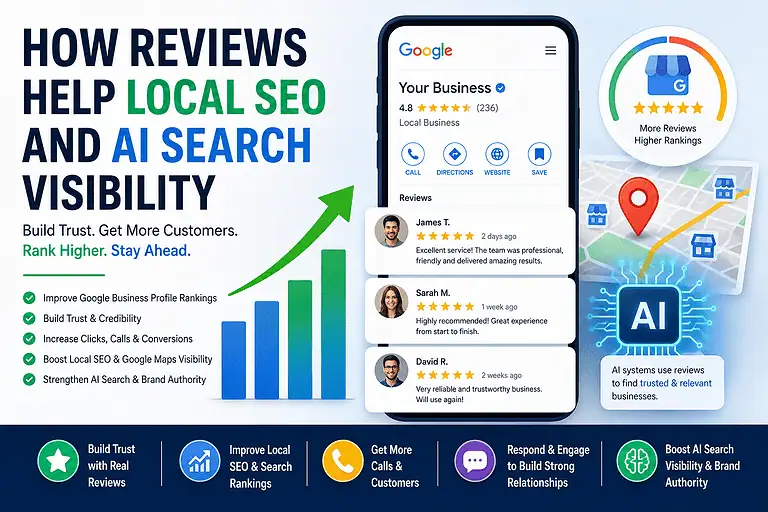
For a complete reputation strategy, read How Reviews Help Local SEO and AI Search Visibility.
Reviews Can Contribute to Local Prominence
Google identifies prominence as one of the primary categories influencing local rankings.
Prominence describes how well-known a business is. Google may evaluate information such as websites linking to the company, articles, business information, review count, and review score. Google confirms that more reviews and positive ratings can support local ranking.
This does not mean that reviews alone guarantee a top position.
Local visibility also depends on:
- Relevance to the search
- Distance from the customer
- Business information
- Website authority
- Competition
- Categories
- Services
- Overall local presence
A sustainable review strategy should focus on genuine feedback from real customers rather than fake, purchased, or manipulated reviews.
A Google Business Profile Can Generate Phone Calls
For many local businesses, a phone call is one of the most valuable conversions.
A potential customer may call to:
- Request a quote
- Confirm availability
- Ask about pricing
- Book an appointment
- Check whether a product is available
- Discuss an urgent problem
- Confirm opening hours
When a phone number is added to the profile, eligible interactions can be tracked through Business Profile performance data. Google reports the number of times customers click the call button on the profile.
This helps the business evaluate whether its profile is producing meaningful customer actions rather than only impressions.
Businesses should ensure that:
- The number works
- Calls are answered professionally
- Missed calls are followed up
- The number belongs to the correct location
- Call handlers understand the services
- Calls are recorded in the CRM where appropriate
A Google Business Profile Can Send Customers to the Website
A Business Profile can include a link to the company’s website.
Google’s performance report can show how many customers clicked the website link from the profile.
The website link should usually direct customers to the most appropriate official business website.
The destination page should:
- Load quickly
- Work on mobile
- Match the business information
- Explain services clearly
- include contact options
- Show relevant locations
- Contain trust evidence
- Provide a clear next step
Sending customers to a slow, broken, or confusing website can reduce the value of strong Google Maps visibility.
Use my Site Speed Optimization guide and WordPress Technical SEO Checklist to improve the website supporting your profile.
A Google Business Profile Can Generate Direction Requests
Storefront businesses can use their profiles to help customers navigate to the physical location.
Google Business Profile performance data includes direction requests, showing how many people requested directions to the business. Google adjusts this metric to account for repeated taps, cancelled requests, and spam.
Direction requests can be particularly valuable for:
- Retail stores
- Restaurants
- Medical clinics
- Hotels
- Offices
- Showrooms
- Automotive businesses
- Local attractions
The address and map pin must be accurate.
If the pin is placed incorrectly, customers may arrive at the wrong location, experience frustration, or leave negative feedback.
A Google Business Profile Can Support Bookings
Depending on the business category and available integrations, a profile may support booking-related actions.
Google’s performance reporting can include completed bookings when they are managed through a supported booking provider.
Booking functionality may be relevant for:
- Consultants
- Salons
- Restaurants
- Health practices
- Fitness businesses
- Hotels
- Professional services
- Appointment-based companies
The booking journey should be:
- Mobile-friendly
- Secure
- Easy to understand
- Connected to the correct calendar
- Clear about availability
- Clear about pricing or deposits
- Tested regularly
Services Help Customers Understand What the Business Offers
Service-based businesses can add services to their profiles.
Google allows eligible businesses to add:
- Predefined services
- Custom services
- Service descriptions
- Prices where appropriate
This is useful for businesses that offer several services.
A roofing company might add:
- Roof inspections
- Roof repairs
- Roof replacement
- Gutter replacement
- Emergency roofing
- Metal roofing
An SEO consultant might add:
- Local SEO
- Technical SEO
- AI SEO
- Keyword research
- WordPress optimization
- Google Business Profile optimization
Service names and descriptions should be accurate and consistent with the services presented on the website.
The profile should not claim services the business cannot provide.
Photos Help Customers Evaluate the Business
Photos can help potential customers understand what the business looks like and what it offers.
Google recommends adding category-specific photos that highlight features customers may consider when deciding whether to purchase a product or service.
Useful photo types may include:
- Logo
- Cover image
- Storefront
- Office
- Interior
- Products
- Completed projects
- Equipment
- Team at work
- Service process
- Before-and-after results
Photos should accurately represent the business.
Google’s current photo guidance recommends clear, well-lit images without significant alteration, excessive filters, or AI modification that misrepresents reality.
Businesses should avoid using:
- Misleading stock images
- Competitor photos
- Unrelated graphics
- Blurry images
- Text-heavy promotional graphics as every upload
- Fake project images
- Images that expose private customer information
Google Business Profile Posts Support Customer Communication
Business Profile posts allow businesses to publish updates that may appear within their profiles on Search and Maps.
Google states that posts can be used to share:
- Announcements
- Offers
- Events
- News
- Photos
- Videos
- Business updates
Posts can support a wider marketing strategy by promoting:
- Seasonal services
- New products
- Limited-time offers
- New blog articles
- Updated opening hours
- Events
- Business achievements
- Important announcements
Posts should be written for customers rather than stuffed with repetitive keywords.
They should include:
- A clear message
- Relevant visual
- Practical customer benefit
- Accurate information
- An appropriate call to action
Business Profile posts are useful, but they do not replace strong service pages, Local SEO, reviews, website content, or authority building.
A Google Business Profile Provides Measurable Performance Data
A major benefit of Google Business Profile is the ability to monitor how people discover and interact with the listing.
Verified owners and managers can access performance information for Search and Maps. Depending on the business type, available metrics may include:
- Profile views
- Search terms
- Direction requests
- Call clicks
- Website clicks
- Bookings
- Product views
- Menu interactions
- Offer interactions
Google allows businesses to select date ranges and download performance reports for further analysis.
This data can help answer questions such as:
- Are more people finding the business?
- Which search terms trigger the profile?
- Are customers clicking the website?
- Are phone-call interactions increasing?
- Are more people requesting directions?
- Which locations perform best?
- Did optimization work improve interactions?
Google Business Profile Performance Should Be Connected to Business Results
Profile interactions should not be treated as isolated vanity metrics.
A high number of views may produce little business value if:
- Calls are unanswered
- Leads are unqualified
- The website does not convert
- The address is wrong
- Customers are outside the service area
- The business has poor availability
- The customer experience is weak
Connect Business Profile performance with:
- Phone-call outcomes
- Quote requests
- Bookings
- Website conversions
- Sales
- Customer acquisition cost
- Revenue
- Customer lifetime value
- CRM data
For example, recording “100 calls” is useful, but knowing that 35 became qualified leads and 12 became customers is much more valuable.
Google Business Profile Supports Local SEO but Does Not Replace the Website
A Business Profile and a business website perform different functions.
The profile helps customers discover and evaluate the business directly within Google.
The website provides deeper information such as:
- Complete service descriptions
- Product information
- Case studies
- Portfolio examples
- Pricing guidance
- Team experience
- Policies
- Detailed FAQs
- Contact forms
- Supporting content
Google states that prominence can include information from across the web, including websites linking to the business and the company’s wider web presence. Google also confirms that traditional web visibility contributes to local prominence.
The strongest strategy usually combines:
- Optimized Google Business Profile
- Strong website
- Local landing pages
- Accurate citations
- Reviews
- Local content
- Relevant backlinks
- Structured data
- Consistent business information
Explore my Local SEO portfolio for practical examples of how these elements work together.
Local Business Structured Data Supports Entity Clarity
LocalBusiness structured data can help Google understand business details published on the website.
Google states that LocalBusiness structured data can communicate information such as:
- Business hours
- Departments
- Business details
- Other relevant local information
Structured data should match visible information on the website and remain consistent with the Business Profile.
For example, the following should agree wherever applicable:
- Business name
- Address
- Phone number
- Opening hours
- URL
- Business type
- Location
Structured data does not replace Google Business Profile, and adding schema does not guarantee better rankings.
It is one supporting component of a broader Local SEO and entity strategy.
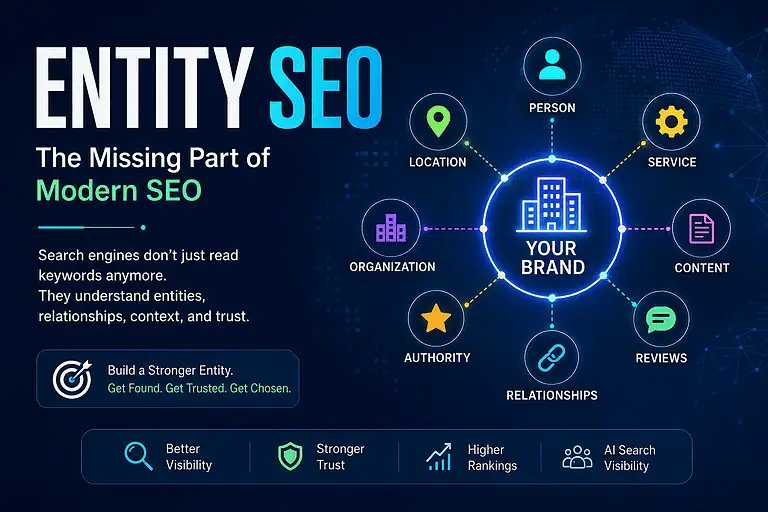
Read Entity SEO: The Missing Part of Modern SEO for a deeper explanation of how consistent business information helps search and AI systems understand an organization.
Google Business Profile Can Strengthen Brand Visibility
A customer may discover the business through a generic search and later search for the company by name.
A strong profile can reinforce branded visibility by presenting:
- Business identity
- Logo
- Contact details
- Reviews
- Photos
- Website
- Opening hours
- Location
- Services
Consistent business information across the profile, website, directories, social media, and structured data can reduce ambiguity.
This is particularly important where:
- Several businesses have similar names
- The company has multiple locations
- The business recently changed its name
- The company operates under a trading name
- The owner is also a public professional
For broader brand development, read How to Build Brand Authority for AI Search.
Google Business Profile Can Support AI-Assisted Local Discovery
Search experiences are increasingly using generative AI to help users compare places, services, products, and businesses.
Accurate local business information may help Google understand:
- What the business offers
- Where it operates
- When it is available
- What customers say
- Which website represents it
Google’s AI search guidance recommends maintaining accurate business information through Google Business Profile and following established SEO best practices when preparing for generative search experiences.
A Business Profile alone does not guarantee a mention in an AI-generated answer.
AI visibility also depends on factors such as:
- Website quality
- Entity clarity
- Brand authority
- Reviews
- Content usefulness
- Technical accessibility
- Wider web recognition
Read AI SEO: How to Rank in Google AI Overviews, ChatGPT, Gemini and Perplexity for the wider AI search framework.
The Three Main Local Ranking Factors
Google identifies three primary factors used in local ranking: relevance, distance, and prominence.
Understanding these factors helps business owners avoid unrealistic expectations.
Relevance Measures How Well the Business Matches the Search
Relevance describes how closely the Business Profile matches what a customer is searching for.
Improve relevance by maintaining:
- Correct primary category
- Relevant additional categories
- Complete service information
- Accurate business description
- Current website content
- Relevant local landing pages
- Consistent business information
Do not add unrelated categories merely to increase visibility.
Google’s guidelines recommend using the fewest categories necessary to describe the core business accurately.
Distance Measures Proximity to the Searcher
Distance considers how far the business is from the person searching.
If Google does not receive a precise location from the customer, it estimates location using available information.
A business cannot optimize its way around every distance limitation.
A company located far from the customer may be less likely to appear than a relevant competitor nearby.
Creating fake locations, virtual offices, or duplicate profiles is not a legitimate solution and may violate Google’s guidelines.
Prominence Measures How Well Known the Business Is
Prominence considers how established or recognized a business appears.
Signals may include:
- Reviews
- Ratings
- Links
- Articles
- Directories
- Website visibility
- Wider business information
Google states that review count and review score can contribute to local ranking and that links and other web information are also considered.
This is why Local SEO should include reputation, authority, content, and website optimization—not only profile editing.
How to Optimize a Google Business Profile
A complete profile optimization process should improve accuracy, relevance, trust, and customer usability.
Use the Correct Real-World Business Name
The profile name should match the business name used in the real world.
Google states that a profile name should reflect the name displayed on the business’s storefront, website, stationery, and branding. Adding unnecessary keywords, phone numbers, locations, or promotional text may violate profile guidelines and can result in suspension.
Do not change:
Brisbane Roofing Solutions
into:
Best Brisbane Roofing Solutions | Roof Repair | Roofing Contractor
unless the longer wording is genuinely the business’s real-world name and can be verified.
Select the Most Accurate Primary Category
The primary category should describe the business’s main activity.
Additional categories should describe genuine secondary services.
Avoid selecting every loosely related category.
Google recommends choosing the smallest number of categories needed to describe the overall core business.
Complete the Business Description
The description should explain:
- What the business does
- Who it serves
- Which services it provides
- Which area it serves
- What makes it different
- Relevant experience
Google requires descriptions to remain relevant and useful. Promotional prices, distracting content, and links are not permitted in the description field.
Add Accurate Opening Hours
Keep regular and special hours updated.
Special hours may be required for:
- Public holidays
- Temporary closures
- Seasonal schedules
- Special events
- Reduced operating periods
Accurate hours help prevent wasted customer journeys and missed calls.
Add Services and Products
Use the profile’s service and product sections where relevant.
Ensure descriptions match what the business actually offers and what appears on the website.
Add Genuine Photos Regularly
Upload authentic photos representing:
- Premises
- Products
- Projects
- Team
- Equipment
- Service delivery
- Customer environment where permission exists
Avoid misleading edits and excessive AI transformation.
Request Genuine Customer Reviews
Create a repeatable review-request process.
Ask satisfied customers at an appropriate time, such as after successful service completion or product delivery.
Do not:
- Purchase reviews
- Review your own business
- Ask staff to create fake reviews
- Use review-gating systems
- Offer prohibited incentives
- Pressure customers to leave only positive feedback
Respond to Reviews
Reply to both positive and negative reviews professionally.
Responses should show that the business listens, values feedback, and is willing to resolve genuine concerns.
Publish Relevant Posts
Use posts to share current updates, offers, events, and useful customer information.
Link to a Strong Website
The website should support the profile’s categories, services, locations, and business claims.
Track Performance
Review performance monthly and connect profile actions with CRM, sales, and conversion data.
Common Google Business Profile Mistakes
A poorly managed profile may create ranking, trust, or suspension problems.
Adding Keywords to the Business Name
Keyword stuffing the business name violates Google’s requirement to use the real-world business name.
Creating Duplicate Profiles
Google generally requires one profile per business location. Duplicate profiles can create display and ownership problems.
Using a Virtual Office
Google does not consider an unstaffed virtual office an eligible location. Co-working offices must meet specific signage, staffing, and customer-contact requirements.
Showing a Residential Address for a Service-Area Business
A service-area business operating from a residential address should normally hide that address from customers and define its service area instead.
Selecting Irrelevant Categories
Adding unrelated categories can confuse customers and misrepresent the business.
Ignoring Reviews
A profile with unanswered customer complaints may make the business appear unresponsive.
Using Fake Reviews
Manipulated reviews create policy, reputation, and trust risks.
Leaving Hours Outdated
Incorrect hours can cause customers to call or visit when the business is closed.
Uploading Misleading Images
Photos should accurately represent the real business, products, and services.
Expecting the Profile to Replace Local SEO
A Business Profile works best when supported by a strong website, citations, reviews, content, links, and entity signals.
A 30–90 Day Google Business Profile Growth Roadmap
A structured plan can transform an incomplete listing into a measurable Local SEO asset.
Days 1–30: Claim, Verify and Correct
During the first month:
- Find or create the correct profile
- Request ownership if necessary
- Complete verification
- Confirm the real-world business name
- Select the correct primary category
- Add relevant secondary categories
- Correct address or service area
- Add phone number
- Add website
- Update business hours
- Add business description
- Remove duplicate listings
- Review Google’s guidelines
The objective is to create a compliant and accurate foundation.
Days 31–60: Build Trust and Relevance
During the second month:
- Add complete services
- Add eligible products
- Upload logo and cover image
- Add authentic business photos
- Request genuine reviews
- Respond to existing reviews
- Publish business updates
- Improve relevant website pages
- Add LocalBusiness structured data
- Strengthen business-name, address, and phone consistency
- Add Local SEO internal links
This phase strengthens relevance and customer confidence.
Days 61–90: Measure and Improve
During the third month:
- Review profile views
- Review customer search terms
- Track call interactions
- Track website clicks
- Review direction requests
- Track bookings
- Connect leads to CRM outcomes
- Identify high-performing services
- Improve weak website landing pages
- Continue review acquisition
- Continue photo updates
- Compare performance month over month
Optimization should continue after 90 days because competitors, customer behaviour, business information, and local search results change over time.
How to Measure Google Business Profile ROI
Business Profile ROI should connect customer interactions with financial outcomes.
A practical framework may include:
| Metric | What It Indicates |
|---|---|
| Profile views | Local discovery and visibility |
| Search terms | How customers find the business |
| Call clicks | Phone-based customer intent |
| Website clicks | Visits sent to the website |
| Direction requests | Storefront visit intent |
| Bookings | Completed appointment actions |
| Qualified leads | Commercial lead quality |
| New customers | Acquired customers |
| Revenue | Financial return |
| Customer acquisition cost | Efficiency of the channel |
Use UTM parameters on the website URL where appropriate so traffic from the Business Profile can be identified more accurately in analytics.
For example:
https://example.com/?utm_source=google&utm_medium=organic&utm_campaign=google_business_profile
Do not evaluate success using profile views alone.
A profile that generates fewer but higher-quality calls may be more valuable than one producing large numbers of irrelevant impressions.
Frequently Asked Questions About Google Business Profile
The following answers address common questions local business owners have about Google Business Profile and Local SEO.
Is Google Business Profile Free?
Yes. Google states that eligible businesses can create and manage how they appear on Search and Maps at no charge.
Is Google Business Profile the Same as GMB?
Yes. Google My Business was renamed Google Business Profile in 2021.
Does Every Business Need a Google Business Profile?
A Business Profile is particularly important for eligible businesses that interact with customers in person.
Online-only businesses that neither receive customers at a physical location nor travel to customers are generally not eligible.
Does a Google Business Profile Guarantee Local Rankings?
No. Google evaluates relevance, distance, and prominence, and it does not provide a way to request or purchase a better organic local ranking.
Do Reviews Help Google Maps Rankings?
Google confirms that review count and positive ratings can contribute to local prominence and ranking. Reviews are one factor among several.
How Many Reviews Does a Business Need?
There is no universal number that guarantees visibility.
The appropriate target depends on:
- Industry
- Location
- Competition
- Customer volume
- Business age
Focus on earning genuine reviews consistently rather than chasing an artificial number.
Can a Service-Area Business Create a Profile?
Yes. Businesses that visit customers may be eligible.
Service-area businesses should normally create one profile for the legitimate base location and hide a residential address from customers where required.
Can I Use a Virtual Office?
An unstaffed virtual office is not eligible. A co-working office must meet Google’s signage, staffing, and customer-contact requirements.
How Often Should the Profile Be Updated?
Update the profile whenever important information changes.
Review it regularly for:
- Hours
- Phone number
- Website
- Services
- Photos
- Reviews
- Posts
- Customer edits
Monthly performance and accuracy reviews are a practical minimum for an active local business.
Can Google Business Profile Replace a Website?
No. The profile provides quick discovery and interaction, while the website provides detailed services, content, case studies, trust evidence, conversion pages, and wider SEO authority.
Can I Track Calls and Website Clicks?
Google Business Profile performance can report call-button clicks, website clicks, direction requests, views, searches, bookings, and other applicable interactions.
Should I Hire a Local SEO Consultant?
Professional support may be useful when:
- The profile is suspended
- Rankings remain weak
- Multiple locations need management
- Information is inconsistent
- Reviews are not growing
- Website and profile data conflict
- Leads are not being tracked
- Competition is strong
Explore my SEO and Digital Growth Services for Local SEO, Google Business Profile, Technical SEO, AI SEO, and WordPress support.
Final Thoughts on the Importance of Google Business Profile
A Google Business Profile is one of the most valuable digital assets available to an eligible local business.
It can help the business:
- Appear in Google Search and Maps
- Reach nearby customers
- Present accurate information
- Generate calls and website visits
- Receive direction requests
- Support bookings
- Showcase services and products
- Collect reviews
- Build trust
- Measure customer interactions
However, the best results come from treating the profile as part of a complete Local SEO system.
That system should include:
- Accurate profile information
- Strong website content
- Technical SEO
- Local landing pages
- Genuine customer reviews
- Consistent business information
- LocalBusiness structured data
- Authority and brand mentions
- Conversion tracking
- Ongoing performance analysis
MD Harunur Rashid is an SEO, AI SEO and Digital Growth Consultant with 17+ years of experience helping local businesses, eCommerce brands, agencies, and website owners improve organic and local visibility.
Review practical projects in my Local SEO portfolio, Roofing Brisbane Local SEO case study, and Pest Control Melbourne GMB case study.
Learn more about MD Harunur Rashid, explore my SEO and Digital Growth Services, or contact MD Harunur Rashid to discuss professional Google Business Profile optimization and Local SEO support.
Further Read:
Here are solid outbound link options for each of those internal content pieces. I’m prioritizing official Google documentation first, then highly reputable industry resources where appropriate.
Tip: Use 1–2 outbound links per page (don’t overdo it). For “policy” topics, always link to Google’s own docs.
1) Google Business Profile Optimization Checklist (blog post)
-
Google Business Profile Help Center (core documentation): https: //support. google. com/business/? hl=en
-
GBP policies & guidelines overview: https: //support. google. com/business/answer/13762416? hl=en
2) How to Get More Google Reviews (Without Breaking Policies) (guide)
-
Prohibited & restricted content (review policy rules): https: //support. google. com/contributionpolicy/answer/7400114? hl=en
-
Create a Google review link or QR code (official steps): https: //support. google. com/business/answer/16816815? hl=en
3) Local SEO Basics: NAP Consistency & Citations (blog post)
-
BrightLocal: What is NAP? (clear, local-SEO-specific): https: //www. brightlocal. com/learn/what-is-nap/
-
Ahrefs: Local citations guide (well-known SEO reference): https: //ahrefs. com/blog/local-citations/
4) Location Page SEO Template (City + Service Pages) (template)
-
Search Engine Land: Service area pages guide (city/service page strategy): https: //searchengineland. com/guide/service-area-pages
-
Oneupweb: Location pages SEO how-to (practical overview): https: //www. oneupweb. com/blog/location-pages-seo/
5) Reputation Management for Local Businesses (service page)
-
Whitespark: Local business reputation management guide (templates + process): https: //whitespark. ca/guides/whitesparks-ultimate-guide-to-local-business-reputation-management/
-
Google: Manage & respond to reviews (official): https: //support. google. com/business/answer/3474050? hl=en
6) Local SEO Audit Guide (blog post)
-
Search Engine Journal: Local SEO audit checklist: https: //www. searchenginejournal. com/local-seo-audit-checklist/437842/
-
Semrush: Local SEO checklist (broad but actionable): https: //www. semrush. com/blog/ultimate-local-seo-checklist/
7) Schema for Local Businesses (LocalBusiness, Service, FAQ) (technical guide)
-
Google: Local business structured data documentation: https: //developers. google. com/search/docs/appearance/structured-data/local-business
-
Schema. org: LocalBusiness type reference: https: //schema. org/LocalBusiness
(Optional extra if your guide includes FAQ schema examples)
-
FAQPage reference (Schema. org): https: //schema. org/FAQPage (not fetched above—use if you want it)