Modern customers use search engines, social media, online reviews, business directories, email, websites, videos, marketplaces, and AI-powered platforms before deciding which company to contact or purchase from.
A business may provide excellent products or services, but it can still struggle to grow when potential customers cannot find it, understand its value, trust its reputation, or complete a purchase easily.
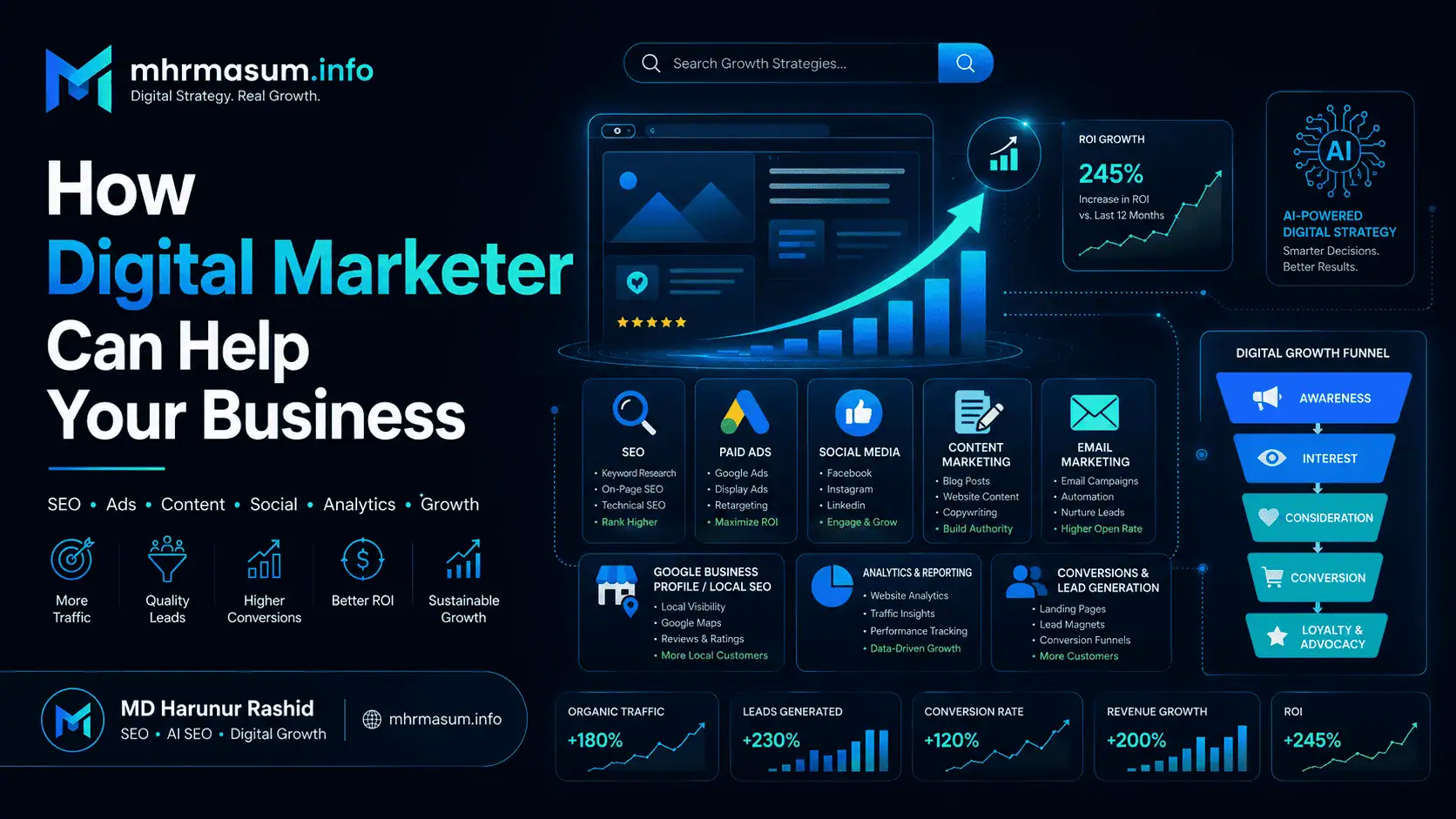
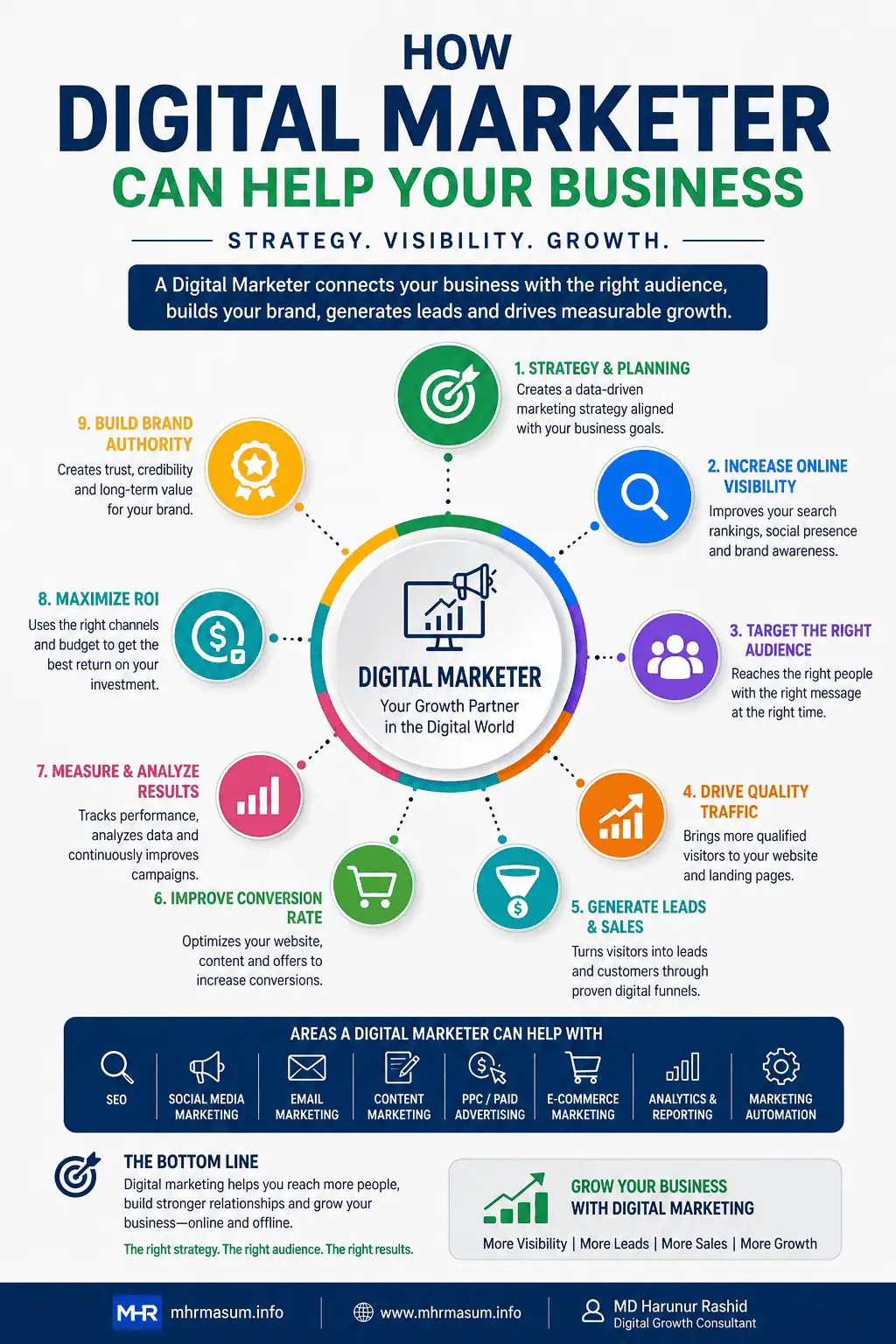
A digital marketer helps solve these problems by creating a connected strategy for attracting, engaging, converting, and retaining customers through digital channels.
The role goes far beyond publishing social media posts or running occasional advertisements.
An experienced digital marketer can help a business:
- Understand its target market
- Define measurable growth objectives
- Improve online visibility
- Reach commercially relevant audiences
- Generate qualified leads
- Increase eCommerce sales
- Strengthen local visibility
- Build brand authority
- Improve website conversion rates
- Track marketing performance
- Reduce wasted advertising expenditure
- Improve customer retention
- Prepare for AI-driven search and discovery
- Generate stronger long-term return on investment
The U.S. Small Business Administration recommends developing a structured marketing plan that identifies the target market, competitive advantage, sales strategy, objectives, action plan, and budget.
A skilled digital marketer helps turn those strategic components into coordinated, measurable campaigns rather than disconnected promotional activities. Review the SBA’s official marketing and sales guidance.
What Is a Digital Marketer?
A digital marketer is a professional who uses online channels, technology, customer data, content, advertising, analytics, and optimization strategies to help a business achieve its marketing and commercial objectives.
Depending on the business and project, a digital marketer may work across:
- Search engine optimization
- Paid search advertising
- Social media marketing
- Content marketing
- Email marketing
- Local SEO
- Google Business Profile
- eCommerce marketing
- Conversion-rate optimization
- Website strategy
- Online reputation management
- Marketing automation
- Analytics and attribution
- AI SEO and generative search
- Customer retention
- Digital brand development
A digital marketer may be a broad strategic consultant or a specialist in one particular channel.
For example, one professional may focus mainly on Google Ads, while another may specialize in Technical SEO, Local SEO, email automation, social media, eCommerce, or analytics.
A digital growth consultant takes a wider view by connecting these channels with business performance, customer acquisition, profit, and long-term brand development.
Why Businesses Need Digital Marketing
Customers increasingly research businesses online before taking action.
They may:
- Search for products or services
- Compare providers
- Read reviews
- Visit websites
- Watch videos
- Check social media profiles
- Look for case studies
- Compare prices
- Ask AI assistants for recommendations
- Search for local businesses on Maps
- Subscribe to email offers
- Return through remarketing advertisements
If a business is missing or poorly represented during these stages, competitors have more opportunities to attract the customer.
Digital marketing helps a business establish visibility and credibility across the customer journey.
It allows the company to communicate:
- What it offers
- Who it serves
- Which problems it solves
- Why customers should trust it
- What makes it different
- How a customer can take the next step
Unlike traditional promotion that may be difficult to measure accurately, many digital interactions can be tracked through analytics, advertising platforms, CRM systems, call tracking, form submissions, purchases, and customer records.
A Digital Marketer Connects Marketing with Business Goals
One of the most important responsibilities of a digital marketer is turning general business ambitions into measurable marketing objectives.
A weak objective might be:
We need more followers and website traffic.
A stronger objective would be:
Increase qualified enquiries for our highest-margin service by 30% over six months while maintaining customer acquisition cost below the agreed limit.
The second objective helps determine:
- Which audience should be targeted
- Which channels deserve investment
- Which offers should be promoted
- Which landing pages are needed
- Which conversions must be tracked
- Which budget is appropriate
- How success will be measured
A digital marketer should begin by understanding:
- Business model
- Revenue sources
- Profit margins
- Customer types
- Service capacity
- Geographic market
- Competitors
- Current marketing channels
- Sales cycle
- Customer lifetime value
- Available budget
- Internal resources
Marketing decisions should support profitable growth rather than vanity metrics.
For example, a campaign producing 500 low-quality leads may create less business value than one producing 50 well-qualified opportunities.
A Digital Marketer Researches the Target Audience
Effective marketing begins with understanding the customer.
A digital marketer researches:
- Who the customers are
- What problems they face
- Which outcomes they want
- How they search for solutions
- Which objections prevent purchases
- Which platforms they use
- What information they require
- Which factors influence trust
- What causes them to choose a competitor
This research can use:
- Customer interviews
- Sales-team feedback
- Website analytics
- Search data
- CRM records
- Review analysis
- Competitor research
- Social media conversations
- Customer-support questions
- Search Console queries
- Advertising results
The objective is not to create a fictional customer profile based on assumptions.
The strongest audience insights come from real behaviour and customer data.
For example, an SEO service provider may assume customers care primarily about ranking positions. Actual customer interviews may reveal that business owners care more about qualified leads, revenue, reporting transparency, and reducing dependency on advertising.
That insight should influence the website copy, content, offers, campaigns, and sales process.
A Digital Marketer Conducts Competitor Research
Businesses compete for customer attention, trust, visibility, and budget.
A digital marketer studies competitors to understand:
- Their market positioning
- Services or products
- Pricing presentation
- Website structure
- Search visibility
- Content strategy
- Advertising messages
- Social media activity
- Reviews
- Offers
- Conversion process
- Strengths and weaknesses
Competitor research should not result in copying another company.
It should help identify opportunities to differentiate.
For example, competitors may have:
- Strong rankings but weak website design
- Large social audiences but poor engagement
- Good products but limited customer support
- Strong advertising but no educational content
- Many reviews but outdated websites
- Broad service claims but little case-study evidence
A digital marketer can use these gaps to build a stronger value proposition and customer experience.
A Digital Marketer Develops a Complete Marketing Strategy
Businesses often waste money because each marketing activity is managed separately.
The SEO provider focuses on rankings, the social media manager focuses on followers, the advertising specialist focuses on clicks, and the website developer focuses on design.
Without a shared strategy, these activities may not support the same commercial objective.
A digital marketing strategy should define:
- Target audience
- Market positioning
- Customer problems
- Value proposition
- Marketing objectives
- Priority products or services
- Customer journey
- Primary channels
- Content requirements
- Budget allocation
- Conversion actions
- Measurement framework
- Testing process
- Reporting schedule
The strategy should explain how the channels support one another.
For example:
- SEO content attracts people researching a problem.
- Social media distributes useful insights and builds familiarity.
- Remarketing advertisements reconnect with previous visitors.
- Case studies build trust.
- Email nurtures prospects who are not ready to buy.
- A focused landing page converts qualified visitors.
- CRM data records which leads become customers.
This connected approach is more effective than treating every channel as an isolated campaign.
A Digital Marketer Improves Search Engine Visibility
Search engine optimization helps search engines understand a website and helps customers find relevant content when searching for products, services, or information.
Google describes SEO as helping search engines understand content and helping users discover a website and decide whether they should visit it. Read Google’s official SEO Starter Guide.
A digital marketer may improve SEO through:
- Keyword research
- Search-intent analysis
- Technical SEO
- On-page optimization
- Website architecture
- Content strategy
- Internal linking
- Structured data
- Link development
- Local SEO
- Image optimization
- Search Console analysis
The objective should not be traffic alone.
A professional strategy prioritizes searches connected to:
- Relevant customer problems
- Commercial products
- Profitable services
- Priority locations
- Qualified leads
- Business growth
For a complete explanation of professional SEO support, read How an SEO Consultant Helps Businesses Grow.
A Digital Marketer Conducts Keyword and Search-Intent Research
Keyword research identifies what potential customers search for and how those searches relate to their buying journey.
A digital marketer may classify search intent as:
- Informational
- Commercial investigation
- Transactional
- Navigational
- Local
Informational Searches
These users are trying to learn.
Examples include:
- What is Local SEO?
- Why is my website slow?
- How can I improve online sales?
- What causes rankings to drop?
Informational content builds awareness and authority.
Commercial Investigation Searches
These users are comparing solutions.
Examples include:
- Best SEO consultant for small businesses
- Digital marketer versus marketing agency
- Local SEO service pricing
- Best CRM for a hotel
These searches can lead to case studies, service comparisons, testimonials, and consultations.
Transactional Searches
These users may be ready to act.
Examples include:
- Hire a digital marketing consultant
- Request an SEO audit
- Book a Local SEO consultation
- Buy portable power station online
Transactional pages should make the next step clear and easy.
Local Searches
These searches have geographic intent.
Examples include:
- Roofing company near me
- SEO consultant in Dhaka
- Carpet cleaner Brisbane
- Restaurant near my location
Local searches may lead to Google Maps, Google Business Profile, location pages, phone calls, bookings, and direction requests.
A digital marketer maps these searches to the correct page type instead of forcing every keyword into a blog article.
A Digital Marketer Fixes Technical Website Problems
Marketing campaigns cannot produce their full value when the website has technical problems.
Common issues include:
- Pages not indexed
- Incorrect canonical tags
- Broken links
- Redirect chains
- Slow loading
- Poor mobile layout
- Duplicate content
- Missing XML sitemaps
- JavaScript rendering problems
- Structured data errors
- Server errors
- Unclear website architecture
A digital marketer with Technical SEO knowledge can identify these problems and coordinate with developers or hosting providers to resolve them.
Google’s technical documentation recommends ensuring that websites are secure, fast, accessible, and functional across devices. Review Google’s SEO guidance for web developers.
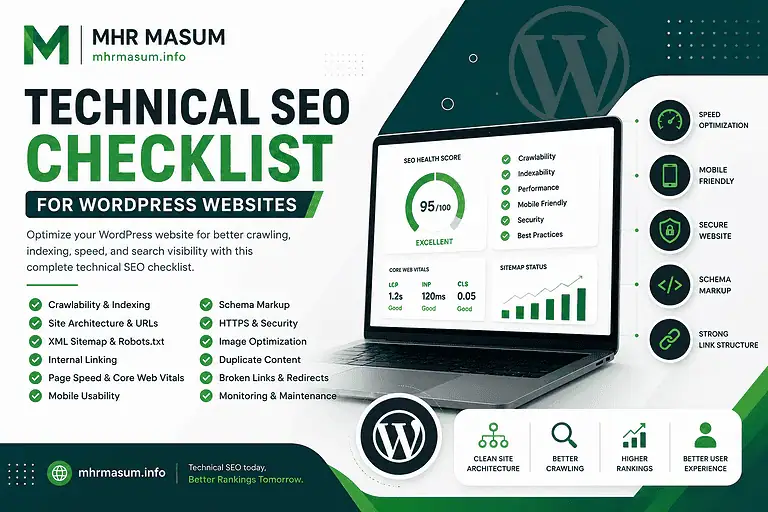
Use my Technical SEO Checklist for WordPress Websites to review the core technical areas affecting search visibility and user experience.
Practical examples are available in my Technical SEO and Keyword Research portfolio.
A Digital Marketer Improves Website Speed and User Experience
Attracting traffic is only useful if visitors can use the website effectively.
A slow or unstable website may cause people to leave before:
- Reading the offer
- Viewing a product
- Completing a form
- Calling the business
- Adding an item to the cart
- Finishing checkout
Google’s Core Web Vitals measure real-world loading performance, responsiveness, and visual stability. Google recommends achieving good Core Web Vitals for search success and user experience, while noting that strong scores do not guarantee top rankings because overall quality and relevance still matter. Read Google’s Core Web Vitals guidance.
A digital marketer may coordinate improvements involving:
- Hosting
- Caching
- CDN
- Image compression
- JavaScript
- CSS
- Web fonts
- WordPress plugins
- Themes
- Mobile layouts
- Checkout performance
Review my Website Speed Optimization portfolio for practical performance work.
A Digital Marketer Creates a Content Strategy
Content marketing helps a business answer customer questions, demonstrate expertise, build trust, attract search traffic, and support purchasing decisions.
A complete strategy may include:
- Service pages
- Product descriptions
- Blog articles
- Case studies
- Comparison guides
- Videos
- Infographics
- Social posts
- Email campaigns
- Checklists
- Downloadable resources
- Frequently asked questions
- Thought-leadership content
The correct content should be based on:
- Customer demand
- Search intent
- Sales objections
- Product priorities
- Business expertise
- Market opportunities
Google states that its ranking systems are designed to prioritize helpful, reliable, people-first content rather than content created primarily to manipulate rankings. Review Google’s people-first content guidance.
A digital marketer should therefore add real business value through:
- First-hand experience
- Original examples
- Case studies
- Professional analysis
- Useful images
- Clear processes
- Accurate research
- Expert commentary
- Transparent limitations
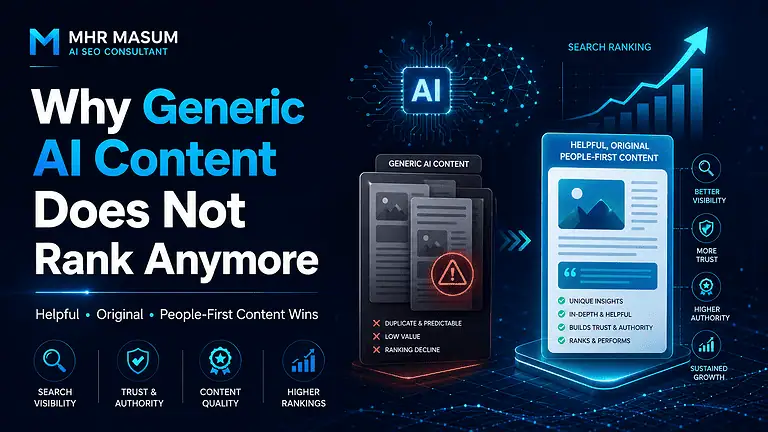
Read Why Generic AI Content Does Not Rank Anymore for a deeper content-quality framework.
A Digital Marketer Connects Content with Sales
Publishing content without connecting it to products, services, and conversions limits its commercial value.
A digital marketer builds pathways between:
- Educational articles
- Service pages
- Product pages
- Case studies
- Portfolio projects
- Email subscriptions
- Consultation forms
- Sales pages
For example, an article explaining Google core-update recovery can naturally lead readers to:
- Technical SEO services
- Content audits
- Search Console analysis
- Recovery consultation
- Relevant case studies
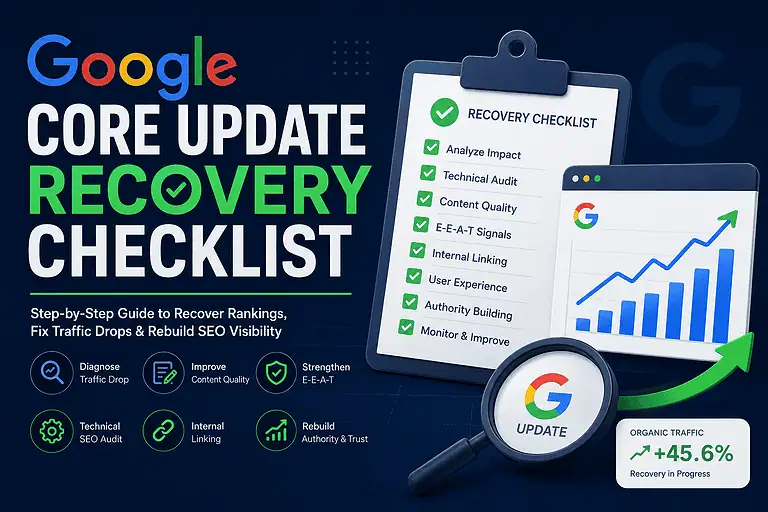
Use my Google Core Update Recovery Checklist as an example of content that supports both education and professional service demand.
A Digital Marketer Manages Paid Search Advertising
Paid search advertising can place a business in front of people actively searching for relevant products or services.
A digital marketer may manage:
- Keyword selection
- Audience targeting
- Campaign structure
- Advertisement copy
- Landing pages
- Budget allocation
- Bidding
- Negative keywords
- Conversion tracking
- Remarketing
- Performance analysis
The objective should not be to generate the highest number of clicks.
A click has value only when it contributes to:
- Qualified leads
- Sales
- Bookings
- Calls
- Customer acquisition
- Profit
A digital marketer identifies and removes wasted spending caused by:
- Irrelevant search terms
- Weak location targeting
- Low-quality landing pages
- Duplicate campaigns
- Poor conversion tracking
- Unprofitable products
- Low-value leads
A Digital Marketer Optimizes Advertising for Customer Value
Not every conversion has the same value.
A basic enquiry, a qualified lead, an accepted proposal, and a completed sale should not necessarily be treated equally.
Google Ads supports value-based bidding, which allows campaigns to optimize around business values such as revenue, profit margin, or lead score rather than focusing only on conversion volume. Review Google’s value-based bidding best practices.
A digital marketer may assign values to stages such as:
| Conversion Action | Example Value |
|---|---|
| Newsletter registration | $5 |
| Basic enquiry | $20 |
| Qualified lead | $150 |
| Consultation attended | $300 |
| Sale completed | Actual transaction value |
These values should reflect real business data rather than arbitrary numbers.
Connecting CRM outcomes with advertising helps platforms optimize toward customers who produce business value, not merely people who complete a form.
A Digital Marketer Builds Landing Pages That Convert
Sending every campaign to the homepage is rarely the strongest approach.
A focused landing page should match:
- Advertisement message
- Customer intent
- Product or service
- Location
- Offer
- Call to action
A strong landing page may include:
- Clear headline
- Customer problem
- Relevant solution
- Business benefits
- Trust evidence
- Reviews
- Case studies
- Process
- Frequently asked questions
- Clear call to action
- Simple form
A digital marketer tests whether the page is helping visitors progress rather than merely looking attractive.
Possible tests include:
- Headline
- Form length
- CTA text
- Page layout
- Offer
- Pricing presentation
- Testimonial placement
- Mobile form design
A Digital Marketer Improves Social Media Marketing
Social media can help businesses build awareness, distribute content, engage customers, demonstrate expertise, and remain visible between purchase cycles.
A digital marketer decides which platforms are appropriate based on:
- Audience
- Industry
- Content format
- Business resources
- Customer journey
- Commercial objective
A business does not need to publish on every available network.
The SBA advises small businesses to select platforms strategically according to their size, location, industry, resources, and audience rather than attempting to manage every channel. Read the SBA’s social media guide.
A digital marketer may use social media to publish:
- Educational tips
- Product demonstrations
- Project results
- Customer stories
- Business updates
- Short videos
- Industry opinions
- Offers
- Events
- Behind-the-scenes content
The goal should be more than collecting followers.
Social activity should support:
- Website visits
- Enquiries
- Sales
- Email subscriptions
- Brand searches
- Customer relationships
- Community engagement
A Digital Marketer Uses Paid Social Advertising
Paid social campaigns can reach customers based on interests, demographics, previous engagement, website behaviour, customer lists, and other eligible audience signals.
Campaign objectives may include:
- Awareness
- Website traffic
- Lead generation
- Video views
- App activity
- Online sales
- Remarketing
- Event promotion
A digital marketer should ensure that:
- The audience is relevant
- Creative matches the platform
- The offer is clear
- The landing page is consistent
- Conversion tracking works
- Budget is controlled
- Results are connected to sales
Social media advertisements should not be evaluated only by reactions, reach, or video views when the actual objective is revenue or qualified leads.
A Digital Marketer Develops Email Marketing
Email marketing helps businesses communicate with prospects and customers they have permission to contact.
Email can support:
- Lead nurturing
- Product promotion
- Customer onboarding
- Reorder reminders
- Event registration
- Abandoned-cart recovery
- Content distribution
- Customer education
- Upselling
- Retention
- Review requests
- Renewals
A digital marketer may segment subscribers according to:
- Interests
- Purchase history
- Location
- Lead stage
- Engagement
- Customer type
- Product ownership
This allows the business to send more relevant messages.
For example, an existing website-speed client may be more interested in Technical SEO and maintenance than in a basic website-design offer.
The SBA describes email marketing as a method for engaging customers, learning how they respond to a business, and generating potential new business. Review the SBA’s email marketing guidance.
A Digital Marketer Strengthens Local SEO
Local SEO helps businesses appear when customers search for products or services within a particular area.
It is especially relevant for:
- Contractors
- Restaurants
- Hotels
- Clinics
- Consultants
- Retailers
- Lawyers
- Accountants
- Cleaning companies
- Home-service businesses
A digital marketer may improve:
- Google Business Profile
- Local landing pages
- Reviews
- Local citations
- Business categories
- Services
- Contact information
- Opening hours
- Local schema
- Location-based content
- Local backlinks
A complete Local SEO strategy should connect the Business Profile with the website and wider business information.
Use my Local SEO in 2026 guide for a detailed implementation framework.
You can also review my:
A Digital Marketer Manages Google Business Profile
A Google Business Profile can help eligible local businesses appear across Google Search and Google Maps.
A digital marketer may optimize:
- Business name compliance
- Primary category
- Additional categories
- Business description
- Address
- Service areas
- Phone number
- Website
- Opening hours
- Products
- Services
- Photos
- Posts
- Reviews
The profile should be accurate, active, and consistent with the business website.
It can generate valuable actions such as:
- Phone calls
- Website clicks
- Bookings
- Direction requests
- Messages where available
A Google Business Profile should not be treated as a replacement for a business website. The profile supports fast local discovery, while the website provides detailed services, content, case studies, policies, and conversion pages.
A Digital Marketer Builds a Review and Reputation Strategy
Online reviews influence trust, local visibility, and customer decisions.
A digital marketer can establish a process for:
- Requesting genuine reviews
- Creating direct review links
- Monitoring new feedback
- Responding professionally
- Identifying recurring customer issues
- Displaying selected testimonials
- Reporting fraudulent reviews where appropriate
Review management should not involve:
- Purchased reviews
- Fake accounts
- Employee-generated reviews
- Review gating
- Prohibited incentives
- Suppressing legitimate criticism
A strong reputation strategy uses feedback to improve both marketing and service delivery.
Read How Reviews Help Local SEO and AI Search Visibility for a complete review framework.
A Digital Marketer Helps eCommerce Businesses Grow
eCommerce digital marketing combines product visibility, customer acquisition, conversion, retention, and merchandising.
A digital marketer may work on:
- Product SEO
- Product-category optimization
- Shopping campaigns
- Merchant Center
- Product feeds
- Email automation
- Abandoned carts
- Product reviews
- Upselling
- Cross-selling
- Remarketing
- Customer retention
Google Merchant Center free listings can make eligible products visible without advertising cost across surfaces including Google Search, Maps, Gemini, YouTube, the Shopping tab, Images, and Lens. Review Google’s free product-listing guidance.
Accurate product data is important because Google uses attributes such as product title, description, price, availability, brand, and identifiers to match products with relevant searches. Read Google’s Merchant Center product-data specification.
A Digital Marketer Increases Average Customer Value
Growth does not depend only on acquiring new customers.
A digital marketer can help increase the value of existing customer relationships through:
- Relevant upsells
- Cross-sells
- Product bundles
- Premium packages
- Subscription plans
- Maintenance services
- Renewal campaigns
- Loyalty offers
- Reorder reminders
For example, a customer purchasing website design may later require:
- Hosting
- Maintenance
- SEO
- Speed optimization
- CRM integration
- Content support
- Conversion tracking
These offers should improve the customer’s outcome rather than pressure them into buying unnecessary services.
A Digital Marketer Improves Customer Retention
Acquiring a new customer can become unprofitable when the relationship ends immediately after the first purchase.
Retention strategies may include:
- Strong onboarding
- Regular communication
- Customer education
- Follow-up campaigns
- Loyalty programs
- Subscription options
- Support improvements
- Customer feedback
- Personalized offers
- Renewal reminders
A digital marketer can measure:
- Repeat purchase rate
- Churn
- Customer lifetime value
- Renewal rate
- Purchase frequency
- Referral rate
- Email engagement
Retention often requires coordination between marketing, sales, customer service, and operations.
Marketing cannot compensate indefinitely for poor product quality or customer support.
A Digital Marketer Prepares Businesses for AI Search
Customers are increasingly discovering brands through Google AI Overviews, AI Mode, ChatGPT, Gemini, Perplexity, and other generative platforms.
A digital marketer can help make the business easier for search and AI systems to understand by strengthening:
- Content quality
- Entity clarity
- Brand consistency
- Technical SEO
- Structured data
- Expert authorship
- Case studies
- Reviews
- External mentions
- Topic coverage
Google’s current guidance explains that its generative search experiences are connected to its core ranking and quality systems. Website owners should continue focusing on crawlability, indexing, useful content, page experience, accurate business information, and standard SEO practices rather than searching for a special AI-ranking shortcut.
Use these supporting guides:
- AI SEO for Google AI Overviews, ChatGPT, Gemini and Perplexity
- GEO vs AEO vs SEO
- Entity SEO
- Brand Authority for AI Search
A Digital Marketer Strengthens Brand Authority
Customers are more likely to choose a company they recognize and trust.
Brand authority can be strengthened through:
- Consistent visual identity
- Expert-led content
- Case studies
- Reviews
- Media mentions
- Social activity
- Partnerships
- Professional profiles
- Original research
- Thought leadership
- Community involvement
A digital marketer ensures that the brand communicates consistently across:
- Website
- Google Business Profile
- Social media
- Directories
- Advertisements
- Content
- Structured data
Strong branding can contribute to:
- More branded searches
- Better conversion confidence
- Higher customer recall
- More referrals
- Stronger AI-search recognition
- Reduced dependence on discounts
A Digital Marketer Improves Conversion Rate
Generating more traffic is not always the most efficient path to growth.
A business may generate more revenue by converting a higher percentage of its existing visitors.
Conversion-rate optimization may involve:
- Improving the headline
- Clarifying the offer
- Simplifying navigation
- Reducing form fields
- Adding reviews
- Adding case studies
- Improving mobile UX
- Increasing page speed
- Strengthening calls to action
- Clarifying pricing
- Reducing checkout friction
A digital marketer analyzes where customers abandon the journey and develops tests to improve performance.
For example, the business may discover that:
- Users visit the service page but do not open the form
- Mobile users abandon checkout
- Customers cannot find pricing information
- The call-to-action is hidden
- The form produces an error
- The website does not show enough trust evidence
Fixing these problems can increase results without requiring more advertising expenditure.
A Digital Marketer Configures Analytics and Conversion Tracking
Marketing cannot be optimized accurately when important customer actions are not measured.
A digital marketer may configure:
- Google Analytics 4
- Google Tag Manager
- Google Search Console
- Advertising pixels
- Form tracking
- Call tracking
- eCommerce tracking
- CRM attribution
- Looker Studio dashboards
Google Analytics allows businesses to mark important actions as key events. These can include purchases, form submissions, registrations, or other actions that represent business success. Review Google Analytics key-event documentation.
For a lead-generation website, useful events may include:
- Contact form submitted
- Quote requested
- Consultation booked
- Phone number clicked
- WhatsApp clicked
- Email link clicked
- Pricing page viewed
- Case study viewed
For eCommerce, useful events include:
- Product viewed
- Add to cart
- Begin checkout
- Purchase
- Refund
- Repeat purchase
A Digital Marketer Analyzes Attribution
Customers often interact with several channels before converting.
A customer might:
- Discover the business through an article.
- Follow the company on LinkedIn.
- Return through a Google advertisement.
- Read a case study.
- Join the email list.
- Search for the brand.
- Submit a form.
Giving all conversion credit to the final branded search would hide the contribution of earlier channels.
Google Analytics provides attribution-path reports that help businesses understand the sequence of touchpoints users experience before completing important actions. Review Google’s attribution-path documentation.
A digital marketer uses this information to avoid cutting channels that assist conversions even when they are not the final interaction.
A Digital Marketer Connects Marketing with CRM Data
Analytics can record that a form was submitted, but it may not show whether the enquiry was qualified, accepted a proposal, or became a customer.
A CRM can record:
- Lead source
- Contact information
- Lead quality
- Sales stage
- Opportunity value
- Closed revenue
- Lost reason
- Repeat purchase
- Customer lifetime value
Connecting marketing data with CRM outcomes helps determine:
- Which channels generate high-value customers
- Which campaigns create unqualified leads
- Which content assists sales
- Which services have the strongest close rates
- Which locations generate profitable business
This prevents optimization around form submissions that never create revenue.
A Digital Marketer Improves Marketing ROI
Digital marketing should ultimately contribute to measurable business value.
A simplified marketing ROI formula is:
Marketing ROI = (Profit Attributable to Marketing − Marketing Cost) ÷ Marketing Cost × 100
Marketing costs may include:
- Advertising
- Consultant or agency fees
- Content creation
- Design
- Software
- Website development
- Internal staff time
- Analytics tools
- Email platforms
Return should ideally be calculated using profit rather than gross revenue.
A campaign generating $50,000 in revenue may still be unprofitable after product costs, delivery, discounts, advertising, and staff expenses.
A digital marketer improves ROI by:
- Reducing wasted expenditure
- Improving audience targeting
- Increasing conversion rate
- Promoting higher-margin services
- Increasing customer value
- Improving retention
- Scaling profitable channels
- Stopping weak campaigns
A Digital Marketer Creates Clear Reports
A digital marketing report should explain more than traffic and follower counts.
A useful report may include:
- Marketing work completed
- Visibility changes
- Qualified leads
- Sales
- Revenue
- Conversion rate
- Customer acquisition cost
- Best-performing channels
- Weak campaigns
- Content performance
- Local actions
- Opportunities
- Risks
- Next priorities
The report should answer:
- What happened?
- Why might it have happened?
- What business impact did it create?
- What should be done next?
A dashboard without analysis is only a collection of numbers.
Digital Marketer vs Digital Marketing Agency
A business can work with an independent marketer, consultant, agency, or internal team.
Independent Digital Marketer
An independent marketer may provide:
- Direct communication
- Flexible support
- Strategic guidance
- Specialist expertise
- Lower overhead
- Personalized service
This can be suitable for small and medium businesses, agencies needing white-label support, or companies with internal execution resources.
Digital Marketing Agency
An agency may provide a larger team covering:
- Strategy
- SEO
- Paid advertising
- Social media
- Design
- Content
- Development
- Analytics
An agency may be suitable for larger campaigns requiring substantial execution capacity.
In-House Marketing Team
An internal team offers:
- Deep business familiarity
- Daily access
- Continuous ownership
- Close coordination with sales and operations
The team may still require external specialists for Technical SEO, analytics, paid media, AI SEO, or development.
Hybrid Model
Many businesses use a hybrid model where:
- A consultant creates the strategy
- Internal staff manage daily communication
- Specialists manage selected channels
- Developers implement technical improvements
The best structure depends on budget, expertise, workload, and business objectives.
What Should a Digital Marketer Deliver?
Deliverables should match the project, but may include:
- Digital marketing audit
- Competitor research
- Audience research
- Marketing strategy
- SEO audit
- Keyword research
- Content plan
- Advertising campaigns
- Social media calendar
- Email automation
- Landing pages
- Conversion tracking
- Analytics dashboard
- Google Business Profile optimization
- Monthly reporting
- Conversion testing
- Staff training
Every deliverable should connect to a business objective.
A content calendar without an audience strategy has limited value.
An advertising campaign without conversion tracking is difficult to optimize.
A report without financial context may encourage the wrong decisions.
How to Choose the Right Digital Marketer
The right marketer should understand both marketing channels and business performance.
Review Relevant Experience
Ask whether the marketer has experience with:
- Your industry
- Your business model
- Your website platform
- Your target locations
- Your audience
- Your priority channels
- Your commercial objectives
Review Previous Work
Look for:
- Case studies
- Portfolio projects
- Clear problems
- Work completed
- Measurable outcomes
- Realistic explanations
Review my SEO, WordPress and Digital Growth Portfolio for examples of practical work.
Ask How Success Will Be Measured
The marketer should be able to define:
- Conversions
- Lead quality
- Revenue
- Customer acquisition cost
- Return on investment
- Reporting frequency
Ask How Data Will Be Managed
Confirm:
- Who owns advertising accounts
- Who owns analytics accounts
- Who owns customer data
- What access is required
- How reporting will be shared
- How privacy and security are handled
Avoid Unrealistic Guarantees
Be cautious when a marketer promises:
- Guaranteed first position
- Immediate viral growth
- Guaranteed revenue without data
- Thousands of followers with no strategy
- Instant SEO results
- Risk-free advertising returns
Marketing involves testing, competition, platform changes, customer behaviour, and business variables.
A professional should provide a clear strategy without pretending that every result is guaranteed.
Common Digital Marketing Mistakes
Businesses often reduce their return by repeating avoidable mistakes.
Using Every Channel Without a Strategy
Being active everywhere can spread budget and attention too thinly.
Choose channels based on audience behaviour and commercial value.
Focusing Only on Traffic
Traffic has limited value if it does not support awareness, leads, sales, retention, or another defined objective.
Running Advertising Without Tracking
Without conversion tracking, the business cannot determine which campaigns generate results.
Publishing Generic Content
Generic content may fail to demonstrate expertise, attract links, build trust, or support conversions.
Ignoring the Website
Social media and advertisements may attract attention, but a weak website can prevent conversion.
Ignoring Existing Customers
Businesses often focus entirely on acquisition while missing opportunities for retention, referrals, renewals, and repeat sales.
Measuring Only the Final Click
The final interaction may receive all the credit even when several channels contributed to the decision.
Scaling Before Fixing Conversion
Increasing advertising expenditure on a weak landing page usually increases waste.
A 90-Day Digital Marketing Growth Roadmap
A structured plan allows the business to build its marketing foundation before scaling expenditure.
Days 1–30: Research, Audit and Measurement
During the first month, the digital marketer should:
- Understand the business model
- Define target audiences
- Review competitors
- Audit the website
- Review SEO
- Review advertising accounts
- Review social media
- Review email marketing
- Review Google Business Profile
- Audit analytics
- Verify conversion tracking
- Calculate baseline metrics
- Identify quick wins
- Create a prioritized roadmap
The objective is to understand current performance before making large changes.
Days 31–60: Build and Optimize
During the second month, priority actions may include:
- Fix Technical SEO problems
- Improve service or product pages
- Improve website speed
- Optimize Google Business Profile
- Create high-intent content
- Restructure advertising campaigns
- Improve landing pages
- Configure email automation
- Improve calls to action
- Connect analytics with CRM
- Begin review acquisition
This phase should improve both traffic quality and conversion readiness.
Days 61–90: Test, Measure and Scale
During the third month:
- Review channel performance
- Test advertisements
- Test landing pages
- Improve weak conversion points
- Expand successful SEO topics
- Refine audience targeting
- Increase investment in profitable campaigns
- Reduce waste
- Improve retention campaigns
- Build a monthly reporting framework
- Develop the next-quarter strategy
Scaling should happen only after measurement and conversion systems are reliable.
Frequently Asked Questions About Digital Marketers
What Does a Digital Marketer Do?
A digital marketer develops and manages online strategies designed to improve visibility, attract customers, generate leads, increase sales, strengthen branding, and measure marketing performance.
Can a Digital Marketer Help a Small Business?
Yes. A digital marketer can help a small business identify the most effective channels, avoid wasted expenditure, improve local visibility, generate leads, and build a practical growth system within the available budget.
Does a Digital Marketer Build Websites?
Some digital marketers provide website design and WordPress development, while others work with developers.
The marketer should at least understand how website structure, speed, UX, analytics, and conversion affect campaign performance.
Does a Digital Marketer Manage SEO?
Many digital marketers provide SEO, but expertise varies.
A technically complex website may require a specialist SEO consultant or developer in addition to the wider digital marketer.
Can a Digital Marketer Manage Social Media?
Yes. Services may include strategy, content planning, publishing, paid social campaigns, engagement, and reporting.
How Much Does a Digital Marketer Cost?
Fees depend on:
- Experience
- Scope
- Number of channels
- Business size
- Competition
- Advertising budget
- Content requirements
- Technical complexity
- Reporting needs
The cheapest option may become expensive when poor tracking, weak targeting, or low-quality work wastes business resources.
How Long Does Digital Marketing Take to Work?
Paid campaigns can generate activity quickly, but optimization still requires data and testing.
SEO, content authority, brand development, email-list growth, and Local SEO generally require consistent work over a longer period.
Should I Hire a Digital Marketer or an Agency?
An independent marketer may be suitable for personalized strategy and flexible support.
An agency may be better when large-scale production and multiple specialists are required.
A hybrid model can combine senior consulting with internal or outsourced implementation.
How Do I Know Whether Digital Marketing Is Working?
Track metrics connected to the business objective, such as:
- Qualified leads
- Sales
- Revenue
- Conversion rate
- Customer acquisition cost
- Customer lifetime value
- Repeat purchases
- Return on investment
Does Digital Marketing Still Work with AI Search?
Yes. Digital marketing now includes optimizing visibility across both traditional and AI-driven discovery platforms.
Strong content, technical SEO, entity clarity, reviews, brand authority, and accurate business information remain essential.
Final Thoughts on How a Digital Marketer Helps a Business
A digital marketer helps a business grow by connecting customer demand, online visibility, marketing channels, website performance, conversion, analytics, and long-term customer value.
The most valuable digital marketers do not focus only on:
- Followers
- Clicks
- Impressions
- Rankings
- Traffic
They connect these metrics with:
- Qualified leads
- Customers
- Revenue
- Profit
- Retention
- Sustainable growth
A complete digital marketing strategy may include:
- SEO
- Paid advertising
- Content
- Social media
- Local SEO
- Google Business Profile
- eCommerce
- AI search
- Conversion optimization
- Analytics
- CRM attribution
- Customer retention
MD Harunur Rashid is an SEO, AI SEO and Digital Growth Consultant with 17+ years of experience helping local businesses, eCommerce brands, agencies, and website owners improve online visibility, website performance, customer acquisition, and measurable digital growth.
Explore my SEO and Digital Growth Services, learn more about MD Harunur Rashid, review completed projects in my portfolio, or contact MD Harunur Rashid to discuss a tailored digital marketing strategy for your business.