Generating more revenue does not always mean your business is becoming more profitable.
A business can increase website traffic, leads, advertising spend, staff, orders, and total revenue while producing a lower return on investment. This happens when customer acquisition costs rise, conversion rates remain weak, profit margins decline, operational costs increase, or marketing activity attracts the wrong customers.
To generate more ROI, you must improve the relationship between the money, time, technology, and resources invested in the business and the profit created from those investments.
This requires more than running additional advertisements or publishing more content. A profitable ROI strategy must connect:
- Business objectives
- Customer demand
- Marketing channels
- Conversion rates
- Average transaction value
- Gross profit
- Customer retention
- Operational efficiency
- Measurement and attribution
The strongest ROI improvements often come from optimizing the complete customer journey rather than focusing on one isolated metric.
For example, generating 20% more website traffic may produce very little commercial value if the visitors are not qualified. However, improving lead quality, conversion rate, average customer value, and retention can generate significantly more profit without requiring the same increase in traffic.
This guide explains how local businesses, eCommerce stores, agencies, professional service providers, startups, and established companies can generate more ROI through measurable and sustainable growth strategies.
What Does ROI Mean in Business?
Return on investment, commonly abbreviated as ROI, measures how much financial value an investment generates compared with its total cost.
The standard ROI formula is:
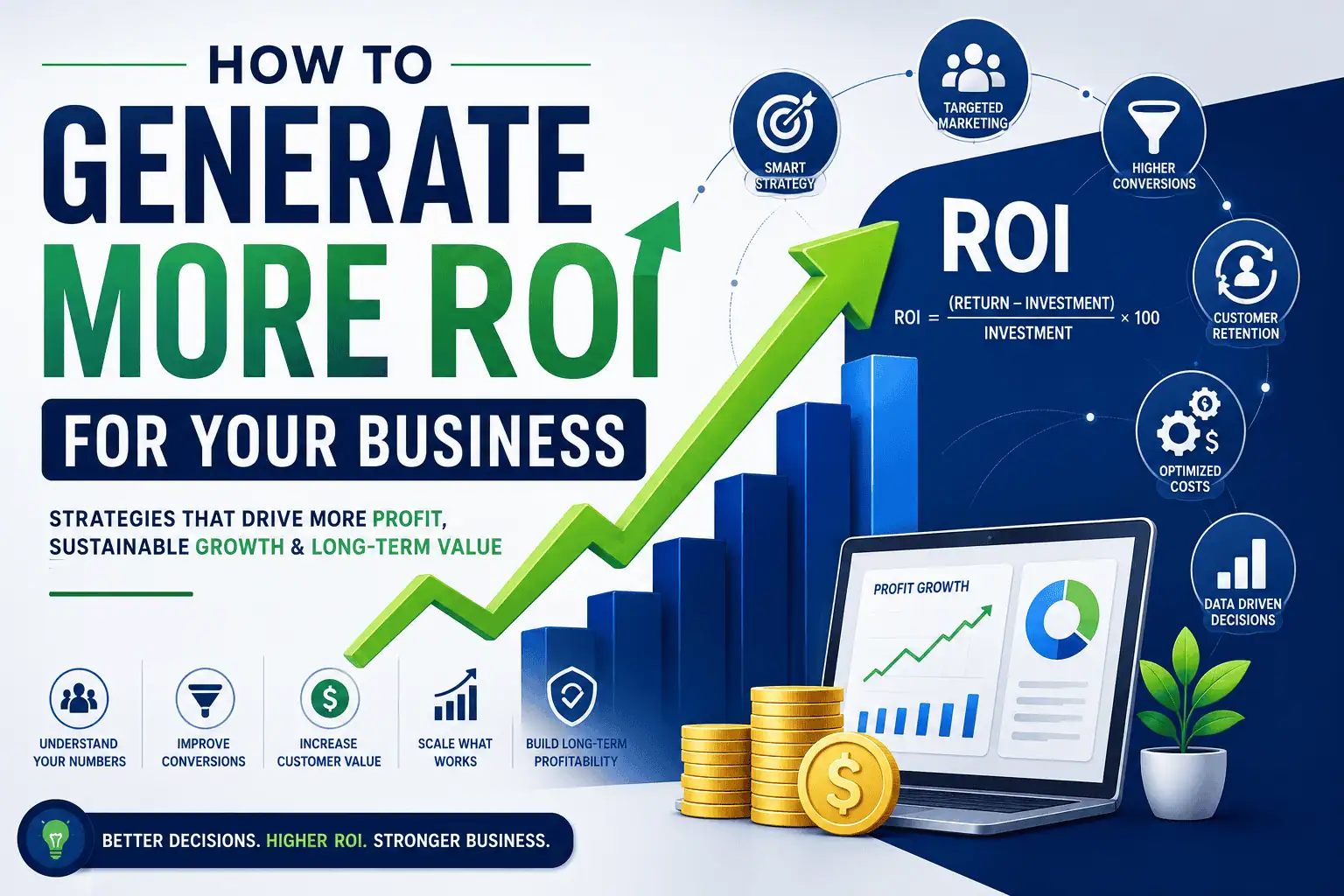
ROI = (Return from Investment − Cost of Investment) ÷ Cost of Investment × 100
Suppose a business invests $10,000 in a marketing campaign and generates $16,000 in additional profit attributable to that campaign.
The ROI would be:
($16,000 − $10,000) ÷ $10,000 × 100 = 60%
This means the investment generated a 60% return after recovering its original cost.
However, businesses frequently calculate ROI incorrectly by using revenue instead of profit.
If a campaign generates $50,000 in sales, that does not mean the return is $50,000. The business may also have product costs, staff costs, payment fees, shipping, software expenses, discounts, refunds, and service-delivery costs.
A more realistic calculation should consider the incremental profit generated by the investment.
ROI, Revenue, Profit and ROAS Are Not the Same
Revenue, profit, ROI, and return on advertising spend measure different parts of business performance.
Understanding the difference is essential because optimizing the wrong metric can lead to unprofitable growth.
Revenue Measures Total Sales
Revenue is the total amount earned before deducting expenses.
If an eCommerce store sells 1,000 products at $50 each, its revenue is $50,000.
Revenue is important, but it does not reveal whether the business made a profit.
Profit Measures What Remains After Costs
Profit is the amount remaining after relevant costs have been deducted.
If the same store generates $50,000 in revenue but incurs $40,000 in product, marketing, delivery, platform, and operational costs, its profit is $10,000.
Profit gives a more realistic picture of business health than revenue alone.
ROAS Measures Advertising Revenue Efficiency
Return on advertising spend measures the revenue generated for every unit of advertising cost.
The standard ROAS formula is:
ROAS = Advertising Revenue ÷ Advertising Cost
If a business spends $5,000 on advertising and generates $25,000 in attributed sales, the ROAS is 5:1.
This means every $1 of advertising spend produced $5 in revenue.
ROAS does not automatically include:
- Product costs
- Staff costs
- Agency fees
- Creative production
- Discounts
- Refunds
- Payment-processing fees
- Technology costs
A campaign can have a strong ROAS while still producing a weak overall ROI.
ROI Measures Wider Financial Return
ROI evaluates the return after considering the relevant cost of the investment.
It can be applied to:
- Marketing
- SEO
- Technology
- Staff recruitment
- Training
- Website redesign
- Software
- Equipment
- New locations
- Business acquisitions
- Product development
ROI is therefore a broader profitability metric than ROAS.
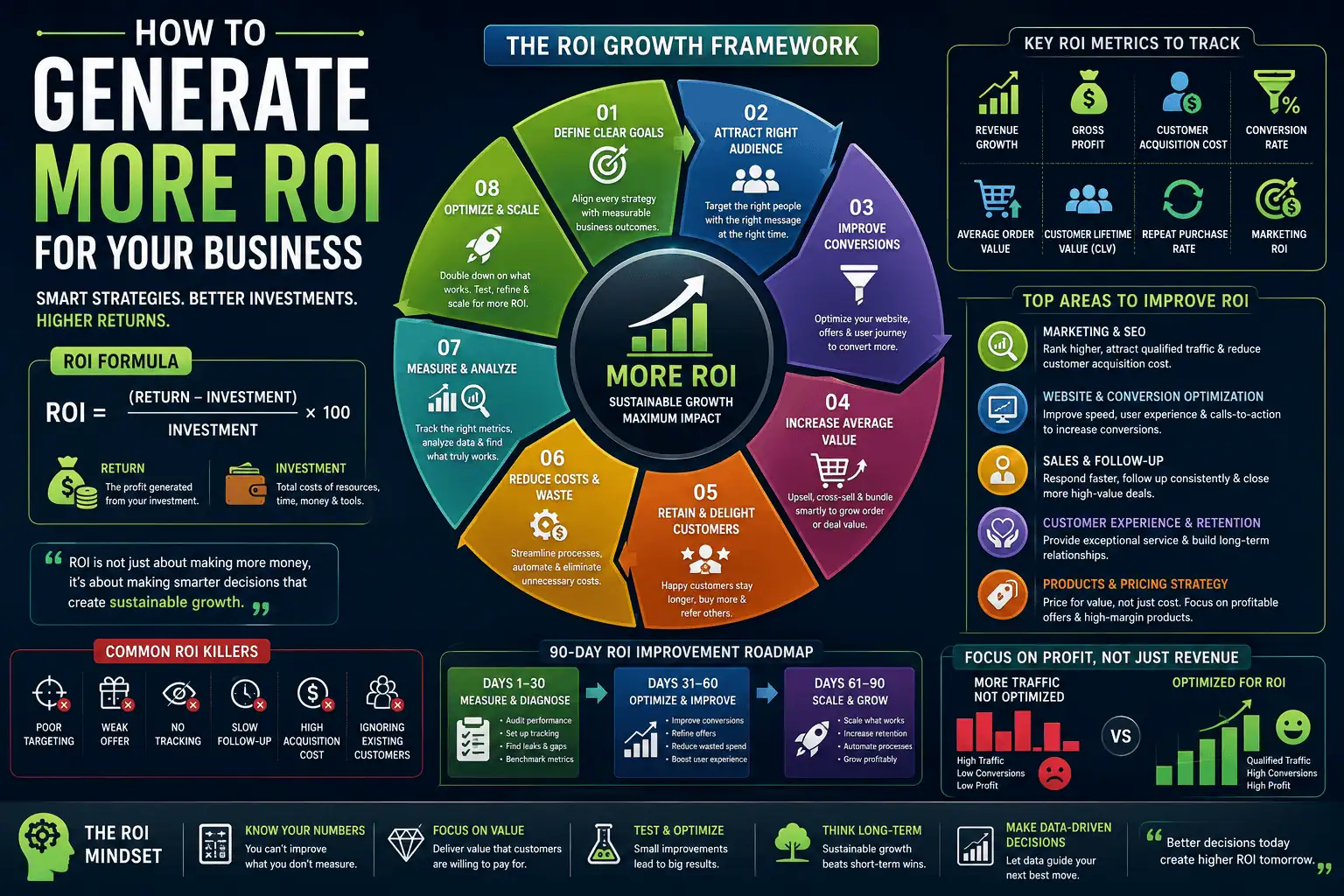
Why Many Businesses Struggle to Generate Strong ROI
Low ROI is rarely caused by one isolated problem. It is usually the result of several weaknesses across acquisition, conversion, delivery, retention, and measurement.
A business may struggle with ROI because it:
- Attracts low-intent visitors
- Targets broad or irrelevant audiences
- Has an unclear value proposition
- Competes mainly through price
- Sends paid traffic to weak landing pages
- Does not track phone calls or form submissions
- Treats every lead as equally valuable
- Has a slow or confusing website
- Does not follow up with leads quickly
- Fails to retain existing customers
- Does not know its customer acquisition cost
- Does not calculate customer lifetime value
- Invests in channels without proper attribution
- Continues campaigns based on traffic rather than profit
- Uses disconnected marketing and CRM systems
Improving ROI requires identifying where financial value is being lost.
The Business ROI Growth Formula
A practical way to understand ROI growth is to break it into several connected variables.
Business profit can be influenced by:
Qualified demand × Conversion rate × Average transaction value × Purchase frequency × Profit margin
This means a business can generate more return by improving one or more of the following:
- Attracting more qualified prospects
- Converting more prospects into customers
- Increasing the average value of each sale
- Encouraging customers to purchase more frequently
- Retaining customers for longer
- Improving gross profit margins
- Reducing unnecessary acquisition and operational costs
A company does not always need to double traffic to double profit.
Consider a website that currently generates:
- 10,000 monthly visitors
- A 2% lead conversion rate
- 200 leads
- A 20% lead-to-customer conversion rate
- 40 customers
- An average first purchase of $500
The business generates $20,000 in initial revenue.
If the business improves its website conversion rate from 2% to 3%, it produces 300 leads from the same traffic.
If lead qualification and follow-up improve the closing rate from 20% to 25%, the business gains 75 customers.
At the same $500 average sale, revenue increases to $37,500 without increasing website traffic.
This example demonstrates why conversion quality can have a greater ROI impact than traffic volume alone.
Start by Establishing a Reliable ROI Baseline
Before attempting to improve ROI, determine what the business is currently producing.
A useful baseline should include financial, marketing, sales, and operational information.
Track at least:
- Total revenue
- Gross profit
- Net profit
- Marketing expenditure
- Cost per lead
- Customer acquisition cost
- Lead-to-customer conversion rate
- Average transaction value
- Repeat purchase rate
- Customer lifetime value
- Refund or cancellation rate
- Sales cycle length
- Revenue by marketing channel
- Profit by product or service
- Profit by customer segment
The U.S. Small Business Administration recommends maintaining clear financial records and analysing different business segments, such as comparing online and offline sales. It also advises businesses to create a structured marketing plan that converts strategy into specific, budgeted actions.
Useful official resources include:
- U.S. Small Business Administration marketing and sales guidance
- SBA financial management guidance
- SBA break-even point calculator and explanation
Without a baseline, the business cannot confidently determine whether a campaign, website improvement, employee, software platform, or sales process is creating a positive return.
Define Business Outcomes Before Choosing Marketing Channels
A marketing channel should be selected based on the business outcome it can support, not because it is currently popular.
Before investing, define the primary commercial objective.
Examples include:
- Generate qualified leads
- Increase online purchases
- Increase booked consultations
- Increase repeat orders
- Improve average order value
- Expand into a new location
- Reduce customer acquisition cost
- Increase subscription renewals
- Improve profit from existing traffic
- Generate more high-margin sales
The objective should then be translated into measurable targets.
Instead of saying:
We need more website traffic.
Use a measurable objective such as:
Increase qualified organic enquiries from 80 to 120 per month while maintaining a cost per acquired customer below $250.
This target connects traffic, lead quality, sales performance, and financial value.
Measure the Complete Customer Journey
One of the largest causes of poor ROI is incomplete measurement.
A business may track advertisement clicks or website visits but fail to track what happens afterwards.
A complete customer journey may include:
- Search impression
- Advertisement or organic-result click
- Landing-page visit
- Service-page view
- Case-study view
- Contact-form submission
- Phone call
- Sales qualification
- Proposal
- Purchase
- Repeat purchase
- Referral
Tracking only the first few steps can make weak channels appear successful and high-value channels appear less important.
Configure GA4 Key Events
Google Analytics allows businesses to mark important actions as key events. These can include purchases, form submissions, phone clicks, registrations, downloads, or other actions connected to business success. Google also allows Analytics key events to be used as Google Ads conversions, creating a more consistent connection between measurement and campaign optimization.
Useful resources include:
For a lead-generation website, consider tracking:
- Contact form submitted
- Quote request submitted
- Consultation booked
- Phone number clicked
- WhatsApp button clicked
- Email link clicked
- Pricing page viewed
- Case study viewed
- Proposal accepted
For an eCommerce website, consider tracking:
- Product viewed
- Add to cart
- Begin checkout
- Shipping details submitted
- Payment details submitted
- Purchase
- Refund
- Repeat purchase
Use Attribution Reports Carefully
Customers rarely convert after one interaction.
A buyer may discover a business through organic search, return through social media, read a case study, click a retargeting advertisement, and finally contact the company through a branded Google search.
Google Analytics provides attribution reports that show the paths users take before completing key events and how different attribution models distribute credit across touchpoints.
Review the official Google Analytics attribution paths documentation when evaluating cross-channel customer journeys.
Avoid automatically giving all credit to the final click. The last interaction may close the conversion, but earlier content and marketing activity may have created the demand and trust required for that conversion.
Connect Marketing Data with CRM Outcomes
Website analytics can confirm that a form was submitted, but it cannot always confirm whether the lead was qualified or became a paying customer.
Connect marketing data with your CRM so you can track:
- Lead source
- Lead quality
- Sales stage
- Estimated opportunity value
- Closed revenue
- Lost reason
- Customer type
- Repeat revenue
- Profitability
This allows the business to compare the number of leads with the value of those leads.
Ten high-value leads may produce more ROI than 100 low-quality enquiries.
Focus on Customer Acquisition Cost and Lifetime Value
Customer acquisition cost and customer lifetime value are two of the most important ROI metrics.
Calculate Customer Acquisition Cost
Customer acquisition cost measures the average cost of gaining a new customer.
The formula is:
Customer Acquisition Cost = Total Sales and Marketing Cost ÷ Number of New Customers
If a business spends $20,000 on marketing and sales during one quarter and acquires 80 customers, its average acquisition cost is $250.
Include relevant costs such as:
- Advertising
- SEO services
- Content production
- Marketing software
- Agency fees
- Sales salaries
- Sales commissions
- Creative production
- Landing-page development
Leaving out major costs creates an artificially attractive acquisition cost.
Calculate Customer Lifetime Value
Customer lifetime value estimates the total financial value a customer is expected to generate during their relationship with the business.
A simplified formula is:
Customer Lifetime Value = Average Purchase Value × Purchase Frequency × Customer Lifespan
For more accurate decision-making, use gross profit rather than revenue.
A business with a $500 customer acquisition cost may appear unprofitable if the first purchase generates only $400. However, if the average customer produces $3,000 in gross profit over three years, the acquisition cost may be commercially reasonable.
The objective should not always be to acquire customers at the lowest possible cost. It should be to acquire profitable customers at a sustainable cost.
Prioritize High-Value Customers, Products and Services
Not every customer, service, product, or location creates the same financial return.
Segment your business performance to identify:
- Highest-margin products
- Highest-retention customers
- Most profitable service packages
- Locations with the strongest close rates
- Industries with the highest contract values
- Channels producing the best customers
- Products with high refund rates
- Services requiring excessive support
You may discover that one service produces substantial revenue but weak profit because it requires too much labour.
Another service may produce fewer sales but a stronger margin, shorter delivery time, and higher customer retention.
Use this information to decide:
- Which services should receive more marketing investment
- Which offers should be repositioned
- Which customers should be excluded
- Which products should be discontinued
- Which packages should be expanded
- Which locations deserve dedicated campaigns
ROI improves when the business deliberately attracts customers who fit its profitable operating model.
Improve Your Value Proposition
A weak value proposition forces a business to compete through price.
A strong value proposition clearly communicates:
- Who the service is for
- What problem it solves
- What outcome it creates
- Why the business is different
- Why the customer should trust it
- What the customer should do next
A generic statement such as:
We provide high-quality digital marketing services.
does not explain why a prospect should choose the company.
A stronger statement might say:
We help local businesses, eCommerce brands and agencies improve qualified organic visibility through Technical SEO, Local SEO, AI-ready content systems, WordPress optimization and measurable conversion strategies.
The second version provides more context, differentiation, and relevance.
Your website should connect the value proposition with evidence such as:
- Experience
- Case studies
- Client results
- Portfolio work
- Reviews
- Certifications
- Detailed processes
- Transparent service information
Learn more about my experience on the About MD Harunur Rashid page and review practical projects in my SEO and WordPress portfolio.
Use SEO as a Compounding ROI Channel
Search engine optimization can create strong long-term ROI because a well-performing page can continue attracting qualified demand after the initial optimization work has been completed.
Unlike a paid campaign that generally stops producing traffic when spending stops, an established organic asset may continue generating:
- Search impressions
- Website visits
- Leads
- Sales
- Brand searches
- Backlinks
- AI citations
- Referral traffic
However, SEO ROI should not be evaluated using traffic alone.
The correct questions include:
- Which pages generate qualified leads?
- Which keywords attract commercial intent?
- Which services produce the most profit?
- Which content assists conversions?
- Which locations generate customers?
- Which pages increase branded demand?
- Which pages influence AI visibility?
- Which organic visitors become repeat customers?
Google Search Console’s Performance report shows how search traffic changes over time, which queries bring users to a website, and which pages generate impressions and clicks.
Use the official Google Search Console Performance report guide to understand organic search visibility.
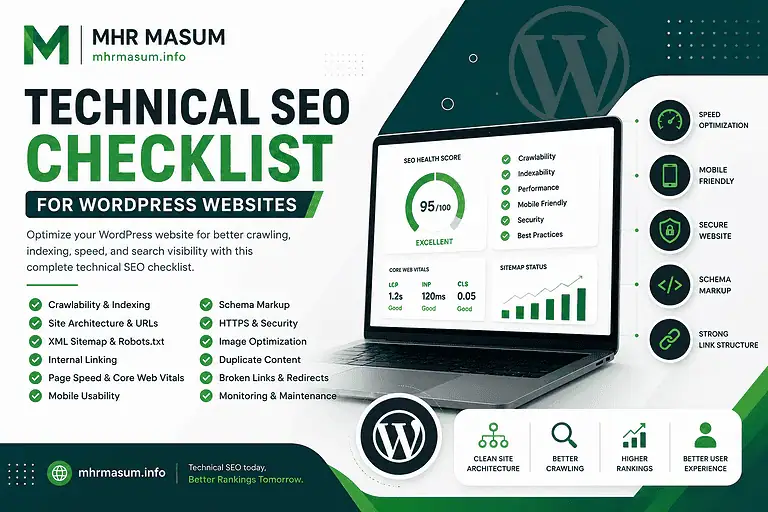
For a complete website-level framework, use my Technical SEO Checklist for WordPress Websites. You can also review examples in my Technical SEO and Keyword Research portfolio.
Target Commercial Search Intent
High traffic does not automatically produce high ROI.
A broad informational keyword may generate thousands of visitors who are not ready to purchase. A specific commercial keyword may generate fewer visits but more enquiries and sales.
A profitable keyword strategy should cover different stages of the customer journey.
Informational Keywords Build Awareness
Examples include:
- What is Technical SEO?
- How does Local SEO work?
- How can I recover after a Google update?
- Why is my WordPress website slow?
These topics can attract early-stage prospects and build trust.
Commercial Investigation Keywords Support Comparison
Examples include:
- Best SEO consultant for local businesses
- Local SEO agency versus freelancer
- WooCommerce SEO service
- Technical SEO audit provider
- WordPress speed optimization service
These users are evaluating potential solutions.
Transactional Keywords Indicate Action
Examples include:
- Hire an SEO consultant
- Request a Technical SEO audit
- Book a Local SEO consultation
- WordPress speed optimization quote
- Google Business Profile management service
These users may be closer to conversion.
A strong content strategy supports all stages while creating clear pathways from informational articles to service, portfolio, and contact pages.
Improve AI Search Visibility and Brand Authority
Customers are increasingly discovering companies through AI Overviews, AI Mode, ChatGPT, Gemini, Perplexity, and other answer-driven environments.
A business may lose visibility if its website does not clearly communicate:
- Who the company is
- What it specialises in
- Which services it provides
- Which industries it serves
- Why its expertise is credible
- Where it operates
- How customers can contact it
Improving AI search visibility requires a combination of content quality, technical SEO, entity clarity, brand authority, and external validation.
Use these related guides to strengthen that foundation:
- AI SEO: How to Rank in Google AI Overviews, ChatGPT, Gemini and Perplexity
- Entity SEO: The Missing Part of Modern SEO
- GEO vs AEO vs SEO
- How to Build Brand Authority for AI Search
- Why Generic AI Content Does Not Rank Anymore
AI visibility should not be treated as a vanity metric. Connect it with branded searches, referral traffic, assisted conversions, enquiries, and sales.
Use Local SEO to Generate High-Intent Leads
Local SEO can generate strong ROI for businesses that serve a defined geographic area.
Local searches frequently involve immediate commercial needs, such as:
- Roofing company near me
- SEO consultant in my city
- Emergency plumber
- Carpet cleaner near me
- Pest control service
- Restaurant booking
- Local web designer
A complete Local SEO strategy should include:
- Google Business Profile optimization
- Accurate contact information
- Correct business categories
- Service descriptions
- Local landing pages
- Customer reviews
- Local citations
- Location-relevant content
- LocalBusiness schema
- Consistent business information
- Conversion tracking
Google recommends maintaining complete and accurate Business Profile information, including business category, address, phone number, hours, photos, and other useful details. Google also advises businesses to respond to reviews because thoughtful responses demonstrate that customer feedback is valued.
Review Google’s official tips to improve local ranking and my Local SEO in 2026 guide.
Practical implementation examples are available in my:
Improve Website Conversion Rate
A website should not function only as an online brochure. It should help visitors understand the offer, trust the business, and complete the next logical action.
Conversion-rate optimization can increase ROI from existing traffic.
Make the Primary Action Clear
Every commercial page should have a clearly defined action.
Examples include:
- Request a quote
- Book a consultation
- Call the business
- Purchase the product
- Start a free trial
- Download the guide
- Check availability
Avoid placing too many competing calls to action on the same page.
Reduce Form Friction
Long and confusing forms can reduce completion rates.
Only request information required for the current stage.
An initial lead form may need:
- Name
- Phone number
- Service required
- Short project description
Detailed documents and technical information can be requested after the lead has been qualified.
Add Trust Evidence Near Conversion Points
Place relevant trust signals close to the call to action.
These may include:
- Years of experience
- Customer reviews
- Case-study results
- Secure payment information
- Guarantees
- Certifications
- Client logos
- Clear policies
- Contact details
Make Mobile Conversion Easy
Mobile visitors should be able to:
- Read the page
- Open the menu
- Click the phone number
- Use WhatsApp
- Complete the form
- View pricing or service details
- Submit without horizontal scrolling
A responsive design that looks attractive but has unusable forms will produce weak ROI.
Improve Website Speed and Page Experience
Website performance affects the user’s ability to explore products, submit forms, read content, and complete checkout.
Google’s Core Web Vitals measure real-world loading performance, interactivity, and visual stability. Google recommends achieving good Core Web Vitals for search success and a strong user experience, while also clarifying that good scores alone do not guarantee high rankings.
Review Google’s official Core Web Vitals documentation.
Common performance improvements include:
- Compressing images
- Serving modern image formats
- Reducing unnecessary plugins
- Removing unused JavaScript
- Improving hosting
- Configuring caching
- Reducing third-party scripts
- Preloading important fonts
- Setting image dimensions
- Optimizing the database
- Fixing layout shifts
- Reducing server response time
My Website Speed Optimization portfolio demonstrates practical performance work for business websites.
Use Behavioural Data to Find Conversion Problems
Analytics can show that visitors are leaving, but behavioural tools can help reveal why.
Heatmaps and session recordings can identify:
- Dead clicks
- Rage clicks
- Unused buttons
- Forms that cause abandonment
- Sections visitors ignore
- Mobile-menu problems
- Confusing navigation
- Repeated errors
- Content that users never reach
Microsoft Clarity recordings recreate user interactions such as clicks, scrolls, mouse movements, and navigation, helping website owners understand user behaviour and identify functionality problems.
Review the official Microsoft Clarity session-recording guide.
Do not make major design decisions based on one recording. Look for repeated behaviour patterns across meaningful traffic segments.
Optimize Paid Advertising for Profit, Not Lead Volume
Paid advertising can generate immediate demand, but it can also consume budget quickly when optimization focuses only on clicks or low-quality conversions.
Improve paid-media ROI by:
- Tracking qualified conversions
- Assigning realistic conversion values
- Excluding irrelevant searches
- Segmenting campaigns by service or product
- Using dedicated landing pages
- Importing offline sales outcomes
- Adjusting bids according to customer value
- Excluding unprofitable locations
- Testing offers and creative
- Monitoring profit after refunds and fulfilment
Assign Values to Conversions
A purchase has an obvious transaction value, but lead-generation businesses should also assign values to meaningful sales stages.
For example:
- Basic enquiry: $10
- Qualified lead: $100
- Consultation attended: $250
- Proposal accepted: $1,000
- Closed customer: actual contract value
Google Ads allows businesses to use conversion values and value-based bidding to optimize toward outcomes such as sales revenue, profit margins, or lead scores. Google also provides conversion value rules that can adjust value according to conditions such as location, device, or customer attributes.
Useful official resources include:
- Google Ads value-based bidding best practices
- Google Ads conversion value best practices
- Google Ads conversion value rules
Automated bidding cannot compensate for poor conversion data. If low-quality leads are recorded as successful conversions, the system may optimize toward more low-quality leads.
Increase Average Order and Contract Value
Increasing the value of each transaction can improve ROI without requiring the same increase in customer acquisition.
Practical strategies include:
- Product bundles
- Service packages
- Volume discounts
- Premium plans
- Add-on services
- Upsells
- Cross-sells
- Annual contracts
- Maintenance plans
- Extended warranties
- Priority support
The additional offer must be relevant to the customer.
For example, an SEO client purchasing a Technical SEO audit may also need:
- WordPress speed optimization
- Schema implementation
- Local SEO
- Content strategy
- Analytics configuration
- Monthly monitoring
Do not use manipulative upsells. The additional offer should improve the customer’s expected outcome.
Improve Customer Retention
Acquiring a customer and losing them immediately creates weak lifetime value.
Retention strategies can improve ROI by generating more revenue from customers the business has already paid to acquire.
Useful retention activities include:
- Structured onboarding
- Clear delivery expectations
- Progress updates
- Customer education
- Fast support
- Loyalty programs
- Reorder reminders
- Subscription options
- Maintenance services
- Renewal campaigns
- Personalised recommendations
- Post-purchase follow-up
Track:
- Repeat purchase rate
- Customer churn
- Renewal rate
- Average customer lifespan
- Support volume
- Refund rate
- Customer satisfaction
- Referral rate
Do not treat customer retention as only a marketing responsibility. Product quality, service delivery, communication, billing, and support all influence retention.
Build a Review and Referral System
Reviews can improve trust, conversion, Local SEO, and brand credibility.
A consistent review process may include:
- Deliver the product or service.
- Confirm customer satisfaction.
- Send a direct review request.
- Make the process easy.
- Respond professionally.
- Use feedback to improve operations.
Avoid purchasing fake reviews or offering incentives that violate platform policies.
A referral program can also generate high-value customers because referred prospects often begin with existing trust.
Possible referral incentives include:
- Account credit
- Service upgrades
- Discounts
- Gift cards where legally and contractually appropriate
- Partner commissions
- Loyalty rewards
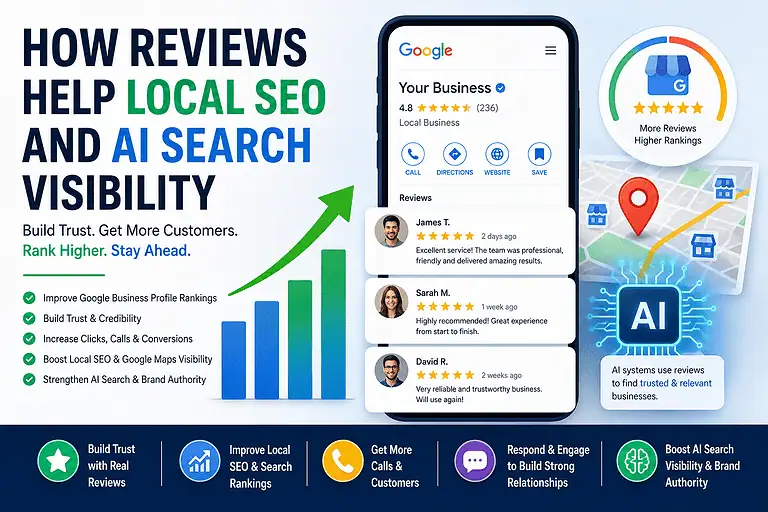
Read How Reviews Help Local SEO and AI Search Visibility for a more detailed reputation strategy.
Use eCommerce Free Listings and Accurate Product Data
eCommerce businesses can improve ROI by expanding product visibility through organic and free shopping surfaces.
Google Merchant Center free listings can display eligible products across Google Search, Maps, Gemini, YouTube, the Shopping tab, Google Images, and Google Lens.
Review the official Google Merchant Center free listings guide.
Product data should accurately include:
- Product title
- Description
- Price
- Availability
- Brand
- GTIN, MPN, or SKU
- Product images
- Shipping information
- Return information
- Variants
Google states that accurate and correctly formatted product data is essential for successful advertisements and free listings and helps prevent product disapprovals or display problems.
Use the official Google Merchant Center product data specification to review feed requirements.
Automate Repetitive Work Without Sacrificing Quality
Automation can improve ROI by reducing repetitive labour and accelerating important processes.
Useful automation opportunities include:
- Lead assignment
- Appointment reminders
- Follow-up emails
- CRM updates
- Invoice creation
- Reporting
- Stock notifications
- Review requests
- Customer segmentation
- Content distribution
- Internal alerts
- Data synchronization
AI can also support:
- Content research
- Report summarization
- Lead categorization
- Customer-service assistance
- Sales-call analysis
- Product description drafts
- Workflow documentation
- Data analysis
However, automation should not replace necessary judgment, quality control, security, or human approval.
Poor automation can create:
- Incorrect customer communication
- Duplicate messages
- Inaccurate reports
- Generic content
- Privacy problems
- Damaged trust
- Missed high-value leads
Start by automating stable, repeatable processes with clear rules.
Reduce Operational Waste
ROI can improve when a business produces the same or better output with fewer unnecessary costs.
Review expenses such as:
- Unused software subscriptions
- Duplicate tools
- Inefficient manual reporting
- Underused advertising channels
- Excessive meetings
- Repeated data entry
- High refund products
- Unprofitable delivery areas
- Inefficient approval processes
- Poor inventory management
Cost reduction should not damage the customer experience or remove capabilities that generate long-term value.
The objective is to eliminate waste, not simply minimize spending.
Improve Sales Follow-Up
Marketing ROI can appear weak when the real problem is slow or inconsistent sales follow-up.
Track:
- Initial response time
- Number of contact attempts
- Follow-up sequence
- Consultation attendance
- Proposal delivery time
- Proposal acceptance rate
- Reasons leads are lost
A practical lead process may include:
- Immediate confirmation message
- Lead qualification
- Personal response
- Consultation or discovery call
- Written proposal
- Scheduled follow-up
- CRM status update
High-intent leads should not remain unanswered for several days.
Marketing and sales must use shared definitions for:
- Enquiry
- Marketing-qualified lead
- Sales-qualified lead
- Opportunity
- Customer
- Lost lead
Without these definitions, marketing may report success while the sales team reports poor lead quality.
Repurpose High-Performing Content
Creating one piece of content and using it once produces limited value.
A detailed article can be repurposed into:
- LinkedIn post
- Facebook post
- Google Business Profile post
- Email newsletter
- Short video
- Slide presentation
- Infographic
- Checklist
- Webinar
- Sales resource
- FAQ content
- Internal training guide
Repurposing should adapt the content for each platform rather than copying the same text everywhere.
Start with topics connected to customer questions, commercial services, and proven demand.
Create a Clear Internal Linking Strategy
Internal links help users discover related information and move toward commercial pages.
A useful internal-linking structure connects:
- Informational articles to specialist guides
- Specialist guides to service pages
- Service pages to case studies
- Case studies to contact pages
- Related articles to one another
- Author pages to expertise content
For example, an article about increasing business ROI can naturally link to:
- SEO services
- Technical SEO guidance
- Local SEO strategy
- Website speed case studies
- AI SEO resources
- Portfolio examples
- Contact options
Avoid forcing dozens of links into every paragraph. Each link should help the reader take a logical next step.
Explore my complete SEO, AI SEO and Digital Growth Services to understand how these strategies can be implemented across one coordinated growth plan.
Test One Business Variable at a Time
Business improvement requires experimentation, but random changes make attribution difficult.
Use a structured testing process:
- Identify a measurable problem.
- Create a hypothesis.
- Select one primary metric.
- Change one meaningful variable.
- Run the test for a reasonable period.
- Evaluate financial impact.
- Keep, revise, or reject the change.
Possible tests include:
- Landing-page headline
- Offer structure
- Form length
- Call-to-action wording
- Service package
- Pricing presentation
- Follow-up sequence
- Product bundle
- Advertisement message
- Checkout flow
Do not declare a test successful only because clicks increased. Confirm whether qualified leads, sales, profit, retention, or lifetime value improved.
Build an ROI Dashboard
An ROI dashboard should help decision-makers identify where profit is being created and where resources are being wasted.
A useful monthly dashboard may include:
| Metric | Current Month | Previous Month | Change |
|---|---|---|---|
| Revenue | |||
| Gross profit | |||
| Marketing cost | |||
| Qualified leads | |||
| New customers | |||
| Customer acquisition cost | |||
| Average transaction value | |||
| Lead conversion rate | |||
| Repeat customer rate | |||
| Customer lifetime value | |||
| Marketing ROI |
Include comments explaining:
- What changed
- Why it may have changed
- What action was taken
- What should happen next
A dashboard without analysis is only a collection of numbers.
A 90-Day Business ROI Improvement Roadmap
ROI improvement should be approached as a structured process rather than a collection of disconnected marketing activities.
Days 1–30: Measure and Diagnose
The first phase should establish visibility into current performance.
Complete the following:
- Calculate revenue, gross profit, and net profit
- Calculate customer acquisition cost
- Estimate customer lifetime value
- Audit GA4 key events
- Audit advertising conversion tracking
- Review Search Console performance
- Connect leads to CRM outcomes
- Identify profitable services and products
- Review website conversion problems
- Document baseline metrics
At the end of the first month, the business should understand where value is being created and where it is being lost.
Days 31–60: Optimize Acquisition and Conversion
The second phase should improve marketing quality and website performance.
Priorities may include:
- Refine target audiences
- Remove irrelevant advertising terms
- Improve service and product pages
- Strengthen calls to action
- Shorten forms
- Improve website speed
- Fix mobile issues
- Add case studies and reviews
- Strengthen internal linking
- Update Local SEO information
- Improve high-intent SEO content
This phase should focus on generating more value from existing traffic and expenditure.
Days 61–90: Improve Retention and Scale
The final phase should build repeatable growth systems.
Actions may include:
- Implement customer follow-up
- Launch review requests
- Introduce upsells or bundles
- Automate CRM processes
- Import offline conversion values
- Build an ROI dashboard
- Increase investment in profitable channels
- Reduce investment in weak channels
- Create retention campaigns
- Develop a quarterly testing plan
Scaling should begin only after measurement and conversion foundations are reliable.
Common ROI Mistakes to Avoid
Businesses often reduce ROI by repeating avoidable strategic and measurement mistakes.
Chasing Traffic Without Commercial Intent
Traffic is useful only when it contributes to awareness, trust, leads, sales, retention, or another defined objective.
Treating Every Lead as Equal
A spam submission and a qualified enterprise enquiry should not receive the same conversion value.
Measuring Revenue Instead of Profit
High-revenue campaigns may be unprofitable after fulfilment and acquisition costs.
Scaling Before Fixing Conversion Problems
Increasing advertising spend on a weak funnel usually increases waste.
Ignoring Existing Customers
Acquisition receives attention, but retention and repeat purchases may create stronger long-term value.
Depending on One Marketing Channel
A business becomes vulnerable when all demand comes from one advertisement platform, search engine, marketplace, or social network.
Creating Generic Content
Generic content may attract impressions without trust, differentiation, or conversion value.
Stopping SEO Too Early
SEO often requires time to build authority, rankings, traffic, and conversion pathways. Evaluate progress using leading and commercial indicators rather than expecting immediate revenue from every activity.
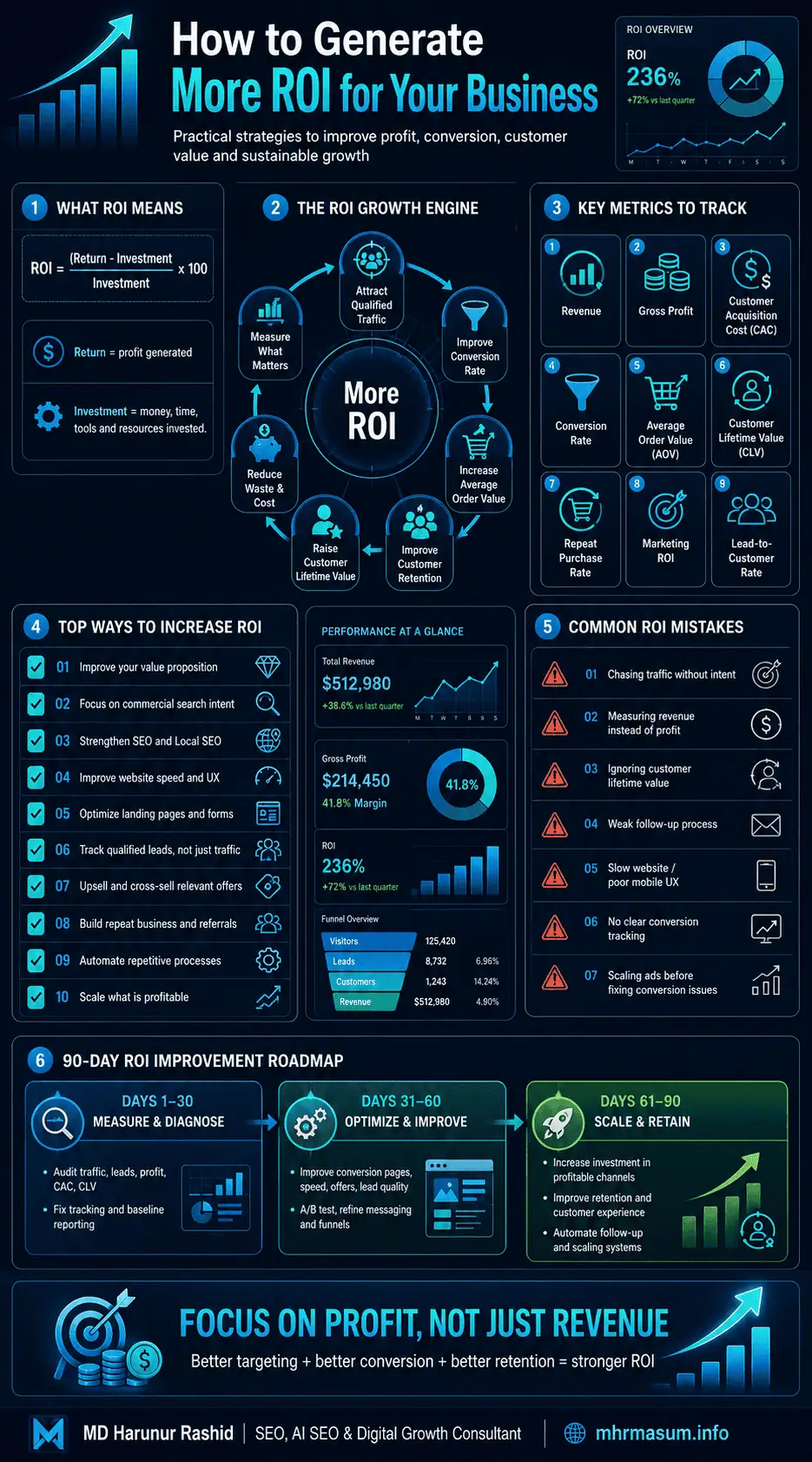
Frequently Asked Questions About Increasing Business ROI
The following questions address common concerns about marketing ROI, SEO, customer acquisition, conversion, and business growth.
What Is a Good ROI for a Business?
There is no universal good ROI percentage for every business.
An acceptable return depends on:
- Industry
- Profit margin
- Risk
- Cash flow
- Sales cycle
- Customer lifetime value
- Investment duration
- Alternative opportunities
Compare investments using the same financial assumptions and time period.
How Can a Small Business Increase ROI Quickly?
A small business can often improve ROI quickly by fixing conversion tracking, responding to leads faster, improving high-traffic landing pages, removing wasted advertising spend, increasing repeat purchases, and promoting higher-margin services.
Does SEO Generate a Positive ROI?
SEO can generate positive ROI when it attracts relevant search demand, supports commercial pages, produces qualified leads or sales, and creates durable visibility.
SEO ROI should include content, technical implementation, tools, consulting, and internal labour costs.
How Do I Calculate Marketing ROI?
A simplified formula is:
Marketing ROI = (Incremental Gross Profit − Marketing Cost) ÷ Marketing Cost × 100
Incremental gross profit is generally more useful than gross revenue because it accounts for the direct costs required to fulfil the additional sales.
How Can I Improve ROI Without Spending More?
Improve conversion rate, customer retention, average transaction value, sales follow-up, website speed, internal linking, email marketing, and operational efficiency.
These improvements can generate more value from existing assets and traffic.
Should I Focus on SEO or Paid Advertising?
The correct mix depends on urgency, competition, margins, market demand, and available resources.
Paid advertising can generate immediate exposure, while SEO can build longer-term organic visibility. Many businesses benefit from using paid campaigns for immediate demand and SEO for sustainable growth.
What Is the Most Important ROI Metric?
Net profit is the ultimate financial outcome, but supporting metrics such as acquisition cost, lifetime value, gross margin, conversion rate, and retention explain how that profit is being created.
How Often Should ROI Be Reviewed?
Operational marketing metrics may be reviewed weekly, while overall ROI is usually more meaningful monthly or quarterly.
Businesses with long sales cycles may need a longer evaluation window.
Final Thoughts on Generating More ROI
Generating more ROI is not simply about increasing marketing spend, website traffic, or sales volume.
It requires a connected system that improves:
- Customer targeting
- Marketing measurement
- Conversion
- Sales follow-up
- Transaction value
- Retention
- Profit margin
- Operational efficiency
- Long-term brand demand
The strongest businesses understand which customers, services, products, locations, and marketing channels create real profit.
They then use that information to:
- Invest more in profitable activity
- Improve weak conversion points
- Reduce unnecessary costs
- Build customer loyalty
- Strengthen organic visibility
- Automate repeatable processes
- Measure financial outcomes accurately
MD Harunur Rashid is an SEO, AI SEO and Digital Growth Consultant with 17+ years of experience helping local businesses, eCommerce brands, agencies, and website owners improve organic visibility, website performance, lead generation, and sustainable digital growth.
Explore my SEO and Digital Growth Services, review completed projects in my portfolio, or contact MD Harunur Rashid to discuss a practical ROI-focused digital growth strategy for your business.